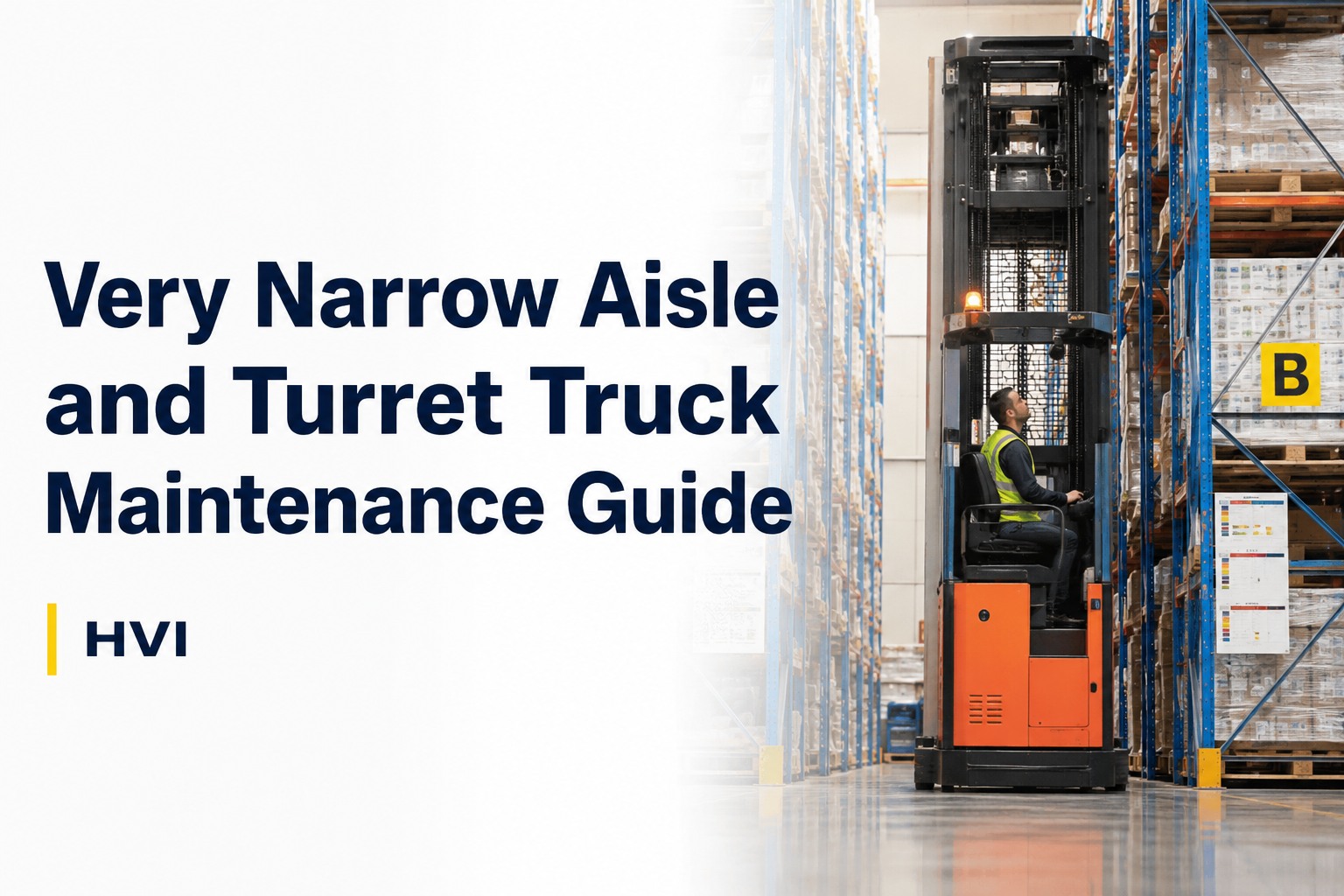
A very narrow aisle truck down is not like a counterbalance truck down. When a forklift fails, you borrow another one. When your VNA truck fails, the aisle it serves is effectively closed, because nothing else in the building fits between those racks. That is the core problem with VNA truck maintenance: the machines work at extreme lift heights inside guided aisles, the guidance system, multi-stage mast, turret head and operator cab each carry their own failure modes, and there is usually no backup unit to slot in. This guide walks through what actually needs inspecting on wire- and rail-guided turret trucks, man-up trucks and swing reach machines, how often, and how to keep records that hold up when someone asks why a truck was running with a worn guidance sensor. If you want to see how this looks as a live digital workflow, you can book a 30-minute walkthrough on your own units before you finish reading.
When the only truck that fits the aisle goes down, what is your plan?
VNA and turret trucks concentrate risk: one machine, one aisle, no substitute. The inspection routine has to match that reality, not a generic forklift checklist.
The cost of a down turret truck, in numbers
Wire guidance and rail guidance: what to inspect and why floor flatness matters
The guidance system is what lets a VNA truck travel at speed in an aisle barely wider than the load. It is also the first place sloppy maintenance shows up, because a guidance fault at height is not a nuisance - it is a rack strike or a shutdown.
Wire guidance
- Sensor heads: check both sensors for damage, contamination and secure mounting. A cracked sensor housing or a bracket knocked out of alignment gives intermittent dropouts that operators start ignoring - until the truck steers off line at the wrong moment.
- Signal strength: test along the full aisle length, including the ends where wire joints and terminations sit. Weak signal at one bay usually means a wire break or a corroded joint under the floor.
- End-of-aisle behaviour: verify the truck slows and stops correctly at wire end. This is a height-and-load restriction function, not just guidance.
Rail guidance
- Guide rollers: inspect for flat spots, chunking and bearing play. Worn rollers let the truck wander inside the rail channel, and the operator compensates without realising how far the wear has gone.
- Rail condition: look for impact damage, loose fixings and debris packed into the channel. A bent rail section will throw the truck against the opposite rollers every pass.
- Rail-to-rack clearance: confirm nothing has encroached - a pushed-back pallet or a leaning upright changes the geometry the truck was set up for.
Floor flatness is the hidden variable. VNA trucks are specified against a floor flatness tolerance, and floors degrade. Grinding, joint spalling and slab curl change how the truck sits at height, which accelerates mast roller wear and makes the guidance system work harder. If operators report the truck "feeling different" in one aisle, check the floor before you blame the truck. Recording these findings against the asset in a system like HVI means the pattern is visible across months, not trapped in one technician's memory - you can see it in action when you walk through a demo with your own aisle layout.
VNA mast inspection: multi-stage wear you cannot see from the floor
A three- or four-stage mast at full extension is a different machine from the same mast at ground level. Wear that is cosmetic at two metres becomes structural at twelve.
| Component | What to check | Failure mode if missed | Typical interval |
|---|---|---|---|
| Lift chains | Elongation with a chain gauge, pin wear, lubrication, anchor condition | Chain failure at height - load and carriage drop | Every PM; measure, do not eyeball |
| Mast rollers | Side thrust and load rollers for flat spots, play, cracked tyres | Mast bind, jerky staging, rail-side loading at height | Every PM, full extension test |
| Hydraulic rams and hoses | Rod scoring, seal weep, hose chafing at mast flex points | Drift-down under load, burst hose at elevation | Daily visual, PM for fittings |
| Carriage and fork stops | Cracks at welds, fork heel wear, stop engagement | Load shift or pallet drop at top level | Daily pre-op plus PM measurement |
| Height and load restriction system | Height encoder accuracy, load moment cut-outs, travel-speed interlocks | Truck travels elevated at speed, or lifts beyond rated height into services | Function test every PM |
The interval column is where most sites slip. A VNA truck in a busy distribution centre can accumulate engine hours far faster than a calendar-based schedule assumes, which is why hour-based PM triggers matter more here than on almost any other truck class. If your current setup cannot fire a work order off meter readings, that gap alone is worth a look at how HVI schedules preventive maintenance by hours.
Turret truck service: the rotation and traverse mechanism
The turret or swing head is what makes these trucks worth their aisle width - and it is the assembly most generic checklists ignore entirely.
Rotation bearing and drive
Listen and feel for roughness through a full 180-degree sweep with a rated load. Check slew bearing bolt torque marks and gearbox oil level. Backlash that grows month over month is the bearing wearing, and it only gets cheaper to fix the earlier you catch it.
Traverse (side-shift) mechanism
Inspect traverse rails, rollers and the drive chain or rack for wear and lubrication. Test end-stop cushioning - a turret that slams to the stops is shaking the mast, the load and the operator every cycle.
Hydraulic and electrical services across the head
Hoses and cables that cross the rotation joint flex thousands of times a week. Look for chafing at clamp points and for connectors working loose. Intermittent faults here are miserable to diagnose after the fact - photo-documenting condition at each PM gives you a timeline to compare against.
Interlocks and centring
Verify the truck will not travel with the head off-centre beyond its permitted envelope, and that automatic centring works before travel. This interlock is the difference between a near-miss and a rack collapse.
Man-up truck maintenance: the cab is a work-at-height platform
On a man-up or operator-up VNA truck, the cab rises with the load. That makes the cab itself safety-critical equipment, with its own inspection list that has nothing to do with the powertrain.
Fall protection
Guard rails, gates and their latches, plus harness anchor points where specified. A gate latch that does not positively close is a fall-from-height exposure at twelve metres. Check it every pre-op, and treat any defect as a lockout, not a note.
Emergency lowering
Test the emergency lowering function on schedule - manually where the design allows. An operator stranded at height with a dead traction system needs this to work the first time, every time. Record each test with a date and a name.
Controls and deadman
Foot presence switches, control return-to-neutral, and emergency stop at the cab. Spongy or intermittent deadman behaviour gets reported late because operators adapt - make it a standing checklist item with a photo field so the report takes ten seconds.
Cab structure and glazing
Overhead guard condition, cracked panels, and visibility through any mesh or glazing. Impact damage from a falling carton at height is common; structural damage is rarer but must be caught before the next lift, not after.
Sites that digitise this cab checklist see the same pattern: defects get reported the shift they appear instead of at the Friday PM, because the operator taps it into a phone with a photo rather than hunting for a paper form. If your cab checks still live on a clipboard, you can start logging them free and have the first digital pre-op running this week.
See your whole VNA fleet's status on one screen
Book a 30-minute demo and we will load one of your turret trucks as a live example - guidance checks, mast PM, cab inspection and all.
VNA truck reliability: planning around a machine with no backup
Here is a worked example worth taking to your next budget meeting.
If that aisle holds 2,000 pallet positions and your putaway and picking flow reroutes through other aisles, you are paying double-handling labour on every pallet, burning overtime to keep service levels, and pushing extra hours onto trucks that now wear faster. The roller set costs a few hundred dollars. The three days cost many times that - and the failure was visible at the last PM if anyone had measured the rollers instead of glancing at them.
Without per-asset tracking
- PM due dates guessed from a wall calendar
- Defects reported by radio and forgotten by shift change
- No availability figure per truck, so the aisle-closure cost is invisible
- Parts ordered after the failure, adding days of downtime
With per-asset tracking
- Hour-based PM fires a work order before the interval passes
- Photo-backed defects convert to work orders the same shift
- Availability per truck is a number you can defend in a budget meeting
- Wear parts like rollers and chains are stocked against PM forecasts
The difference between those two columns is not effort - your technicians already know the trucks. It is whether the knowledge lives in a system or in someone's head. Teams that want to see the per-asset availability view before committing usually book a demo and bring one problem truck's history with them.
Built for guided-aisle equipment, not just road fleets
Custom templates per truck type
Build a VNA-specific checklist - guidance sensors, mast rollers, turret sweep, cab fall protection, emergency lowering - instead of forcing a generic forklift form onto a machine it does not fit. Different template for wire-guided versus rail-guided units.
Photo capture on critical items
Chain elongation readings, roller condition, gate latches: make a photo mandatory on the items that get argued about later. When a rack gets struck, you have timestamped evidence of the truck's condition, not a memory.
Hour-based preventive maintenance
VNA trucks out-run calendar schedules. HVI triggers PMs off engine hours with due and overdue alerts, so a high-utilisation turret truck gets serviced at the interval the manufacturer intended, not whenever the whiteboard says.
Per-asset availability tracking
See uptime and downtime per truck, per aisle. When you ask for a second unit or a spare-parts budget, you bring a number - "this truck was available 91% of scheduled hours and each dark day costs us X" - instead of a feeling.
VNA truck maintenance, condensed
- The guidance system is safety equipment. Sensors, rollers, rails and wire signal get inspected on a schedule, and floor condition is part of that inspection, not someone else's department.
- Mast wear is measured, not eyeballed. Chain elongation gauges and roller checks at full extension, every PM, because wear at twelve metres is not the same as wear at two.
- The turret head and the cab carry their own checklists. Rotation bearings, traverse stops, fall protection and emergency lowering all need named, dated, photo-backed records.
- Availability is the number that justifies everything else. A down VNA truck is a closed aisle. Track it per asset and the maintenance budget writes itself. If you want that number without building spreadsheets, sign up free and log your first truck today.
The thing that used to drive me mad was the guidance sensor faults. Operator reports it on the radio, tech checks it two days later, truck seems fine, ticket closed. Then it drops out again at height and we lose the aisle for a morning. Now every report is a photo and a timestamp against that truck, and I can see the same sensor flagged three times in six weeks. That is a pattern you can act on. I track one number above all others: aisle-available hours. Everything else feeds it.
Mark Delaney - Maintenance Manager, regional third-party logistics distribution centre
VNA and turret truck maintenance FAQs
How often should a VNA truck be inspected?
Daily pre-operation checks by the operator, plus a full PM at the manufacturer's hour interval - commonly every 250 to 500 hours depending on the unit and duty cycle. Because guided trucks often run double shifts, those hours arrive faster than a monthly calendar suggests, which is why hour-based triggers beat date-based ones for this equipment class.
What is the difference between wire guidance and rail guidance maintenance?
Wire guidance needs sensor condition, signal strength testing along the aisle and end-of-wire stop verification. Rail guidance needs guide roller inspection, rail damage and fixing checks, and channel cleaning. Both depend on floor condition, and both should be function-tested at every PM, not just when an operator complains.
Can I use a standard forklift checklist for a turret truck?
No - a generic forklift form misses the items that fail on these machines: guidance sensors or rollers, turret rotation and traverse, height and load restriction interlocks, and on man-up units the cab fall protection and emergency lowering. You need a template built per equipment type. In HVI you can create that template once and apply it to every VNA unit, and you can see exactly how that works in a short demo.
What records should I keep for guided aisle equipment?
Keep every pre-op check, every PM with measurements (chain elongation, roller condition), every defect with photos, and every repair with parts used. Timestamped, attributed records are what protect you after a rack strike or a fall-from-height incident, and they are what insurers and auditors ask for first.
How do I justify a spare truck or bigger parts budget for VNA equipment?
With per-asset availability data. Track downtime hours per truck, multiply by the cost of a dark aisle - double-handling labour, overtime, missed cut-offs - and the business case writes itself. Fleets that sign up free and log a few months of history typically have the number they need within a quarter.
Keep every aisle open - start with the trucks that have no backup
Digital checklists for guidance, mast, turret and cab. Hour-based PM. Photo-backed records. Availability per truck, per aisle, on one screen.
Free to start - Works on any phone or tablet - No card needed