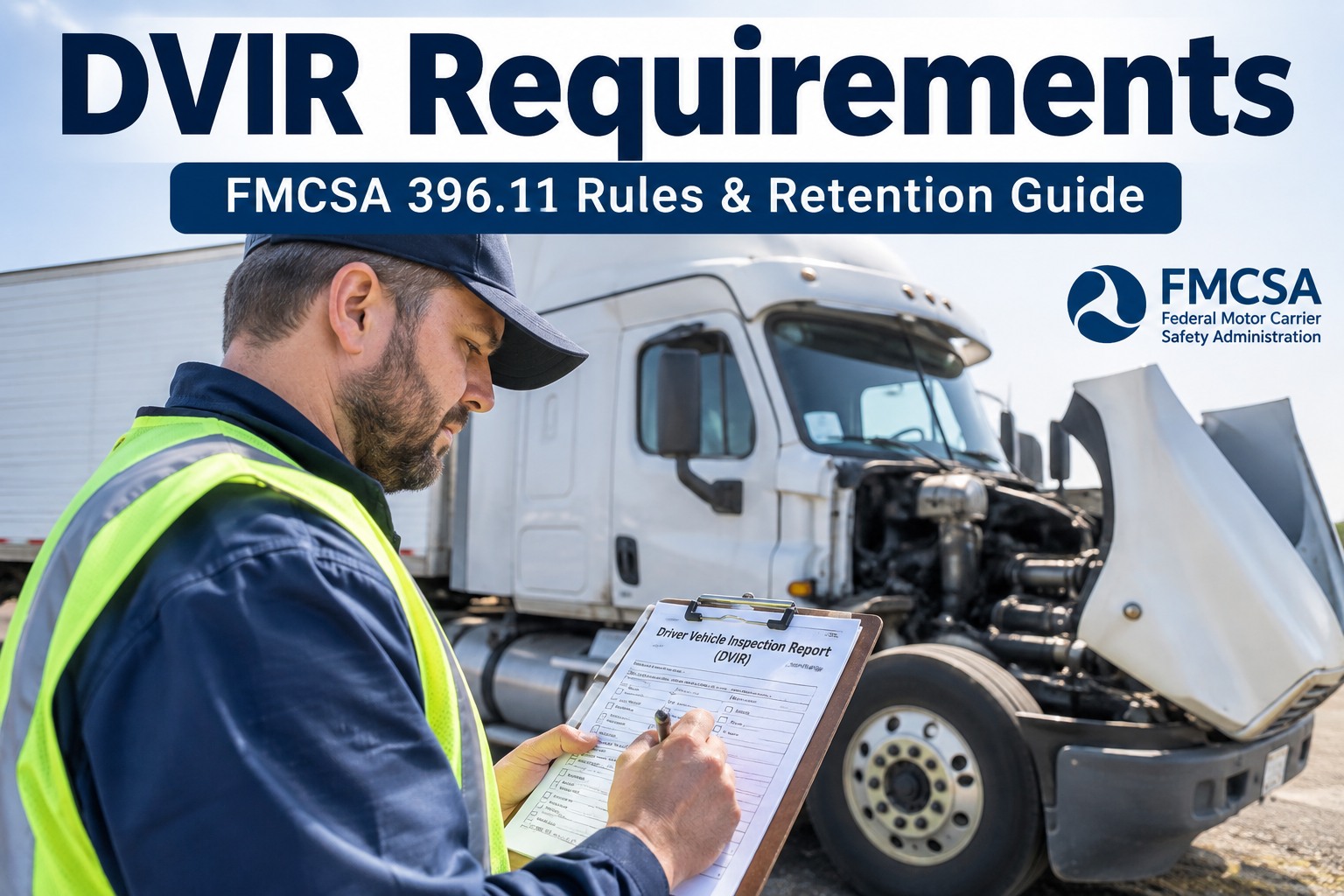
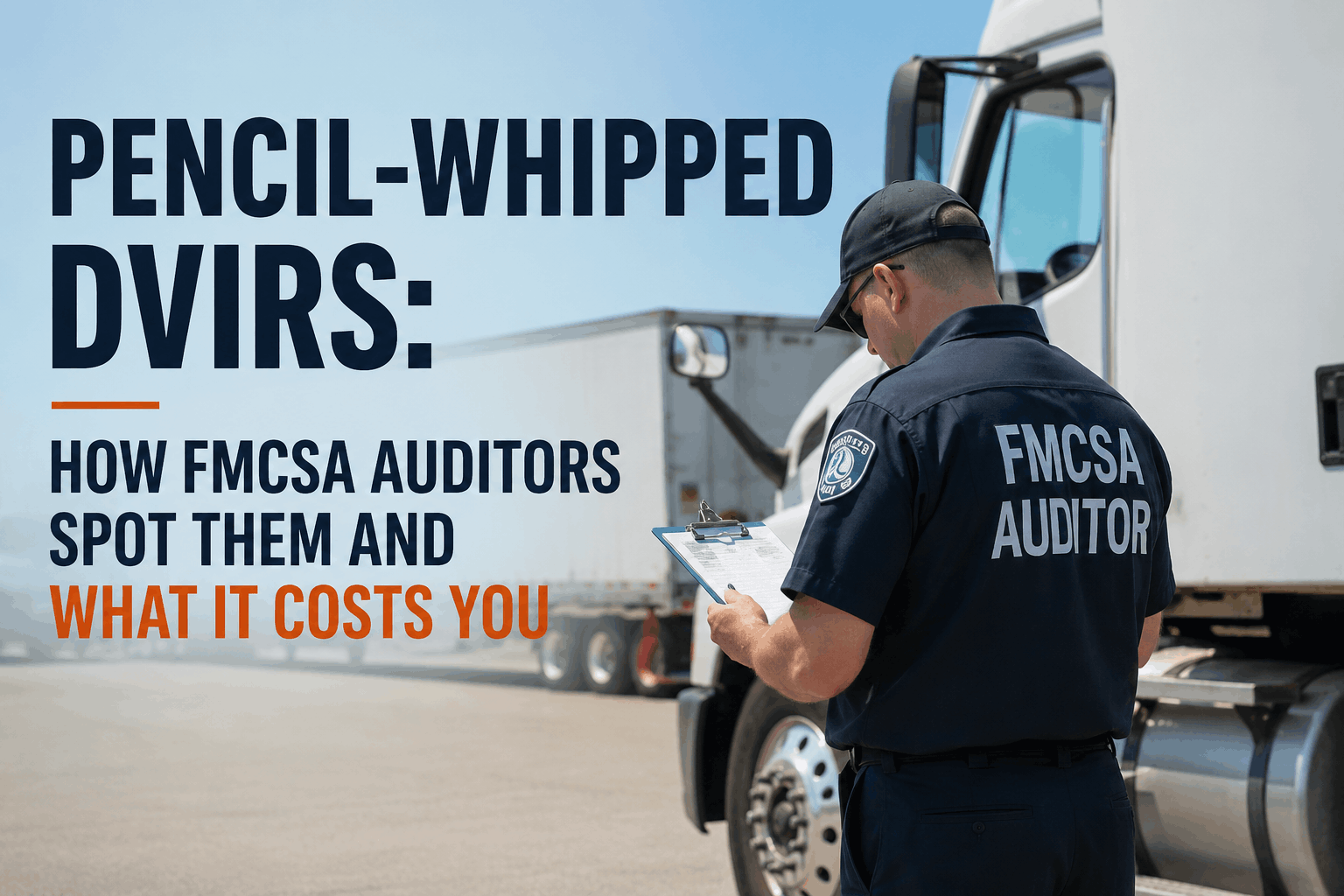
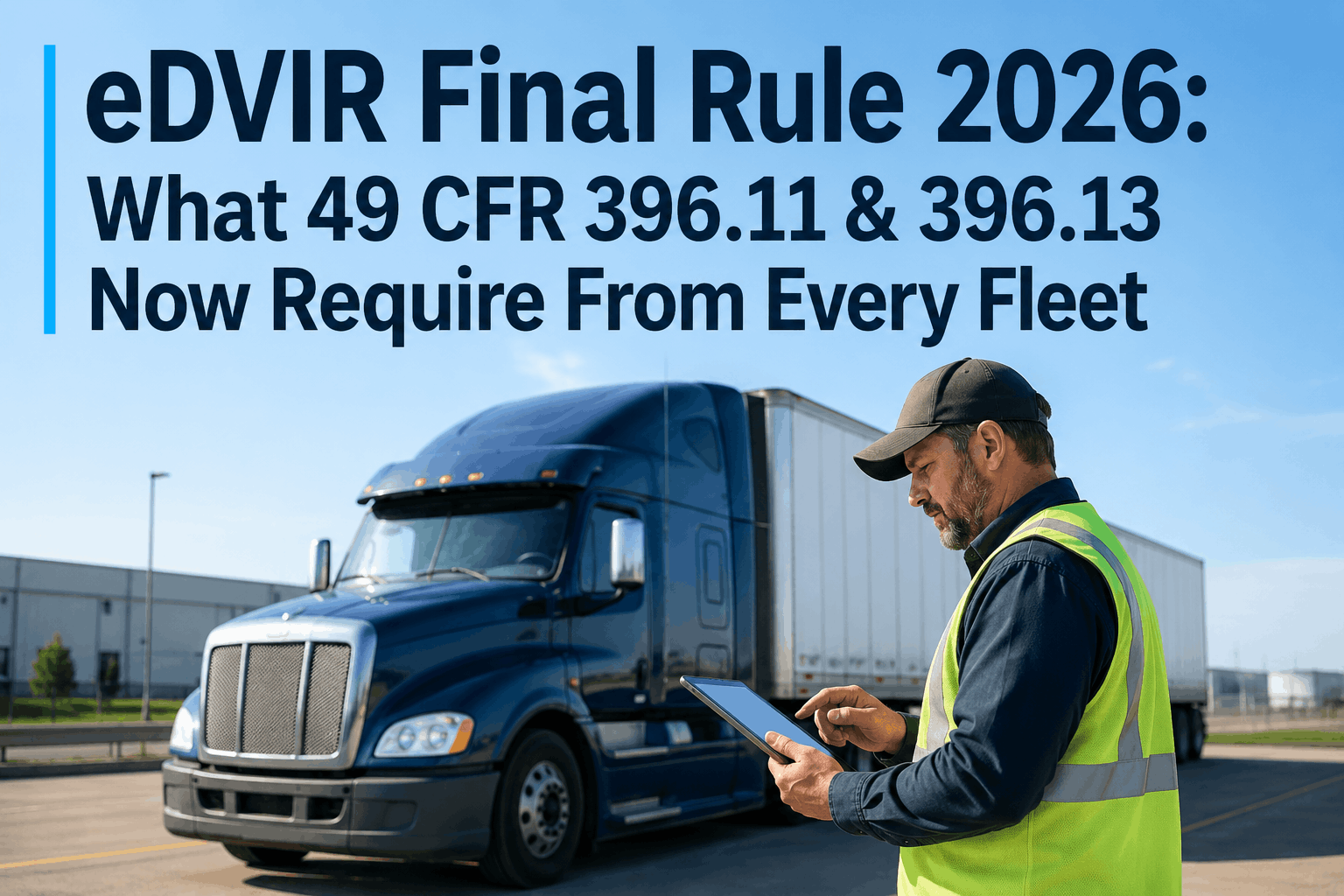
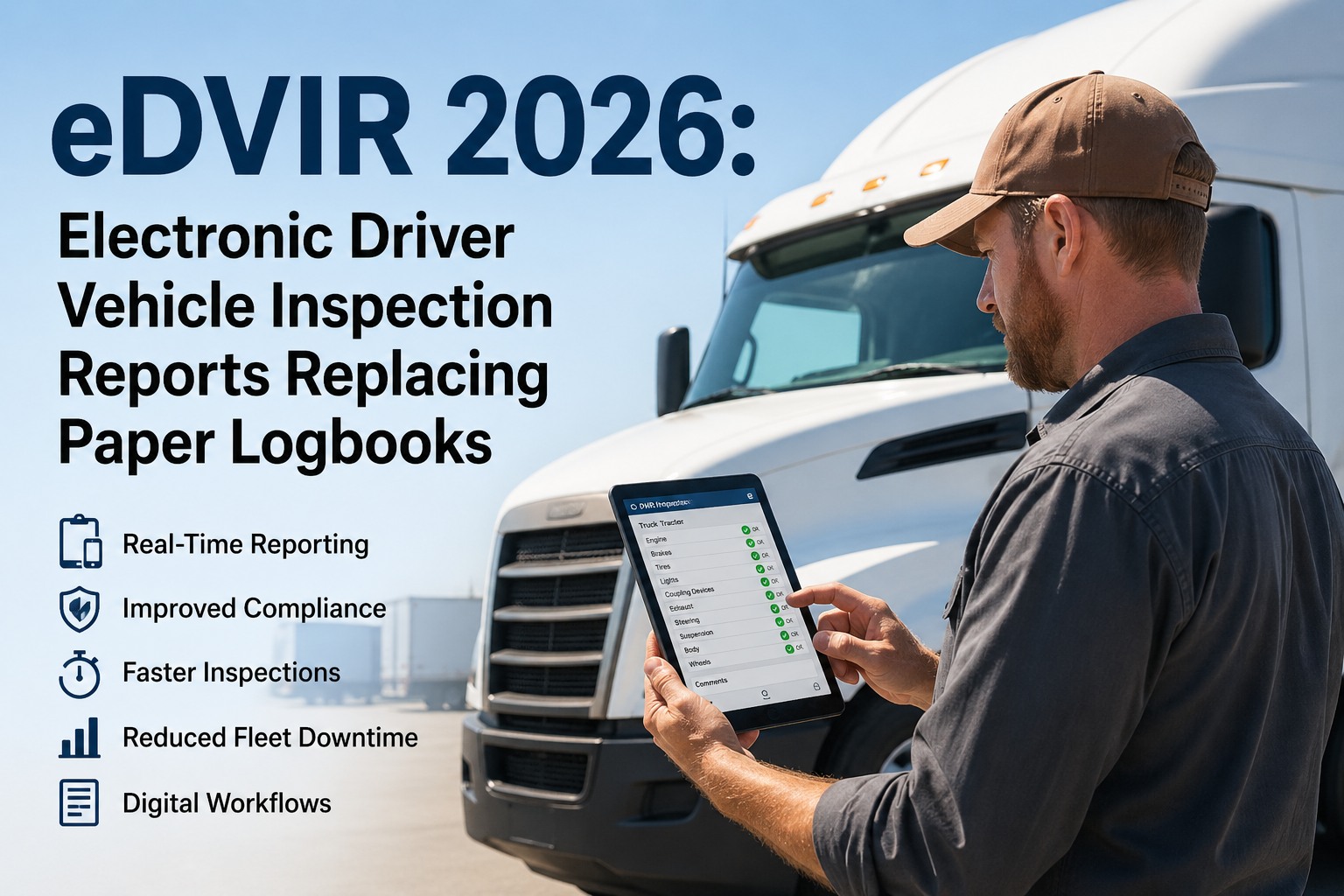
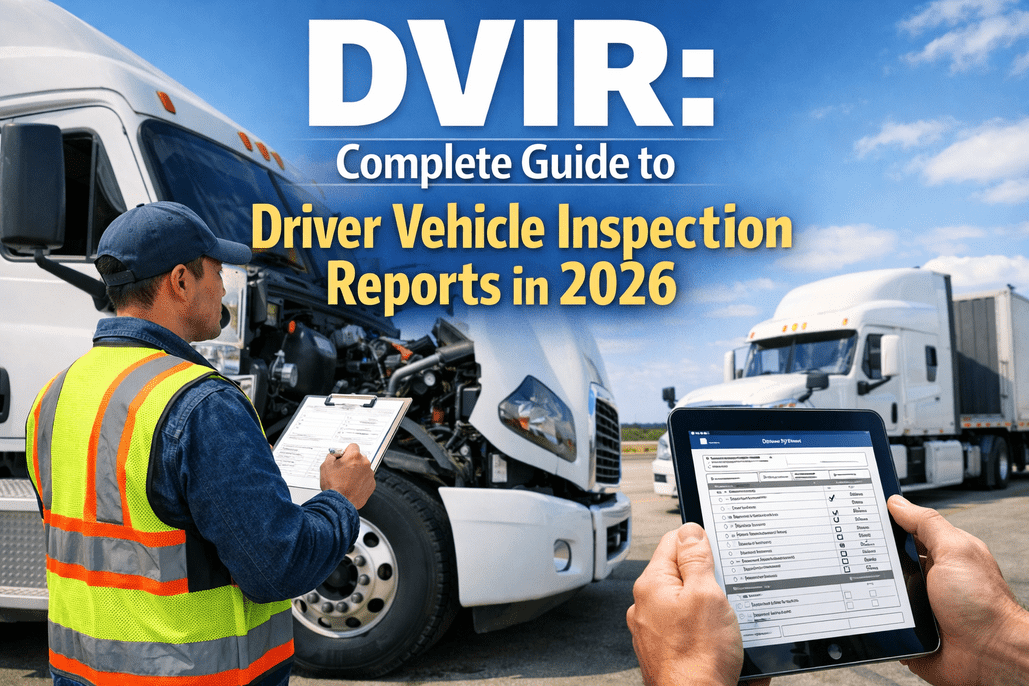
The 3-signature DVIR cycle is the daily control system that connects a driver's defect report on Monday evening to the next driver's safe dispatch on Tuesday morning. It is governed by two separate federal regulations — 49 CFR 396.11 (the post-trip report and repair certification) and 49 CFR 396.13 (the next-driver acknowledgment) — that operate as one continuous chain of custody for vehicle condition. Most fleets understand the driver's signature. Fewer realize FMCSA requires up to three separate signatures per defect, and that the most commonly missed one — the Driver B acknowledgment — is the single most-cited DVIR violation in DOT audits. Fleets with DVIR non-compliance score 15–20% higher in the Vehicle Maintenance BASIC, with fines that range from $1,270 per day for missing signatures to $15,420 per occurrence for dispatching a vehicle with an unrepaired defect. The 2026 eDVIR final rule (effective March 23) confirms all three signatures can be captured electronically with timestamps — but it does not change the chain itself. Each link still requires a real person, a real action, and real evidence. This guide walks drivers, mechanics, and safety managers through the chain step by step: who signs what, when, why each signature exists, where it most commonly breaks, and how to defend the chain when an auditor or roadside officer examines it. HVI's inspection & maintenance software enforces the chain digitally — each signature becomes a required field, and the next link cannot proceed until the previous one is complete.
The 3-Signature Chain — Enforced, Not Hoped For
HVI makes each signature a required field. Driver A cannot submit without signing. Mechanic cannot mark complete without certifying. Driver B cannot dispatch without acknowledging. The chain cannot break — by design.
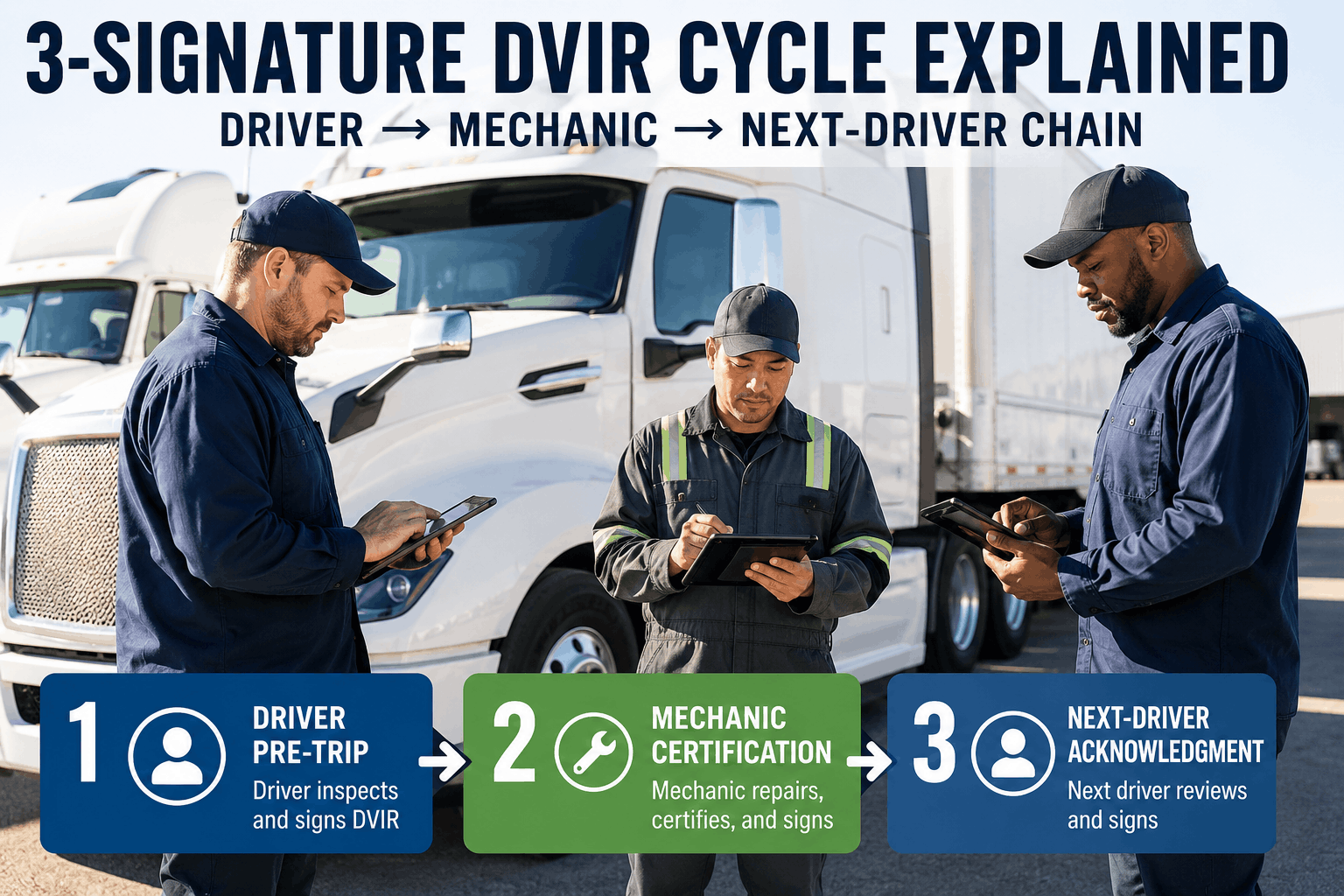
The Chain in One Picture
Three actors, three signatures, two regulations, one continuous chain. Here is what the cycle looks like end to end.
1
DRIVER A
Reports defect
49 CFR 396.11
2
MECHANIC
Certifies repair
49 CFR 396.11(b)
3
DRIVER B
Acknowledges repair
49 CFR 396.13
Signature 1: Driver A — The Post-Trip Report
The cycle begins with the driver who operated the vehicle that day. At the completion of each day's work, Driver A prepares a written report covering all 11 FMCSA components, documents any defect "affecting safe operation or likely to cause breakdown," and signs the DVIR.
WHEN
At the completion of the workday on each vehicle operated
WHAT
Written report of any safety-affecting defects across the 11 FMCSA components
SIGNATURE
Driver's name + date + time. Under 2026 eDVIR rule, signature can be electronic with timestamp.
EXCEPTION
Property-carrying CMVs since 2014: DVIR only required when a defect is found. Passenger-carrying still daily regardless.
EVIDENCE THE AUDITOR LOOKS FOR
Driver name & CDL ID
Timestamp at submission
All 11 components addressed
Defect descriptions specific
Photos for critical defects
Signature 2: Mechanic — The Repair Certification
Once the DVIR reaches the carrier, the mechanic (or carrier official) repairs every defect listed — or certifies the repair was unnecessary for safe operation — and signs the original DVIR. Without this signature, the next driver cannot lawfully be dispatched in the vehicle.
WHEN
After repair work is performed or after determination that repair is not required
WHAT
Certification that the defect has been repaired OR that repair was unnecessary for safe operation
SIGNATURE
Mechanic or carrier-authorized official's name + date. Electronic signature compliant under 2026 rule.
CRITICAL DETAIL
Repair certification must be on the ORIGINAL DVIR — not a separate work order. The chain breaks if the documents diverge.
EVIDENCE THE AUDITOR LOOKS FOR
Mechanic name & credentials
Date of repair certification
Specific defect addressed
Work order referenced
"Repair not required" justified if claimed
Signature 3: Driver B — The Next-Driver Acknowledgment
Before operating the vehicle, the next driver reviews the most recent DVIR and the repair certification, satisfies themselves the vehicle is in safe operating condition, and signs acknowledgment. This is the most frequently missed signature in DOT audits — and the most expensive when it is.
WHEN
Before operating the vehicle — pre-trip, prior to leaving the yard
WHAT
Review of the most recent DVIR + signature acknowledging the repair status
SIGNATURE
Driver's name + date confirming review. Electronic signature compliant under 2026 rule.
WHY IT MATTERS
This signature transfers operational responsibility for vehicle condition to the new driver. Without it, the chain of custody is broken.
EVIDENCE THE AUDITOR LOOKS FOR
Driver B name & CDL ID
Date BEFORE dispatch
Acknowledgment of prior DVIR
Confirmation of safe condition
Distinct from Driver A pre-trip
The Driver B acknowledgment is the top violation trap in DVIR enforcement. HVI prevents it from breaking — Driver B literally cannot begin their pre-trip until the previous DVIR is acknowledged.
Start free with HVI.
Why Each Signature Exists — The Logic of the Chain
The three signatures are not bureaucratic redundancy. Each one transfers accountability between specific people at specific moments. Remove any one and the legal chain of custody for vehicle condition collapses.
A → M
Defect Acknowledgment
Driver A's signature transfers the documented defect from the cab to the carrier. Until signed, the defect has not entered the carrier's system of record. The signature starts the clock.
M → B
Repair Closure
Mechanic's signature certifies the defect is closed — repaired or determined unnecessary. Without this, the next dispatch is in violation of 396.11(b) and 396.13 simultaneously.
B → ROAD
Operational Acceptance
Driver B's signature confirms a real human reviewed the repair certification, accepted the vehicle, and assumes responsibility for its safe operation from that moment forward.
Where the Chain Breaks — The 6 Most Common Failure Points
Paper-based DVIR chains break in predictable ways. These six failure modes account for the vast majority of cited violations. Recognize them and you know where to enforce.
01
Driver B Never Acknowledges
The single most common failure. Driver B starts the truck, completes their own pre-trip, but never reviews the prior DVIR and never signs the acknowledgment. Roadside officers find this in seconds.
Fix: Dispatch block until Driver B acknowledges. HVI enforces this digitally — the pre-trip workflow cannot begin without the prior DVIR review.
02
Mechanic Repairs but Forgets to Certify
The repair actually happens. The work order is closed. But the mechanic never signs back on the original DVIR. From the paperwork side, the defect is still open and the chain is broken.
Fix: Work order completion requires mechanic e-signature in HVI. Cannot mark complete without certifying the DVIR.
03
DVIR Stays in the Cab
Driver A completes the post-trip report on paper, signs it, and tucks it into the visor or glove box. It never reaches the office. The repair never gets scheduled. The chain has no link 2 or 3.
Fix: Digital submission syncs the moment the driver hits "submit." 73% of paper DVIRs never make it to the office — eDVIR makes this 0%.
04
Repair Certification on Wrong Document
Mechanic signs the work order but not the original DVIR. The two documents reference the same defect, but the DVIR shows no repair certification. Auditors treat this as missing signature.
Fix: Work order and DVIR are the same record in HVI — mechanic signature attaches to both simultaneously.
05
Driver B Signs Before Reviewing
Driver B signs the acknowledgment as a habit without actually reviewing the prior DVIR or repair status. If a defect was left unrepaired and an incident occurs, the signature becomes liability evidence.
Fix: HVI presents the prior DVIR and repair certification on-screen before the acknowledge button activates — the review is enforced.
06
Illegible Handwritten Signatures
All three signatures are present on paper, but auditors cannot read them. No CDL number, no printed name, no date legible. Treated by FMCSA as missing signatures.
Fix: Electronic signatures are typed identity + timestamp + GPS. No legibility disputes possible.
All six failure modes are paper failures. The 2026 eDVIR rule does not eliminate them by mandate — it eliminates them by making the digital alternative explicitly compliant.
Book a demo to see the chain enforced.
The Penalty Stack: What Broken Links Actually Cost
Every failure point above corresponds to a specific FMCSA penalty schedule. Here is what each broken link costs per occurrence — before factoring in the CSA score impact that compounds for 24 months.
Broken Link
Citation
Maximum Penalty
CSA Impact
Missing Driver A signature
49 CFR 396.11(a)
$1,270/day
Vehicle Maintenance BASIC
Missing mechanic certification
49 CFR 396.11(b)
$1,270/day
Vehicle Maintenance BASIC
Missing Driver B acknowledgment
49 CFR 396.13
$1,270/day
Vehicle Maintenance BASIC
Dispatching with unrepaired safety defect
49 CFR 396.7
$15,420
Both BASICs (2026)
Falsified DVIR
49 CFR 390.35
$12,700
Both BASICs + audit escalation
Failure to retain DVIRs 90 days
49 CFR 396.11(a)(4)
$1,270/day
Record-keeping BASIC
The Team-Driver Exception
One signature scenario worth knowing because it is misunderstood: when two drivers share a vehicle as a team during the same workday.
RULE
For team-driver operations, only ONE driver needs to sign the DVIR — as long as both drivers agree on the defects identified.
Source: 49 CFR 396.11, team-driver provision
WATCH OUT
If the two drivers disagree on defects, both must sign their own DVIRs documenting their respective findings. Disagreement is not optional to record.
Audit trap: silent disagreement = falsification risk for one driver
The Chain Is the Compliance Program
The 3-signature DVIR cycle is not a paperwork requirement layered on top of fleet operations. It is the daily control system that keeps unsafe vehicles off the road, transfers operational responsibility between specific people at specific moments, and creates the legally binding chain of custody that auditors examine first. Driver A's post-trip report under 49 CFR 396.11 starts the clock. The mechanic's repair certification under 396.11(b) closes the defect. Driver B's acknowledgment under 396.13 accepts operational responsibility. Three signatures, three federal citations, three accountabilities — and one chain that breaks in six predictable ways under paper-based workflows. The 2026 eDVIR final rule confirms all three signatures can be captured electronically with timestamps, GPS, and immutable audit trails — but it does not eliminate the chain. Each link still requires a real person doing a real action with real evidence. HVI's inspection & maintenance software enforces the chain digitally as a sequence of required fields: Driver A cannot submit without signing, the mechanic cannot mark complete without certifying, Driver B cannot dispatch without acknowledging. Each signature is timestamped, GPS-tagged, and tied to an authenticated user identity. The chain becomes structurally unbreakable — by design rather than by hope. Start free today or book a 30-minute demo to see the 3-signature chain enforced live on your fleet.
Enforce the 3-Signature Chain with HVI
Required fields at every link. Electronic signatures with GPS, timestamp, and driver ID. Dispatch block until chain complete. 396.11 + 396.13 satisfied automatically. Trusted by 25,000+ users worldwide.
Frequently Asked Questions
Q: Who has to sign a DVIR?
Up to three different people on every defect: (1) the driver who operated the vehicle that day signs the post-trip report under 49 CFR 396.11(a), (2) the mechanic or carrier official who repairs the defect signs the repair certification under 396.11(b), and (3) the next driver who operates the vehicle signs the acknowledgment under 49 CFR 396.13 before dispatch. Missing any one is a citable violation.
Q: Which signature is most commonly missed?
Driver B's next-driver acknowledgment under 49 CFR 396.13. It is the most frequently cited signature failure in DOT audits because paper workflows make it easy to skip — the driver completes their own pre-trip without first reviewing the prior DVIR. HVI prevents this by blocking the pre-trip workflow until the prior DVIR is acknowledged.
Start free with HVI.
Q: Can electronic signatures satisfy the 3-signature chain?
Yes — explicitly authorized under FMCSA's 2026 final rule effective March 23. All three signatures (driver, mechanic, next driver) may be captured electronically with timestamps, GPS coordinates, and signer identity. The E-SIGN Act of 2000 gives electronic signatures the same legal weight as wet ink, and digital signatures are typically more defensible because they include the metadata wet-ink signatures lack.
Q: What if two drivers operated the same vehicle as a team?
Only one DVIR signature is required for team operations, provided both drivers agree on the defects identified. If the drivers disagree on findings, each must sign their own DVIR documenting their respective inspection. Silent disagreement — where one driver's findings differ from the other but no separate DVIR exists — creates a falsification risk under 49 CFR 390.35.
Book a demo for team-driver workflow.
Q: What happens if the chain breaks at any link?
Each broken link is a separate violation with its own penalty schedule. Missing signatures alone are $1,270 per day per occurrence. Dispatching a vehicle with an unrepaired safety defect is $15,420 per occurrence. Falsified DVIRs are $12,700. These compound under the 2026 CSA framework, which now scores Vehicle Maintenance in two categories (Driver Observed + Inspector Detected) — effectively doubling the CSA impact of chain failures.
Q: How does HVI enforce the chain digitally?
Each signature is a required field in the workflow sequence. Driver A's post-trip cannot be submitted without their e-signature. The mechanic's work-order completion is blocked until the DVIR repair certification is signed. Driver B's pre-trip workflow refuses to start until the prior DVIR is acknowledged on-screen. Each signature is timestamped, GPS-tagged, and tied to an authenticated user identity — no signature can be backdated, forged, or skipped.
Start free today.