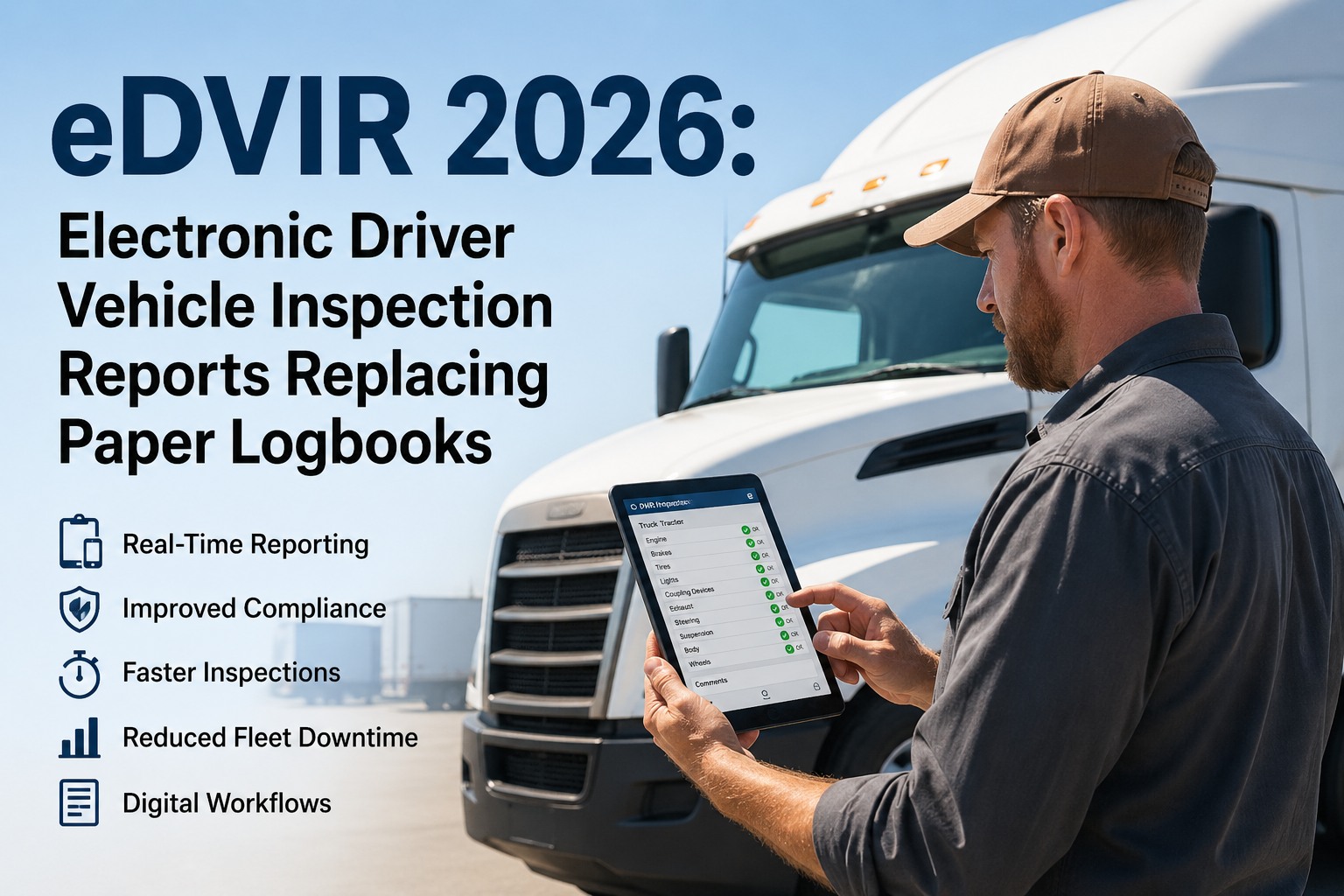
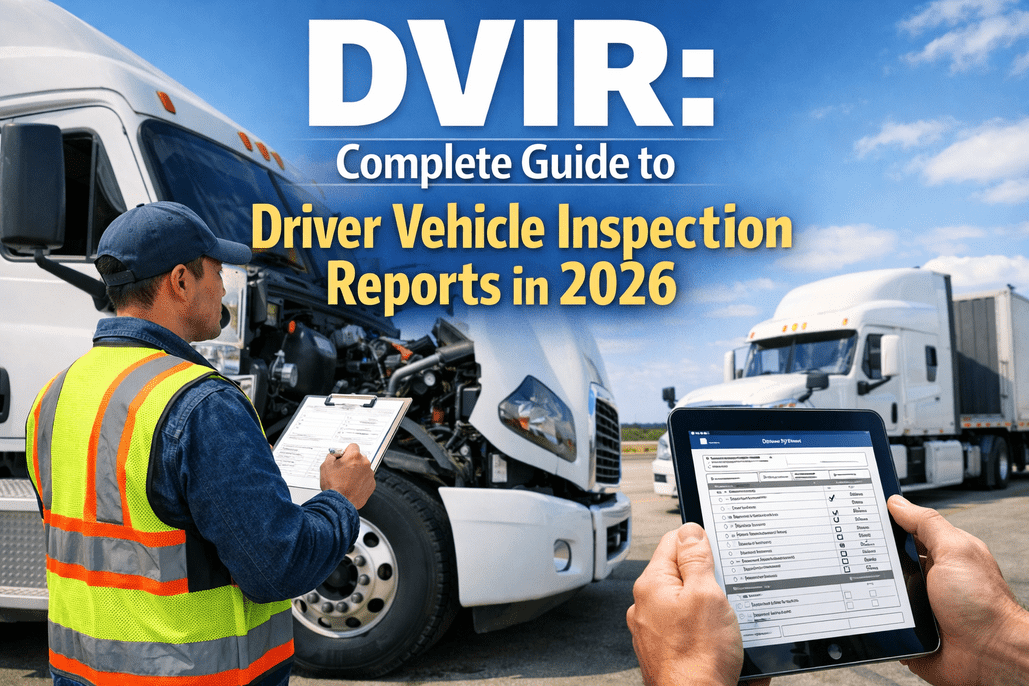
On February 19, 2026, FMCSA published its final rule on Electronic Driver Vehicle Inspection Reports under Docket FMCSA-2025-0115, with an effective date of March 23, 2026. The rule added a single, clarifying sentence to 49 CFR 396.11 and 396.13 — but for compliance managers and safety directors, that one sentence resolved a decade of ambiguity that had been costing fleets audit failures, insurance penalties, and litigation exposure. Electronic DVIRs were technically permissible since 2018 under 49 CFR 390.32, but the previous paper-centric language in 396.11 and 396.13 was interpreted differently by different auditors, attorneys, and DOT officers. That interpretive grey area is now gone. The rule explicitly authorizes electronic creation, electronic maintenance, and electronic signatures across the entire DVIR lifecycle — including all three signatures in the federally mandated chain of accountability. FMCSA estimates DVIRs prevent approximately 14,000 accidents annually, yet only 7% of motor carriers pass a focused compliance review without a single DVIR-related violation. The 2026 rule is the cleanest regulatory moment in a decade to fix that — and HVI's inspection & maintenance software is built to deliver every requirement of the new rule, end to end.
Get Compliant with the 2026 eDVIR Final Rule in 2–4 Weeks
HVI delivers full FMCSA-2025-0115 compliance — electronic 3-signature chain, E-SIGN Act–compliant digital signatures, 90-day cloud retention (we store indefinitely), and audit packages exportable in under 15 minutes.
The Rule at a Glance: A Compliance Manager's One-Page Summary
Before the deep dive, here is everything a safety director or compliance manager needs to know about Docket FMCSA-2025-0115, on one card.
Docket Number
FMCSA-2025-0115
Federal Register Published
February 19, 2026 (Vol. 91, No. 33)
Effective Date
March 23, 2026
Sections Amended
49 CFR 396.11 and 49 CFR 396.13
Related Section (Unchanged)
49 CFR 390.32 (Electronic Recordkeeping)
Action Type
Final Rule — Clarifying Authorization
Industry Support
ATA, OOIDA, NTTC
What the Rule Actually Changed — In Plain English
The rule did three things, did not do three things, and clarified three things. Here is the regulatory breakdown without the legalese.
Added explicit language to 396.11 stating DVIRs may be created and maintained electronically per 390.32
Added explicit language to 396.13 allowing electronic creation and maintenance of pre-trip review records
Unambiguously authorized electronic signatures for all three parties in the DVIR chain — no wet ink required
Did not mandate eDVIRs — paper remains legal
Did not reinstate no-defect DVIR reporting for property-carrying CMVs (despite eDVIRs making them faster)
Did not change the 11-item inspection minimum or the 90-day retention requirement
Cloud storage and mobile submission are fully compliant — no separate paper backup needed
The 3-signature chain may be entirely electronic, including next-driver acknowledgment
Electronic records satisfy 90-day retention requirement under 396.11(a)(4)
The 2026 rule does not change what a DVIR is — it confirms how it can be created. HVI was built to deliver every requirement of FMCSA-2025-0115 from day one.
Start free with HVI and migrate in 2–4 weeks.
The 3-Signature Cycle: The Chain the Rule Now Lets You Sign Digitally
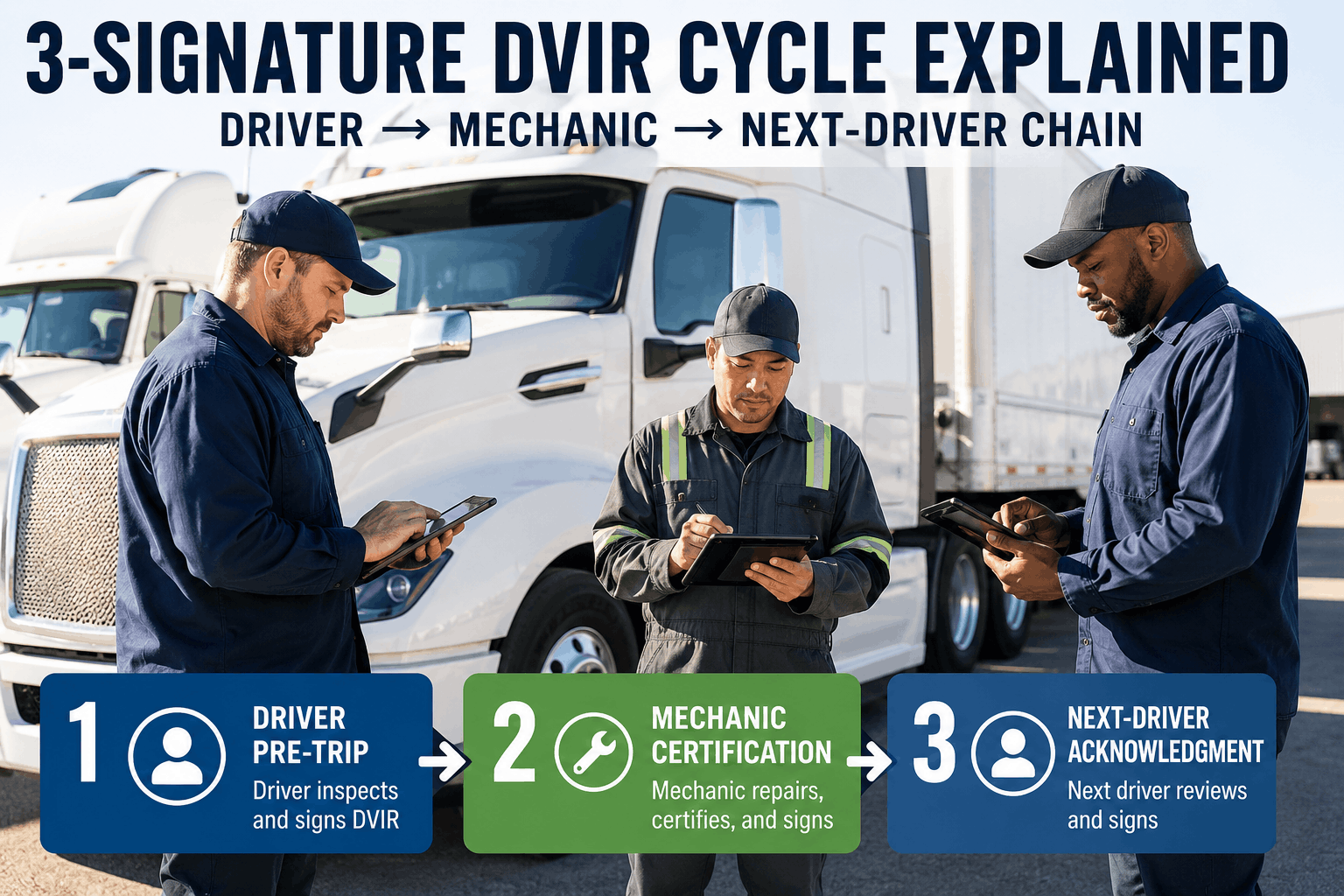
49 CFR 396.11 and 396.13 together create a 3-signature chain of accountability that connects every defect to every repair to every dispatch. The 2026 rule confirms each signature in this chain can now be captured electronically — and HVI enforces the chain so no link can be skipped.
1
DRIVER A — Post-Trip Report
49 CFR 396.11
At end of workday, driver completes post-trip inspection across all 11 FMCSA components. Documents any defects "affecting safe operation or likely to cause breakdown." Signs the DVIR with name, date, and time. Under the 2026 rule, this signature can be electronic with timestamp.
2
MECHANIC / CARRIER OFFICIAL — Repair Certification
49 CFR 396.11(b)
Receives the defect report, performs the repair (or certifies repair was unnecessary for safe operation), and signs the original DVIR certifying the work. Under the 2026 rule, this signature can be a verified electronic signature linked to the technician's identity.
3
DRIVER B — Next-Driver Acknowledgment
49 CFR 396.13
Before operating the vehicle, reviews the most recent DVIR and the repair certification. Signs acknowledging the defect has been addressed. Without this signature, the carrier cannot lawfully dispatch the vehicle. Under the 2026 rule, this acknowledgment may be a digital signature with timestamp.
Missing any signature in the 3-signature chain is a citable violation — and missing signatures are the #1 DVIR audit finding. HVI's workflow makes each signature a required field — the chain cannot break.
Book a demo to see the enforced chain in action.
The Regulatory Text: Before vs After
For compliance teams who need to see exactly what changed in the Code of Federal Regulations, here is the side-by-side. The amendments are surgical — a single inserted clause in each section.
BEFORE March 23, 2026
49 CFR 396.11(a)
"Every motor carrier shall require its drivers to report, and every driver shall prepare a report in writing at the completion of each day's work on each vehicle operated..."
"In writing" left room for interpretive disputes. Some auditors required wet-ink originals; others accepted digital. Carriers chose paper defensively.
AFTER March 23, 2026
49 CFR 396.11(a) — Amended
"Every motor carrier shall require its drivers to report, and every driver shall prepare a report in writing — which may be created and maintained in electronic format in accordance with section 390.32 — at the completion of each day's work..."
Identical language was added to 49 CFR 396.13 covering the next-driver review cycle. Both sections now explicitly point to 390.32 as the controlling electronic standard.
E-SIGN Act + FMCSA: Why Digital Signatures Are More Defensible
The 2026 rule confirms FMCSA accepts electronic signatures. But what makes those signatures legally enforceable is the federal E-SIGN Act of 2000 (Electronic Signatures in Global and National Commerce Act), which gives electronic signatures the same legal weight as handwritten ones. Together, the two frameworks make a digital DVIR signature more defensible than a wet-ink one — because of what an electronic signature captures that paper cannot.
1
Signer Identity
Linked to authenticated user account — not a scribble that could be anyone's.
2
Timestamp
Server-verified date and time, cannot be backdated or altered.
3
GPS Location
Geographic coordinates where signature was applied — proves on-site inspection.
4
Device Identifier
Hardware ID of the phone or tablet used — additional authenticity anchor.
5
Intent to Sign
User action confirming intent (tap, draw, biometric) — E-SIGN Act requirement.
6
Audit Trail
Tamper-evident log of every change — cryptographically secured.
A handwritten signature on a paper DVIR captures only one of these six data points. An HVI electronic signature captures all six — making it materially more defensible in audits, insurance claims, and litigation.
See HVI's E-SIGN compliant signatures live.
Your 7-Step Compliance Checklist for the 2026 Rule
If your fleet has not yet completed the migration, here is the practical action sequence safety directors are using to get FMCSA-2025-0115 compliant in 2–4 weeks.
01
Audit Your Current DVIR Workflow
Document where paper DVIRs are completed, signed, transmitted, stored. Identify each break in the 3-signature chain and the average defect-to-repair time. This is your baseline.
02
Select a Compliant eDVIR Platform
Platform must enforce the 3-signature chain (396.11 + 396.13), capture E-SIGN Act–compliant signatures, store records per 390.32, and produce audit packages on demand. HVI is purpose-built for this.
03
Configure Vehicle-Specific Templates
Map the 11 FMCSA inspection categories to each vehicle type — tractor, trailer, reefer, straight truck, bus. Generic templates create audit gaps. HVI provides pre-loaded templates per vehicle class.
04
Set Up Defect Routing & Work Order Rules
Critical defects (brakes, tires, steering) route instantly to maintenance with dispatch block. Routine defects route to scheduled repair. HVI auto-generates work orders from defects — no manual handoff.
05
Train Drivers (One Session)
Driver training for HVI's mobile inspection app typically requires a single session. Drivers use existing smartphones — no hardware required. Walk through pre-trip, post-trip, defect logging, e-signature.
06
Test Audit Export Before Going Live
Run a mock 90-day audit export across 5 sample vehicles. Confirm the package includes all DVIRs, defects, photos, signatures, and timestamps in a single PDF. HVI exports in under 15 minutes.
07
Activate CSA Dashboard Monitoring
Configure dashboards for the 2026 CSA "Driver Observed" category. HVI auto-maps inspection findings to CSA categories — giving safety directors weekly trend visibility instead of quarterly surprises.
What Auditors Now Expect — In the Post-Rule Era
FMCSA enforcement has intensified alongside the rule clarification. Offsite audits are up 400% with 48-hour record demands. Here is what compliance managers should expect at the next audit, and how HVI satisfies each expectation.
Auditor Expectation
How HVI Delivers
90-day DVIR history per vehicle, on demand
Filter + export in under 15 minutes via compliance dashboard
Complete 3-signature chain on every defect
Workflow enforces all 3 signatures — dispatch blocked otherwise
Photo evidence on safety-critical defects
Camera integration with auto-timestamp and GPS tag
CSA "Driver Observed" defect documentation
Automatic mapping of every finding to correct CSA category
Tamper-evident audit trail
Cryptographically timestamped records — meets 390.32
Records produced within 48 hours of request
15-minute exports — comfortably beat the deadline
The Rule Is Live — HVI Makes Compliance Routine
Docket FMCSA-2025-0115 became effective March 23, 2026. The interpretive grey area that let cautious carriers stay on paper is gone. The 2026 rule explicitly authorizes electronic DVIRs under 49 CFR 396.11 and 396.13, accepts E-SIGN Act–compliant digital signatures across the full 3-signature chain, and confirms cloud storage satisfies the 90-day retention requirement under 390.32. For compliance managers and safety directors, the question is no longer whether to migrate — it is how quickly. Fleets that complete the migration in the next 2–4 weeks join the 96% audit pass rate cohort, eliminate the 73% paper-record loss rate, and produce audit packages in 15 minutes instead of 1–3 days. HVI is the inspection & maintenance software built for exactly this transition: guided mobile checklists covering all 11 FMCSA components, photo-verified defects with GPS and timestamp, the 3-signature chain enforced as required fields, auto-generated work orders from every defect, and indefinite cloud retention that exceeds federal minimums. Start free today or book a 30-minute demo to see HVI's audit-ready compliance dashboard live on your fleet.
Get Your Fleet Compliant with the 2026 eDVIR Rule
FMCSA-2025-0115 compliance built in. E-SIGN Act–compliant signatures. 3-signature chain enforced. 15-minute audit exports. Migration in 2–4 weeks. Trusted by 25,000+ users worldwide.
Frequently Asked Questions
Q: What did the 2026 eDVIR final rule actually change?
FMCSA Docket FMCSA-2025-0115 added explicit language to 49 CFR 396.11 and 396.13 stating DVIRs may be created and maintained electronically per 390.32. The rule did not mandate digital — paper remains legal — but it removed all interpretive ambiguity about whether electronic creation, maintenance, and signature are compliant. They unambiguously are.
Q: Are electronic signatures on DVIRs legally binding?
Yes — under both FMCSA's 2026 rule and the federal E-SIGN Act of 2000. Electronic signatures have the same legal weight as handwritten ones, and digital signatures captured by platforms like HVI typically provide more legal defensibility because they include signer identity, server timestamp, GPS location, device ID, intent confirmation, and tamper-evident audit trail.
Start free with HVI.
Q: Are paper DVIRs still legal after March 23, 2026?
Yes — the 2026 rule does not ban paper. However, paper DVIRs achieve only 7% audit pass rates versus 96% for digital, and 73% of paper DVIRs never reach the office. FMCSA explicitly noted the rule is intended to encourage carriers to switch to cost-saving electronic methods. Paper is legal but measurably disadvantaged.
Q: Does the rule require all 3 signatures to be electronic?
No — the rule permits but does not require electronic signatures. You can mix wet-ink and electronic during transition. However, platforms that capture all 3 signatures electronically (driver, mechanic, next driver) provide the most defensible chain of custody. HVI enforces the full electronic 3-signature chain as required fields — no signature can be skipped.
Book a demo to see the enforced workflow.
Q: How long do we need to retain eDVIRs under the new rule?
Minimum 90 days from the date the report was prepared, per 49 CFR 396.11(a)(4). This requirement is unchanged by the 2026 rule. Most safety-conscious fleets retain DVIRs for 12 months or longer for litigation defense and CSA score dispute evidence. HVI retains all DVIRs indefinitely in cloud storage — far exceeding the federal minimum at no additional cost.
Q: How fast can a fleet migrate to eDVIR compliance?
Most fleets complete the paper-to-digital transition in 2–4 weeks. Week 1: audit current workflow, configure HVI templates. Week 2: defect routing setup and mechanic workflow integration. Weeks 3–4: full fleet rollout, audit-export testing, CSA dashboard activation. Drivers use existing smartphones — no hardware required.
Start free today.