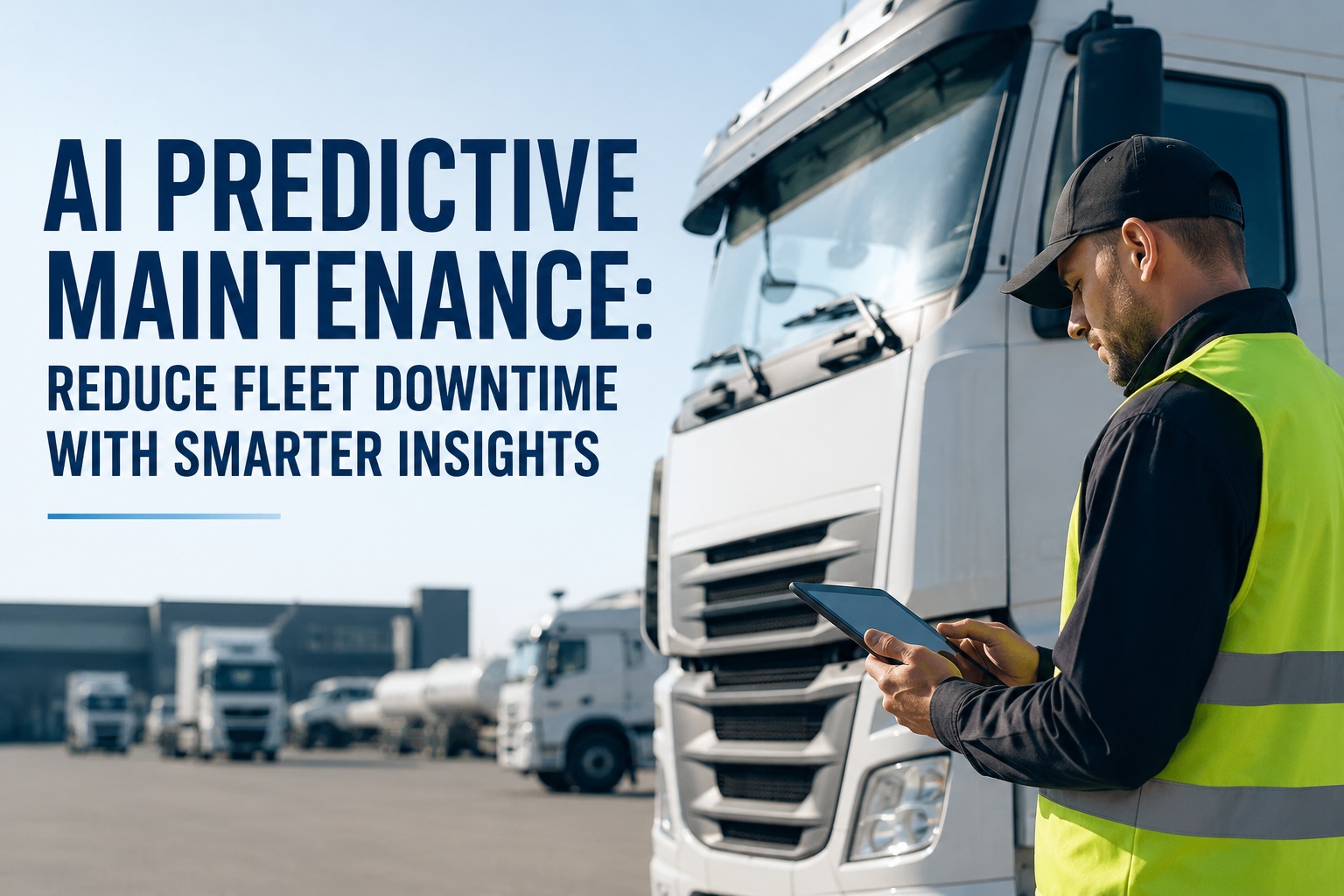
AI predictive maintenance uses machine learning to identify developing equipment issues from operational data patterns — days or weeks before those issues become breakdowns. Where preventive maintenance follows fixed schedules regardless of vehicle condition, AI predictive maintenance analyzes telematics, sensor, and inspection data to catch 75% of failures 2-4 weeks in advance and deliver 10:1 to 30:1 ROI within 12-18 months per McKinsey research. Book an HVI demo to explore predictive maintenance for your fleet.
From fixing what broke to preventing what will break.
Three maintenance approaches. Three cost structures. Three downtime outcomes. AI predictive maintenance sits at the top of the maturity ladder — and the data pipeline that gets you there uses infrastructure most fleets already have.
Fleet operates in constant firefighting. Breakdowns hit at worst possible moments. 23% of emergency repairs occur within 2,000 miles of scheduled service.
Schedule-based service catches many failures. But parts get replaced with remaining life; emerging failures between intervals still cause breakdowns.
ML models analyze patterns in operational data to predict failures 2-4 weeks in advance. Emergency repairs drop 60-70%; scheduled service happens on actual condition, not calendar.
What AI predictive maintenance actually is
AI predictive maintenance is a maintenance strategy that uses machine learning models to analyze operational data from vehicles and equipment — identifying patterns that indicate developing failures before those failures cause breakdowns. It differs from preventive maintenance in a fundamental way: preventive maintenance follows fixed schedules based on time or mileage, while predictive maintenance responds to actual equipment condition inferred from data.
ISO 17359 (Condition Monitoring and Diagnostics of Machines) defines the technical framework: measurable parameters like vibration, temperature, oil analysis, pressure, and current generate signals that indicate machine health. AI predictive maintenance takes this framework beyond individual measurements to pattern-recognition across many parameters simultaneously, learning from a fleet's specific operational history what "healthy" looks like — and what the signatures of developing failure look like.
Every truck gets the same service at the same interval regardless of actual condition. Predictable planning, but wastes remaining component life on parts replaced early and misses failures between scheduled services.
Each truck gets service based on its actual condition inferred from operational data patterns. Higher planning complexity, but catches emerging failures between traditional PM intervals and preserves component life.
The two approaches are complementary, not competing. Best-in-class fleets combine SMRP-standard preventive maintenance for routine service items (oil, filters, fluids) with AI predictive maintenance for wear-critical components (engines, transmissions, aftertreatment, brakes, batteries) where individual variation is high. Book an HVI demo to see AI predictive maintenance layered onto your existing PM program
How AI predictive maintenance works — the 4-stage data pipeline
Machine learning models don't predict failures magically. They follow a specific 4-stage pipeline that takes raw operational data and produces actionable maintenance decisions. Understanding the pipeline is what separates fleet managers who can evaluate PdM platforms from those who buy on marketing claims.
The pipeline starts with data. Modern trucks generate 1,000+ data points per minute across telematics, ECM (engine control module), aftertreatment sensors, brake systems, and driver behavior signals. AI PdM platforms ingest this stream continuously, layered with digital inspection records, work order history, and known failure timestamps. The data volume isn't the challenge — over 90% of new commercial trucks ship with factory-installed telematics already generating the data. The challenge is integration into a single training-ready dataset per truck.
Machine learning models analyze the ingested data at three levels simultaneously. Level 1: per-truck baseline — what does "healthy" data look like for this specific truck given its age, duty cycle, and history. Level 2: fleet-wide patterns — how do similar trucks behave in similar conditions. Level 3: failure signatures — what data patterns preceded known failures in this fleet or in industry-wide training data. Ensemble ML pipelines combining supervised learning (trained on known failures) with unsupervised anomaly detection (finding new failure patterns) currently achieve 85-95% precision predicting bearing, pump, motor, and aftertreatment failures.
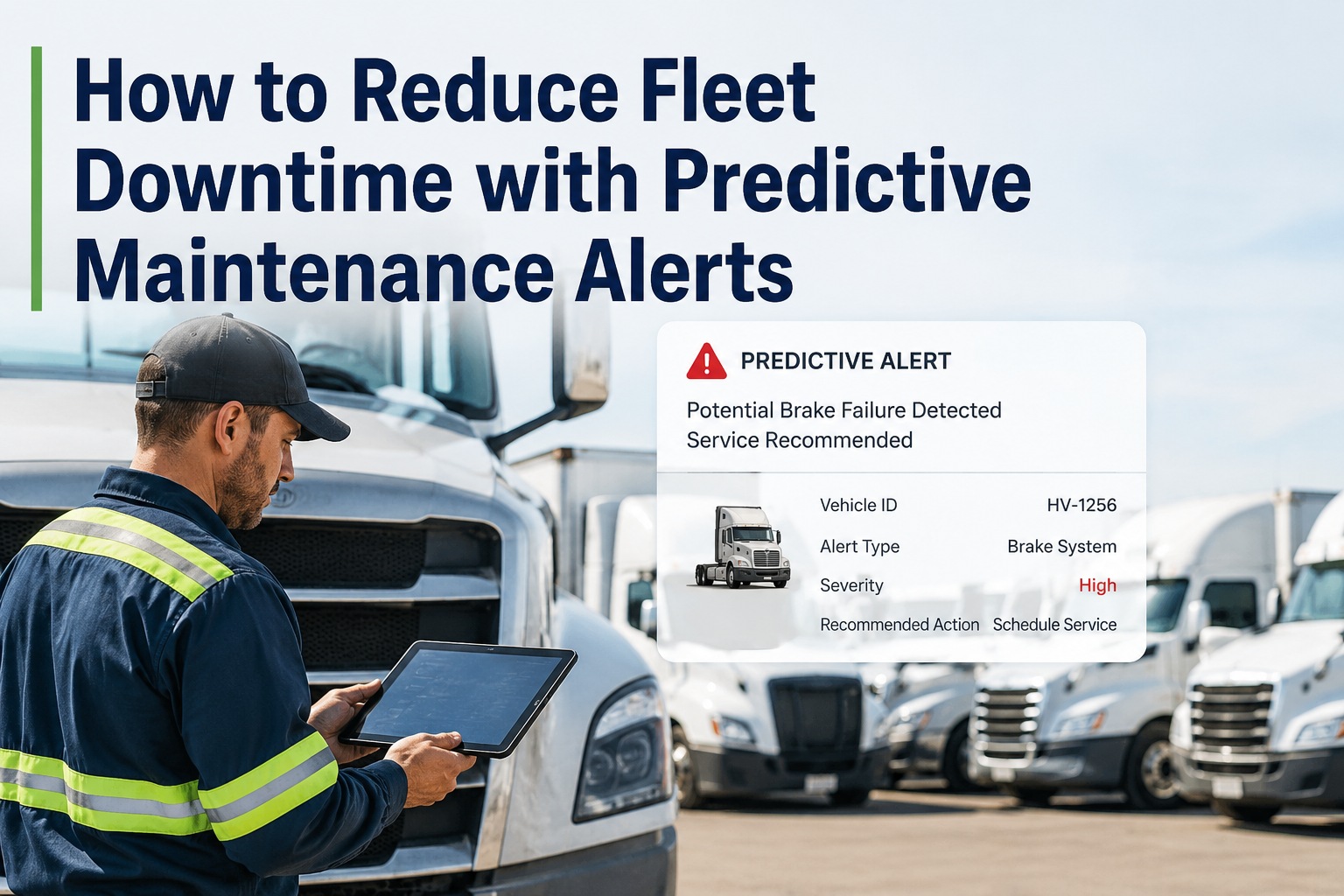
The model output is not a raw score but a specific failure prediction. Example: "Vehicle 247 shows brake pad wear consistent with replacement needed within 2,100 miles — confidence 91%. Schedule service before next long-haul assignment." The prediction includes the component, the failure mode, the estimated lead time to failure, and the confidence level. Fleet managers get answers they can act on, not dashboards they need to interpret. Lead times of 2-4 weeks are typical for wear-based failures; catastrophic failures like injector or turbo issues typically produce 3-7 day lead times.
The final stage closes the loop. Predictions with high confidence auto-generate work orders in the maintenance system, schedule replacement parts against inventory, alert the shop foreman, and flag the truck for scheduled service before its next dispatch. Low-confidence predictions trigger enhanced monitoring rather than immediate action — keeping the system efficient rather than alert-fatigued. The transition from prediction to work order is where PdM actually saves money; without automation the predictions are just alerts that get missed.
Each stage of the pipeline requires infrastructure, but the infrastructure that matters most already exists in most modern fleets. Telematics is factory-installed on 90%+ of new commercial trucks; digital inspection platforms produce structured historical data; work order systems accept API integration. The barrier to AI PdM isn't hardware — it's platform integration. Book an HVI demo to see the pipeline running against your fleet's actual data
What AI can predict — component by component
Not every failure is equally predictable. Some components produce clear pattern signatures in operational data; others fail more suddenly with less warning. Understanding which components AI PdM excels at — and which still require scheduled inspection — is what separates realistic ROI projections from overhyped ones.
ECM data streams reveal cylinder imbalance, injector degradation, and oil pressure trends. Typical lead time: 2-4 weeks for wear-based failures, 3-7 days for catastrophic risks. Highest-value category due to repair cost.
DPF regen frequency, DEF consumption rate, and NOx sensor readings surface aftertreatment stress. Case study: Maine waste hauler reduced exhaust-related repairs 41% in 10 weeks with AI predictions.
Pushrod stroke trends, air pressure decay rates, and pad wear patterns predict brake service needs. Lead time: 2-5 weeks for lining wear, days for chamber failure. Critical for CVSA compliance.
Cranking voltage, alternator output, and load cycle patterns produce highly reliable predictions. Battery failure is the most common cold-weather breakdown; AI prediction eliminates 60-70% of cases.
TPMS pressure trends, temperature patterns, and mileage-per-position wear predict tire failure. Wheel-end vibration signals bearing degradation. Lower predictability due to environmental variables.
Coolant temperature spikes, radiator delta-T, and fan cycle patterns identify developing cooling issues. Critical for summer operation; catches water pump and thermostat failures before overheating.
The precision varies by component because the underlying failure physics vary. Wear-based failures (linings, batteries, filters) are highly predictable from operational patterns. Sudden failures (electrical shorts, physical damage, foreign-object events) remain less predictable and continue to require scheduled inspection. AI PdM augments the maintenance program; it doesn't replace comprehensive inspection discipline. Start a free trial to test AI predictions against your fleet's component failure history.
Realistic ROI — what the case studies actually show
McKinsey research documents AI predictive maintenance producing 10:1 to 30:1 ROI within 12-18 months across industrial deployments. Fleet-specific case studies from 2025-2026 show consistent patterns: measurable downtime reduction within 30 days, cost savings within 90 days, and full ROI within one to two quarters of deployment.
Combined effect of eliminating emergency repair premiums and reducing early replacement of parts with remaining useful life. Compounds year-over-year as the model improves.
Documented across fleets running 100-500 vehicles. Emergency roadside events drop; scheduled service happens on planned windows rather than customer-facing surprise breakdowns.
Wear-based failures detected 2-4 weeks in advance with high confidence. Catastrophic failures detected days in advance. Accuracy improves 5-10 points over the first 6 months as the model calibrates.
Cost savings exceed platform cost within the first quarter for most fleets. Meridian Logistics (250-vehicle case): $1.4M prevented downtime in year one, 89% prediction accuracy sustained.
The ROI depends on baseline. Fleets currently running heavily reactive maintenance (Tier 4 PM compliance, high emergency repair spend) capture the largest improvements. Fleets already operating with strong preventive discipline capture smaller but still meaningful gains — typically 15-20% cost reduction rather than 30%. The technology works consistently; the improvement magnitude scales with the starting point. Start a free trial to model expected ROI against your fleet's baseline.
Implementation roadmap — from zero to first predictions
Getting to production AI predictive maintenance takes weeks, not years. The industry has matured to the point where implementation follows a predictable sequence with defined milestones.
Connect existing telematics provider via API. Import fleet roster, work order history (24+ months preferred), and inspection records. No hardware installation for fleets on modern telematics.
Platform builds per-truck operational baselines from the first 7 days of streaming data. Historical failure data trains the initial prediction model. First anomaly alerts begin appearing.
Model confidence reaches actionable thresholds for high-signal components (batteries, brakes, aftertreatment). Fleet management team validates first predictions against physical inspection.
Predictions auto-generate work orders. Parts pre-staged based on forecast. Executive dashboards track prediction accuracy, prevented breakdowns, and estimated ROI.
Accuracy climbs 5-10 percentage points as model incorporates fleet-specific failure history. Coverage expands to lower-signal components (transmission, cooling, electrical). ROI fully realized.
The largest implementation risk isn't technology — it's organizational. Fleets that treat AI PdM as a data science project rather than a fleet management transformation see slower adoption. Fleets that make the maintenance department the customer of the platform — not the vendor of a new data source — see the fastest results.
From a Reliability Engineer running AI PdM across 320 tractors
We piloted AI predictive maintenance on 40 trucks for six months before rolling to the full 320-tractor fleet. The pilot period was educational — not because the model was inaccurate, but because we needed to build trust with the shop. When the platform flagged a truck for imminent injector failure and our tech didn't find anything on inspection, we had to work through the credibility gap.
Second month, that same truck came in with cylinder-3 injector stuck open. The prediction was right; the inspection had missed it. After that, the shop bought in. Twelve months later we've prevented 47 documented breakdowns, saved $890,000 in avoided roadside costs, and cut our emergency-repair spend 52%. The technology is proven. The bottleneck is organizational trust — and that's earned one accurate prediction at a time.
Frequently asked questions
What's the difference between preventive maintenance and AI predictive maintenance?
Preventive maintenance follows fixed schedules based on time or mileage regardless of actual vehicle condition. Every truck of the same model gets the same service at the same interval. AI predictive maintenance uses machine learning to analyze operational data patterns — telematics streams, ECM data, sensor readings, inspection history, and known failure signatures — to identify which specific trucks need service based on their actual condition, not their schedule position. The two approaches are complementary rather than competing. Preventive maintenance catches 45-55% of failures through routine service on wear items like oil, filters, and fluids where uniform intervals make sense. AI predictive maintenance catches 75-95% of wear-based failures 2-4 weeks in advance by monitoring individual truck condition patterns that vary from unit to unit. Best-in-class fleets combine both: SMRP-standard preventive maintenance for routine service items, layered with AI predictive maintenance for wear-critical components (engines, transmissions, aftertreatment, brakes, batteries) where individual truck variation is highest. This combined approach reduces total maintenance cost 25-30% versus pure preventive maintenance while cutting unplanned downtime 40-50%. The economic case for adding predictive maintenance to an existing preventive maintenance program is stronger than the case for replacing preventive with predictive — fleets get the reliability floor from PM discipline and the individual-truck precision from predictive AI.
How accurate is AI predictive maintenance for commercial fleets?
Current-generation ensemble machine learning pipelines achieve 85-95% precision predicting bearing, pump, motor, and aftertreatment failures according to 2025-2026 industry deployments. Accuracy varies meaningfully by component. Batteries and charging systems: 88-95% accuracy — highly predictable from voltage patterns and load cycle data. Engine and powertrain: 85-92% accuracy — ECM streams reveal cylinder imbalance and injector degradation early. Brake systems: 85-93% accuracy — pushrod stroke trends and air pressure decay produce clear signals. Aftertreatment (DPF/DEF/SCR): 80-90% accuracy — regen frequency and NOx sensor readings surface stress. Cooling systems: 80-88% accuracy — temperature trends catch water pump and thermostat failures before overheating. Tires and wheel-end: 75-85% accuracy — TPMS patterns and vibration signals moderate predictability with environmental variables reducing certainty. Meridian Logistics documented 89% overall failure prediction accuracy across a 250-vehicle mixed fleet in 2025. Regional logistics case studies show 89% prediction accuracy sustained over 12 months with $312,000 year-one savings on 85-vehicle fleets. Accuracy typically improves 5-10 percentage points over the first 6 months as the model calibrates to fleet-specific patterns. The realistic expectation for a well-implemented AI PdM system in year one is 85-90% accuracy on high-signal components (engine, brakes, batteries) and 75-85% on lower-signal components (transmission, hydraulics, electrical), with continuous improvement as the model accumulates fleet history.
Do I need special hardware or sensors for AI predictive maintenance?
For most modern commercial fleets, no additional hardware is required. Over 90% of new commercial trucks ship with factory-installed telematics that generates the data AI predictive maintenance platforms use for prediction. The ECM (Engine Control Module), aftertreatment sensors, brake system monitors, and TPMS units already stream operational data through the vehicle's telematics provider. AI PdM platforms integrate with existing telematics via API — connecting to the data stream that's already being generated, not installing new hardware to generate new data. For older vehicles (typically pre-2015) without telematics, low-cost plug-in diagnostic adapters that install in under five minutes per vehicle through the OBD-II or J1939 port provide the necessary data feed. Advanced monitoring for specific reliability engineering programs — vibration sensors on wheel ends, oil analysis integration, ultrasonic testing for hydraulic leaks — can add prediction accuracy for specific failure modes but is not required for the initial deployment. The reason AI PdM has become viable in the last 2-3 years is precisely that the data infrastructure has caught up: telematics is now standard, digital inspection platforms produce structured historical data, and work order systems accept API integration. The barrier to AI PdM in 2026 is not hardware investment — it's platform selection and organizational adoption. Fleets can typically be operational within 2-4 weeks of platform selection using data infrastructure they already have.
What's the realistic ROI for AI predictive maintenance in a commercial fleet?
McKinsey research documents AI predictive maintenance producing 10:1 to 30:1 ROI within 12-18 months across industrial deployments. Fleet-specific case studies from 2025-2026 show consistent patterns. Regional 85-vehicle logistics fleet: 35% breakdown reduction, 89% prediction accuracy, $312,000 year-one savings. Meridian Logistics 250-vehicle mixed fleet: 89% prediction accuracy, $1.4M in prevented downtime. 250-vehicle documented case: $1.8M in annual savings combining 30% maintenance cost reduction with 45% downtime decrease. Maine waste hauler: 41% reduction in exhaust-related repairs, $1,600 per truck saved in 10 weeks. Payback periods typically hit within 3-6 months as cost savings from prevented breakdowns exceed platform cost within the first quarter. The specific ROI depends on baseline. Fleets currently running heavily reactive maintenance (Tier 4 PM compliance, high emergency repair spend, $2,500+ per breakdown incident) capture the largest improvements — often 40-50% maintenance cost reduction versus reactive baseline. Fleets already operating with strong preventive discipline (85%+ PM compliance) capture smaller but still meaningful gains — typically 15-20% cost reduction and 25-30% downtime reduction. The technology works consistently across fleet sizes and duty cycles; the improvement magnitude scales with the starting point. Small fleets (10-25 vehicles) typically see full ROI within 6 months due to lower absolute platform cost. Large fleets (500+ vehicles) see larger dollar ROI but longer amortization due to more complex organizational adoption.
How long does it take to see results from AI predictive maintenance?
The AI PdM timeline follows a predictable sequence with defined milestones. Week 1: Platform integration and telematics connection. API integration to existing telematics provider takes 1-2 days. Historical work order and inspection data import takes another 2-3 days for fleets with 24+ months of digital history. Week 2: Baseline model training. Platform builds per-truck operational baselines from the first 7 days of streaming data. Historical failure data trains the initial prediction model. First anomaly alerts begin appearing. Week 3-4: First actionable predictions. Model confidence reaches actionable thresholds for high-signal components — batteries, brakes, aftertreatment. Fleet management team validates first predictions against physical inspection. Month 2-3: Workflow automation. Predictions auto-generate work orders. Parts pre-staged based on forecast. Executive dashboards track prediction accuracy and prevented breakdowns. Month 6-12: Model refinement and expansion. Accuracy climbs 5-10 percentage points as model incorporates fleet-specific failure history. Coverage expands to lower-signal components. Full ROI realized. Most fleets report measurable reductions in unplanned breakdown frequency within the first 30 days of deployment and full ROI within the first quarter. The largest implementation risk is not technology — it's organizational adoption. Fleets that treat AI PdM as a data science project rather than a fleet management transformation see slower results. Fleets that position the maintenance department as the primary user of the platform, with strong executive sponsorship, see the fastest measurable outcomes.
From reactive firefighting to predictive precision — in under 30 days.
HVI's AI predictive maintenance module integrates with existing telematics providers to layer failure prediction onto your current PM program. Baseline models build within 24 hours; first actionable predictions within 72 hours; measurable downtime reduction within 30 days. Executive dashboards translate ML output into fleet-manager-actionable recommendations. Live for your fleet in under three weeks — typical result: 30% maintenance cost reduction, 45% downtime decrease, and 10:1 to 30:1 ROI within 12-18 months.
ISO 17359 alignment · No new hardware required · ML-driven predictions · SOC 2 Type II