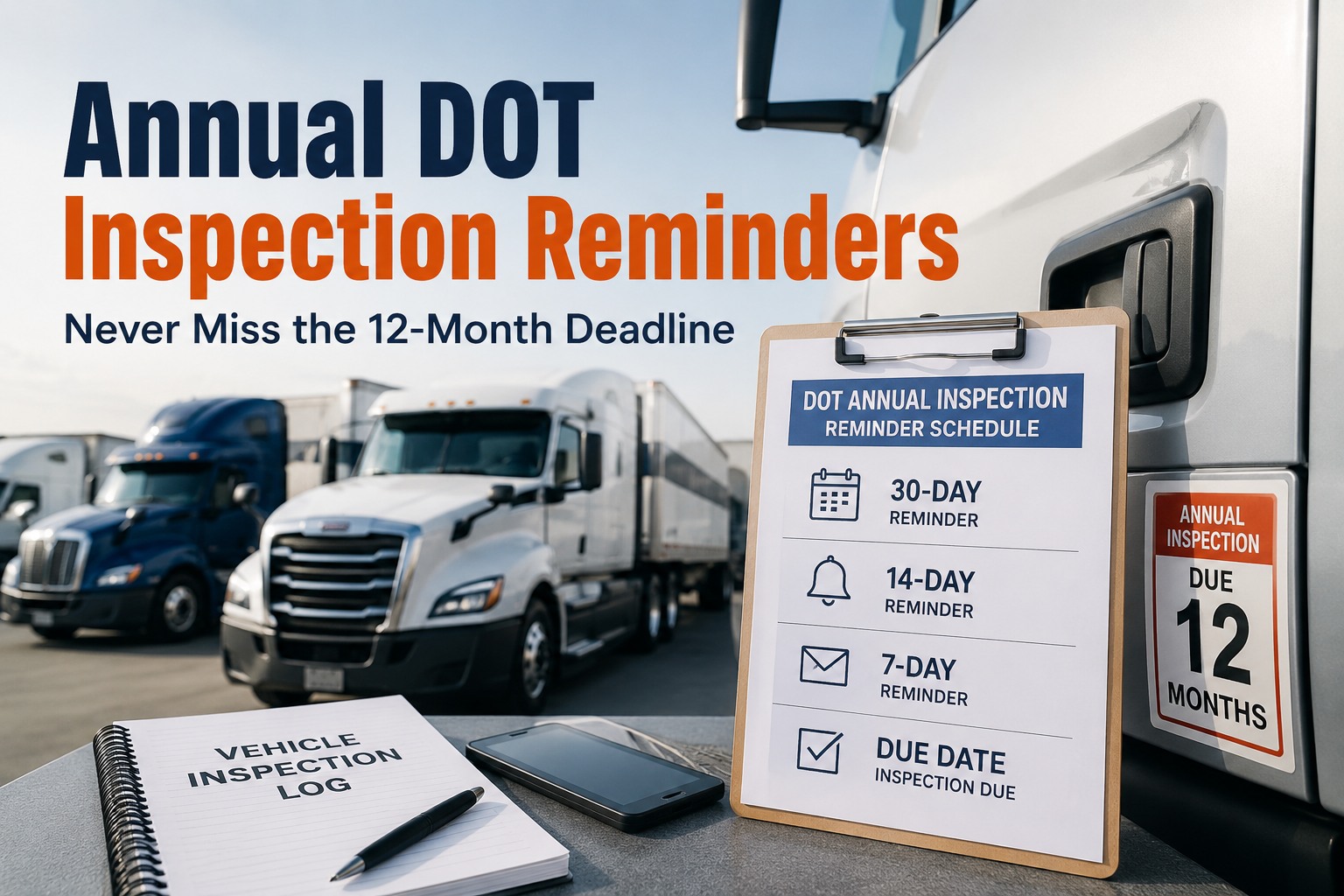
Under 49 CFR §396.17, every commercial motor vehicle over 10,001 lb GVWR must pass a periodic inspection at least every 12 months, certificate posted at all times. No grace period. An expired sticker at any roadside stop is an automatic out-of-service order, exposing carriers to $1,000-$16,000 per vehicle per day in civil penalties. Manual calendar tracking works until a fleet passes 20 units and staff turnover kicks in. Automated 30/14/7-day reminder cadences prevent the miss — book a demo to see automated DOT inspection reminders in HVI.
The 365-Day Reminder Timeline — When to Alert, Who to Alert, What Happens If You Don't
The deadline never moves. The truck rolls every day toward it. Here is exactly where each escalating reminder fires.
Approximately 133,000 citations issued annually for expired or missing annual inspection stickers. Only 7% of carriers pass FMCSA audits without a single violation. Reminder discipline is the difference between clean audits and the other 93%.
The rest of this page walks the exact §396.17 requirements that trigger the annual clock, the state-by-state variations that override the federal 12-month floor (New York 6 months, California 90 days for heavy buses), the CVSA Level I substitution rule under §396.23, and the 4-step reminder workflow that turns compliance from a spreadsheet management problem into a system the fleet manager barely thinks about. Book a 30-minute demo to see per-unit annual inspection tracking in HVI.
The §396.17 requirements — what triggers the annual clock
The annual periodic inspection rule under 49 CFR §396.17 covers every commercial motor vehicle with a GVWR of 10,001 lbs or more operating in interstate commerce, plus combination vehicles where each component is inspected separately. The rule looks simple in summary but has specific mechanics worth understanding before building the reminder workflow, because those mechanics determine when the clock actually resets and what counts as a valid inspection.
| Rule element | Requirement | Reference |
|---|---|---|
| Inspection interval | At least once every 12 months from the last day of the month of the prior inspection | 49 CFR §396.17(a) + (f) |
| Vehicle coverage | CMV with GVWR >10,001 lbs, combination vehicles, each unit inspected separately | 49 CFR §396.17 |
| Inspection standard | Every item in Appendix A: brakes, coupling, exhaust, fuel, lighting, safe loading, steering, suspension, frame, tires, wheels/rims, windshield | 49 CFR Part 396 Appendix A |
| Certificate location | Proof of inspection on vehicle at all times (decal or paper report in cab) | 49 CFR §396.17(c) |
| Inspector qualification | Trained + demonstrated experience per §396.19; in-house mechanic, third-party shop, or state-certified station all qualify with documented credentials | 49 CFR §396.19 |
| Substitution allowed | A passing CVSA Level I roadside inspection within the 12-month window covering all Appendix A items counts as the annual periodic inspection | 49 CFR §396.23 |
| Record retention | Report kept 14 months from inspection date (2-month audit overlap with next annual) | 49 CFR §396.21 |
The rule most fleets miss when building their reminder workflow: the 12-month clock resets on the last day of the month the inspection was performed, not on the specific calendar date. A vehicle inspected on March 15 has until the last day of March the following year to be re-inspected. This gives an operational buffer that most spreadsheet-based tracking systems fail to model correctly, either alerting too early (wasting shop capacity) or too late (creating same-week scheduling scrambles). Book a demo to see per-unit month-anchored expiration tracking in HVI.
The 4 failure modes that cause fleets to miss the deadline
Missed annual inspections almost never come from carriers ignoring the rule. They come from four operational failure modes in ongoing tracking and reminder discipline that produce compliant-looking fleets right up until the day a unit rolls with an expired sticker. Each failure mode has a specific structural cause and a specific fix.
Spreadsheet-based tracking
Fleet manager maintains an Excel sheet of expiration dates, glances at it monthly. Works fine for 10-20 units. At 50+ units and multiple yards, the sheet is out of date within a week of any inspection completion. Missed unit is discovered when a driver gets pulled over at roadside.
Single-point-of-failure ownership
One compliance manager owns the entire tracking process. Goes on vacation, changes jobs, or gets pulled to another priority. Reminder ownership drifts. Two units expire before anyone notices. Reminder responsibility must be automated, not personal.
Late-notice scheduling scramble
Reminder finally fires 5 days before expiration. Dealer or in-house shop is booked. Unit runs one more day with expired sticker "just to finish the load." Roadside inspection that day — OOS + fine + CSA hit. Reminder cadence must fire 60+ days out to preserve booking flexibility.
Certificate not on vehicle
Inspection was completed on time; certificate/decal was never posted to the vehicle or fell off the windshield. Roadside inspector sees no proof, treats as OOS pending certificate production. Even valid inspections require the certificate to be physically on the unit at all times per §396.17(c).
All four failure modes are structurally identical: the compliance task exists somewhere in the fleet's workflow but is not automated end-to-end. Best-practice systems handle the entire lifecycle — escalating reminders that fire without human involvement, dispatch integration that blocks at-risk units automatically, certificate posting tracked as a required task before the reminder loop closes, and shared visibility across compliance/maintenance/dispatch/driver roles so no single person is a bottleneck. Book a demo to see end-to-end lifecycle automation for annual inspections in HVI.
The 4-step reminder workflow that keeps every unit ahead of the deadline
Well-run fleets share the same 4-step reminder workflow regardless of platform or fleet size. The elements are deceptively simple; the discipline of applying them consistently across every unit, every month, is where compliance actually lives. This is the framework that turns annual inspection tracking from a personal-attention burden into a background process.
Month-anchored calculation
- Expiration = last day of inspection month +12
- Not calendar-date arithmetic per §396.17(f)
- Applies uniformly across every unit
- State variations override where stricter
Escalating reminder cadence
- 60 days out: compliance + maintenance manager
- 30 days out: escalates to fleet director
- 14 days out: safety + dispatch alerted
- 7 days out: automated dispatch hold on unit
Booking + completion confirmation
- Booking confirmed at 30-day escalation or unit flagged
- Inspection completion triggers new certificate workflow
- Report attached to unit record for 14-month retention
- New 12-month countdown starts on last-day-of-month
Certificate posting verification
- Physical decal or paper report on vehicle per §396.17(c)
- Photo evidence captured to close reminder loop
- Weathering + peel checked at monthly walkaround
- Reissue triggered if certificate deteriorates before expiration
Fleets running the 4-step workflow consistently maintain 100% annual inspection compliance across mixed fleets of 50-500 units without dedicated headcount for the task. Fleets running spreadsheet-based tracking with personal-attention reminders typically miss 1-3 units per year in the 50-100 unit range, and 5-10 units per year at 200+ units. The compliance cost differential runs $10K-$50K per year in direct penalties alone, plus insurance and CSA impacts that compound over multiple renewal cycles. Start a free HVI trial to see the 4-step workflow applied per unit.
A maintenance director on rebuilding annual inspection tracking after 3 expired units in one quarter
We're a 118-tractor + 220-trailer regional carrier operating primarily Midwest and Great Lakes. Ran annual inspection tracking on a shared Excel sheet for 8 years — three columns per unit, sortable by expiration month, updated by our compliance coordinator quarterly. Worked well enough until Q3 2024 when we had 3 units expire in the same 5-week window while the compliance coordinator was on maternity leave.
Two units caught at roadside inspections in Ohio and Illinois. Automatic OOS orders. Direct fines around $18,000 across the two incidents. Third unit caught internally when a driver mentioned the sticker looked old. Dispatch had been assigning that unit for 12 days after actual expiration without anyone noticing — our shared calendar reminder had fired but landed in the coordinator's out-of-office response and no one else was CC'd. The financial hit was manageable; the CSA Vehicle Maintenance percentile jump from 34th to 51st was harder. Insurance underwriter mentioned it directly at renewal 6 months later — premium up 8% attributable specifically to that quarter.
We rebuilt in Q4 2024 on a proper reminder system. Every unit has a dashboard entry with month-anchored expiration. Automated escalation at 60, 30, 14, and 7 days to different role groups — not one person. Dispatch integration means at-risk units cannot be assigned to lanes over 4 hours starting at day 14, and cannot be dispatched at all starting at day 7 until re-inspection confirmed. Photo evidence of certificate posting required to close the reminder loop. Since Q4 2024: 100% compliance across 338 units. Coordinator can go on any leave without the fleet's compliance status being tied to her personal availability. The math is simple — even one avoided OOS event pays for the system for years.
Frequently asked questions
How often is a DOT annual inspection required?
Under 49 CFR §396.17, every commercial motor vehicle (CMV) with a gross vehicle weight rating over 10,001 pounds operating in interstate commerce must pass a periodic inspection at least once every 12 months. Combination vehicles must have each component inspected separately — the tractor and each trailer or dolly counts as a distinct inspection unit. The 12-month clock runs from the last day of the month the prior inspection was performed per §396.17(f), not from the specific calendar date. A vehicle inspected on any day in March has until the last day of March the following year to be re-inspected. Some states impose stricter requirements that override the federal 12-month floor: New York requires every 6 months for CMVs over 10,000 lb GVWR, and California requires 90-day periodic inspections for vehicles over 26,001 lb GVWR (particularly buses). Where state requirements are stricter, the state rule applies. Buses have an additional federal requirement under §396.3: emergency exits, push-out windows, and emergency door marking lights must be inspected every 90 days independent of the annual periodic inspection. Proof of the completed inspection — either a decal punched with the month and year or a paper inspection report — must be on the vehicle at all times per §396.17(c). An expired sticker at any roadside stop is an automatic out-of-service condition, regardless of whether the underlying vehicle condition is compliant.
What happens if you miss the annual DOT inspection deadline?
An expired annual inspection sticker triggers automatic out-of-service (OOS) status at any roadside inspection — no grace period, no discretionary warning. The vehicle stops at the inspection location and cannot move until a valid inspection is completed and the certificate is posted. Direct civil penalties range from $1,000 to $16,000 per vehicle per day depending on the specific violation and jurisdiction, and can compound rapidly for extended non-compliance. Operating with known out-of-service defects carries penalties up to $19,277 per violation under the December 2024 fine schedule, and operating under an OOS order (moving the vehicle after being placed OOS) carries penalties up to $23,048. Beyond the direct penalties, every roadside OOS event feeds into the carrier's CSA Vehicle Maintenance BASIC score for a 12-month window, which affects insurance premiums (commonly 8-40% at next renewal), shipper contract eligibility, and future roadside inspection selection probability. The 2026 CSA overhaul doubled the severity weight of OOS violations. Approximately 133,000 citations are issued annually for expired or missing annual inspection stickers across the US commercial vehicle fleet, and only about 7% of motor carriers pass FMCSA audits without at least one finding — the remaining 93% face fines, out-of-service orders, or in serious cases, operating authority suspension. Missed annual inspections are among the most preventable causes of these outcomes, which is why reminder discipline matters disproportionately to its apparent simplicity.
Can a CVSA roadside inspection count as the annual DOT inspection?
Yes, under 49 CFR §396.23, a passing CVSA Level I North American Standard Inspection performed within the 12-month window that covered all Appendix A items can substitute for the periodic annual inspection. This is a legitimate compliance path and saves the fleet the cost and downtime of a separate annual inspection when a Level I is already available. Three conditions must be met: (1) the roadside inspection must be a CVSA Level I — the 37-step comprehensive inspection covering both driver credentials and full vehicle mechanical inspection, not a Level II walkaround or Level III driver-only inspection; (2) the vehicle must have passed the inspection (received a CVSA decal, no OOS violations noted); and (3) the inspection must have covered every item required under Appendix A of Part 396. Roadside inspectors are trained on Appendix A and Level I inspections do meet the standard, but the fleet is responsible for verifying the inspection report shows coverage of all required items before treating it as the annual substitute. When using this substitution, retain the roadside inspection report for 14 months per §396.21, exactly as would be required for a shop-performed annual. State periodic inspections performed under any US state, Canadian province, Yukon Territory, or Mexico that meet Appendix A minimum standards also count as the annual per §396.17(f), giving fleets running multi-jurisdiction operations additional compliance flexibility.
Who can perform a DOT annual inspection?
Under 49 CFR §396.19, an annual inspection must be performed by an inspector qualified through demonstrated training and experience with commercial vehicle inspection procedures and demonstrated ability to identify Appendix A defects. The regulation is specific about the qualifications but flexible about where inspectors can come from. Three inspector types satisfy the requirement. First, in-house mechanics or maintenance staff at the carrier itself who meet the training and experience threshold — typically requiring documentation of a formal training program plus one year of practical inspection experience, or demonstrated equivalent experience from a commercial vehicle manufacturer training program, carrier mechanic role, maintenance facility position, or state/federal inspector role. Second, third-party inspection services including commercial garages, dealer service departments, fleet leasing company maintenance operations, and certified truck stop inspection facilities. Third, state-certified inspection stations in states that operate their own CMV inspection programs. Regardless of inspector type, the carrier must retain documentation of the inspector's qualifications and produce it during any FMCSA compliance review or audit. The regulation does not require federal certification of the inspector, but does require the carrier to demonstrate the inspector met the §396.19 threshold. Inspection reports must include the inspector's name, the motor carrier or intermodal equipment provider name, the inspection date, the vehicle identifier, and each component inspected with pass/fail status. Missing any of these elements can invalidate the inspection during audit.
How can fleets track annual DOT inspection deadlines?
Small fleets under 20 units can manage annual inspection tracking on shared calendars or spreadsheets if the discipline of updating them consistently after every inspection is maintained. The failure point historically hits somewhere between 20 and 50 units when the manual tracking overhead exceeds the compliance coordinator's available attention and gaps start appearing. Best-practice systems for fleets above that threshold use automated reminder platforms with four common elements. First, month-anchored expiration calculation per §396.17(f) rather than calendar-date arithmetic, so reminders fire on the correct schedule. Second, escalating reminder cadence at 60, 30, 14, and 7 days out sent to different role groups (compliance manager first, escalating to fleet director, then safety manager, then dispatch integration) so no single person is a bottleneck. Third, dispatch integration that blocks at-risk units from being assigned to lanes over a specific duration threshold in the 14-day window and blocks dispatch entirely at 7 days out. Fourth, certificate posting verification via photo evidence to close the reminder loop, plus a 14-month retention archive matching the §396.21 requirement so the completed inspection record is available for any subsequent FMCSA audit. Well-implemented systems produce 100% annual inspection compliance across fleets of 50-500+ units without requiring dedicated headcount for the tracking task. The direct cost of a single avoided out-of-service event ($4,200 average penalty plus insurance premium and CSA impacts) typically justifies the system cost within the first prevented incident.
Never miss the deadline. Never lose the certificate. Never worry about staff turnover.
HVI tracks every unit's annual inspection expiration month-anchored per §396.17(f), fires escalating reminders to the right people at the right time, blocks at-risk units from dispatch, and confirms certificate posting to close the loop. What used to be a spreadsheet-and-Post-It-Notes discipline becomes a system that runs itself. Live in under two weeks. No hardware. No credit card.
Trusted by DOT-regulated fleets across the USA & Canada · Ready on day one