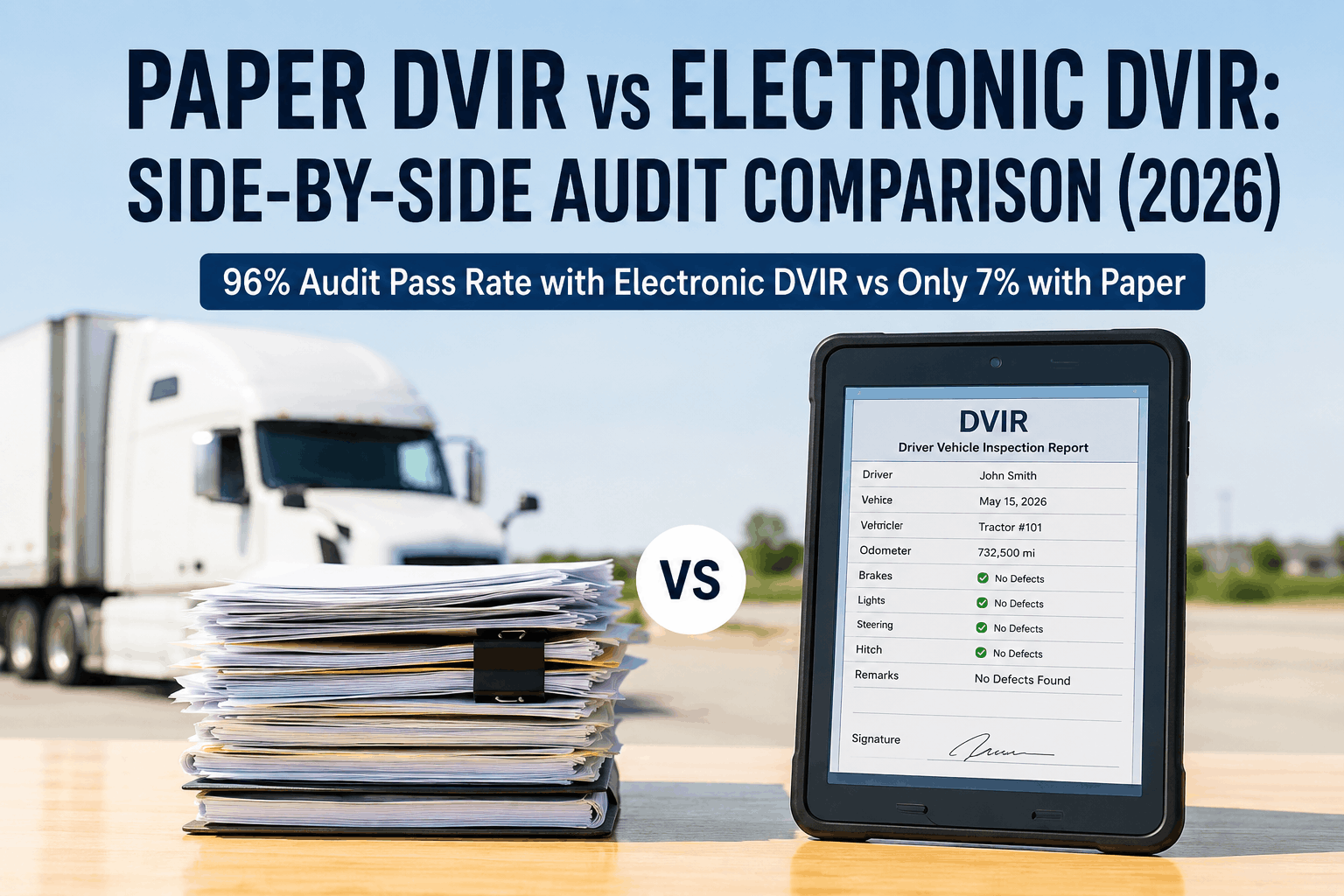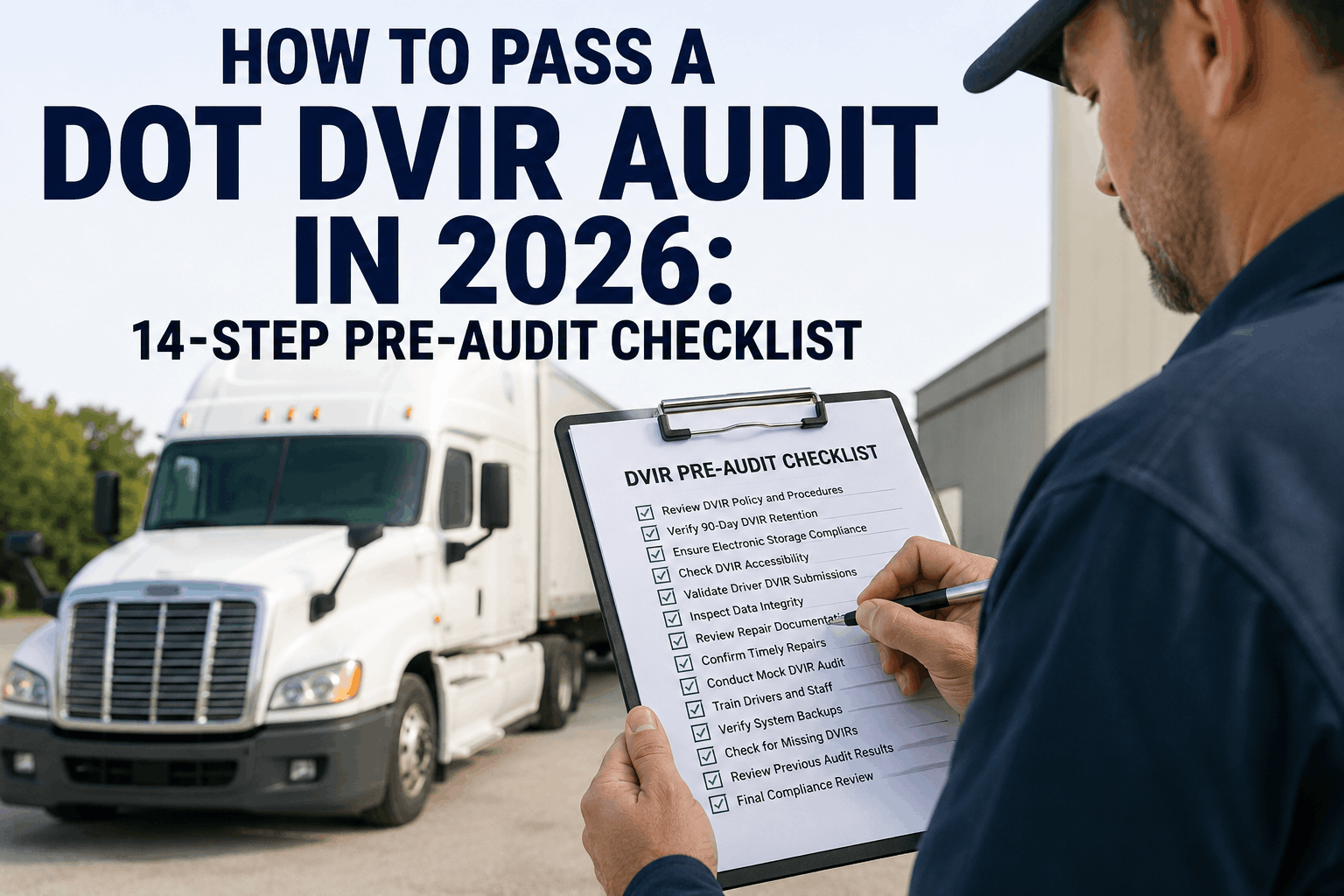
The DVIR is the single most-cited document in DOT compliance reviews — FMCSA audits DVIR records in about 89% of reviews, and only 7% of carriers pass without a DVIR-related citation. That's not because the rules are impossible; it's because most carriers prepare for the wrong thing. They keep the driver's report and forget the mechanic's repair certification and the next driver's acknowledgment, or they retain records but can't produce them inside the 48-hour window auditors now routinely give. The penalties for getting it wrong are steep: $1,270 a day for failure to file, up to $12,700 for falsification, and $15,420 for dispatching a vehicle with an unrepaired safety defect. And the ground just shifted — FMCSA's final rule effective March 23, 2026 (Docket FMCSA-2025-0115) added explicit electronic-DVIR language to 49 CFR 396.11 and 396.13, so digital records are now unambiguously accepted and increasingly expected. This 14-step pre-audit checklist walks through exactly what an auditor looks for: the complete document inventory, proof of 90-day retention, the three-signature chain, electronic-storage acceptance, and a mock-audit walkthrough. A digital DVIR system turns most of this list into something automatic — which is why digital fleets pass at 96% versus 73% on paper. Run these 14 steps before the auditor calls.
What an Auditor Actually Checks
Before the 14 steps, know the targets. DVIR audits fail on four recurring gaps — and every step below maps to closing one of them.
The 14-Step Pre-Audit Checklist
Work through these in order. Each step is something an auditor can cite — close them all and a DVIR review becomes a non-event. The four phases group the work: inventory, retention, the signature chain, and the mock audit.
Confirm a DVIR exists for every operating day
Auditors cross-reference DVIRs against driver logs — a report must exist for every day each vehicle ran. Gaps are counted as violations under 396.11(c)(2).
Verify vehicle identification on every report
Each DVIR must carry a unit number, VIN, or license plate. Reports that can't be matched to a specific vehicle are treated as non-compliant.
Check all 14 required components are recorded
Service brakes, parking brake, steering, lights, tires, horn, wipers, mirrors, coupling, wheels, emergency equipment, and more — each inspected and its result recorded.
Locate annual (periodic) inspection records
Every CMV needs a 396.17 annual inspection on file, retained 14 months. Confirm each unit has a current one and the decal or report travels with the vehicle.
Prove 90-day DVIR retention
Under 396.11(a)(4), every DVIR — defect or no-defect — must be kept at least 90 days from the date prepared. Confirm nothing in the trailing 90 days is missing.
Confirm 14-month annual-inspection retention
Annual periodic inspection reports (396.21) must be retained 14 months from the report date — a separate, longer clock from the DVIR's 90 days.
Test instant retrieval
With 48-hour audit notice now standard, records must be producible fast. Pull a random vehicle's last 90 days as a drill — if it takes hours, that's the risk.
Adopt extended retention as best practice
Lawsuits run years; keep DVIRs 12–24 months even though 90 days is the minimum. Digital storage makes extended retention essentially free and improves litigation defense.
Verify the driver's signature & certification
The original driver-signed report is link one. Marking items "pass" without inspecting is falsification — up to $12,700+ and potential criminal penalties.
Confirm the mechanic's repair certification
When a defect is reported, the carrier must certify the repair (or that none was needed) on the original DVIR. A missing repair cert is a common, citable gap.
Check the next-driver acknowledgment
Under 396.13, the next driver must review the most recent DVIR and sign before operating. Skipping this breaks the custody chain — a separate violation.
Confirm no defective vehicle was dispatched
A vehicle with a defect affecting safe operation can't be dispatched until repaired and certified. Dispatching anyway carries a $15,420 penalty — verify none slipped through.
Confirm electronic records meet the 2026 rule
eDVIRs are explicitly authorized under the March 23, 2026 final rule (390.32, 396.11, 396.13). Electronic signatures, mobile submission, and cloud storage are fully compliant — verify yours capture all signatures with timestamps.
Run a full mock audit
Have someone play auditor: request a random week, cross-check against logs, trace the three-signature chain on defect reports, and time the retrieval. Fix every gap before the real notice arrives.
The Three-Signature Chain, Visualized
Most DVIR citations trace to a broken chain — the part carriers most often get wrong. Every defect report needs all three links, retained together. Miss one and the whole record is incomplete.
Driver Reports
The driver inspects and signs the DVIR, documenting any defect or certifying no-defect. 396.11.
Carrier Certifies Repair
The carrier or mechanic repairs the defect and certifies it on the original report — or certifies none was needed.
Next Driver Acknowledges
The next driver reviews and signs before operating, confirming awareness of any condition. 396.13.
The Penalty Stakes
Why the discipline matters. A single broken link or missing record carries real financial exposure — and FMCSA estimates proper DVIRs prevent roughly 14,000 accidents a year, so the safety case matches the compliance one.
Walk Into Your Next Audit Already Passing
Digital DVIRs with all 14 components, the full three-signature chain captured with timestamps, defects routed to maintenance and repair-certified, and 90+ days of records retrievable in seconds — built for the March 2026 eDVIR rule. Digital fleets pass DOT audits at 96% versus 73% on paper. Trusted by 25,000+ users worldwide.