The auditor walks into your office on a Tuesday morning with a 48-hour notice. They want 90 days of DVIRs for 12 specific vehicles — every pre-trip, every post-trip, every defect noted, every repair certified, every next-driver signature acknowledged. For fleets still running paper, the next tw business days disappear into filing cabinets that will likely turn up incomplete records, illegible handwriting, and missing signatures — the same documentation failures auditors have seen 1,000 times. For fleets running HVI's electronic DVIR platform, the same request becomes a 15-minute task: filter by date range, export a complete PDF package with photos and GPS-tagged signatures, send. That is the operational difference HVI delivers. The compliance difference is starker: paper DVIRs achieve only a 7% audit pass rate without a single violation, while fleets using digital eDVIRs hit 96% — and 73% of paper DVIRs never make it from the truck cab to the office in the first place. With FMCSA's February 19, 2026 final rule (effective March 23, 2026) explicitly authorizing eDVIRs and the new CSA "Driver Observed" scoring category penalizing exactly what paper inspections fail to document, the audit-comparison evidence is no longer ambiguous. HVI's inspection & maintenance software is purpose-built to close this gap — guided mobile checklists, photo-verified defects, auto-generated work orders, and 3-signature chain enforcement that turns your worst audit day into a 15-minute task.
Trade Your Filing Cabinet for HVI's Export Button
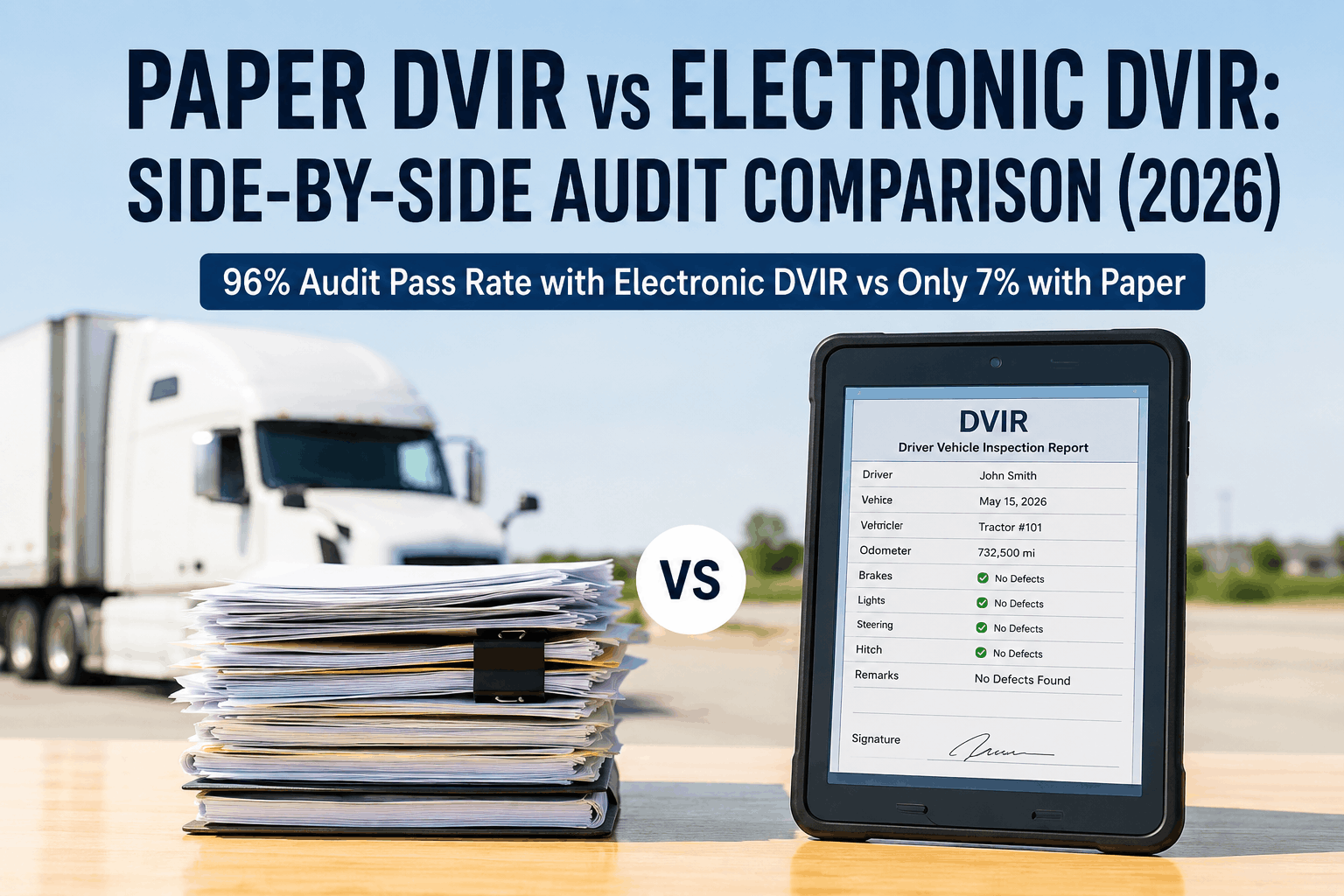
Paper DVIRs pass 7% of audits. HVI's electronic DVIRs pass 96%. Our inspection & maintenance software delivers FMCSA-compliant eDVIRs, 30-second audit exports, photo-verified defects, and the 3-signature chain enforced automatically — all from one platform.
The Audit Pass-Rate Gap: 7% vs 96%
This is the single number that ends the paper-vs-digital debate. Only 7% of motor carriers pass a focused FMCSA compliance review without a DVIR-related violation — but fleets running electronic DVIRs through platforms like HVI achieve 96% pass rates. The 89-point gap is not about driver effort or manager attention. It is about whether the system structurally prevents the failures that paper enables. HVI's inspection & maintenance software does exactly that — by design.
Paper DVIR
7%
audits passed without a single violation
93% face fines, OOS orders, or escalated audits
VS
HVI eDVIR
96%
audits passed without a single violation
Audit-ready records produced in under 15 minutes
A 50-truck fleet with systematic DVIR failures faces $63,500+ in fines from a single audit. The 7% pass rate is not a paper inspection problem — it is a paper system problem.
Start free with HVI and move to the 96% side in 2–4 weeks.
The 73% Problem HVI Eliminates
Before an auditor ever asks for records, paper has already failed. 73% of paper DVIRs never make it from the truck cab to the dispatch office. They get crumpled in glove boxes, soaked by spilled coffee, forgotten in trailer logbooks, or shoved into a clipboard that never gets emptied. The defect is documented — but no one can see it. The repair never happens. HVI's mobile inspection app eliminates this failure mode at the source by syncing every inspection to the cloud the moment the driver hits submit.
PAPER DVIR JOURNEY
1
Driver completes paper checklist at end of shift
2
Form goes into clipboard, glove box, or cab pocket
3
73% never reach the office — lost, damaged, illegible, or forgotten in the cab
4
Defects sit undocumented — repairs delayed 3.2 days average
5
Auditor requests records — 1–3 days to assemble incomplete files
HVI eDVIR JOURNEY
1
Driver taps through HVI guided mobile checklist with photo capture
2
Record syncs to HVI cloud instantly — GPS, timestamp, e-signature attached
3
100% reach the office — zero lost records, zero illegibility
4
HVI auto-generates work orders from defects — repair in 2–4 hours
5
Auditor request: HVI filter, export PDF, send — under 15 minutes
The Retrieval-Speed Test HVI Was Built For
Speed of audit response is itself a compliance test. An auditor who requests records and hears "we'll have to look for those" has already found a citation. HVI's compliance dashboard collapses the audit-preparation timeline from days to minutes — here is how each system performs when the audit clock is running.
Paper DVIR Retrieval
1–3 days
Manual search through filing cabinets, multiple terminals, archived boxes. Average paper fleet produces only 60–75% of requested records in reasonable timeframes. The remainder become documentation gaps — each one a potential citation.
HVI eDVIR Retrieval
Under 15 min
Filter HVI's compliance dashboard by date range, vehicle ID, or driver. Export a complete PDF package with photos, e-signatures, timestamps, and GPS data. 100% record completeness. Zero preparation time. Ready before the auditor finishes their coffee.
FMCSA auditors expect records within 48 hours — sometimes same-day. Paper retrieval at 1–3 days is already a compliance failure before any record is reviewed.
Schedule a demo and see HVI's 15-minute audit exports in action.
Side-by-Side: Every Audit Dimension HVI Wins
This is the comparison owner-operators and small-fleet managers ask for: the dimensions auditors actually score, with paper measured against HVI's inspection & maintenance software side by side.
Audit Dimension
Paper DVIR
HVI eDVIR
FMCSA Audit Pass Rate
7%
96%
Records That Reach Office
27% (73% lost)
100% (cloud sync)
DVIR Completion Rate
55–78%
99%+ (HVI reminders)
Audit Record Retrieval
1–3 days
Under 15 minutes
Defect-to-Repair Time
3.2 days average
2–4 hours (auto WO)
3-Signature Chain
Manual — frequently broken
HVI-enforced — cannot skip
Photo Evidence per Defect
None — handwritten note only
Timestamped + GPS-tagged
CSA "Driver Observed" Score
No automated documentation
Auto-mapped by HVI
Admin Hours per Week
5–8 hours data entry
Zero — HVI auto-logs
Inspection Time per Vehicle
12–18 minutes
Under 5 minutes
Cost of Single Audit Failure
$1,270 – $15,420 per occurrence
Avoided by design
How HVI Delivers Compliance with the 2026 FMCSA Rule
On February 19, 2026, FMCSA published final rule Docket FMCSA-2025-0115, explicitly authorizing electronic DVIRs under 49 CFR 396.11 and 396.13. The rule took effect March 23, 2026. HVI's inspection & maintenance software was built to satisfy every requirement of this rule — and every dimension auditors now expect.
Electronic Signatures End-to-End
HVI captures driver, mechanic, and next-driver signatures electronically with timestamps and GPS tags. Wet-ink is no longer required at any point in the 3-signature chain.
Cloud Storage Meets 90-Day Retention
HVI stores every inspection in tamper-evident cloud archives with automatic backup — exceeding the 90-day retention requirement and producing audit packages digitally. No paper required.
CSA "Driver Observed" Auto-Mapped
The 2026 CSA methodology tracks defects drivers should have caught during pre-trip inspections. HVI maps every finding to the correct CSA category in real time — automatic compliance evidence paper fleets cannot produce.
48-Hour Offsite Audit Ready
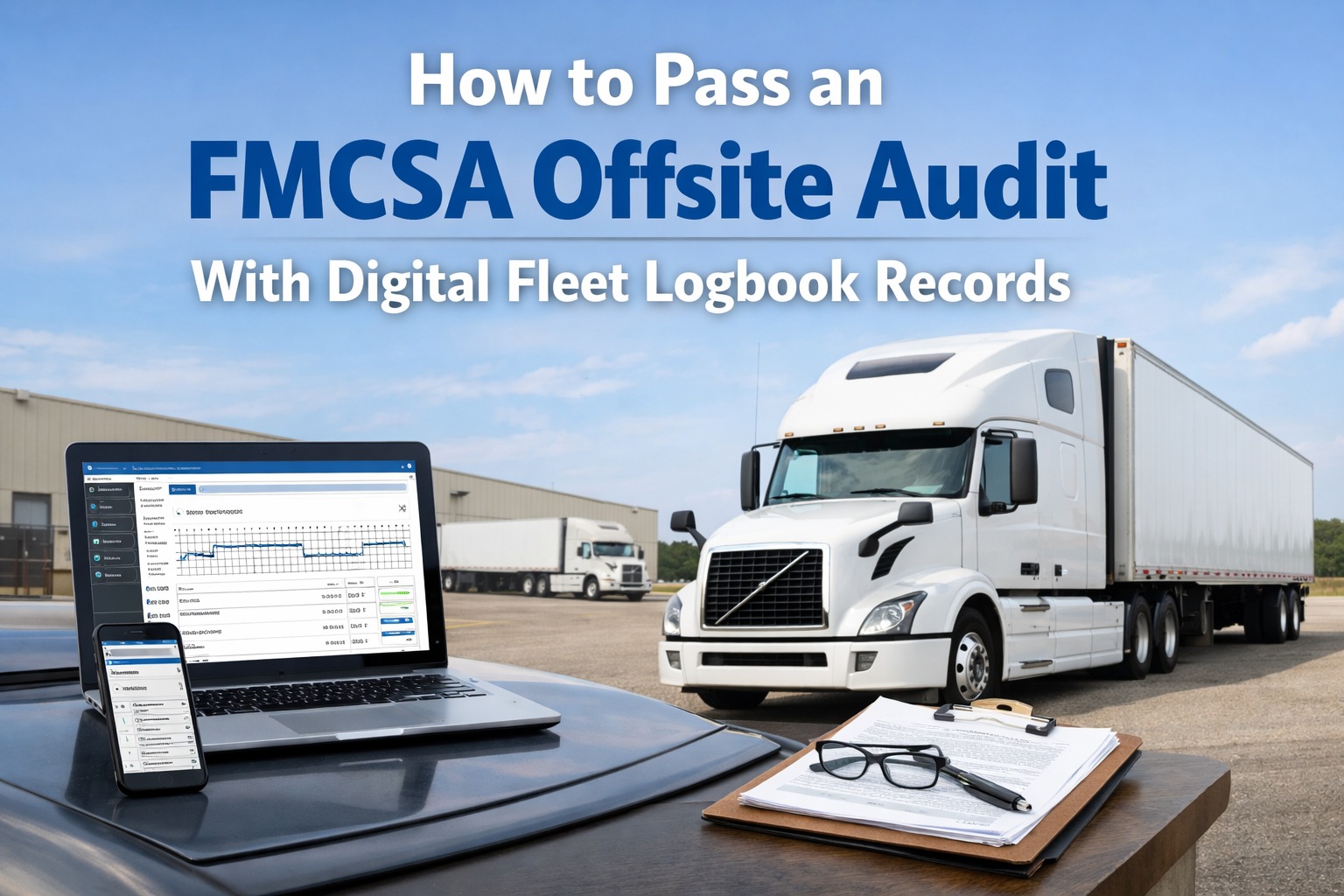
Offsite audits jumped 400% with 48-hour record demands. HVI's compliance dashboard produces FMCSA-ready exports in 15 minutes — turning offsite audits from a crisis into a routine task.
The rule does not ban paper — but it eliminates every argument for keeping it. Paper DVIRs remain legal; they just lose audits at 13x the rate of digital.
Start free with HVI and migrate in 2–4 weeks.
The Real Cost of Staying on Paper — Per HVI's Compliance Data
For owner-ops and small-fleet managers, the question is rarely "is digital better" — it is "what does paper actually cost me." Here is the per-occurrence math HVI customers eliminate from day one.
$1,270/day
Missing DVIR signature
$12,700
Falsified inspection report
$15,420
Dispatching with unrepaired defect
$16,000
Per missing/falsified DVIR (max)
$23,048
Operating under OOS order
$1,900+
Average unplanned breakdown cost
HVI Closes the Comparison
The audit pass-rate gap is 7% vs 96%. The retrieval-speed gap is 1–3 days vs 15 minutes. The records-that-reach-office gap is 27% vs 100%. The defect-to-repair gap is 3.2 days vs 2–4 hours. Every dimension that FMCSA auditors score, every metric that CSA tracks, every operational outcome that determines whether a vehicle stays in service or sits idle — paper loses, HVI wins. The 2026 final rule did not create this gap; it removed the last argument against acting on what was already true. Owner-ops and small-fleet managers who migrate to HVI in the next 2–4 weeks join the 96% audit pass rate cohort. Those who do not become the headline statistics of 2026 — the 93% with citations, the $63,500 fines, the lost shipper contracts from CSA score damage. HVI is the inspection & maintenance software built for this migration: guided mobile checklists, photo-verified defects, auto-generated work orders, 3-signature chain enforcement, and 15-minute audit exports — all in one platform. Start free today or book a 30-minute demo to see HVI's audit-ready dashboard live on your fleet.
Move from 7% Pass Rate to 96% with HVI — Free Trial
FMCSA-compliant eDVIRs. 15-minute audit exports. 3-signature chain enforced. Photo-verified defects. Auto-generated work orders. Migration in 2–4 weeks. Trusted by 25,000+ users worldwide.
Frequently Asked Questions
Q: Are paper DVIRs still legal in 2026?
Yes — paper DVIRs remain legal. The FMCSA final rule effective March 23, 2026 explicitly authorizes electronic DVIRs but does not ban paper. However, paper DVIRs achieve only 7% audit pass rates versus 96% for digital systems like HVI, and 73% of paper DVIRs never reach the office. Paper is legal but measurably disadvantaged.
Q: How does HVI's software actually improve audit pass rates?
HVI eliminates the system-level failures behind the 7% paper pass rate: lost forms (cloud sync), illegible handwriting (typed entries + photos), missing signatures (enforced 3-signature chain), defects that never reach maintenance (auto-generated work orders), and slow record retrieval (15-minute exports). Each fix targets a specific audit citation category.
Start free with HVI.
Q: How long does paper-to-HVI migration actually take?
Most fleets complete the transition in 2–4 weeks. Week 1: driver app rollout and HVI template configuration. Week 2: defect routing setup and mechanic workflow integration. Weeks 3–4: full fleet deployment, audit-export testing, and CSA dashboard activation. No hardware required — drivers use existing smartphones.
Q: How does HVI enforce the 3-signature chain?
HVI makes each signature a required field in the workflow: driver reports defect with e-signature, mechanic certifies repair with e-signature, next driver reviews repair and signs acknowledgment before the dispatch lock releases. The next driver literally cannot move the vehicle without acknowledging the repair record. Paper breaks this chain through lost forms; HVI enforces it structurally.
Book a demo to see the enforced workflow.
Q: How fast can HVI produce 90 days of DVIR records during an audit?
Under 15 minutes. From HVI's compliance dashboard, filter by date range and vehicle ID, then export a complete PDF package with photos, e-signatures, timestamps, and GPS data. With paper, the same retrieval takes 1–3 days and typically yields only 60–75% of requested records. FMCSA expects records within 48 hours — HVI exports comfortably beat that window.
Q: Does HVI handle the new CSA "Driver Observed" scoring category?
Yes. The 2026 CSA methodology split Vehicle Maintenance into "Driver Observed" and "Inspector Detected" categories. HVI automatically maps every inspection finding to the correct CSA category in real time — producing the driver-level defect detection evidence that paper fleets cannot generate. This is one of the largest scoring gaps between paper and HVI.
Start free today.