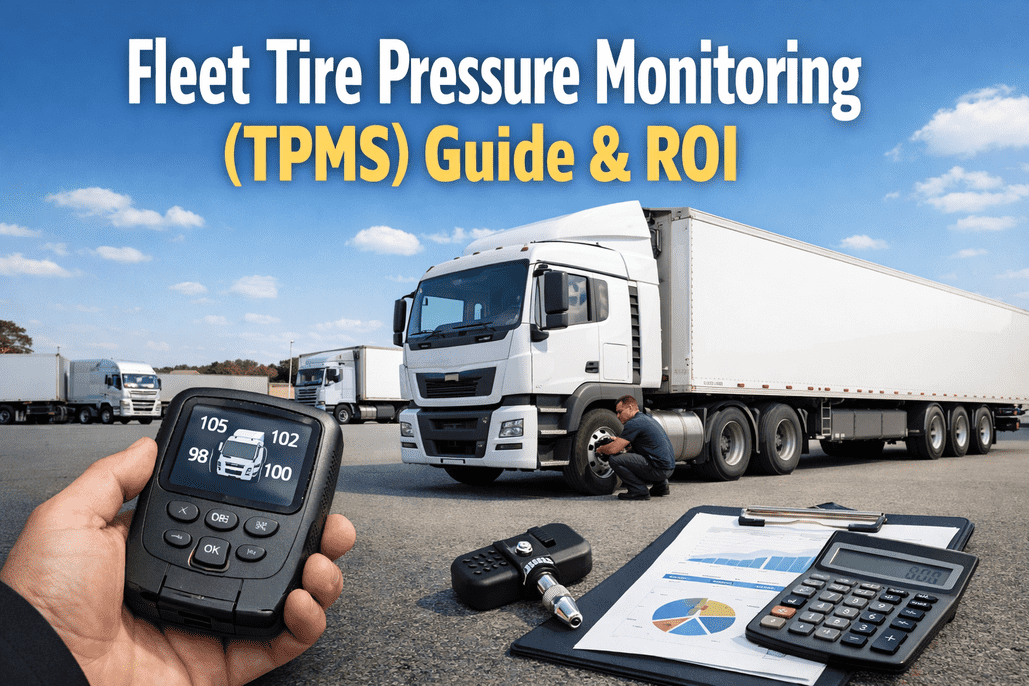
Fifty-five percent of commercial vehicles on the road right now have at least one tire running 10 or more PSI below optimal pressure. Each of those tires is silently burning fuel, shaving miles off its lifespan, and moving closer to failure — and nobody in the cab or the office knows about it until the blowout happens or the roadside service bill arrives. Tire Pressure Monitoring Systems (TPMS) close this visibility gap by providing continuous, real-time pressure and temperature data from every tire across the fleet. The economics are straightforward: the U.S. Department of Energy estimates that every 1 PSI drop reduces fuel economy by 0.2-0.3%, while industry data shows each 10 PSI drop costs 15-20% of tire life and 2% fuel efficiency. For a 50-truck fleet, that invisible pressure loss adds up to $87,000-$175,000 in annual waste — waste that TPMS eliminates with an ROI typically under 12 months. This guide covers how TPMS works for commercial fleets, the ROI case by fleet size, installation considerations, integration with inspection workflows, and the 2026 regulatory environment that makes tire pressure data more consequential than ever.
How Fleet TPMS Works
A fleet TPMS uses sensors on each tire to continuously measure pressure and temperature, transmitting data wirelessly to a receiver that alerts the driver in the cab and the fleet manager in the office. The system catches underinflation, overinflation, slow leaks, and rapid pressure loss — conditions that manual checks miss between inspection intervals.
Internal Sensors
Mounted: Inside tire on valve stem or band-mounted to rim
Accuracy: Higher precision (reads pressure directly from inside)
Battery: 5-7 year lifespan, requires demount to replace
Durability: Protected from road debris and weather
Downside: Must be remapped after tire rotation — adds shop time
Best for: Long-haul, high-value cargo, fleets with dedicated tire shops
External Sensors
Mounted: Threaded onto valve stem cap externally
Accuracy: Good precision, slightly affected by ambient temperature
Battery: 2-4 year lifespan, easy replacement (no demount)
Durability: Exposed to road spray, theft possible without locking caps
Advantage: Quick rescan after rotation — Bluetooth sensors ID instantly
Best for: Mixed fleets, high-rotation operations, easier retrofit
TPMS Data Flow
1
Sensor reads pressure + temperature every 15-60 seconds while moving, less frequently when parked
→
2
Transmitter sends data wirelessly (Bluetooth or RF) to gateway/receiver on the vehicle
→
3
In-cab alert warns driver of low/high pressure, rapid loss, or temperature spike
→
4
Cloud platform streams data to fleet manager dashboard — alerts, trends, analytics
The ROI Case for Fleet TPMS
TPMS ROI comes from four sources: fuel savings from correct inflation, extended tire life from preventing underinflation damage, eliminated roadside service calls from early leak detection, and avoided OOS violations from continuous compliance monitoring. The North American Council on Freight Efficiency (NACFE) rates TPMS with a "high confidence" ROI of less than one year.
Fuel Savings
1.4%
FMCSA study: fleet-wide fuel economy improvement
At $3.50/gal and 120,000 mi/yr: $700/vehicle/year. DOE: 0.2-0.3% per 1 PSI drop. Fleet-wide, correcting average underinflation recaptures 1-2% fuel economy.
Tire Life Extension
10-20%
Industry data: proper inflation maintains rated mileage
At $4,500/yr tire cost per vehicle: $450-$900/vehicle/year in extended life. Proper inflation also preserves casing integrity for 2-3 retread cycles.
Roadside Call Reduction
40-70%
Tire-related breakdown prevention via early detection
Avg tire road call: $600-$1,200. Fleet avg: 2-4 tire events/vehicle/year. Preventing 50%: $600-$2,400/vehicle/year saved plus eliminated downtime.
OOS Violation Prevention
65K+
Annual "inflation <50%" violations nationally
Each tire OOS: CSA severity weight of 2 (new scoring). Shutdown cost: $760/day minimum. TPMS alerts before pressure reaches OOS threshold — zero surprises at roadside.
ROI Calculator: 50-Truck Fleet
Fuel savings (1.4% x 50 trucks)
$35,000/yr
Extended tire life (10% x $4,500 x 50)
$22,500/yr
Reduced road calls (1.5 prevented x $800 x 50)
$60,000/yr
CSA/downtime avoidance (conservative)
$12,500/yr
Total annual benefit
$130,000/yr
TPMS investment (50 trucks x 18 tires x $35/sensor + install)
$45,000-$65,000
Payback period
4-6 months
HVI integrates tire pressure data from pre-trip inspections alongside TPMS alerts in one fleet dashboard.
Book a demo to see how inspection-captured pressure readings combine with real-time TPMS monitoring. Or
start free.
TPMS Installation and Setup
Installing TPMS across a fleet involves sensor selection, gateway configuration, alert threshold programming, and integration with existing telematics and maintenance platforms. The setup decisions you make at the start determine whether TPMS becomes a decision-making tool or just another source of ignored alerts.
1
Sensor Selection
Choose internal or external based on fleet needs. External sensors install in minutes per tire with no demount — best for rapid fleet-wide deployment. Internal sensors offer better durability and accuracy for long-haul operations. Budget: $25-$50 per sensor, 18 sensors per tractor-trailer.
2
Gateway / Receiver Installation
One receiver per vehicle collects data from all tire sensors. Most integrate with existing ELD or telematics hardware. Some require standalone installation with cab-mounted display. Confirm Bluetooth range covers all axle positions including rear trailer tandems.
3
Alert Threshold Configuration
Set thresholds by position and season: low-pressure warning at 10% below target, critical alert at 20% below. Temperature alerts for sustained readings above 160°F. Consider seasonal adjustment — cold weather drops PSI 1-2 per 10°F temperature change.
4
Platform Integration
Connect TPMS data to your fleet management, maintenance, and inspection platforms. TPMS alerts should create work orders automatically. Combine with inspection-captured tread depth data for complete tire health visibility. API integration enables unified dashboards.
5
Driver Training
Drivers must understand alert types: low-pressure warning vs. critical low vs. rapid loss. Define response protocols: slow leak = complete trip then service; rapid loss = pull over immediately. Clear procedures prevent alert fatigue and ensure drivers act on real warnings.
TPMS + Inspection Integration
TPMS alone monitors pressure — but a tire can have perfect pressure and still have exposed cord, sidewall damage, or 1/32" tread depth. Integrating TPMS with your inspection process creates a complete tire safety picture: TPMS handles what sensors can measure (pressure, temperature), and inspections handle what requires human eyes (tread depth, sidewall condition, wear patterns, hardware integrity).
What TPMS Monitors
Real-time pressure (continuous)
Temperature (continuous)
Slow leaks (pressure trend over hours)
Rapid pressure loss (instant alert)
Overinflation detection
+
What Inspections Capture
Tread depth (gauge measurement)
Sidewall damage (visual + photo)
Wear patterns (diagnostic)
Lug nut / wheel condition
DOT age code verification
=
Complete Tire Safety
Zero-gap monitoring: no blind spots between inspections
Predictive maintenance: wear rate + pressure data = optimal replacement timing
Compliance defense: continuous + periodic documentation
Cost-per-mile accuracy: complete data for every tire
CSA protection: Driver Observed + standard categories both covered
Alert Management: Preventing Alert Fatigue
The #1 reason TPMS deployments underperform isn't the technology — it's alert overload. When drivers get too many non-critical notifications, they start ignoring all of them, including the ones that matter. Structured alert tiers and clear response protocols make the difference between a system that prevents failures and one that gets muted.
INFORMATIONAL
5-12% below target PSI
Logged to dashboard. Visible at next pre-trip. Add air at next stop or end-of-day.
WARNING
12-20% below target PSI
In-cab alert + fleet manager notification. Plan service within 24 hours. Monitor for worsening.
CRITICAL
20%+ below target or rapid loss
Immediate in-cab alarm + fleet manager alert. Reduce speed, plan nearest safe stop. Service before continuing.
OOS THRESHOLD
Below 50% of max sidewall pressure
Vehicle out-of-service per CVSA criteria. Do NOT operate. Service on-site or tow. CSA severity weight: 2.
CSA Driver Observed: Pressure Violations Score Separately
The February 2026 CSA overhaul creates "Vehicle Maintenance: Driver Observed" as a standalone category. Tire underinflation that a driver should catch during walk-around now scores separately from shop-detected maintenance issues. TPMS alerts combined with
HVI's digital pre-trip inspection with required PSI entry fields provide dual-layer protection: continuous monitoring plus documented daily verification.
65,184 "Inflation <50%" Violations Annually
FMCSA data shows tire inflation violations are the 4th most-cited violation nationally. Over 5 years, more than 456,000 flat/audible leak violations have been issued. The 2025 CVSA Roadcheck — which focused specifically on tires — produced 2,899 tire OOS violations in just 72 hours. TPMS eliminates surprise underinflation discoveries at roadside.
NACFE Rates TPMS "High Confidence" ROI Under 12 Months
The North American Council on Freight Efficiency rates both TPMS and Automatic Tire Inflation Systems (ATIS) with high confidence and "very adoptable" status. The combination of fuel savings, tire life extension, and breakdown prevention delivers payback in under one year for most fleet configurations.
TPMS + Predictive Analytics: The Next Step
Leading fleet platforms now combine real-time TPMS pressure data with inspection-captured tread depth history to build predictive tire failure models. The system calculates wear rate (32nds per 10K miles) from inspections and correlates with pressure patterns from TPMS to predict which tires will need service 30-60 days in advance — converting emergency road calls into scheduled PM stops.
Book a demo to see HVI's tire data integration.
The Math Is Simple
Every underinflated tire on your fleet is silently burning fuel, shortening its own life, weakening its casing for future retreads, and moving toward a failure that will cost 10-50x more than the TPMS sensor that would have prevented it. With 55% of commercial vehicles running underinflated and NACFE confirming sub-12-month payback, the question isn't whether TPMS has ROI — it's how much you're losing by waiting. Pair TPMS with digital pre-trip inspections that capture tread depth, sidewall condition, and wheel integrity, and you have zero-gap tire coverage: every tire, every metric, every day.
Complete Tire Visibility: TPMS + Inspections in One Dashboard
HVI integrates tire pressure data from digital inspections with fleet-wide TPMS monitoring — tread depth trending, wear-rate prediction, OOS threshold alerts, and cost-per-mile tracking in a single platform. See every tire's health across your entire fleet.
Frequently Asked Questions
Q: What does a fleet TPMS cost per vehicle?
For a tractor-trailer with 18 tires: sensors cost $25-$50 each ($450-$900 per vehicle), plus a gateway/receiver at $100-$300 per vehicle, plus installation labor. Total per vehicle: approximately $650-$1,500 depending on sensor type and integration complexity. External Bluetooth sensors are at the lower end with faster installation. Payback is typically under 12 months from combined fuel savings, tire life extension, and road call prevention.
Q: How much fuel does TPMS actually save?
An FMCSA study found TPMS improves fleet fuel economy by approximately 1.4%. The U.S. Department of Energy estimates every 1 PSI drop reduces fuel economy by 0.2-0.3%. For a truck running 120,000 miles/year at 6 MPG and $3.50/gallon, that's roughly $700/vehicle/year. Across a 50-truck fleet, that's $35,000 annually in fuel savings alone — before counting tire life and breakdown prevention.
Q: Internal or external TPMS sensors — which is better for fleets?
External sensors are easier and faster to install (no tire demount), easier to replace when batteries die, and quick to rescan after rotations. Internal sensors are more durable (protected inside the tire), more accurate, and not vulnerable to theft or road damage. Long-haul fleets with dedicated tire shops often prefer internal. Mixed fleets with frequent tire rotations typically choose external Bluetooth sensors for operational simplicity.
Q: Does TPMS replace tire inspections?
No. TPMS monitors pressure and temperature continuously, but cannot detect tread depth, sidewall damage, wear patterns, lug nut condition, or DOT age code expiration. These require human inspection with physical measurement tools. TPMS and inspections are complementary: TPMS handles between-inspection monitoring, inspections handle what sensors can't see. Combined, they create zero-gap tire coverage.
Book a demo to see how HVI integrates both data streams.
Q: What tire pressure triggers a CVSA out-of-service order?
Any tire inflated below 50% of the maximum pressure stated on the sidewall is an immediate OOS violation. For example, a tire rated at 110 PSI on the sidewall is OOS at 55 PSI or below. Under the February 2026 CSA overhaul, tire OOS violations carry a severity weight of 2 and score in the Driver Observed compliance category. TPMS critical alerts should trigger well above this threshold — typically at 20% below target.
Q: How do I prevent TPMS alert fatigue in my fleet?
Use tiered alerts: informational (5-12% low, dashboard only), warning (12-20% low, driver + manager alert), critical (20%+ low, immediate action). Only send in-cab alerts for warning and critical levels. Set seasonal thresholds — cold weather naturally drops PSI. Train drivers on which alerts require immediate action vs. next-stop service. Review alert frequency monthly and adjust thresholds to minimize false positives.