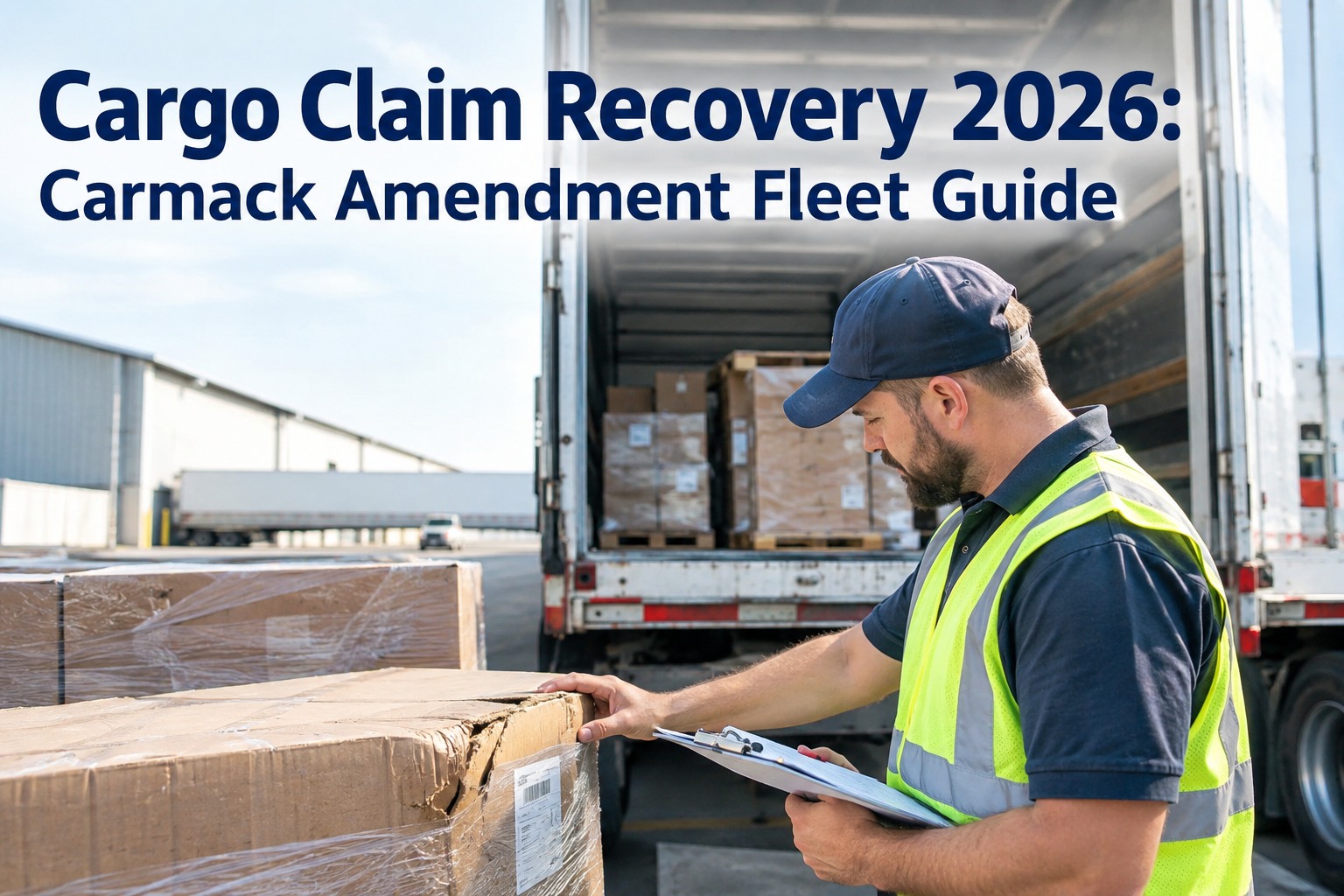
Here's the uncomfortable truth about a cargo claim: under the Carmack Amendment, the carrier is presumed liable before anyone proves you did anything wrong. The shipper doesn't have to show negligence — only that the freight left clean and arrived damaged. Cargo claim recovery in 2026 comes down to whether you can rebut that presumption with documentation, and whether you know the defenses and deadlines federal law gives you. This guide breaks down how Carmack liability works, the five defenses, the timeline and the records that decide these cases. Book a demo to see cargo-claim documentation organized in HVI.
Cargo Claim Recovery & the Carmack Amendment
Federal law starts the carrier out presumed liable. Here's how the burden shifts, the five defenses, the deadlines and the documents that win.
Educational overview for carriers — not legal advice. Consult qualified counsel on any specific claim.
The Carmack Amendment (49 U.S.C. § 14706) has governed interstate motor-carrier cargo liability since 1906, and it's deliberately tough on carriers: it imposes near-strict liability for the actual loss or injury to cargo in the carrier's care, custody, and control. Your negligence — or lack of it — isn't the starting question. That's why cargo claim recovery isn't about arguing you were careful; it's about understanding a specific legal framework and holding the documentation that framework rewards. Let's walk it.
How Carmack liability actually works
The single most important thing to understand is the burden of proof and how it shifts. The shipper starts with a light load; once they carry it, the weight lands squarely on the carrier. Here's the sequence.
Notice how little the shipper must show — nothing about how the damage happened, just that it did. That's why a clean bill of lading at origin is so powerful for them: it's the proof the cargo started in good condition. And it's why the carrier's rebuttal has to clear a high bar — not just "we weren't careless," but freedom from negligence and a specific excepted cause. This framework, confirmed by the Supreme Court, is the spine of every cargo claim. Book a demo to keep origin-condition records that document the true state of the freight
The five defenses that can clear a carrier
Federal law recognizes exactly five causes that, if proven alongside freedom from negligence, relieve the carrier of liability. Knowing them tells you what evidence to preserve the moment a claim looks likely.
A natural event the carrier couldn't control or foresee — a tornado, flood, or similar. Note: a foreseeable storm the carrier could have anticipated generally won't qualify.
Damage caused by an organized military or hostile force — a narrow, rarely-invoked defense rooted in acts of war, not ordinary crime or theft.
The most common defense: the shipper's own actions caused the loss — improper packaging, faulty loading or blocking/bracing, or misdescription. The carrier still must show it exercised reasonable care.
A government action caused the loss — a road closure, quarantine, seizure, or condemnation of the goods by lawful authority beyond the carrier's control.
The cargo damaged itself by its own characteristics — fruit ripening and rotting, chemicals reacting, or livestock dying of natural causes — not from anything the carrier did.
Two things matter here. First, every one of these still requires the carrier to prove it was also free from negligence — the defense alone isn't enough. Second, each defense is won or lost on evidence: temperature logs for inherent-vice reefer claims, load photos for act-of-shipper packaging disputes, weather and routing records for an Act of God. The defense is only as strong as the documentation behind it. None of this is legal advice — how a defense applies to a specific claim is a question for counsel. Start free on HVI to preserve the inspection and condition records these defenses rely on.
The claim timeline and the deadlines that bind
Cargo claims run on strict clocks — and the biggest misconception is what those clocks actually are. Here's the real sequence, on both sides of the claim, grounded in the statute and 49 CFR Part 370.
A carrier cannot require a claim be filed in less than 9 months from delivery (or expected delivery for lost freight). The exact deadline lives in the bill of lading or tariff — it can be longer, so read the contract.
Under 49 CFR 370.5, the carrier must acknowledge a properly filed claim in writing within 30 days and identify any additional documents it needs.
Under 49 CFR 370.9, within 120 days the carrier must pay, decline, or make a firm written settlement offer — then update the claimant every 60 days if it remains unresolved.
A carrier cannot require suit be filed in less than 2 years measured from written disallowance of the claim. Again, a minimum the carrier must allow — not the automatic deadline.
For a carrier, the acknowledgment and disposition duties cut the other way: miss the 30-day acknowledgment or the 120-day disposition and you've committed a regulatory violation that weakens your position badly if the dispute reaches court. Tracking these dates on both the incoming and outgoing side is basic claim hygiene. Book a demo to track acknowledgment and disposition deadlines automatically
What "recovery" actually covers
Even a valid claim doesn't mean unlimited payout. Carmack aims to make the claimant whole for the actual loss — but the amount can be shaped, and capped, by the contract. Three points decide the number.
Recovery targets the real value of the lost or damaged goods — most often the invoice value — to make the claimant whole.
A lawful limitation of liability — a released or declared value in the contract — can cap what's recoverable in exchange for a lower rate.
Carmack generally covers actual loss, not speculative lost profits, and attorney's fees generally aren't recoverable under the statute.
This is where the contract you signed matters as much as the law. A broker-carrier or shipper-carrier agreement can expand your exposure beyond baseline Carmack — waiving limits, adding consequential damages, or shifting attorney's fees — and your cargo policy may not cover that extra risk. Reading and flagging those terms before the freight moves is a core risk-control step, and again, a matter for qualified counsel, not a blog. Start free to keep shipment contracts and their liability terms on file per load.
The documents that decide the case
Strip away the legal theory and cargo claims come down to evidence. The party with the clean, timestamped, complete record wins the close ones. These are the documents that matter most — build the habit of capturing them on every load.
The origin BOL establishes condition at pickup. A clean BOL cuts against the carrier; noting visible damage or packaging issues at pickup preserves a defense.
What the consignee signed for, with any damage or shortage noted at delivery — the other bookend of the freight's condition story.
Condition photos at pickup, in transit if relevant, and at delivery — the single most persuasive evidence in a disputed damage claim.
Pre-trip and cargo-securement records, and for temperature-sensitive freight, reefer/temperature logs that support or refute an inherent-vice claim.
The written claim, your acknowledgment, document requests, and disposition — a complete paper trail with dates on every step.
The bill of lading terms, tariff, and any broker/shipper agreement setting claim deadlines, liability limits, and valuation.
The pattern across every one of these: they're only useful if they were captured at the time and can be found later. A cargo claim often lands months after delivery — long after a driver's phone photos are gone and the paper BOL is buried. Systematic capture at the moment of pickup and delivery is what turns "we think it was fine" into provable fact. Book a demo to make condition capture a standard step on every shipment
From a claims coordinator who learned the hard way
We took a $9,000 damage claim on a load we were sure we'd handled fine — but "sure" isn't evidence. The driver's delivery photos were gone off his old phone, the BOL didn't note the pre-existing dent, and we had nothing to prove the freight left the shipper that way. We paid it, and we shouldn't have had to.
Now every load has pickup and delivery photos, a BOL with any exceptions written down, and the whole claim trail in one place with the dates tracked. The next time a claim came in, we pulled the file in two minutes and it never went anywhere. The law didn't change — our documentation did.
Understand the law, but win on the records
Cargo claim recovery in 2026 rests on a framework that hasn't fundamentally changed but is easy to get wrong. Under the Carmack Amendment, a motor carrier faces near-strict liability: the shipper need only prove good condition at origin, damaged or short delivery, and the amount of loss, after which the carrier must prove both freedom from negligence and one of five recognized defenses — Act of God, public enemy, act or default of the shipper, public authority, or inherent vice of the goods. Claims run on strict clocks, but the 9-month and 2-year figures are minimums a carrier must allow, not automatic deadlines — the binding dates live in the bill of lading and tariff, alongside any liability limits that cap recovery.
What ties it all together is documentation. These cases are won and lost on the bill of lading, the delivery condition notes, the timestamped photos, the inspection records, and a complete, dated claim trail — evidence that must exist before a claim ever arrives and be retrievable months later. That's precisely where HVI helps: capturing bills of lading, condition photos, and inspection records per shipment, and keeping claim documentation and timelines organized and searchable. HVI is a documentation and record-keeping platform, not a law firm — it doesn't provide legal advice or resolve claims; carriers and their counsel do that. Always consult qualified legal counsel on any specific cargo claim, and verify current requirements, since regulations can change. Book a demo to build cargo-claim documentation into your workflow.
Frequently asked questions
What is the Carmack Amendment and how does it affect cargo claims?
The Carmack Amendment, codified at 49 U.S.C. § 14706, is the federal law that has governed interstate motor-carrier liability for cargo loss, damage, and delay since 1906. It establishes a uniform national standard and broadly preempts state-law claims like negligence and breach of contract against the carrier. Its defining feature is near-strict liability: a carrier is liable for the actual loss or injury to property in its care, custody, and control regardless of whether the carrier was negligent. In practical terms, this means a shipper bringing a cargo claim doesn't have to prove the carrier did anything wrong. The shipper only needs to establish a three-part prima facie case — that the goods were tendered to the carrier in good condition, that they arrived damaged, short, or not at all, and the dollar amount of the loss. Once that's shown, the burden shifts to the carrier to prove both that it was free from negligence and that the loss was caused by one of five specific recognized defenses. This framework makes documentation of a shipment's condition at pickup and delivery central to how any cargo claim is resolved. This is general information, not legal advice.
What are the five defenses a carrier can raise under Carmack?
Federal law recognizes five common-law defenses that can relieve a motor carrier of Carmack liability, but the carrier must prove both that it was free from negligence and that the loss was caused by one of these five: first, an Act of God — a natural event beyond the carrier's control that generally must be unforeseeable, so a predictable storm often won't qualify; second, the public enemy — damage from an organized hostile or military force, a narrow defense rooted in acts of war rather than ordinary theft or crime; third, the act or default of the shipper — the most commonly raised defense, where the shipper's own conduct, such as improper packaging, faulty loading, blocking and bracing, or misdescription, caused the loss, though the carrier must still show it exercised reasonable care; fourth, public authority — a lawful government action such as a seizure, quarantine, or road closure that caused the loss; and fifth, the inherent vice or nature of the goods — where the cargo damaged itself through its own characteristics, like produce ripening and rotting or chemicals reacting. Each defense stands or falls on evidence, which is why preserving condition records, photos, temperature logs, and loading documentation is so important. How any defense applies to a specific claim is a legal question for qualified counsel.
How long do I have to file a cargo claim?
The most important thing to understand is that the well-known 9-month figure is a minimum the carrier must allow, not a universal statute of limitations. Under the Carmack Amendment, a carrier cannot require a cargo claim to be filed in less than 9 months from the date of delivery — or from the date delivery should have occurred, in the case of lost freight — and cannot require a lawsuit to be filed in less than 2 years measured from the carrier's written disallowance of the claim. However, the actual binding deadline is whatever the governing bill of lading or tariff specifies, which must meet or exceed those federal minimums but can be longer. This is why you should always read the specific bill of lading and contract terms rather than assuming you automatically have 9 months; a provision attempting to impose a shorter window than the federal minimum is generally unenforceable, but you still need to know the exact deadline that applies to your shipment. On the carrier's side, once a properly filed written claim is received, federal regulations require acknowledging it in writing within 30 days and paying, declining, or making a firm settlement offer within 120 days, with status updates every 60 days after that if the claim remains unresolved. Calendar these dates immediately and confirm specifics with counsel.
What documentation do I need to handle a cargo claim?
Cargo claims are effectively won or lost on documentation, so the goal is a complete, timestamped record for every shipment captured at the time — not reconstructed months later when a claim arrives. The core documents are: the bill of lading, which establishes the cargo's condition at origin, ideally with any visible damage or packaging concerns noted at pickup; the delivery receipt with any damage or shortage noted at delivery; timestamped photographs of the freight's condition at pickup and delivery, which are often the most persuasive evidence in a disputed claim; inspection and handling records, including cargo-securement documentation and, for temperature-sensitive freight, reefer or temperature logs that can support or rebut an inherent-vice defense; and the full claim correspondence trail — the written claim, the carrier's acknowledgment, any document requests, and the disposition — with dates on every step. You'll also want the governing contract documents, since the bill of lading terms, tariff, and any broker or shipper agreement define the claim deadlines, liability limits, and valuation that apply. The practical challenge is that these records often live in a driver's phone, email, and paper files, and go missing before a claim surfaces, which is why systematic capture and centralized storage matter so much.
How can software help with cargo claim management?
Cargo claim management is fundamentally a documentation and deadline problem, which is exactly where a platform like HVI helps — as a record-keeping and organizational tool, not a legal service or a guarantee of any claim outcome. Because Carmack cases turn on evidence of a shipment's condition and a clean procedural trail, the biggest practical risk is that the necessary records don't exist or can't be found when a claim lands months after delivery. HVI addresses this by making condition capture a standard part of the workflow: bills of lading, timestamped pickup and delivery photos, inspection and cargo-securement records, and delivery condition notes can be captured per shipment and stored centrally, so the evidence is retrievable when needed rather than scattered across phones and filing cabinets. It also helps organize the claim timeline itself — tracking when a claim was received, the 30-day acknowledgment and 120-day disposition windows, and follow-up dates — so procedural deadlines aren't missed and a documented trail exists. What software like this does not do is provide legal advice, decide liability, or resolve claims; those judgments belong to carriers, their insurers, and qualified legal counsel. Used as a documentation backbone, though, it directly strengthens the factual record that every cargo claim ultimately depends on.
Build cargo-claim documentation into every shipment
HVI captures bills of lading, timestamped condition photos, inspection records, and delivery notes per shipment, and keeps claim documentation and timelines organized and searchable — so when a Carmack claim arrives, the evidence is already there. A documentation backbone for your claims process; the legal calls stay with your counsel. Mobile-first for drivers and the office, live in under two weeks.
No credit card · BOL, photo & inspection capture · Claim-timeline tracking on day one