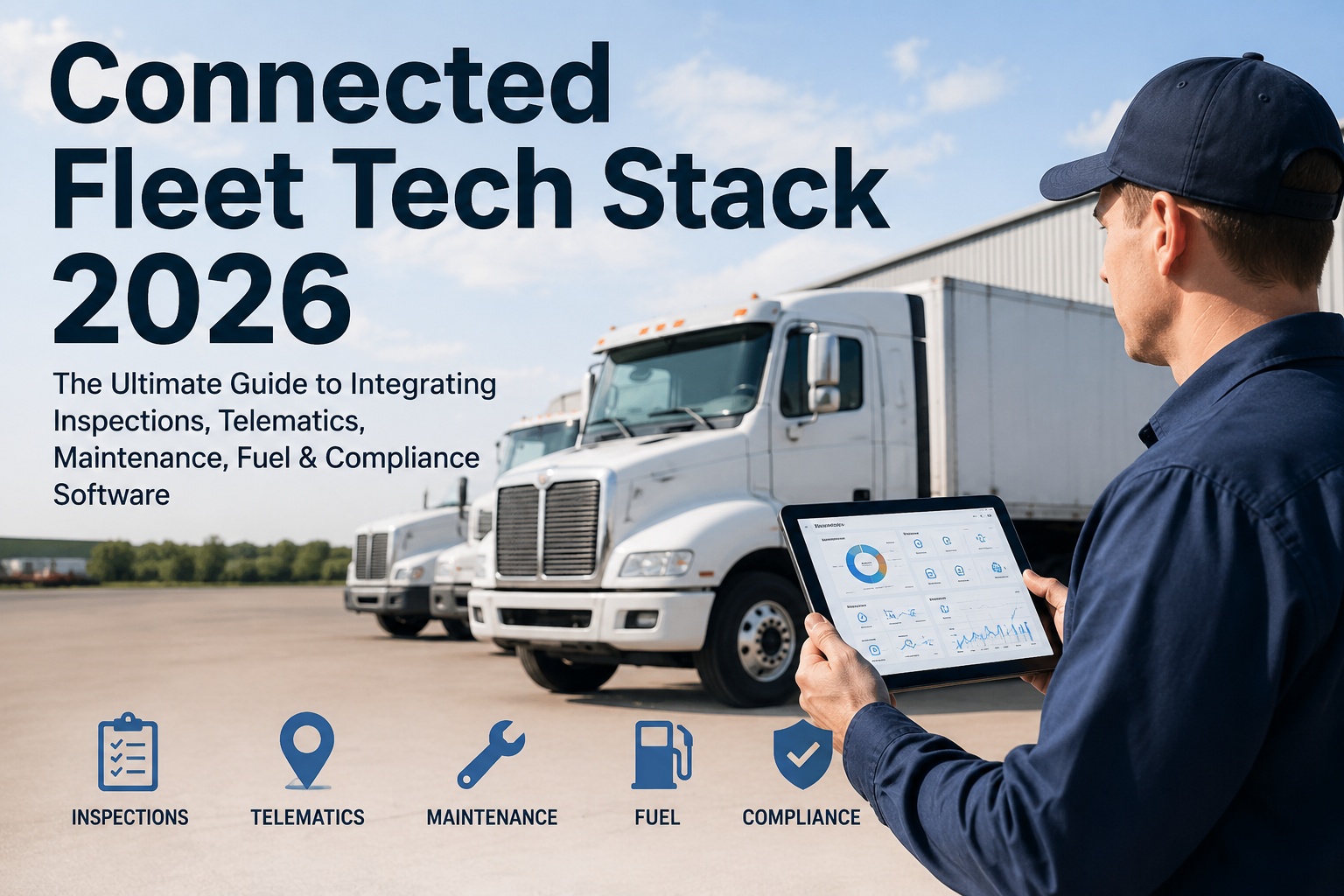
The average mid-sized fleet in 2026 runs 8 to 12 separate technology tools — ELDs, GPS telematics, fuel cards, cameras, inspection software, maintenance CMMS, dispatch/TMS, accounting, insurance telematics, driver-facing apps, cargo visibility platforms. Most of them don't talk to each other. Data lives in silos. Reports have to be manually reconciled. Signals get missed because they never travel from where they're captured to where they're needed. The winning fleets in 2026 aren't the ones with more tools — they're the ones with a connected fleet tech stack where data flows freely between every layer. This guide covers the 5 layers of a modern fleet tech stack, why disconnected stacks fail, the 2026 trends reshaping fleet technology decisions, and how to evaluate where your own stack stands today. Book a demo to see the connected stack built for your operation.
The 5 layers that separate a connected fleet from a tool collection
From raw telemetry to business outcomes — every layer builds on the one below it
Walking through the 5 layers of a modern fleet tech stack
Each layer serves a specific purpose. The stack fails when any layer is missing or when the connections between layers break down. Below is what a well-architected fleet tech stack looks like in 2026, working from the ground up.
Data Sources — the foundation
The physical hardware and edge devices generating raw telemetry. In 2026, a typical Class 8 tractor is instrumented with an FMCSA-registered ELD (mandatory), a GPS unit (usually bundled with ELD), forward-facing and driver-facing cameras (increasingly standard), a fuel card system, CAN bus access via J1939 for engine diagnostics, and optionally cargo sensors, tire pressure monitors, or trailer tracking devices. Each device generates its own data stream, sometimes to different vendor clouds.
Integration Layer — connective tissue
APIs, webhooks, middleware (iPaaS platforms like Zapier for enterprise, or purpose-built fleet middleware), and internal data pipelines. This is the layer that determines whether the stack is connected or siloed. A weak integration layer means data gets copied manually between systems; a strong integration layer means data flows automatically. Modern platforms like HVI provide native integration to major ELD, GPS, fuel card, and TMS providers, eliminating the need for custom middleware in most cases.
Core Fleet Applications — where work happens
The operational software drivers, technicians, dispatchers, and managers interact with daily: digital DVIR platforms, maintenance CMMS, dispatch or TMS, compliance record management, and safety management platforms. These applications translate raw telemetry into workflows: a fault code becomes a work order, an inspection defect becomes a repair ticket, an HOS ceiling becomes a dispatch constraint. Applications must be tightly integrated to the integration layer beneath them or they become expensive silos.
Analytics & AI — intelligence layer
Dashboards showing fleet KPIs (uptime, CSA percentiles, cost per mile, defect resolution time), predictive maintenance models that flag components before they fail, anomaly detection on fuel usage or driving patterns, and automated report generation for compliance and management. In 2026, AI-driven predictions have moved from novel to standard-issue — the question isn't whether AI is in the stack but how well it's integrated with the underlying data.
Business Outcomes — why the stack exists
The measurable results the entire stack is architected to deliver: fleet uptime percentage, CSA BASIC scores below intervention thresholds, cost-per-mile trend, safety incident rate, driver retention, insurance premium trajectory. The top layer isn't software — it's the business outcomes the four layers below are designed to produce. Fleets that don't tie stack decisions back to business outcomes typically over-invest in tools and under-invest in integration.
Reading the layers top-down reveals the architecture logic: business outcomes require intelligence, which requires applications, which require integration, which requires data sources. Reading them bottom-up reveals the value creation path: data becomes insight becomes action becomes results. Book a demo to see all 5 layers in one connected platform
5 ways disconnected stacks fail
Disconnected stacks don't fail catastrophically — they fail continuously, in small ways, across the whole operation. Five failure modes account for most of the pain.
The same information gets typed into 3-4 different systems. Someone updates a truck's mileage in maintenance, forgets to update it in dispatch. Both systems now disagree with each other and with the actual truck.
The ELD detects a fault code. It sits in the ELD's dashboard. Nobody looks at that dashboard for 3 days. By then the truck has broken down on the highway. The signal existed — it just never traveled to where it could be acted on.
Management wants a "single view" of fleet performance. Data comes from 6 different systems in 6 different formats. Someone spends every Monday morning reconciling spreadsheets. The report is a week out of date the moment it's finished.
A driver runs low on hours. Dispatch doesn't know because HOS data updates once a day. Load gets rescheduled at the last minute. Customer relationship takes a hit. Fleet loses a lane. The root cause was a missing 15-minute data sync.
Auditor requests records that span DQ files, DVIRs, maintenance, HOS, and drug/alcohol. Each lives in a different system. Compilation takes 40 hours. Two records can't be found in the retention window. Audit finding.
Every failure mode above traces back to the same root cause: missing integration layer. Adding more tools to a disconnected stack multiplies the problems — adding an integration layer solves them. Book a demo to see how the integration layer sits alongside your existing tools
6 trends reshaping fleet tech stacks in 2026
The connected fleet tech stack isn't static — it's evolving fast. Six trends are actively reshaping what a competitive 2026 stack looks like, and each one raises the bar on integration quality.
AI-driven predictive maintenance
Machine learning models trained on engine telemetry, historical work orders, and fault code patterns now predict component failures 48-96 hours in advance. Fleets running predictive maintenance report 30-50% reductions in unplanned failures. Requirement: continuous data flow from ELD/telematics into maintenance system.
Insurance telematics API integration
Commercial fleet insurers increasingly offer premium discounts (5-15%) for direct API integration of driver behavior, DVIR completeness, and maintenance discipline data. The stack that shares data with the insurer earns real dollars at renewal.
Real-time cargo & customer visibility
Shippers and 3PL customers expect API-level visibility into shipment location, ETA precision, and exception alerts. The fleet's TMS must integrate with dispatch, telematics, and customer portals continuously — batch overnight updates no longer meet SLA.
Sustainability & emissions tracking
Fuel consumption, idle time, and emissions estimation now feed sustainability reporting for shippers with ESG mandates. The fleet with clean emissions data becomes the preferred carrier on lanes where sustainability drives sourcing decisions.
Driver retention & scorecard tech
Driver-facing apps showing personal scorecards, gamified safety metrics, and transparent payroll data have become table stakes for retention. Turnover costs $15K-$25K per driver — the stack that keeps drivers engaged has a direct P&L impact.
Automated compliance reporting
FMCSA audit exports, IFTA reports, CSA data reviews, and Clearinghouse queries increasingly auto-generate from the integrated stack. Fleets that still assemble compliance reports manually run at a permanent cost disadvantage against integrated competitors.
Each trend on the list assumes a connected stack as the starting point. A disconnected stack can't leverage any of them without heroic manual work. Start a free trial to layer these 2026 capabilities onto your fleet without swapping your existing hardware or ELD.
Rate your stack integration readiness
Six-question self-assessment. Each yes = 1 point. Score interprets what stage your stack is at and where to focus next.
Most fleets score in the 1-3 range on their first honest self-assessment. That's not a failure grade — it's a starting position with clear next moves. Start a free trial to move from 2-3 yes to 5-6 yes inside a quarter without swapping any of your existing hardware.
The 4-level fleet tech stack maturity model
Where does your fleet sit today? Fleet tech stacks evolve through four distinct maturity levels. Each level unlocks new capabilities the previous one couldn't support.
ELD present (federal mandate), otherwise paper or point-solution tools. No integration. Data silos. Compliance is reactive. Most fleets under 20 trucks live here by default.
Digital DVIRs, digital maintenance CMMS, telematics platform — each running independently. Individually functional, collectively still siloed. This is where most fleets stall.
Layers 1-3 connected. ELD data flows into DVIR and maintenance automatically. Compliance records assemble across sources. Reporting is unified. Most operational KPIs live in one dashboard.
All 5 layers connected. Predictive maintenance active. Insurance API integrated. Real-time customer visibility. Automated compliance and sustainability reporting. The 2026 competitive frontier.
Most mid-market fleets in 2026 sit at Level 2. Moving to Level 3 typically takes 60-90 days and pays for itself inside a quarter through downtime reduction and compliance discipline. Moving from Level 3 to Level 4 is where the next 3-year competitive advantage lives. Book a demo to see the specific path from your current level to Level 3 or Level 4
From a COO who moved a 240-truck fleet from Level 2 to Level 4 in 18 months
We had every tool the industry sells — ELD, GPS, cameras, fuel cards, inspection software, CMMS, TMS. Twelve tools total. None of them talked to each other. Every Monday my ops team spent 6 hours reconciling reports before we could even see what happened the previous week.
The integration layer was the missing floor of the building. Once we put it in, everything else worked differently — ELD data drove dispatch, fault codes triggered maintenance in real time, PM ran itself off actual meter reads, and my Monday morning report is now waiting for me at 6am, already assembled. Unplanned downtime dropped 34%. Insurance renewal came in 11% below the prior year. We didn't add tools. We added connective tissue. That's what the 2026 stack is.
Frequently asked questions
What is a connected fleet tech stack?
A connected fleet tech stack is the layered architecture of hardware, integration middleware, applications, analytics, and business-outcome tracking that operates as a unified system rather than a collection of isolated tools. The stack has five layers: (1) Data Sources — ELDs, GPS units, cameras, fuel cards, CAN bus feeds, IoT sensors that generate raw telemetry; (2) Integration Layer — APIs, webhooks, middleware, and data pipelines that move data between systems; (3) Core Fleet Applications — DVIRs, maintenance CMMS, dispatch/TMS, compliance and safety platforms where day-to-day work happens; (4) Analytics & AI — dashboards, predictive maintenance models, anomaly detection, automated reporting; (5) Business Outcomes — uptime, CSA scores, cost per mile, driver retention, safety, and other measurable results. The difference between a connected stack and a disconnected one isn't the number of tools — it's whether data flows freely between them. A fleet running 12 tools that don't talk to each other operates worse than a fleet running 5 tools that fully integrate. The stack architecture matters more than the tool count.
Do I need to replace my existing fleet software to build a connected stack?
Usually no. Modern connected-fleet platforms like HVI are built to integrate with the ELD, GPS, fuel card, and TMS systems fleets already have via native APIs and standard webhooks. The typical migration path is not "rip and replace" but "add the connective tissue." Fleets keep their existing hardware (ELDs are federally regulated, expensive to swap, and drivers are already trained), keep their existing GPS and fuel card providers (long-term contracts, established data), and add HVI as the integration and application layer that connects everything together. In some cases fleets may consolidate multiple point-solution tools into HVI's unified platform to reduce vendor sprawl, but that's an optimization not a prerequisite. Fleets that successfully move to Level 3 (integrated stack) or Level 4 (AI-augmented) typically retain 70-90% of their existing tech investment and add only the missing integration and application layers. The economic case is much stronger this way — no wasted CapEx on hardware replacement, faster deployment, less disruption.
How much does building a connected fleet tech stack cost?
Cost varies significantly by fleet size and starting maturity level. For a fleet already at Level 2 (digital tools but not integrated) moving to Level 3 (integrated), the incremental spend is typically $25-45 per vehicle per month for the integration and application layer on a platform like HVI, on top of existing ELD, GPS, and fuel card subscriptions. A 50-truck fleet spends roughly $18K-$27K per year to close the integration gap. The typical payback period is 60-90 days from reduced unplanned downtime, faster audit prep, avoided compliance findings, and eliminated duplicate data entry labor. Moving from Level 3 to Level 4 (AI-augmented) may require additional predictive-analytics or advanced integration modules, but these are typically add-ons rather than full-platform replacements. Compared to the cost of the tools already in the stack (a mid-size fleet often spends $150-250K annually across ELD, GPS, cameras, fuel cards, and TMS), the integration layer is one of the highest-ROI additions available — because it multiplies the value of everything else already purchased.
What's the difference between a connected stack and a single-vendor all-in-one platform?
Two different architectural philosophies with meaningful trade-offs. A single-vendor all-in-one platform provides ELD, DVIR, maintenance, dispatch, and analytics from one vendor under one contract with unified UI. Simpler operationally, one throat to choke on support, potentially lower total cost for small fleets. Trade-off: locked into one vendor's roadmap, one vendor's pricing model, and one vendor's approach to each functional module. If any module is weak — most all-in-ones have some — the fleet lives with that weakness. Connected-stack architecture uses best-of-breed tools in each layer connected via a strong integration layer. Advantage: best-in-class performance in every module, ability to swap vendors as better options emerge without replacing the whole stack, and preservation of existing investments. Trade-off: multiple vendors, more contracts, and the integration itself has to work well. For fleets over 30-50 vehicles, connected-stack architecture typically wins on both cost and operational quality because best-of-breed tools outperform all-in-one modules by enough to justify the additional integration effort. HVI is architected specifically for the connected-stack approach — it provides the integration layer plus best-of-breed inspection, maintenance, and compliance applications, but doesn't require replacing existing ELD or telematics investments.
Which layer of the stack should I fix first?
Almost always Layer 2 — the integration layer. Most fleets already have adequate Layer 1 (data sources: ELD is mandatory, GPS is usually present) and Layer 3 (some digital applications, even if imperfect). What's typically missing is the connective tissue between them. Fixing Layer 2 first is high-leverage: it unlocks the value already sitting in Layers 1 and 3 without requiring any hardware replacement or workflow disruption. Once Layer 2 is in place, Layer 4 (Analytics & AI) becomes possible because the data now flows to it cleanly. Layer 5 (Business Outcomes) starts moving because the previous layers finally work as a system. Trying to fix Layer 4 or Layer 5 without addressing Layer 2 typically produces disappointing results — dashboards fed by fragmented data give fragmented insights, and business outcomes don't move meaningfully without the underlying operational integration. Fleets that follow this sequence (Layer 2 first, then Layer 4, then optimize Layer 3) typically report the fastest ROI and the most sustainable capability build. Fleets that jump to buying AI or analytics tools before fixing integration typically waste 30-50% of that investment on data quality problems the tools can't solve on their own.
Build the 2026 connected fleet stack on the tools you already have
HVI provides the integration layer, best-of-breed core applications, and analytics tier of the connected fleet stack. Native integration to major ELDs, GPS, fuel cards, and TMS platforms. No hardware replacement required. Live for your fleet in under two weeks — typical carriers move from Level 2 to Level 3 inside a quarter.
No credit card · Works with your existing hardware · 60-90 day payback