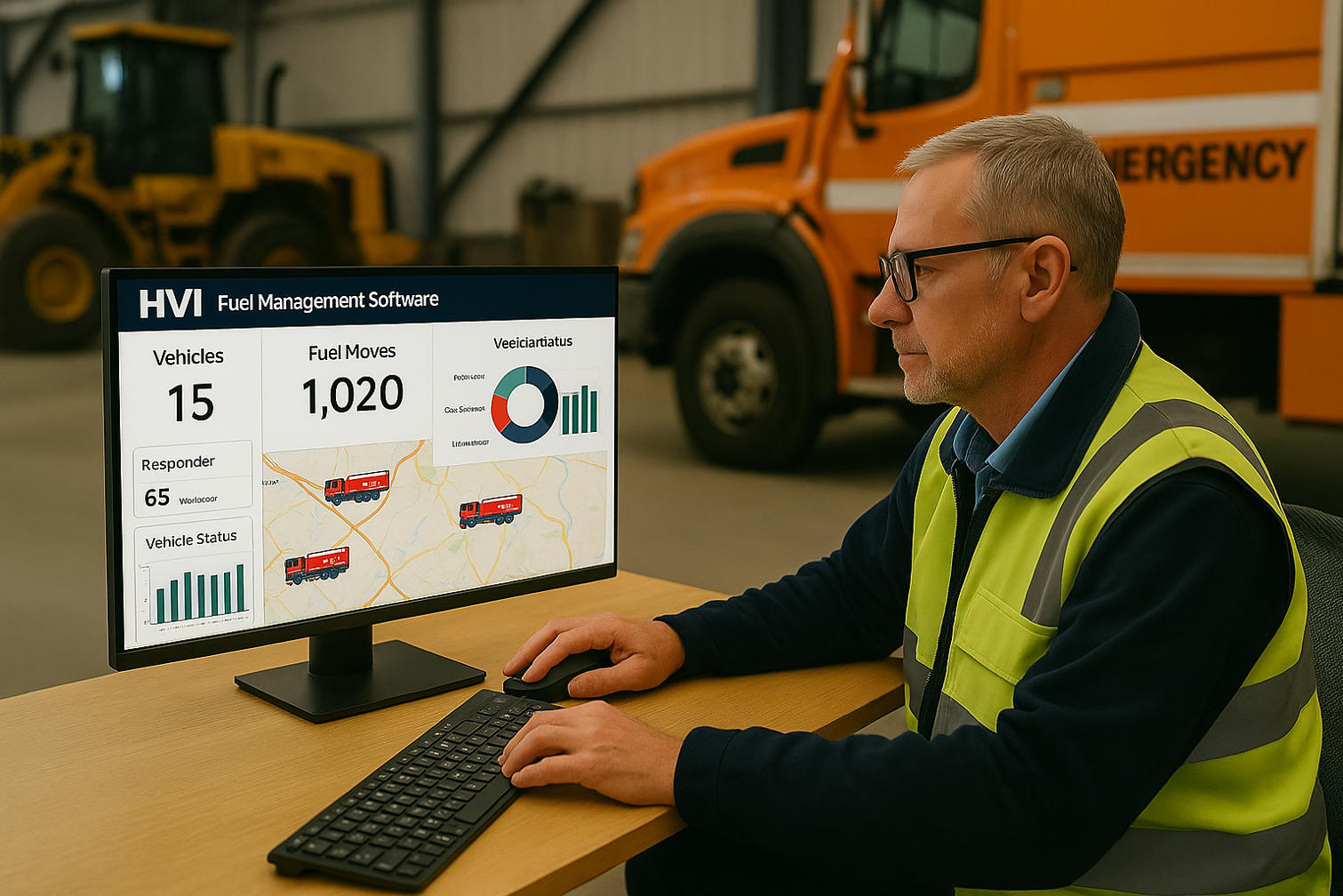
Fleet managers in 2026 are not asking whether to automate — they are asking which platform actually delivers on the promise. Smart fleet automation software has stopped being a competitive advantage and become a structural requirement, with documented results across deployed fleets: 15–25% lower fuel costs, 30% less downtime, 89% accuracy on predictive maintenance, and near-elimination of compliance violations. This is the buying guide for fleet operators evaluating their options — what smart fleet automation actually does, where the fuel and compliance ROI comes from, how HVI's inspection and maintenance automation fits into the stack, and the 30/60/90-day rollout timeline most fleets see. Start your free HVI trial to put automated inspections, work orders, and PM tracking on your fleet from day one, or book a demo for a fleet-specific ROI breakdown in 30 minutes.
The two outcomes fleet managers buy software for — fuel savings and compliance — both compound with automation.
What "smart fleet automation" actually means in 2026
Smart fleet automation is technology that executes routine fleet management tasks automatically — driven by rules, sensor triggers, and AI-driven intelligence — instead of waiting on someone to remember, file, or follow up. The difference between a fleet running on spreadsheets and one running on automation is not a feature checklist. It is a fundamentally different operational model.
- Paper DVIRs filed in cabinets, hand-keyed later
- PM intervals tracked on calendar reminders
- Defects called in or scrawled on a clipboard
- Compliance documents chased weekly
- Audit prep takes days of binder retrieval
- Fuel waste invisible until the monthly bill arrives
- Mobile eDVIRs, photo-verified, instantly archived
- PM fires automatically on real engine hours
- Defects auto-generate work orders in seconds
- Compliance alerts before violations happen
- Audit-ready exports in 30 seconds
- Fuel anomalies flagged in real time per vehicle
The 5 pillars of smart fleet automation
Modern fleet automation breaks down into five operational pillars. The platforms worth evaluating cover all five — and tie them together so data from one pillar fuels decisions in the others.
Guided mobile DVIRs replace paper. Every duty period generates a photo-verified, timestamped, signature-locked eDVIR — automatically archived to the cloud, searchable by VIN.
PM intervals fire on actual engine hours, not memory. Defect-to-work-order routing closes in seconds, with parts and technician auto-assigned by rule sets.
Driver qualification files, medical cards, HOS logs, annual inspections — all centralized with auto-alerts 30/60/90 days before expiry. Audit-ready exports in 30 seconds.
Fuel-card transactions auto-reconcile against vehicle location, engine hours, and tank capacity. Anomalies — off-route, off-hours, double-fills — fire alerts before the next billing cycle.
Every metric — MPG, idle ratio, PM compliance, harsh events, driver scorecards — surfaced on one dashboard. Reports schedule themselves to inbox, no analyst required.
Driver coaching alerts fire automatically on harsh events, speeding, or HOS-window risks. Top performers identified for incentives, bottom quartile flagged for review.
Fuel savings and compliance — the two ROI pillars
The two business cases that drive fleet automation purchases are almost always fuel and compliance. They sit on opposite ends of the operational spectrum — one is variable cost, one is risk exposure — but both compound month-over-month when automation runs them together.
Before vs after — 8 operational shifts you actually feel
The ROI numbers above tell the financial story. Here's what changes on a typical Wednesday at a fleet that ran on paper last quarter and runs on smart automation this quarter.
ROI timeline — month by month, what fleets actually see
Most smart-fleet automation deployments hit positive ROI within 90 days. Here's the typical month-by-month trajectory across deployed fleets in 2026.
Software configured, drivers onboarded. Inspection and PM admin time savings appear immediately. Compliance alerts start firing.
Telematics reveals idle and routing inefficiencies. Driver coaching launches. First measurable MPG improvement on monthly fuel report.
Defect-to-work-order routing prevents emergency repairs. CSA score improvement visible. Manager admin hours reduced by 60%+.
AI accumulates failure pattern data. Predictive alerts become accurate. Asset lifecycles extending 20–30%. Resale values rise.
All five pillars now fully integrated. Fleet operates as a data-driven asset, not a cost center. Decisions made on numbers, not gut.
Manual vs smart fleet automation — full comparison
| Operational area | Manual / spreadsheet | Smart fleet automation |
|---|---|---|
| Daily DVIRs | Paper, 55–71% completion | Mobile app, 99% completion |
| Defect routing | 1.8 days average delay | Seconds, auto-assigned |
| PM tracking | Calendar reminders, often missed | Engine-hour triggered, automatic |
| Compliance alerts | Manual chase, violations slip | 90% of violations prevented |
| Audit preparation | 2–3 days of filing retrieval | Under 60-second exports |
| Fuel anomaly detection | End-of-month, after the fact | Real-time alerts per transaction |
| Driver coaching | Annual reviews, no data | Weekly scorecards, targeted |
| Maintenance forecasting | Reactive — fix on breakdown | 89% accuracy on predictive alerts |
| Asset lifecycle | Baseline (5–7 years) | Extended 20–30% |
| Manager admin time | 10–15 hr/week on reports | 1–2 hr/week dashboard review |
| Operating cost trend | Rising with fuel + repairs | 15–25% lower year-over-year |
Why fleet managers choose HVI for inspection & maintenance automation
Most fleet automation stacks include telematics, route planning, fuel cards, and ELDs — but leave the inspection-and-maintenance backbone on paper or spreadsheets. That gap costs money on both sides of the title: fuel waste from undetected mechanical issues, and compliance exposure from missing or incomplete inspection records. HVI was built to close it.
Drivers complete guided pre-trip and post-trip inspections on the HVI app. Photo evidence, GPS timestamps, digital signatures, and tamper-evident archive — all FMCSA-2025-0115 compliant out of the box.
Any "Fail" tap in an HVI inspection fires an instant maintenance work order with photo, vehicle ID, and DVIR reference. No paper handoff, no end-of-shift surprise, no 1.8-day delay.
HVI tracks actual engine hours and odometer data per vehicle, firing PM reminders at every interval. Oil changes, hydraulic filters, undercarriage service — automated, not from memory.
Driver pre-trip, mechanic certification, next-driver acknowledgment — HVI enforces the full chain as a workflow rule, closing 61% of typical DVIR-citation gaps automatically.
Every inspection, work order, repair certification, and PM record indexed by VIN and date. A roadside officer or DOT auditor gets the file in under a minute.
Inspections at remote yards, rural depots, and cellular dead zones complete fully offline. Data syncs automatically when signal returns — no inspection is ever lost to a connectivity gap.
Whether your fleet runs 10 trucks or 500, HVI's automation handles the inspection-and-maintenance side of your stack. Start your free HVI trial and have your equipment profiles, PM intervals, and inspection templates live in under an hour.
Real-world outcomes — what deployed fleets actually report
30 / 60 / 90 day rollout — what to expect
Smart fleet automation deployment is not a 6-month IT project. Modern cloud platforms are designed for fast onboarding. Here's the standard rollout timeline.
- Vehicle profiles created, inspection templates configured
- Driver mobile-app rollout, 30-min training per driver
- First eDVIRs flowing through the system within 48 hours
- PM intervals seeded on existing odometer / engine-hour data
- Compliance documents centralized, expiry alerts active
- Defect-to-work-order routing fully automated
- Driver scorecards launched, first coaching cycle
- Fuel-card reconciliation flagging anomalies
- Route optimization layer deployed (if integrated)
- First measurable MPG and downtime improvements
- Predictive maintenance AI accumulating pattern data
- CSA score improvements visible in roadside data
- Manager admin time down 60–80%
- Asset utilization and lifecycle metrics on dashboard
- Net positive monthly ROI, compounding from here
Want HVI's team to walk through how a 30/60/90 rollout would look for your specific fleet size and current operational state? Schedule an HVI demo and we'll build a phased rollout plan and ROI projection together in 30 minutes.
Frequently asked questions
Smart fleet automation isn't a future-state question anymore. It's the baseline. HVI handles the inspection & maintenance side of your stack.
Replace paper inspections, calendar PM reminders, and audit-week panic with one digital platform that runs the workflow automatically. No hardware, no IT lift, measurable ROI within 30 days.
No credit card required · Fleet ROI breakdown in 30 minutes · Inspection + maintenance + compliance in one platform