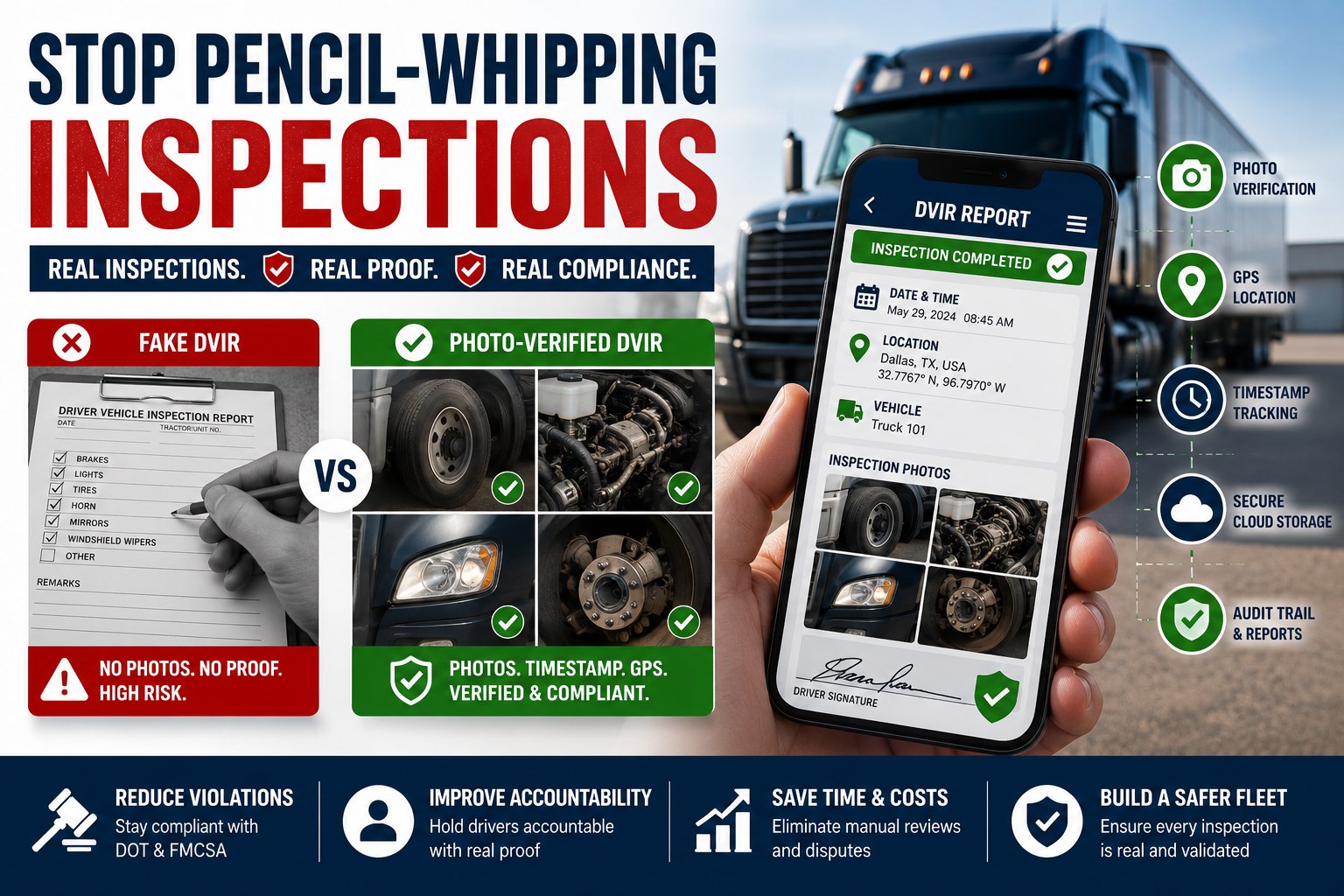
A missing inspection form is worth $36 million to a plaintiff attorney. That's not hyperbole — it's the median nuclear verdict in trucking litigation per the latest ATRI forensic analysis. Between 2010 and 2018, the average trucking verdict over $1 million climbed from $2.3 million to $22.3 million — a 967% increase. In 2024 alone, nuclear verdicts against corporations rose 52%, with the median reaching $51 million. And in ATRI's most damning finding: 100% of cases involving Hours-of-Service or documented safety violations resulted in plaintiff verdicts. The inspection record isn't a compliance formality anymore — it's the single most consequential piece of evidence in any post-accident lawsuit. This guide explains how digital inspections change the courtroom dynamic, the 4 evidentiary pillars they establish, and the 5 deposition questions every fleet's DVIR system must be able to answer under oath. Book a demo to see litigation-defensible inspection records built into your fleet.
How an accident becomes a $36 million verdict
Every stage is a pivot point · every pivot has a digital-DVIR defense
Crash happens. Fleet is now on the clock. Evidence preservation begins the moment law enforcement arrives.
Plaintiff's attorney sends preservation demand within 30 days. All records must be locked from destruction.
90–180 days of driver & vehicle inspection records demanded. Missing or altered records become the case.
Paper DVIRs missing dates, illegible signatures, backdated entries. Plaintiff attorney has case.
Attorney walks through inspection procedures line-by-line. Every inconsistency becomes jury exhibit.
Plaintiff frames the fleet as a threat to public safety. Missing inspections become "corporate neglect."
Jury delivers $36M+ median award. Primary insurance exhausted at $1M. Fleet exposure to excess layers begins.
The nuclear verdict landscape by the numbers
Trucking litigation isn't following normal patterns. The frequency of cases, the size of verdicts, and the percentage of losses when documentation gaps exist have all accelerated in the last decade. Here's what the data actually shows.
Verdicts over $1M grew from $2.3M average (2010) to $22.3M average (2018) — while inflation averaged 1.7%/year.
The middle number in 2022 nuclear verdict awards per ATRI. Verdicts over $50M rose 6.4 percentage points 2013–2022.
Every case in ATRI's study involving hours-of-service violations or documented safety history resulted in a plaintiff verdict.
Excess liability rates driven by nuclear verdict exposure per Swiss Re's 2024 Sigma report. Some carriers withdrawing from the market entirely.
These aren't projections — they're what fleets are already paying and what juries have already awarded. The question for every operating fleet is no longer whether the trend continues but how prepared the inspection record is when a case lands. Start a free trial and audit-proof your DVIR discipline before the next incident tests it.
Why the trucking industry is targeted
Nuclear verdicts don't happen randomly. Plaintiff attorneys have industrialized the litigation process around specific vulnerabilities that trucking fleets consistently present.
Missing dates, illegible entries, backdated signatures, and post-hoc corrections. Every gap is a discovery weapon that becomes courtroom evidence of "corporate carelessness."
Plaintiff attorneys frame the case as a public-safety threat — not "did this driver err" but "does this fleet endanger the community." Emotional stakes drive verdict inflation.
Plaintiff attorney opens with a $100 million ask. Jurors then feel "moderate" awarding $30M. The anchor number frames the entire range of what feels reasonable.
California, Georgia, Florida, New York, Illinois, and Louisiana state courts show median awards significantly higher than federal courts — and plaintiff attorneys select venue accordingly.
Outside investors bankroll lawsuits in exchange for a cut of any settlement. Removes financial pressure to settle early — the incentive is to maximize the payout.
None of these tactics can be legislated away in a single case. What a fleet can control is the quality of the inspection record that arrives in discovery — and that's where the digital DVIR earns its budget many times over. Book a demo to see how photo-verified DVIRs neutralize each of these attack vectors
The 4 pillars of inspection-based litigation defense
A digital DVIR isn't just a compliance tool — in a courtroom, it's a legal evidence system built on four load-bearing pillars. Miss any one of them and the defense collapses.
Every inspection carries a server-generated timestamp that can't be altered by the driver, manager, or fleet. Sequence of events becomes indisputable in court.
Location metadata on every inspection proves the walkaround happened where and when it was claimed. Eliminates "was the driver actually there" as a discovery weapon.
Mandatory photo capture at each inspection zone. The tire that was 4/32" tread on Monday is provably 4/32" — not a claim, a photograph.
Every action logged, every edit versioned, every user attributed. No "post-hoc corrections" or backdated entries possible — the record is what it was when it was created.
Miss any single pillar and the entire defense weakens — a timestamped, GPS-tagged inspection with no photo evidence still leaves room for "was the walkaround actually done" doubt. Book a demo to see all four pillars built into every driver's DVIR
5 deposition questions your DVIR system must answer
In any post-accident deposition, the plaintiff attorney walks the driver and safety manager through the inspection record line by line. Here are the five questions where paper DVIRs consistently fail and digital DVIRs consistently defend.
Every one of these questions is a pivot point in the litigation. Digital DVIRs answer each of them cleanly, cutting off the plaintiff attorney's escalation path before the reptile theory can be deployed. Start a free trial and see the deposition-defensible record built into every inspection your drivers complete.
The verdict trend: 12 years of trucking litigation escalation
The trajectory isn't ambiguous. Average trucking verdicts over $1 million have grown at roughly 51.7% annually per ATRI — a rate 30× faster than inflation. Here's what the last 12 years actually looked like.
Every trucking fleet planning for the next decade needs to assume that median exposure per catastrophic case will continue rising. The variables a fleet controls — documentation quality, driver behavior evidence, inspection defensibility — are the only meaningful counter-force to the trend. Book a demo to see what deposition-ready DVIR records look like on your fleet
From a fleet risk manager who converted mid-litigation
We were 8 months into a wrongful-death case with a paper DVIR system. Discovery was brutal. Plaintiff's attorney had our binders side-by-side comparing entries, finding 3 illegible days here, a missing signature there, one inspection that appeared to be filled out in a different pen than the surrounding week.
We settled at $8.2 million — primary insurance exhausted plus $7.2M from excess. My CEO signed the check and told me: "This never happens to us again." We migrated the entire fleet to digital DVIR the next quarter. When we had our next incident 14 months later, the deposition went 40 minutes and the case settled at policy limits. The difference wasn't the driver. The difference was the record.
Frequently asked questions
What is a nuclear verdict and why is it a threat to trucking companies?
A nuclear verdict is defined by the American Transportation Research Institute (ATRI) as any jury award of $10 million or more in a single case. The term originated in the trucking and commercial transportation space because that's where these verdicts hit hardest and most often. Per ATRI's 2025 forensic analysis, the median nuclear verdict in trucking reached $36 million in 2022 — approximately 50% higher than the median in 2013. Between 2010 and 2018, the average trucking verdict over $1 million grew from $2.3M to $22.3M, a 967% increase while inflation averaged just 1.7% annually. The threat is existential for smaller carriers: primary liability policies typically cap at $1M (the practical broker-required minimum), so any nuclear verdict exhausts primary coverage and begins consuming excess layers, business assets, or both. Nuclear verdicts against corporations rose 52% in 2024 alone, with the median jumping to $51M. Combined with insurance-market hardening (excess coverage rates up 75%+ per Swiss Re), the compounding effect is why litigation-defense strategy has moved from a legal function to a boardroom priority in most fleets.
How do digital inspections actually help defend against a lawsuit?
Digital inspections establish four evidentiary pillars that paper DVIRs cannot: (1) Timestamp integrity — every inspection carries a server-generated timestamp that cannot be altered by the driver, manager, or fleet, making the sequence of events indisputable at deposition; (2) GPS verification — location metadata on every inspection proves the walkaround happened where and when it was claimed, eliminating a common plaintiff attack vector; (3) Photo evidence per zone — mandatory photo capture at each inspection zone means the specific brake chamber, tire, or coupling that later failed can be shown as it was that morning, not merely claimed to have been inspected; (4) Immutable audit trail — every action logged, every edit versioned, every user attributed, making backdated entries or post-hoc corrections impossible. These four pillars combine to transform the DVIR from a compliance form into a defense exhibit. In practice, digital DVIR fleets typically see faster case settlements at policy limits rather than nuclear-verdict escalation, because plaintiff attorneys can see during discovery that the case lacks the documentation gaps they need to drive verdict inflation.
What is the reptile theory in trucking litigation?
The reptile theory is a plaintiff attorney strategy that reframes a specific accident case as a broader public-safety threat, appealing to jurors' primal safety instincts rather than the specific facts of the incident. Instead of arguing "did this driver make an error," the plaintiff argues "does this fleet's approach endanger the entire community." The theory was formalized in the 2009 book "Reptile" by David Ball and Don Keenan and has become a foundational tactic in high-value trucking litigation. Attorneys establish "safety rules" during depositions (e.g., "isn't it always safer to inspect brakes thoroughly?"), get defendants to agree, then frame any deviation from those rules as a threat to jurors' own safety on the road. Missing DVIRs, incomplete inspections, and pattern documentation gaps are the raw material the reptile approach requires. Digital DVIRs with photo evidence and audit trails largely neutralize this tactic by removing the documentary ambiguity the reptile theory exploits — when the record is complete and defensible, the "corporate carelessness" narrative loses its factual basis before jurors ever hear it.
Can paper DVIRs still be admissible in court?
Yes — paper DVIRs remain fully admissible and legally compliant under 49 CFR 396.11. FMCSA's 2026 electronic DVIR rule (effective March 23, 2026) explicitly authorizes digital DVIRs but does not require them. The question is not admissibility but defensibility. In discovery, paper DVIRs present multiple vulnerabilities: (a) missing or illegible entries that plaintiff attorneys highlight as "corporate carelessness"; (b) no way to verify when an entry was actually made versus when it was written down; (c) no way to prove the driver was physically present at the inspection location; (d) no way to rule out post-hoc corrections between the accident date and the discovery request; (e) audit-prep time of 30-60 minutes per driver for a 90-day export. Digital DVIRs close every one of those vulnerabilities. Paper is legal but structurally weaker as evidence. Given that ATRI research shows 100% of cases involving documentation violations resulted in plaintiff verdicts, the litigation-defense case for digital transformation is essentially settled at any fleet operating above 15-20 tractors.
Which states have the highest nuclear verdict risk for trucking companies?
ATRI's 2025 forensic analysis singles out California, Georgia, and Florida as the top states for median nuclear verdict awards — often labeled "judicial hellholes" for their disproportionate share of large jury verdicts. State courts overall were found to be significantly more expensive for trucking defendants than federal courts: median award in state court for cases over $1M was $3.6M, versus $2.5M in federal court. New York, Illinois, Texas, and Louisiana also consistently appear in the top 10 for verdict size. Plaintiff attorneys strategically select venue based on this data, filing in favorable state courts whenever federal jurisdiction can be avoided. The proposed Forum Accountability and Integrity in Roadway (FAIR) Trucking Act of 2025 would route interstate trucking cases over $5M into federal courts specifically to counter this venue-shopping tactic. Fleets operating in high-exposure states should assume that any incident will trigger aggressive plaintiff attorney interest and prepare their inspection documentation accordingly — digital DVIRs matter more in California, Georgia, and Florida than anywhere else in the country.
Turn your inspection records from litigation liability into litigation defense
HVI captures GPS-tagged, photo-verified, immutably-audited DVIRs on every truck. When the litigation-hold letter arrives, the complete 90-day defensible record exports in under a minute. Live for your fleet in under two weeks — and the first prevented nuclear-verdict pattern pays for the platform many times over.
No credit card · DOT-audit-ready format · Cloud retention with immutable audit log