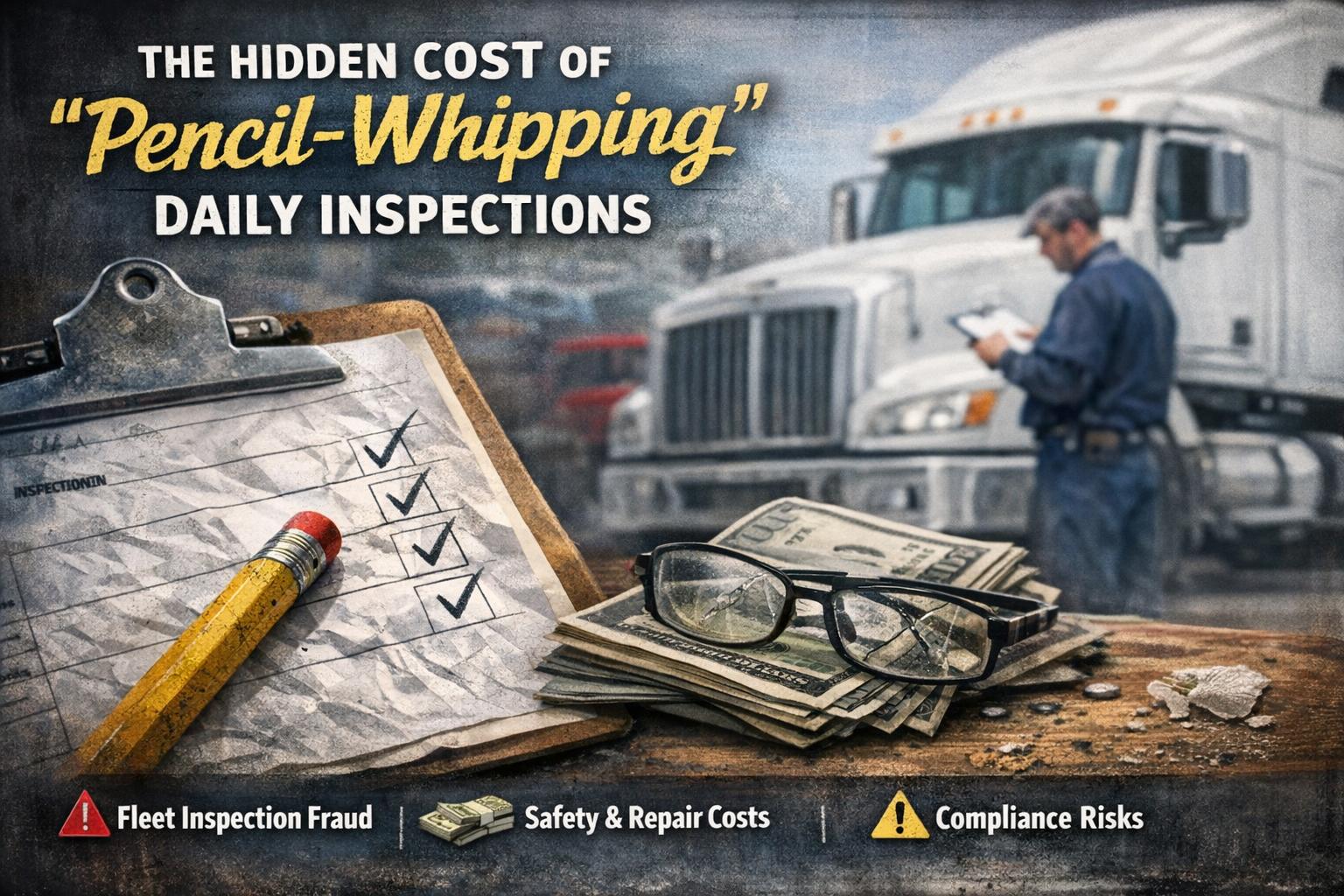
A paper DVIR that says "no defects" for ninety days doesn't just fail a compliance audit. It's the first exhibit in a lawsuit. Pencil-whipping — the fleet-industry name for signing off on an inspection nobody actually did — is the kind of habit that stays invisible until it doesn't, and when it surfaces it's usually in front of a jury. This is a picture-first breakdown of what fake DVIRs look like, how auditors and attorneys spot them in seconds, why paper forms basically invite it, and the four things a modern digital DVIR does — photo verification, GPS proof, timestamps, and pattern detection — that make faking one mechanically impossible. Book a demo to see photo-verified DVIRs live on real trucks.
Pencil-Whipping Inspections: The Anatomy of a Fake DVIR
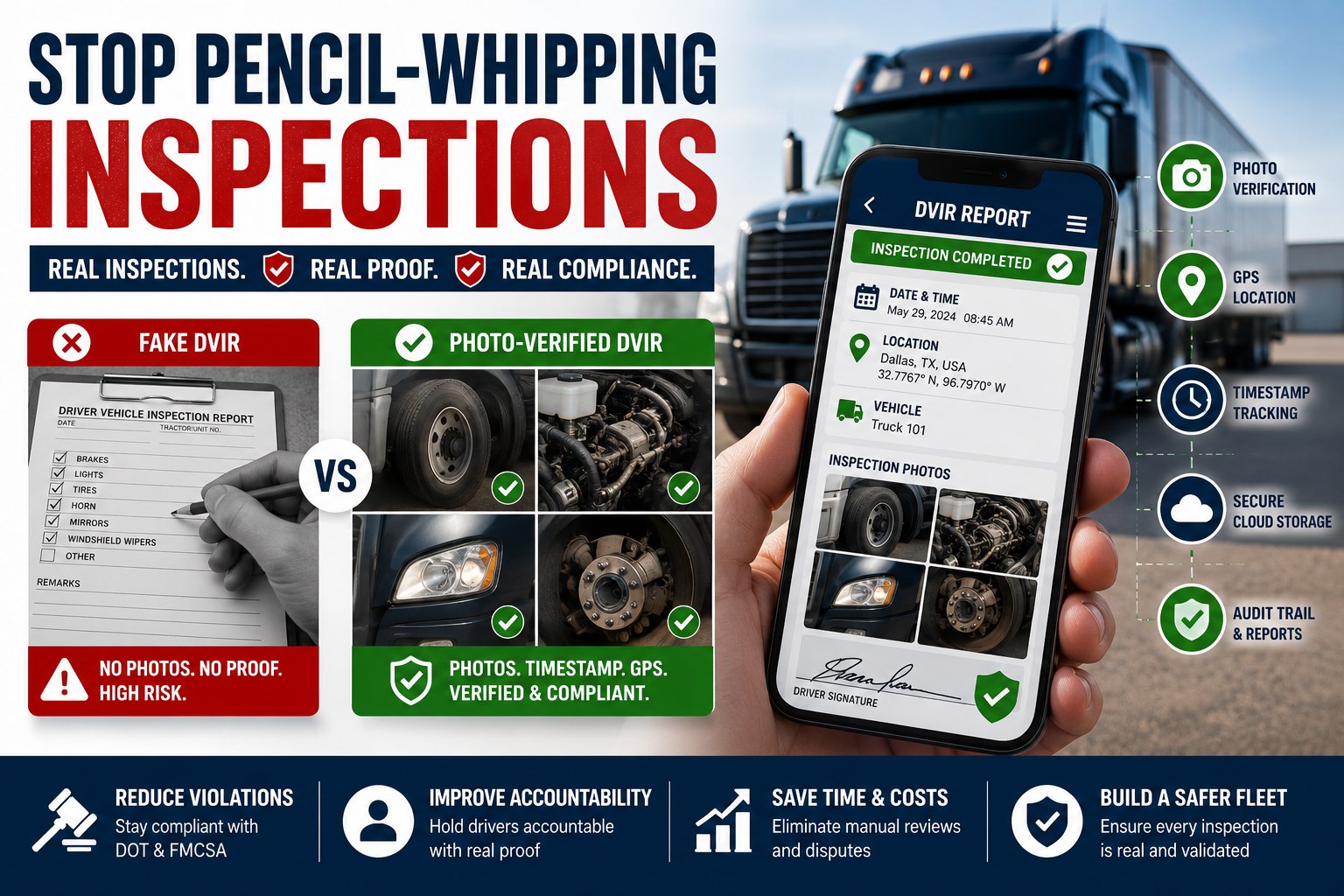
A signature on a paper form is a claim. A photo, a GPS pin, and a timestamp are proof. Here's what the two look like side by side — and why the difference is worth tens of millions of dollars in a courtroom.
Every fleet manager knows pencil-whipping happens. Very few realize how obvious it is to detect and how expensive it becomes when someone finally looks. The fix isn't a lecture and it isn't a policy memo — it's building an inspection where every completed item leaves evidence behind. That's what this page is about: what a fake DVIR looks like, what a real one looks like, and how you get from one to the other.
Anatomy of a suspect DVIR
Auditors don't read every report. They scan for four patterns that are physically or statistically impossible — and any one of them is enough to turn a routine review into an investigation. Here's what they see when they open a stack of paperwork.
A 40-point walk-around takes 8–15 minutes on a truck this size. Sub-two-minute completions are physically impossible.
Timing flagReal trucks develop real defects. A perfect streak on a working vehicle is statistically improbable — and it stands out immediately.
Zero-defect flagDVIR signed at the terminal, ELD shows the truck 40 miles down the interstate. Fuel receipts and toll data triangulate the same discrepancy.
Location flagIdentical ink, pen pressure, and stroke placement across a month of forms is the tell for batch-signing at the end of a pay period.
Signature flagThese aren't sophisticated forensics. They're the first things anyone looking at a stack of DVIRs notices — and once one flag surfaces, the whole pile gets scrutiny. See a digital audit trail that leaves none of these behind
Why pencil-whipping happens (it's not the drivers)
Managers who treat this as a discipline problem end up chasing symptoms. It happens in nearly every fleet for the same three reasons — and none of them are solved by a stern email.
Time pressure
A real walk-around is 8–15 minutes. When dispatch is pressing, the load is late, and the driver is on the clock, that's the time that gets cut. The paper form doesn't push back.
Form design
Forty checkboxes on a clipboard is a signature machine, not an inspection tool. Nothing about it prevents the driver from filling it out in the cab, coffee in hand.
Zero feedback
A DVIR reading "no defects" for a hundred days disappears into a filing cabinet. No supervisor sees the pattern, no alert fires, no consequence — until an incident makes the whole history matter.
Fix any one of these and behavior improves. Fix all three at once — give real time, make faking mechanically hard, and surface the pattern — and the habit essentially disappears without anyone getting fired. That's the design work. Start free and see pattern data on day one
The four things a real digital DVIR does
A well-built digital DVIR doesn't depend on drivers being honest — it makes dishonesty structurally unworkable. Four mechanisms work together, and each one closes off one of the tells above.
Mandatory photos
Flagged items require an in-app camera capture — brake pad, tire tread, mirror crack. GPS and time are embedded in every image. No photo, no submission. Kills the zero-defect flag.
GPS coordinates
Every inspection is tagged with the exact coordinates it was submitted from. A DVIR filed at the driver's home or from a truck already at 40 mph is instantly obvious. Kills the location flag.
Time analysis
The system knows what a genuine inspection takes and flags anything completed below the minimum threshold. Ninety-second walk-arounds trigger an automatic supervisor alert. Kills the timing flag.
Pattern detection
Analytics watch for statistical impossibilities across weeks: zero-defect streaks, identical completion times, sites where every inspection wraps under a minute. Kills the signature flag.
Any one of these closes off a tell. All four together mean a pencil-whipped DVIR simply can't be submitted — and if it's tried, a supervisor knows within seconds. See all four running on a real fleet in a live demo
What's actually at stake — the numbers
This isn't a scare tactic. It's data. Trucking litigation has changed in a fundamental way over the past decade, and a fleet's inspection history is now the first thing plaintiff attorneys pull.
- $2.3M → $22.3M Average truck-crash verdict, 2010 vs. 2018 — roughly a 10× jump in 8 years ATRI
- $27.5M Average trucking verdict, 2020–2023 — the "nuclear" line is now normal ATRI
- 26 → 300 Truck lawsuits over $1M, first vs. last 5 years of a 13-year study ATRI
- 49 CFR 390.35 Falsifying required records — civil penalties, OOS orders, prima facie in court FMCSA
The pattern behind those numbers is what matters: juries increasingly treat a paper DVIR history as evidence of what a company knew and chose not to fix. A photo-verified digital record is the single strongest counter-narrative available. Start free and close the exposure today
From a safety director who's seen both sides
I don't think the guys pencil-whipping ever really thought about it as lying. It was a form to sign, they were tired, the truck seemed fine yesterday. The problem was ours — we handed them a piece of paper with no way for us to know if they walked the truck.
Once the app started asking for a photo on every flagged item and stamping the GPS on submission, the conversation changed overnight. Not because we caught anyone; because they knew it wasn't going to work anymore, so they just started doing the inspection. That's the whole point. Design the fake out of the process and you don't need to police it.
Frequently asked questions
What is pencil-whipping in fleet inspections?
Pencil-whipping is the fleet-industry term for signing off on a vehicle inspection without actually performing it — a driver checks every "OK" box on a paper DVIR, signs, and moves on without leaving the cab. It typically happens on daily pre-trip and post-trip inspections where the paper form has no way to verify the walk-around took place. Under 49 CFR 390.35 it's classified as falsifying required records, carrying civil penalties and potential out-of-service exposure. Beyond the regulatory risk, the bigger problem is that a pencil-whipped DVIR misses real defects: a chafed hydraulic line, a low steer-tire tread, a leaking brake chamber. The purpose of a DVIR is to catch those in the yard; a fake one just documents that nobody looked. The fix isn't disciplinary — it's replacing the paper process with a system where faking an inspection is mechanically impossible.
How can auditors detect a fake DVIR?
Auditors and plaintiff attorneys look for patterns rather than reading each report line by line. The most common tells are impossible timing (an inspection signed at 7:00 with ELD data showing the truck moving at highway speed by 7:02, or a 40-item walk-around completed in 90 seconds), identical handwriting and signatures across weeks of paperwork that suggest a batch signing, location conflicts between the DVIR and other records like fuel receipts and toll data that place the driver miles away at the time of the inspection, and statistical outliers like months of consecutive "no defects" reports on a truck the shop is repeatedly repairing. Any one of these can be enough to challenge a specific report; a pattern of them establishes a systematic falsification claim under 49 CFR 390.35. Digital DVIRs with photo, GPS, and timestamp verification eliminate all four categories of tell by making the inspection provable rather than just claimed.
Why do drivers pencil-whip inspections?
It's almost never about drivers being dishonest — it's about the system they work in creating the shortcut. Three factors show up in nearly every case. First, the schedule punishes doing the inspection properly: a real walk-around takes 8 to 15 minutes, and when dispatch is pressing and the load is running late, that's the time that gets cut. Second, the paper form makes shortcuts easy: a page of checkboxes with no way to verify a walk-around occurred is essentially designed for a signature rather than an inspection, and nothing stops a driver from completing it in the cab. Third, there's no feedback loop when it's faked: a DVIR reading "no defects" for months disappears into a filing cabinet with no signal until an incident makes the history matter. Treating pencil-whipping as a discipline problem tends to chase the symptom; changing the process addresses the cause, which is why fleets that switch to enforced digital DVIRs typically see the behavior disappear without anyone being terminated.
How does a digital DVIR prevent pencil-whipping?
A well-designed digital DVIR uses four enforcement mechanisms that work together to make faking mechanically impractical. First, mandatory photos: the app can require a photo on any flagged item, and the camera embeds GPS coordinates and time in each image, so the evidence either exists or the item isn't complete. Second, GPS proof of presence: each submission is tagged with the location it was filed from, so a DVIR sent from the driver's home or from a moving truck is instantly identifiable. Third, time analysis: the app knows what a real inspection takes and flags submissions completed under a reasonable minimum threshold, sending an alert to a supervisor and marking the record for review. Fourth, pattern analytics: the system watches for statistical impossibilities across days and weeks — a driver reporting zero defects for months, identical completion times, or a site where inspections consistently wrap under a minute — and surfaces the outlier before it becomes a lawsuit. None of these requires trusting the driver; together they design the fake out of the process.
What are the legal and financial risks of pencil-whipped inspections?
There are two, and the second dwarfs the first. The regulatory risk is that 49 CFR 390.35 treats falsifying required records — including DVIRs — as a violation carrying civil penalties, potential out-of-service orders, and CSA scoring consequences. Timestamps on a paper DVIR that conflict with ELD data or with fuel and toll records are strong prima facie evidence of falsification. The far larger risk is civil litigation after a serious crash. According to ATRI, the average verdict in truck-crash cases grew from about $2.3 million in 2010 to over $22 million by 2018, and averaged $27.5 million between 2020 and 2023. Plaintiff attorneys now routinely subpoena inspection history early, and a pattern of pencil-whipped DVIRs on a vehicle involved in a fatal or major-injury incident becomes the foundation of a negligent-maintenance and negligent-supervision claim in front of a jury. The paper DVIR that looked like routine admin often turns out to be a fleet's single largest piece of unpriced legal exposure — and it's also one of the easiest to fix.
Retire the paper DVIR and the pencil-whipping problem with it
HVI runs guided mobile inspections with mandatory defect photos, embedded GPS and timestamps on every image, minimum-time enforcement, and fleet-wide pattern analytics that surface the outlier before an auditor or attorney does. Drivers get a form they can't fake; supervisors get proof the inspection happened. That's the whole difference.
No credit card · No hardware · Live on your fleet in under two weeks