A nuclear verdict is a jury award of $10 million or more — the point where a typical fleet's primary liability policy exhausts and the judgment starts eating excess layers, business assets, or both. The math has changed dramatically. This nuclear verdicts trucking guide walks the 15-year escalation, the four attack vectors plaintiffs' counsel now use routinely, and the documentation stack that consistently defends fleets in the room where the case is actually decided — or book a 15-min HVI demo to see the record built.
The Verdict Escalator
Nuclear verdicts in trucking are not a black swan. They are a baseline shift, tracked across fifteen years of data by three independent sources.
Nuclear verdicts in trucking are jury awards of $10 million or more. The median hit $51 million in 2024, and the number of cases reached 135 — both records. The trend is driven by social inflation, third-party litigation funding, and reptile-theory plaintiff tactics. Fleets don't prevent verdicts by winning the trial — they prevent them by building a documentation record before the incident that makes the "negligent maintenance" or "negligent hiring" arguments unwinnable. The playbook below is what that record looks like.
What Actually Happened Between 2010 and 2025The forces behind the escalator — and why 2024 was the tipping point
Trucking safety has improved. Miles-per-crash has trended favorably for two decades. And yet verdicts are up 1,000% and climbing. The gap is not about safety — it's about legal environment. Three forces converged.
Juries increasingly award damages calibrated to public outrage at corporations rather than to actual medical costs and lost income. Same injury, dramatically higher award — and the trend line correlates directly with anti-corporate sentiment, not with injury severity.
Plaintiffs' counsel frame every incident as a threat to community safety, activating jurors' survival instincts. The specific facts of the case become secondary to a "protect the community from this corporation" narrative.
Outside investors fund lawsuits in exchange for a cut of the settlement. Removes the financial pressure to settle early. Pushes plaintiffs toward maximum-payout strategies that would otherwise be uneconomic to pursue.
Meanwhile the settlement side is quietly worse. Sedgwick's 2026 report shows settlement severity growing 12.6% annually versus verdict severity at just 3.7%. Three out of four trucking cases that go to verdict come in below the last settlement offer — but only 1.25% of cases actually reach verdict. The negotiation happens under the shadow of the escalator.
The 4 Attack Vectors Plaintiffs UseEach one has a defense — but the defense has to already exist before the incident
"The truck's brakes were flagged three months ago and this fleet never fixed them." Missing DVIRs, incomplete PM records, and delayed defect resolution are the plaintiff's exhibit A. Statistical analysis has shown improper hiring and maintenance allegations alone can increase expected awards by more than 270%.
"This driver had two prior violations. Why was this fleet still letting them on the road?" Missing MVRs, incomplete DQ files, and no documented remediation on flagged drivers turn a driver-error case into a corporate-negligence case — and dramatically expand damages exposure.
"This fleet ran drivers with no ongoing training, no coaching, no safety program." Sparse or purely paper-based training records read as "we said we did it but can't prove it." Absence of a coaching cadence directly enables reptile-theory framing.
"Your written safety policy says X. Your actual records show Y." A binder full of policies without operational proof they were followed is worse than no policies at all — it becomes evidence of knowing disregard rather than absence of a program.
The 5-Layer Defense Documentation StackEvery layer defends a different attack vector. Missing any single one is the case.
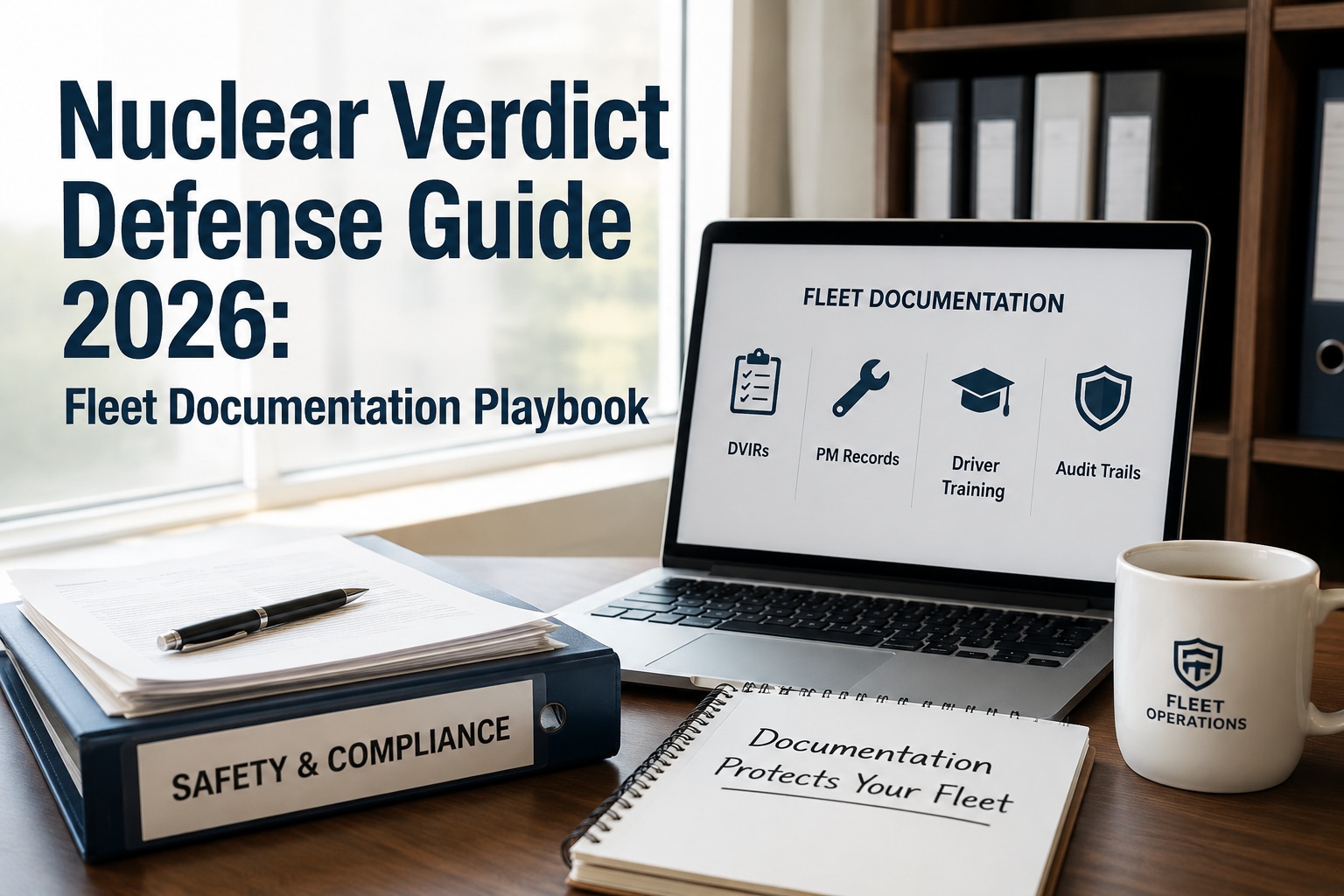
Book a demo to see the 5-layer documentation stack HVI ships pre-configured. The layers below aren't a wish list — they're the record that defense counsel cite from in every successful trucking verdict defense.
Every pre-trip and post-trip inspection captured with driver signature, timestamp, geolocation, and photo evidence for any flagged defect. Not paper. Not "we usually do them."
Meter-based or calendar-based preventive maintenance schedule with completion records for every unit. Defect-to-work-order-to-resolution timeline preserved end-to-end.
Complete DQ files, annual MVR refresh, drug and alcohol testing history, training completion records, remediation documentation for any flagged driver.
Weekly driver scorecards. Dashcam-driven coaching logs. Documented supervisor conversations. Evidence that policy became practice, not that policy sat in a binder.
Immediate litigation-hold workflow: ECM download, dashcam preservation, FMCSA post-accident testing, complete accident file per 49 CFR §390.15. The record that would otherwise disappear in the first 24 hours.
Where Fleets Fail Their Own DefenseThe 4 gaps that show up in almost every nuclear-verdict trial transcript
Defense counsel don't lose trucking cases on facts. They lose them on missing records. Four gaps recur.
Driver "did" the walkaround but the paper went missing at shift change. Plaintiff argues absence proves the walkaround never happened. Jury agrees.
The truck in the crash missed its 30,000-mile PM by 8,000 miles. Doesn't matter if the mechanical failure was unrelated — the missed PM becomes the story.
Annual MVR review is FMCSA-required under §391.25. A missing one on the driver in the incident is not paperwork — it's a jury moment.
Fleet claims safety training was conducted. No signed completion records. Plaintiff frames it as the training never happening. Written policy without evidence of execution becomes worse than having no policy at all.
Paper Records vs Digital Records at TrialSame incident. Same driver. Very different trial outcome.
- Missing DVIRs plaintiff highlights
- Handwritten PM logs open to attack
- MVR review dates disputed
- Training completion unverifiable
- Post-incident file assembled after the fact
- Defense strategy: minimize exposure
- Every DVIR timestamped, signed, photo-verified
- PM compliance record with audit trail
- MVR refresh log with dates
- Training completion with digital signature
- Post-incident file preserved automatically
- Defense strategy: confidently defend on facts
Try HVI free and the 5-layer defense documentation stack ships pre-built. The record you're building this quarter is the record defense counsel will cite from in the next three years.
Quick Questions
What is a nuclear verdict in trucking?
A nuclear verdict is a jury award of $10 million or more in a single case. The $10M threshold is not arbitrary — it is roughly the point where a typical for-hire fleet's primary liability policy is exhausted and the judgment starts eating into excess coverage layers, business assets, or both. Federal minimum liability under 49 CFR Part 387 sits at $750,000 for general freight; the practical broker-tendered minimum is $1M; excess layers above that are what carry the exposure to a nuclear-level award. Per Marathon Strategies 2025 data, the median trucking nuclear verdict hit $51 million in 2024, and 135 corporate nuclear verdicts were recorded that year — both records.
Why have trucking verdicts grown so much?
Three forces converged. First, social inflation — juries increasingly award damages calibrated to public sentiment about corporations rather than to actual medical or economic loss. Second, reptile-theory plaintiff tactics that frame every incident as a threat to community safety, activating jurors' survival instincts and moving deliberation away from the specific facts. Third, third-party litigation funding — outside investors bankroll lawsuits in exchange for a cut of the settlement, removing the financial pressure that used to push plaintiffs toward reasonable early settlement. Trucking safety metrics have actually improved over the same period; the growth is entirely in the legal environment, not in risk itself.
Which states have the worst nuclear verdict exposure for trucking?
Per ATRI's 2025 update: California, Georgia, and Florida had the highest median awards, though Florida's ranking dropped after 2023 tort reform (SB 236). State courts overall run materially higher than federal courts — ATRI's data shows a median award of $3.6M in state court versus $2.5M in federal court on verdicts over $1 million. In 2022 alone, the industry lost roughly $102.8M in excess awards because eligible cases were not removed to federal court. Where the case is filed matters as much as what the case is about.
Do settlements really matter more than verdicts?
Yes, and the data is now hard to argue with. Sedgwick's Summer 2026 liability litigation report shows settlement severity grew at an average annual rate of 12.6% over the last five years while verdict severity grew only 3.7% — roughly in line with inflation. Only 1.25% of bodily injury cases actually reach verdict in 2025 (down from 12% in 2016). Meanwhile 75.4% of cases that do go to verdict come in below the last pre-trial settlement offer. The nuclear-verdict headlines drive settlement expectations upward across the entire industry, even when the trial-level data suggests those cases would resolve for less if actually tried.
Can better compliance records really prevent a nuclear verdict?
They rarely prevent the lawsuit — but they reliably prevent the case from becoming a nuclear verdict. Plaintiff-side statistical analysis shows that improper hiring and negligent maintenance allegations alone can drive award expectations up by more than 270%. Complete DVIR audit trails, PM compliance history, driver qualification files, and coaching documentation take those specific attack vectors off the table. What's left is a case decided on the facts of the incident, not on the corporate-negligence narrative that produces reptile-theory awards. That's the difference between an incident that settles at policy limits and one that becomes a $36M line item.
Nuclear verdict defense is a documentation project. Start it before the incident.
HVI produces the exact 5-layer defense stack that closes the four plaintiff attack vectors — digital DVIR trail, PM compliance history, driver qualification files, coaching cadence documentation, and post-incident preservation workflow. Timestamped. Signed. Litigation-ready.