A truck in your fleet is in a serious crash. Two years later, a plaintiff's attorney stands in front of a jury holding your maintenance file, your driver's qualification records, and the DVIRs from the weeks before the wreck. That file — not the accident itself — is what decides whether the verdict is a manageable settlement or a company-ending number. Nuclear verdict prevention isn't something you do in a courtroom; it's something you build, or fail to build, in your records every single day. This guide explains how litigation risk actually works and how documentation becomes your defense. Book a demo to see what your records would show.
Your Safety Records Are Exhibit A
A nuclear verdict — a jury award of $10 million or more — is rarely won on the facts of the crash alone. It's won on what your documentation says about how you ran your fleet. The file you keep today is the defense you'll have tomorrow.
Nuclear verdicts against trucking companies have climbed sharply in both size and frequency over the past decade, and the American Transportation Research Institute has documented award sizes rising far faster than inflation or real costs. For a mid-sized carrier, a single catastrophic loss — or even the elevated settlement pressure these verdicts create — can be existential. The uncomfortable truth is that the outcome is shaped long before trial, by whether you can demonstrate a consistent, documented commitment to safety. Here's how that works, and how records become the difference.
How the crash becomes a verdictthe reptile strategy, explained plainly
To manage nuclear verdict risk, you first have to understand how a routine crash turns into a nine-figure judgment. Plaintiff attorneys don't argue the accident as a narrow dispute between two drivers. They use what's known as the reptile strategy: they put your entire fleet's safety practices on trial and frame the case as a matter of community safety — convincing jurors that your operation endangered not just the victim, but everyone on the road, including them and their families.
Once that frame is set, the crash is almost secondary. The trial becomes about your patterns: Did you maintain your trucks? Were your drivers qualified and rested? Did you catch and fix defects, or ignore them? And here's the part that should focus every executive's attention — the plaintiff answers those questions using your own records. The moment a serious crash happens, your DVIRs, maintenance logs, driver files, and inspection history stop being compliance paperwork and become evidence.
Missing DVIRs, undocumented repairs, an expired medical card, a defect flagged but not closed out. The plaintiff builds a story of a careless operation. The reptile frame lands, and the number climbs.
Complete inspections, defects tracked to closure, current driver files, documented training and maintenance. The story of a disciplined, safety-first operation. The frame falls apart, and the exposure shrinks.
Same crash. Two completely different exposures — determined by what your documentation demonstrates about the operation behind the truck. That's why litigation preparedness is really a records discipline. Book a demo to see how complete records tell the right story
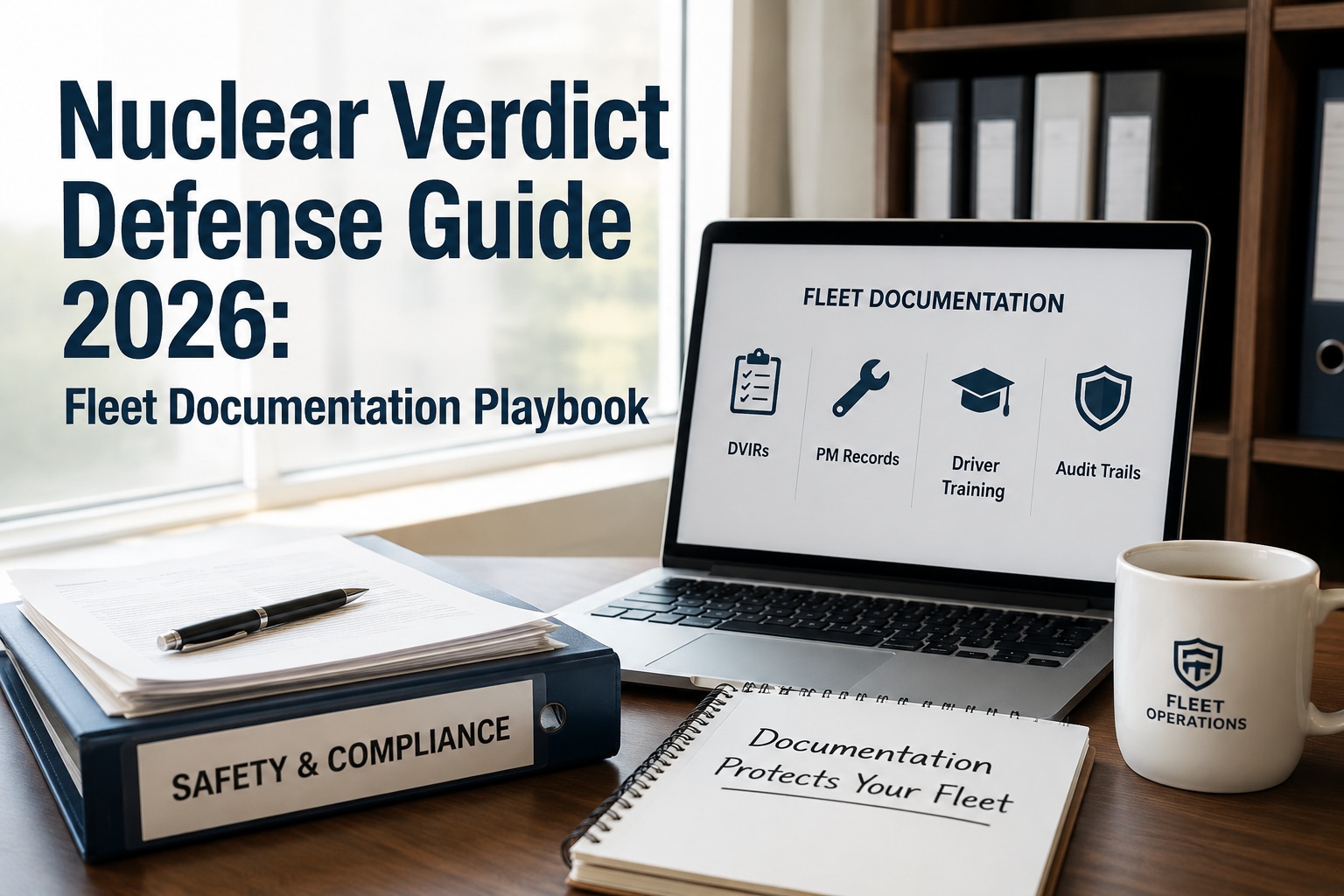
The evidence trailthe four records that carry the most weight
Not all documentation matters equally in litigation. A few categories of record do the heaviest lifting, because they directly answer the questions the reptile strategy raises. ATRI's research is blunt on this point: in its dataset, cases involving hours-of-service violations or a history of driver violations resulted in plaintiff verdicts at strikingly high rates. The records below are exactly where those vulnerabilities live — or where your defense does.
Consistent daily inspection records prove you were looking for defects. Gaps suggest you weren't — and a defect that appears in a report but never in a repair record is a plaintiff's favorite exhibit.
A documented PM schedule — performed on time, with parts and labor recorded — shows a proactive operation. A truck that failed with no maintenance history behind it is the easiest case a plaintiff can make.
Current CDLs, medical certificates, a clean and documented hiring process, and records of ongoing training. Improper hiring and onboarding are specifically correlated with higher awards — this file rebuts that.
Documentation that when something went wrong before, you investigated it and acted. It demonstrates a learning safety culture — the opposite of the reckless indifference a plaintiff needs to prove.
The through-line: each of these is only a defense if it's complete, consistent, and retrievable. A record you did but can't produce is, in a courtroom, the same as a record you never made. Start free and keep all four evidence trails in one place
The gap that hurts mostwhy the open defect is the dangerous one
If there's one documentation failure that does the most damage in trucking litigation, it's the defect that was reported but never resolved — or resolved but never documented as resolved. It's uniquely dangerous because it proves two things a plaintiff needs at once: that you knew about a problem, and that you appear to have done nothing about it. Knowledge plus apparent inaction is the raw material of a punitive-damages argument.
Consider how this plays out. A driver's DVIR notes a brake issue. On paper, that's exactly what the system is supposed to do — the driver caught it. But if there's no corresponding record showing the repair was made and certified before that truck ran again, the plaintiff doesn't see a working safety system. They see a company that was warned and kept driving. The very record meant to protect you becomes the centerpiece of the case against you, purely because the loop was never closed on paper.
Every step timestamped and linked. That unbroken chain is the difference between "they fixed it" and "they knew and ignored it."
A system that automatically ties each reported defect to a work order and a certified repair doesn't just make you more compliant — it removes the single most exploitable gap in trucking litigation. The chain closes itself, and there's no dangling report for anyone to hold up. Book a demo to see defect-to-repair chains close automatically
Consistency is the argumentwhy a pattern beats a snapshot
One good inspection record proves nothing about your operation. A thousand of them, unbroken across every truck and every day, proves everything. In litigation, the power of documentation isn't in any single record — it's in the pattern. A consistent, fleet-wide history of doing the right thing is far harder for a plaintiff to attack than a handful of pristine records surrounded by gaps, because the gaps are where the story of negligence gets written.
This is also where paper quietly fails carriers. A paper-based system can produce excellent records that are impossible to prove were consistent — forms get lost, dates get fuzzy, and "we always inspect" is a claim, not evidence. A digital system produces the pattern automatically: every inspection timestamped, every truck accounted for, every gap visible and closeable before it becomes a courtroom exhibit. The consistency that wins cases is a byproduct of the system, not a heroic effort at trial. It also happens to be the same discipline that lowers your CSA scores and your insurance risk — litigation preparedness and day-to-day safety are the same work. Book a demo to see fleet-wide consistency at a glance Or start free and build a consistent, defensible record across the fleet
From a risk manager who's seen both sides
I sat through a deposition where our own DVIR was blown up on a screen — a brake defect a driver had flagged. The question was simple and brutal: "Show me the repair record." We couldn't find it fast. The work was done, but the documentation was in three different places and one was a paper file nobody could locate quickly.
We settled higher than we should have, purely because we couldn't tell a clean story with our own records. After that, everything went digital and every defect had to close out in the system before the truck moved. The next time we had a claim, I handed the attorney a complete, timestamped chain in an afternoon. Same company, completely different position. The records were the whole difference.
Frequently asked questions
What is a nuclear verdict in trucking?
A nuclear verdict is a jury award of $10 million or more in a single case, a term that originated in trucking and commercial transportation because that's where these outsized awards hit hardest and most often. The American Transportation Research Institute (ATRI) tracks them as a distinct category because their behavior — frequency, size, and geographic concentration — doesn't follow normal litigation patterns. According to ATRI, the median nuclear verdict reached $36 million in 2022, roughly 50 percent higher than the median in 2013, and award sizes have grown far faster than inflation over the past decade. Even carriers that never face a verdict this large feel the effect, because the threat drives up settlement values and insurance premiums across the industry. For smaller and mid-sized fleets in particular, a single catastrophic loss or the elevated settlement pressure these verdicts create can be existential. The key point for fleet leadership is that these awards are driven not only by the severity of a crash but heavily by what a carrier's safety records and practices reveal at trial.
How can fleets reduce nuclear verdict risk?
The most effective nuclear verdict prevention happens long before any crash, through a consistent and well-documented commitment to safety. Because plaintiff attorneys put a carrier's entire safety operation on trial rather than just the accident, the goal is to be able to demonstrate — with complete, retrievable records — that the fleet ran responsibly. That means maintaining consistent DVIR and inspection histories, a documented preventive maintenance program performed on schedule, current driver qualification and training files, and records showing that past incidents were investigated and corrected. It also means closing the loop on every reported defect, so that each one links to a work order and a certified repair with no dangling reports. Beyond documentation, reducing risk involves genuine safety practices: careful hiring and onboarding, ongoing driver training, hours-of-service discipline, and a culture that treats near-misses and defects as signals to act on. Critically, the records only help if they are consistent and instantly producible — a strong safety practice that can't be documented at trial provides little defense. A digital records system makes that consistency and retrievability far easier to achieve than paper.
Why do safety records matter so much in trucking litigation?
Safety records matter because the moment a serious crash happens, they stop being routine compliance paperwork and become evidence. Plaintiff attorneys commonly use a strategy often called the reptile approach, which reframes a trucking lawsuit from a narrow dispute between two parties into a broader question of community safety — arguing that the carrier's practices endangered everyone on the road, including the jurors. To make that argument, they rely on the carrier's own documentation: DVIRs, maintenance logs, driver files, and inspection history. Complete, consistent records tell the story of a disciplined operation and undercut the narrative of recklessness. Gaps do the opposite — a missing repair record, an expired medical card, or an untracked defect becomes an exhibit suggesting the carrier didn't take safety seriously. ATRI's research reinforces how consequential this is, finding very high plaintiff-verdict rates in cases involving hours-of-service violations or a history of driver violations. In short, records are the material from which both the plaintiff's case and the carrier's defense are built, which is why the quality of a fleet's documentation can shape the outcome as much as the facts of the crash.
What is the reptile theory in trucking lawsuits?
The reptile theory is a plaintiff trial strategy that reframes a lawsuit away from the specific facts of a single accident and toward a broader theme of public safety. Instead of arguing narrowly about what happened between two vehicles, the attorney puts the trucking company's entire safety record and practices on trial, aiming to make jurors feel that the fleet's conduct threatened the whole community — including the jurors themselves and their families. The strategy is designed to trigger a protective, safety-first response in jurors that can lead to much larger awards, because they are effectively being asked to punish and deter a perceived danger rather than simply compensate a loss. It has proven highly effective at driving up verdict sizes, and it's frequently amplified by well-resourced legal teams, sometimes backed by third-party litigation funding that allows them to run long, expert-heavy trials. The practical implication for carriers is significant: because this strategy relies on portraying the operation as careless, the strongest counter is a documented, consistent safety record that makes the reckless-operation narrative fall apart. Sound records and genuine safety practices are the direct rebuttal to the reptile frame.
Do digital records really help in litigation compared to paper?
Yes, primarily because litigation defense depends on consistency and retrievability, and those are exactly where paper systems tend to fail. The power of safety documentation in a courtroom is not in any single record but in an unbroken pattern — every truck inspected every day, every defect tracked to a certified repair, every driver file current — and that pattern is difficult to prove when records live in scattered paper files that can be lost, misdated, or slow to produce. A record you actually created but can't quickly locate provides little defense; in practical terms it can be as damaging as a record that was never made. A digital system produces the consistent pattern automatically: inspections are timestamped, defects link to work orders and certified repairs, gaps become visible and closeable before they turn into courtroom exhibits, and the entire history can be exported on demand. That capability also reduces settlement pressure, because the ability to hand opposing counsel a complete, timestamped chain quickly changes the negotiating position. The same discipline that strengthens litigation preparedness also improves day-to-day compliance and lowers CSA and insurance risk, so it delivers value well beyond the courtroom. This overview is general information about risk management and not legal advice; specific situations should be reviewed with qualified counsel.
Build the defense before you ever need it
HVI keeps the records that decide litigation exposure complete, timestamped, and instantly retrievable — DVIRs tied to certified repairs, preventive maintenance on schedule, current driver files, documented incident response. When a crash turns your documentation into evidence, it tells the story of a disciplined, safety-first operation instead of leaving gaps a plaintiff can exploit. The same records lower your CSA and insurance risk every day in between. Live in under two weeks.
No credit card · Audit- and litigation-ready records from day one · Built for USA carriers