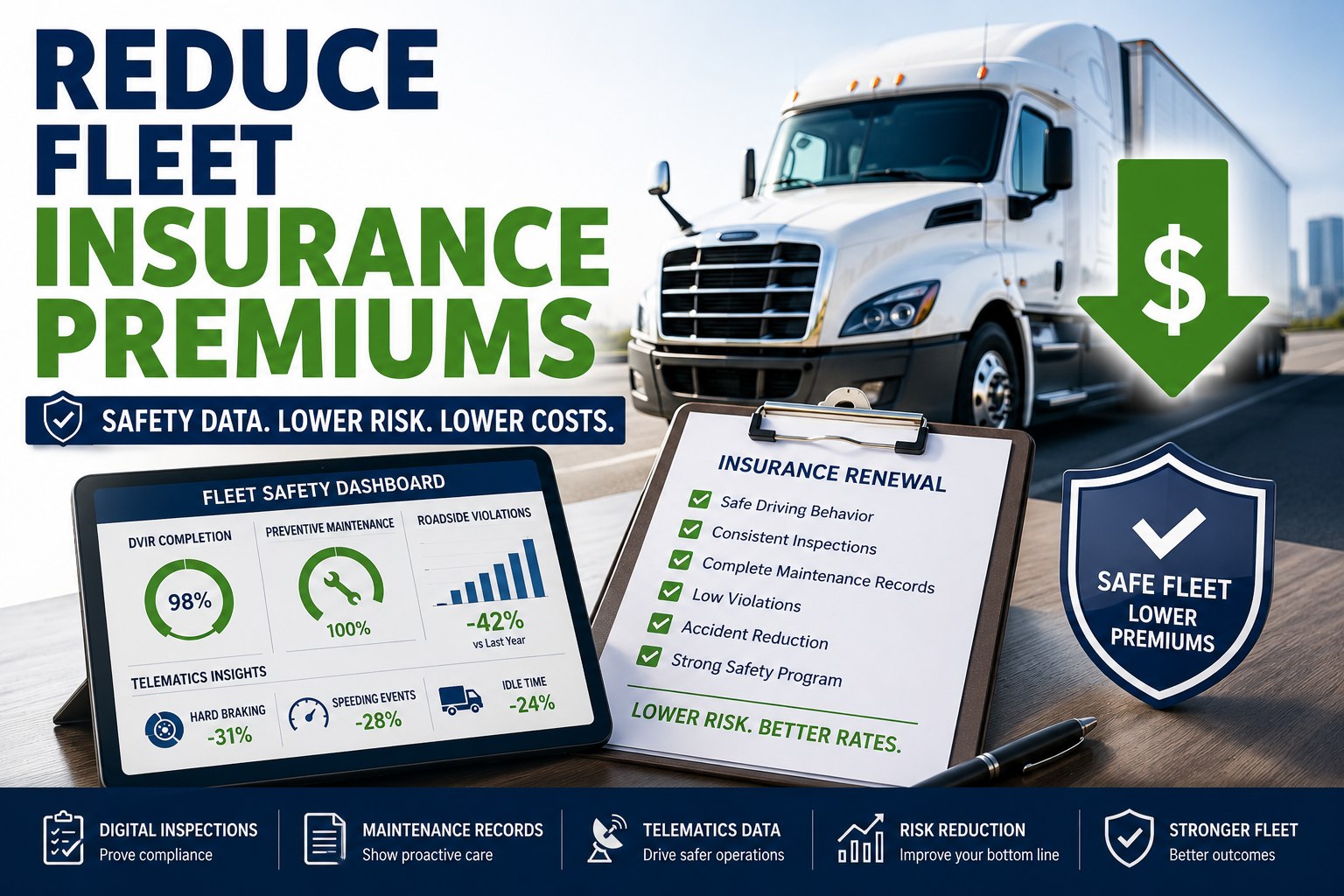
In 2026, the average 20-truck fleet is paying roughly $252,000 a year in commercial auto premiums — and the identical fleet running a documented safety program is paying closer to $176,000. Same trucks, same drivers, same routes. What separates the two is not luck or loss history but a set of specific documents the second fleet handed the underwriter ninety days before renewal. That is the entire game. This is a picture-first walkthrough of what actually reduces fleet insurance premiums with safety data: the five factors underwriters weigh, the dollar impact each one is worth, and the ninety-day submission package that turns a rising quote into a falling one. Book a demo to see the inspection-and-maintenance half of that package build itself.
Reduce Fleet Insurance Premiums with Safety Data
Two identical 20-truck fleets. One priced at industry average. One priced on documented safety evidence. This page is about the $76,000 gap between them — and how to move to the right side of it.
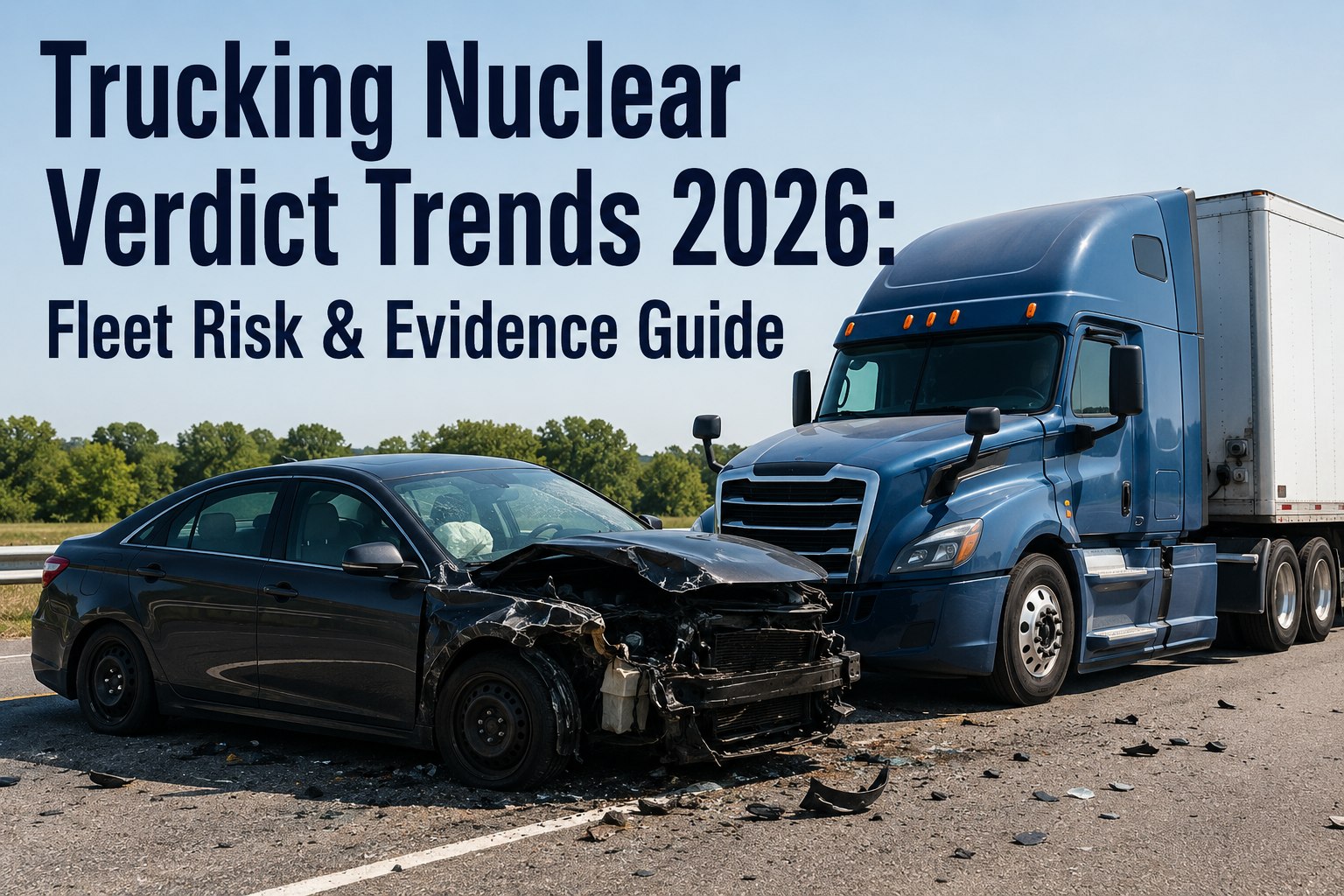
Commercial auto insurance has decoupled from safety metrics. Crash rates fell 2.6% between 2021 and 2024. Premiums climbed 18.6%. That gap is nuclear verdicts, social inflation, and cautious underwriters pricing conservatively across the entire market. The way out is not to argue with the market — it is to opt out of being priced at it. That takes documented evidence, and every fleet already generates most of it. The trick is presenting it.
Why your quote keeps climbing even when you are safer
Three forces are driving 2026 renewal quotes upward regardless of your individual performance. Two of them you cannot fix. The third is where the entire opportunity lives.
-
Uncontrollable$4.1B
Nuclear verdicts
Trucking verdicts over $10M totaled $4.1 billion across just 15 cases in 2024. Median nuclear verdict is now $51M. Insurers price to absorb the tail.
-
Uncontrollable+$30B
Social inflation
Reptile-theory tactics and higher jury awards have added $30 billion to commercial auto claim costs since 2019. Shows up in every renewal quote in the market.
-
Controllable15–30%
Underwriter caution
Absent data, insurers price at the market average. Fleets that share safety evidence are re-priced 15–30% lower. This is your lever.
The reason to focus is arithmetic. You cannot appeal a nuclear verdict. You absolutely can walk into a renewal meeting with six months of documented telematics behavior, a clean CSA export, a DVIR completion report, and a preventive-maintenance compliance chart. That is what the third card unlocks. See the data package in a demo
What insurance actually costs, by fleet size
Before you can size the opportunity, you need the number you are working from. Here is what commercial fleet insurance costs across the four common size tiers in 2026 — and what a documented safety program is realistically worth against each.
-
Small 2–9 trucks
-
Mid 10–24 trucks
-
Large 25–49 trucks
-
Enterprise 50+ trucks
Baseline premium rangeDocumented-program savings (15–30%)
The savings math scales with fleet size, but the smallest fleets often have the highest per-truck rates because their loss history is thinner and their operating profile carries more individual weight. Which means the argument for documentation is proportionally strongest at the smaller end. Start free and start documenting today
The 5 factors underwriters actually price on
Not all safety data carries the same weight. Underwriter worksheets differ carrier to carrier, but the same five categories drive the number on every one of them. Each is ranked here by realistic premium impact when documented well.
CSA BASIC scores
up to 30% swingThe biggest single lever. Clean CSA percentiles unlock 10–20% discounts. Above 80% in any BASIC triggers 15–30% surcharges or possible non-renewal.
Telematics behavior trend
up to 15% offHard braking, speeding severity, distraction alerts, HOS compliance. Not a strong month — a 6–12 month improving trend. Munich Re documents ~15% rebates for sharing this data.
DVIR & PM discipline
up to 10% offDVIR completion rate, three-signature chain completeness, PM-on-schedule percentage. Rising fast in importance because the new 2026 Driver Observed CSA category makes it directly measurable.
Claims history & defense
variable, high leverageFrequency and severity over 3–5 years. Timestamped photos, GPS traces, and ELD data around each incident change severity outcomes and often reduce reserved amounts on open claims.
Documented safety program
culture signalSigned policies (speed, phone use, seatbelts, backing), driver-qualification-file discipline, MVR review cadence, training and coaching logs. The line between "we care about safety" and "we run a documented program."
Fleets that document all five typically shift from standard-risk into preferred-risk pricing — the difference between paying industry average and coming in 15 to 30% below it. Nobody gets all five perfect. The improvement lives in stacking three or four. Start free and build three of the five automatically
How the discount math actually stacks
The mistake most fleets make is assuming a 15% telematics discount plus a 15% CSA discount equals 30% off. Discounts apply to the base, not to each other. Here is the honest waterfall of a well-documented stack.
Realistic net: 25–35% off baseline for a fleet stacking three or four documented factors. Single-lever telematics programs alone commonly deliver 15–30%.
On a $252,000 mid-fleet program, 25 to 35% off is $63,000 to $88,000 a year — back on the bottom line. That is the arithmetic every fleet operator needs to know before renewal season. See it applied to your fleet in a live demo
The 90-day renewal countdown
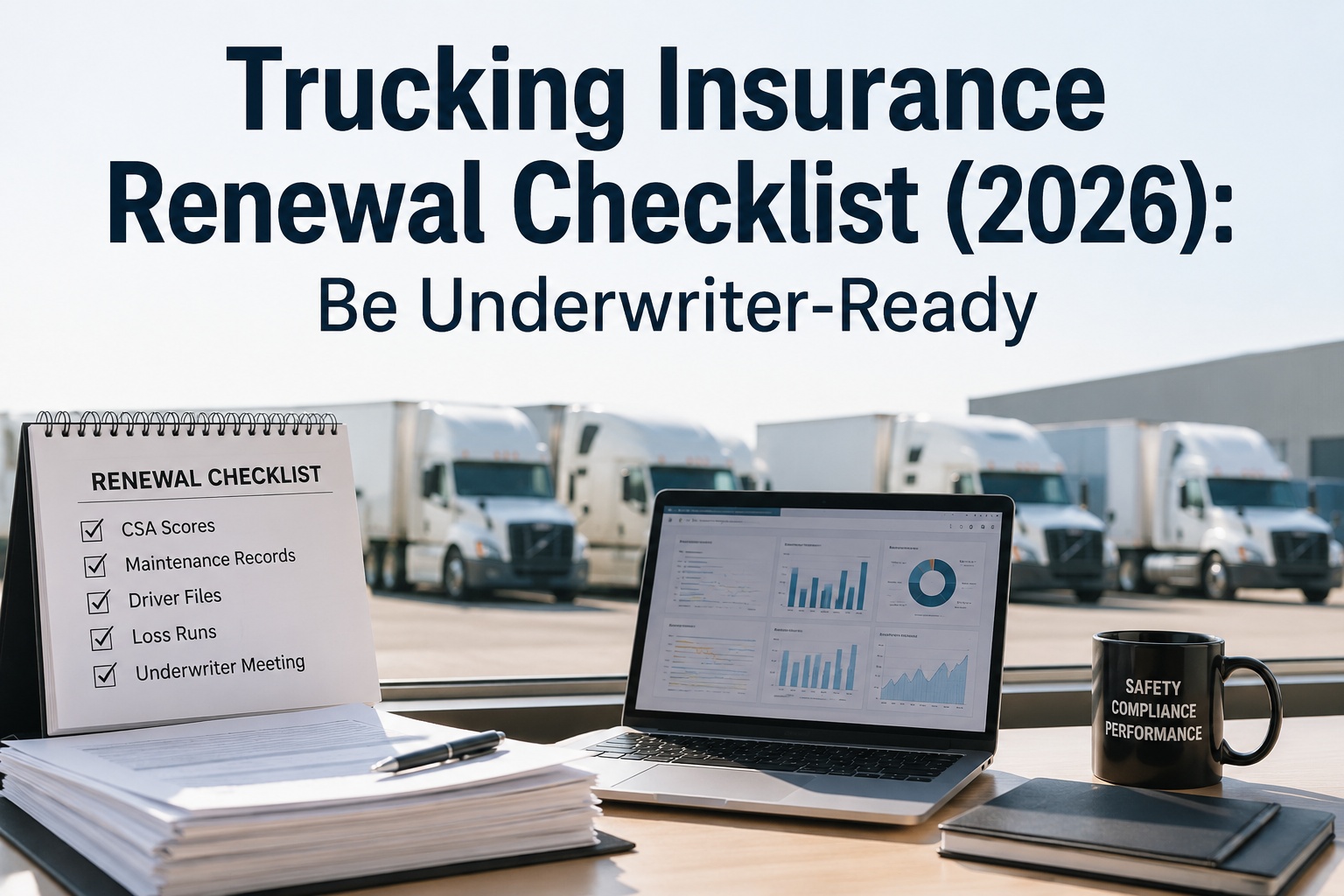
Underwriters price submissions handed to them two weeks before binding at whatever the market says. Submissions handed to them ninety days out get a real review — and often produce materially different numbers. Here is the schedule that produces the second outcome.
-
Day 90Data assembly
Pull the raw data
SMS export for all 7 BASICs, 12-month telematics behavior data, DVIR completion, PM compliance, driver-qualification files, incumbent loss runs.
-
Day 60Package build
Write the narrative
One-page executive summary, trend charts, coaching-session logs, written narratives for every claim in the period, signed safety program document.
-
Day 30Broker review
Hand off proactively
Deliver the full package to your broker and ask them to present it to underwriters before quotes are issued — not after.
-
Day 0Renewal
Price on evidence, not market
You are no longer being priced at industry average. You are being priced on documented below-average risk. That is the whole game.
From a fleet VP who ran the play
Our renewal in 2024 came back up 22%. My CFO looked at the number and asked what I was going to do about it. That was the day I actually sat down and mapped out ninety days.
Ninety days of work — pulled the SMS data, built the DVIR and PM trends out of HVI, wrote up the two open claims with what we changed after each. Our broker walked it into the underwriter meeting in front of the incumbent. We came out 8% under the prior year's rate. Same carrier, same trucks, same drivers. The only difference was we could prove it.
Frequently asked questions
How much can safety data actually reduce a fleet's insurance premium?
Industry data across the 2026 carrier landscape puts the typical range at 15 to 30 percent premium reduction for fleets that share verified telematics behavior data and document clean CSA and DVIR records. Munich Re specifically documents around 15 percent rebates for fleets sharing telematics-enabled coaching data, and stacked programs combining telematics, clean CSA, and documented DVIR-plus-PM discipline commonly land in the 25 to 35 percent off-baseline range. Actual outcomes depend on carrier, loss history, and fleet operating profile, and discounts apply to the base premium rather than to each other, so stacking three 15-percent discounts nets out to roughly 39 percent, not 45. The consistent finding across sources is that fleets sharing data move from standard-risk pricing to preferred-risk, while fleets declining to share are increasingly priced conservatively — insurers now read the absence of data as an absence of risk management rather than a neutral signal.
What safety data do commercial fleet insurers actually look at?
Underwriters at major commercial auto carriers evaluate five categories of documented evidence at every renewal. First, CSA BASIC percentiles from the FMCSA Safety Measurement System, especially Unsafe Driving, Hours of Service, Vehicle Maintenance, and the new Vehicle Maintenance: Driver Observed category introduced in 2026 — above-threshold percentiles trigger automated flags and surcharges. Second, telematics behavior data covering hard braking, speeding severity, distraction alerts, seatbelt use, and HOS compliance, weighted for a 6-to-12 month trend rather than a single month. Third, inspection and maintenance discipline — DVIR completion rate, three-signature chain completeness, preventive maintenance on-schedule percentage, and evidence of defect-to-work-order routing. Fourth, claims history over three to five years with narrative context and defense documentation. Fifth, the written safety program itself — signed policies, driver qualification file audits, MVR review cadence, and coaching session logs. Any single category matters; all five together shift the pricing conversation from industry-average to preferred-risk.
Does a digital DVIR really change my insurance renewal?
Yes, in three concrete ways. First, digital DVIRs with photo verification, GPS coordinates, and timestamps directly influence the new 2026 Vehicle Maintenance: Driver Observed CSA category, which underwriters weigh heavily; a clean Driver Observed percentile is preferred-risk evidence in a way that paper DVIRs cannot demonstrate. Second, the three-signature chain (driver, mechanic, next driver) completion rate is a compliance metric underwriters increasingly ask for at renewal — digital DVIRs enforce it structurally, paper systems break it constantly. Third, claim defensibility: when a crash later becomes a lawsuit, a defensible history of photo-verified inspections showing the vehicle was inspected, defects were noted, and repairs were certified is one of the strongest exhibits available to a defense attorney. That in turn shows up as lower reserved amounts on open claims and better loss-run outcomes at the next renewal. The paper DVIR that looked like routine admin is often a fleet's single largest unpriced piece of insurance exposure — and it's one of the easiest to fix.
When should I start preparing for a fleet insurance renewal?
Ninety to one hundred twenty days before renewal is the standard professional advice, and it holds up in practice. The reason is that underwriters need actual time to review a submission — a package handed to a broker two weeks before binding gets a rushed price, while one submitted three-plus months out gets a proper underwriting review and often produces meaningfully different pricing. During that window, pull the last 12 months of SMS data, build the telematics behavior trend, export your DVIR completion and PM compliance rates, gather written safety program documentation, and write brief narratives explaining any claims in the period. The submission is presented proactively rather than waiting for the underwriter to price the fleet blind. Fleets that treat renewal as a year-round documentation exercise rather than a once-a-year paperwork scramble consistently pay less — the actual work of building the evidence pack is what shifts the pricing default from market-average to below it.
Do all commercial auto insurers offer telematics-based discounts?
Most major commercial fleet insurers now offer some form of usage-based or telematics-linked pricing, though they may call it by different names — usage-based insurance (UBI), telematics discount, safety program credit, or preferred-risk pricing. Progressive Commercial, Sentry, Great West Casualty, and several other major carriers all offer named programs, and reinsurance research from Munich Re documents specific rebate structures around 15 percent for fleets sharing telematics-enabled coaching data. Some carriers offer immediate discounts on presentation of qualifying data; others rebate based on demonstrated performance over 6 to 12 months. The practical move is to ask your broker directly whether your incumbent carrier has a telematics-linked pricing tier, what specific data they require, and in what format. If the answer is no, that's a strong signal to shop for a carrier that does, because the pricing gap between carriers with UBI programs and those without has widened materially through the 2020s and continues to widen in 2026.
Build the underwriter's evidence pack automatically — DVIR, PM, and Vehicle Maintenance
HVI documents three of the five factors underwriters price on: photo-verified DVIRs with the three-signature chain, meter-driven preventive maintenance compliance, and the clean inspection record that quietly moves both Vehicle Maintenance BASICs. Timestamped, exportable, and ready to hand your broker ninety days out.
No credit card · No hardware · Live on your fleet in under two weeks