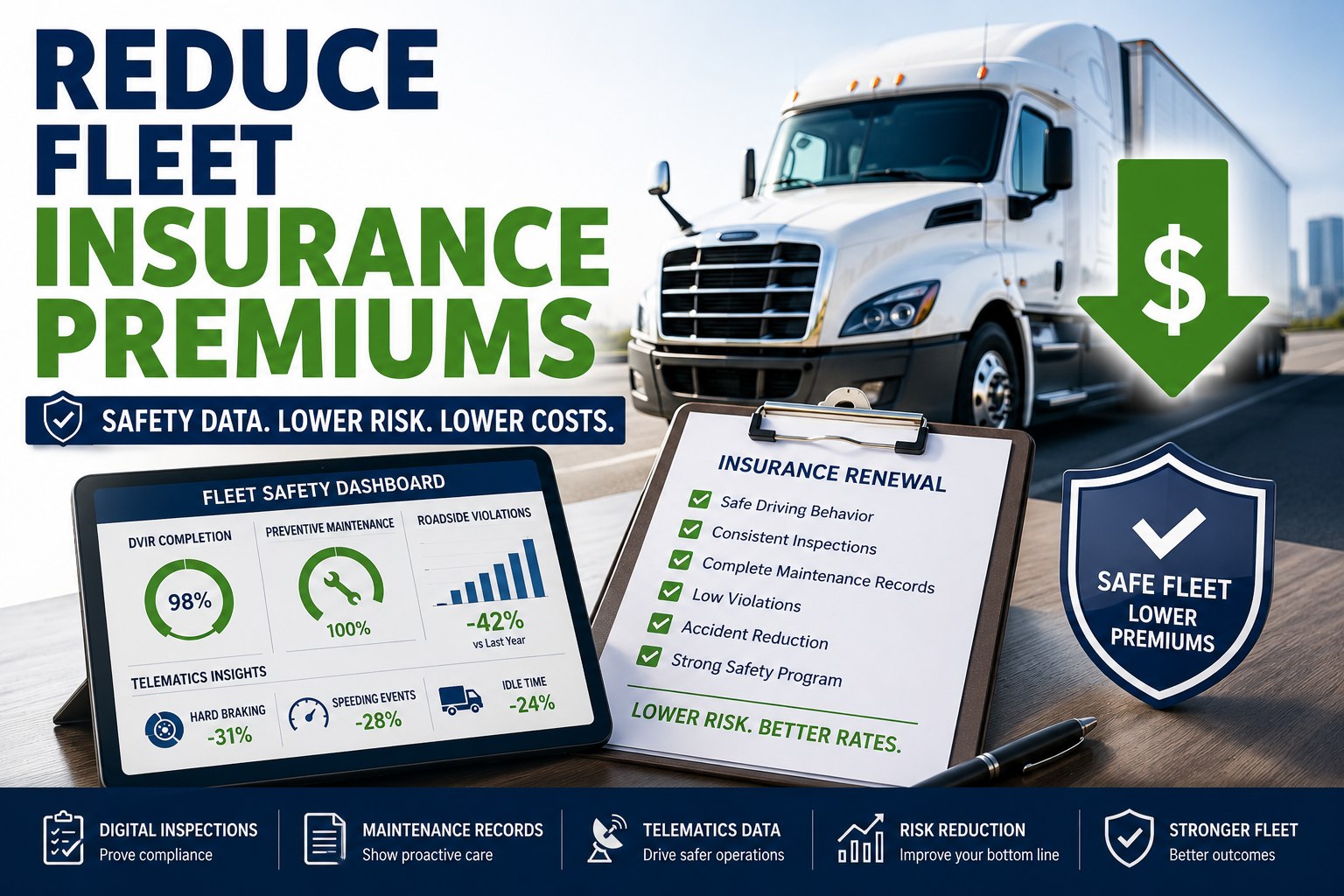
Commercial fleet insurance rates rose an estimated 30% for the least-prepared fleets in 2026, and the industry-average premium hit a record $0.102 per mile. Standing still is a rate increase. The fleets holding their number — and in some cases moving it down — run a deliberate stack of eight levers, not one. This guide walks the strategies to reduce fleet insurance costs, the verified impact of each, and the sequence that compounds them — or book a 15-min HVI demo to see the record built.
The 8-Lever Savings Grid
Every lever below has verified 2026 impact data behind it. None of them alone moves the needle far. Stacked, they compound into 20–35% total.
Fleets reduce commercial insurance costs through eight stacked levers: fixing hot CSA BASIC scores, deploying AI dashcams with weekly driver coaching, sharing telematics data at renewal, right-sizing deductibles, bundling coverage into a package policy, paying annual premium in full, retaining drivers longer, and documenting the safety program end-to-end. Individual impact ranges from 5–25%. Stacked correctly, the total sits around 20–35% below where the same fleet would land doing none of them. The variable is discipline, not access — every lever is available to any fleet willing to run it.
Lever 01: Fix Your Hottest CSA BASICCompliance · The single biggest input to underwriting
Every underwriter at every carrier pulls FMCSA SMS data before quoting. A BASIC over threshold (Unsafe Driving, HOS Compliance, Vehicle Maintenance, Driver Fitness, Controlled Substances, Hazmat, Crash Indicator) is a rate-hike trigger. Fixing the hottest one before renewal is the highest-leverage move most fleets don't make. Focus on the specific violation types driving the score, close them at the source, and document a six-month improvement trend. Underwriters reward direction almost as much as absolute level — a declining Vehicle Maintenance BASIC often prices better than a lower absolute number with no trend.
Lever 02: AI Dashcam + Weekly CoachingSafety Tech · The most direct discount available
Basic dashcams earn minimal discount. AI dashcams paired with a real coaching cadence earn 10–25% at renewal — and reduce crash frequency by up to 60%. Munich Re documents 15% specifically for fleets running active coaching programs. The critical piece: cameras without coaching draw the subscription cost with almost none of the discount, because insurers now measure whether the footage produces behavior change, not whether the hardware is on the truck. Weekly scorecards, documented coaching completion, and a supervisor-signed remediation record are what turns hardware into a rate reduction.
Lever 03: Share Telematics Data at RenewalCompliance · Now a two-sided lever
Two shifts happened in 2026. Fleets that share telematics data qualify for 10–15% premium discounts per Munich Re data confirmed across major carrier programs. Simultaneously, fleets that decline to share data are no longer treated neutrally — underwriters interpret the absence of behavior data as absence of risk management and price accordingly. Hard braking, speeding, idling, and HOS compliance data pulled from the telematics platform, packaged with the submission, is now table-stakes for a competitive quote. The lever is worth mid-teens on the discount side and possibly double that on the penalty side.
Lever 04: Right-Size DeductiblesCoverage · Cash flow trade for premium reduction
Raising physical damage deductibles from $500 to $2,500 typically cuts that coverage component by 15–25%. Higher deductibles on liability move the number similarly. The trade-off is cash reserve exposure — the fleet takes on more risk on smaller incidents in exchange for the premium reduction. Best fit: fleets with low accident rates, strong cash reserves, and duty cycles that produce fewer small claims. Wrong fit: fleets that already run at claim frequency limits or that lack cash flow to absorb a $2,500 hit without operational disruption.
Lever 05: Bundle into a Commercial Package PolicyCoverage · Multi-line consolidation
Combining commercial auto, general liability, and cargo coverage with a single carrier under a Commercial Package Policy (CPP) typically saves 10–20% versus standalone policies. Beyond the direct discount, package policies simplify administration, consolidate claims handling, and reduce the number of certificates you have to reissue to shippers at renewal. Fits fleets that already carry multi-line coverage across two or more carriers. Doesn't fit fleets running purely auto with no other lines to consolidate.
Lever 06: Pay Annual Premium in FullFinancial · The simplest lever nobody uses
Paying the annual premium in full instead of monthly typically earns a 5–10% discount. On a $50,000 annual premium, that's $2,500–$5,000 straight back. The trade-off is pure cash flow — you're using the money for insurance instead of operations for the policy year. Best fit for fleets with strong working capital, tax-planning reasons to book expenses in the current year, or seasonal cash cycles where premium timing aligns with a strong quarter. Wrong fit for anyone running month-to-month cash.
Lever 07: Retain Drivers LongerSafety Tech · The lever nobody prices correctly
Drivers under 12 months of tenure typically carry a 20–40% rate loading versus tenured drivers. Under 3 months is worse. A fleet with 30% annual turnover pays a rate loading on nearly a third of its book at any given time. Retention investments — pay increases, better home-time, improved dispatch culture, benefits — look expensive on the P&L but frequently pay for themselves in insurance alone before the fuel and productivity gains show up. The lever is invisible on next month's invoice but significant on a two-year renewal cycle.
Lever 08: Document the Safety Program End-to-EndCompliance · The compounding lever behind every other one
Every other lever on the list produces its impact only if it's documented. AI dashcams without coaching logs don't discount. Improving CSA scores without a trend export doesn't discount. Retained drivers without training records get priced like the rest. Digital DVIR trail, PM completion history, DQ files with signed MVRs, coaching logs, and post-incident preservation are the foundation. The impact is not a specific percent this year — it's the compounding effect on the 2–3 year loss run that determines every future renewal.
Sequence: Order of ImpactAll 8 matter. Not all 8 matter equally this quarter.
Working the levers in order of impact-per-effort produces the fastest premium movement. This is the sequence that works.
Book a demo to see the current-state audit HVI runs on your fleet and the specific lever sequence with the fastest impact on your numbers.
Doing 2–3 vs Doing All 8Same fleet. Same market. Very different renewal.
- Individual moves without documentation
- No trend the underwriter can trust
- Discount stacking capped by carrier
- Typical outcome: single-digit reduction
- Renewal narrative: "trying some things"
- Levers stacked and documented
- Trend proof underwriters can defend
- Discounts compound across categories
- Typical outcome: 20–35% below market path
- Renewal narrative: "here is the data"
Try HVI free and the compliance and documentation half of the stack — levers 01, 02, 03, 08 — ships pre-built. The other four are broker conversations.
Quick Questions
What's the fastest way to reduce fleet insurance costs?
Two same-month moves with zero operational disruption: pay the annual premium in full instead of monthly (typically 5–10% discount) and raise physical damage deductibles from $500 to $2,500 (typically 15–25% off that coverage component). Both are broker conversations, not operational changes. Combined, they routinely take 8–15% off the total premium within one billing cycle. Everything else on the 8-lever list produces bigger long-term impact but takes 30–90 days to implement or 12–24 months to show up in the loss run.
Do telematics really lower fleet insurance premiums in 2026?
Yes — and the effect is now two-sided. Fleets that share verified telematics data qualify for 10–15% premium discounts per Munich Re data confirmed across major carrier programs. Just as important: fleets that decline to share telematics data are no longer treated neutrally by underwriters — they're assessed more conservatively because absence of behavior data is interpreted as absence of risk management. The 2026 dynamic is different from 2022–2024: sharing data is not a bonus, it's the new baseline. Not sharing carries a penalty of roughly the same magnitude as the discount for sharing.
How much can raising deductibles actually save?
Raising physical damage deductibles from $500 to $2,500 typically cuts that coverage component by 15–25%. Similar movement on liability deductibles produces similar effect. The trade-off is cash reserve: the fleet takes on the first $2,500 of every physical damage claim instead of $500. On a fleet with two physical damage claims a year, that's $4,000 in additional out-of-pocket per year against potentially $6,000–$12,000 in premium savings. Fits fleets with strong cash reserves and low claim frequency. Doesn't fit fleets with cash-flow constraints or high claim frequency.
Can documentation alone lower insurance premiums?
Documentation directly unlocks 5–15% at the renewal itself — underwriters discount for documented safety programs, digital DVIR audit trails, and coaching evidence. The larger effect is indirect: documentation reflects operational discipline, and operational discipline reduces claim frequency. Lower claim frequency shows up in the loss run 12–24 months later, and that loss-run improvement is what drives the biggest single price movement at future renewals. Fleets that switch from paper to digital DVIR, PM, and driver-file recordkeeping typically see the compounding effect materialize as flat or reduced renewals in a market otherwise rising 8–12% annually.
Is it worth switching carriers to save on premium?
Usually not directly — but marketing the account to competing carriers almost always is, whether or not you actually switch. The competing quote is the leverage that either produces a better quote from the incumbent or moves you cleanly to a better fit. Switching itself carries real friction: certificate reissue to every shipper, potential coverage-gap risk on the transition, filing re-submission for interstate authority. Most well-managed renewals end up staying with the incumbent at improved terms after the account is properly marketed. But an account that isn't marketed to competitors is an account with no leverage — and the incumbent knows.
Every lever above needs a record. HVI produces the record.
Digital DVIR audit trail, PM compliance history, CSA snapshot with trend, driver qualification files, coaching logs, and post-incident preservation workflow — on one connected platform. The compliance half of the 8-lever stack, pre-built. So the broker conversation focuses on price, not paperwork.