Insurance renewal starts the day the last one closes. That's the joke. The reality: the fleets that hold their rate at renewal — in a market where the Commercial Auto Liability Combined Ratio hit 113% and truck liability premiums have risen roughly 9% per year since 2017 — are the ones that run a disciplined 90-day playbook. This trucking insurance renewal checklist walks the exact phases, documents, and moves that turn a "surprise increase" into a defended rate — or book a 15-min HVI demo to see the underwriter package auto-generated.
The 90-Day Renewal Runway
Three phases. Ninety days. Every task in its right window — and the underwriter sees a fleet that runs its shop with the same discipline it runs its trucks.
- Pull loss runs (5 yr)
- Snapshot CSA BASICs
- DVIR completion audit
- Driver MVR refresh
- Build underwriter file
- Coach doc + trend
- Broker markets account
- Carrier submissions land
- Compare terms line-by-line
- Negotiate rate & endorsements
- Bind & verify filings
- Certificates issued
A trucking insurance renewal checklist should start 90 days before expiration and run in three phases: Phase 1 (90–60 days out) audits records, pulls loss runs, and identifies gaps; Phase 2 (60–30 days out) builds the underwriter package and lets the broker market the account; Phase 3 (30–0 days out) reviews proposals, negotiates, and binds. Complex operations extend to 120–180 days. Fleets that submit inside 30 days almost always accept incumbent pricing — competitive leverage is gone. The playbook below is what separates a defended rate from a "surprise" increase.
Phase 1: Day 90 → 60 — Audit & DiscoveryFind the gaps before the underwriter does.
The first 30 days of the runway are about knowing what your record actually says. Not what you hope it says. The underwriter is going to see everything below — the goal here is to see it first, so nothing shows up as a surprise on the submission.
Every claim, every reserve, every settlement. Valued within the last 90 days. This is the single most influential document in the submission.
All seven categories. Any BASIC over threshold gets flagged. Trending (last 24 months) matters more than absolute level — underwriters reward direction.
Percentage of shifts with completed DVIR. Percentage of flagged defects resolved within 48 hours. Underwriters read these as culture indicators, not just numbers.
Annual MVR review is an FMCSA requirement (49 CFR §391.25), and any missed one is an audit finding. Refresh all before the submission, not during it.
Every unit currently in service, VIN, year, make, model, GVW, garaging state. Additions and dispositions since last renewal reconciled to a single source.
Phase 2: Day 60 → 30 — Build & MarketThe 30 days where the account gets priced.
This is where the audit output becomes a submission. Your broker is marketing the account to the panel of carriers most likely to fit the risk profile — and the strength of the submission determines the range of quotes that come back. Book a demo to see the underwriter package HVI auto-generates in one click.
Loss runs, CSA snapshot, DVIR audit, driver MVR file, DQ files, vehicle schedule, financials (2 years + interim). One package, not seven email threads.
Weekly driver scorecards. Coaching completion rate. Dashcam program metrics. Anything the fleet does to reduce claim frequency is worth a page in the submission.
Your broker knows which carriers fit your risk profile. Every quote requested strengthens negotiation. Every quote missed narrows it.
Every additional-info request that sits for 3 days is a quote that slips. Underwriters typically return terms within 24–48 hours of a complete file — but only if the file stays complete.
Phase 3: Day 30 → 0 — Compare, Negotiate, BindThe final month where the rate actually moves.
Limits, deductibles, endorsements, filings, sublimits, exclusions. The lowest premium can be the most expensive policy if the cargo sublimit is wrong for the commodities you actually haul.
Incumbent carriers often reduce a proposed increase when they see a viable competing quote. Not always. But often enough that the effort is always worth it.
BMC-91 or BMC-91X for federal operating authority. State filings where required. Insurance can be paid and still not be "live" if filings aren't posted correctly. Confirm, don't assume.
Every shipper needs a certificate of insurance dated for the new policy period. Missed certificates cause missed loads even when coverage is bound.
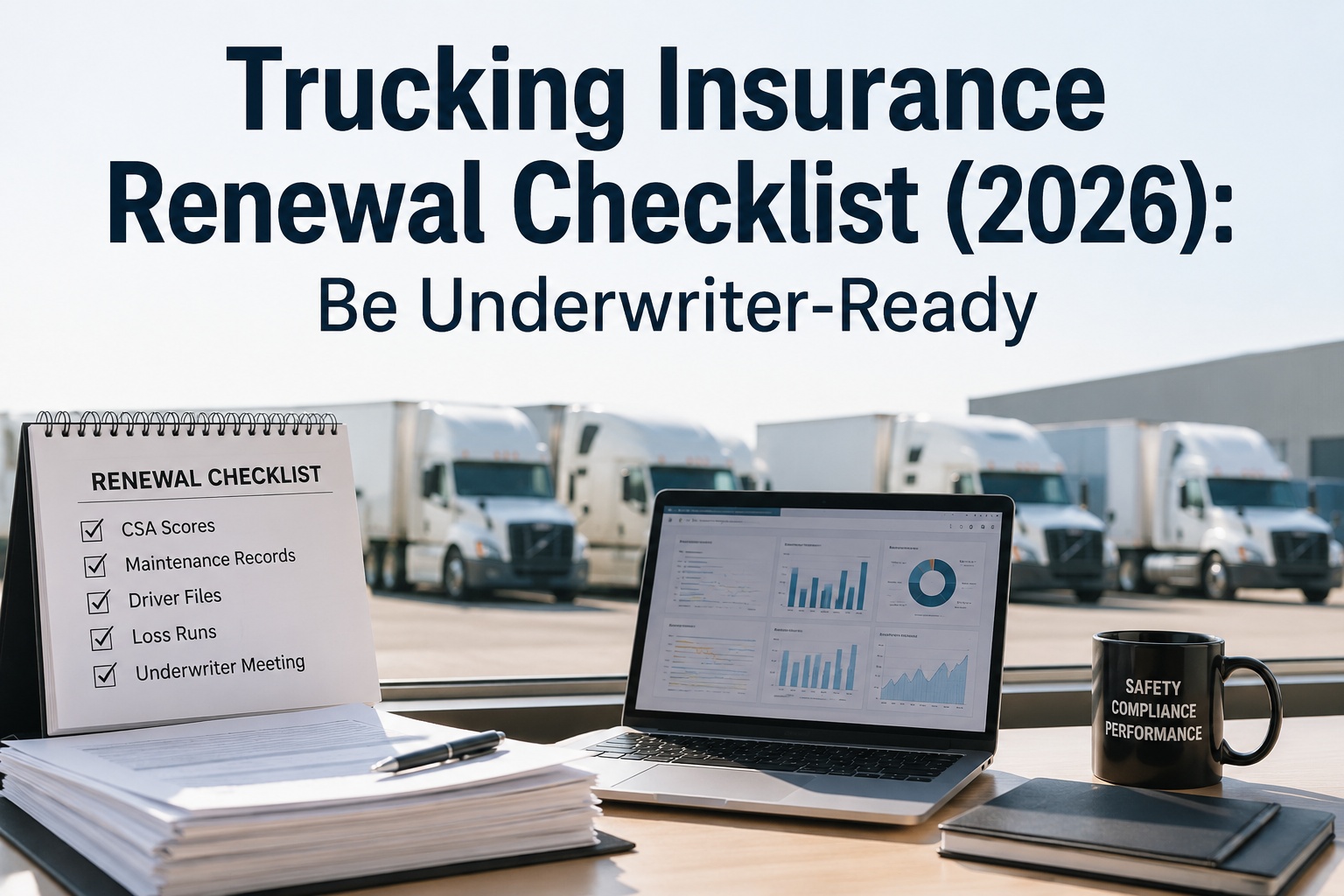
The 8 Documents Every Underwriter PullsMiss one and the submission is incomplete. Incomplete = slow = expensive.
Every claim, valued within 90 days. The most-scrutinized document.
All 7 BASICs. Trend chart if any category is near threshold.
Refreshed within the current policy year. FMCSA-required.
Full unit list with VINs, year, make, GVW, garaging.
Completion rate + defect resolution time. Digital records preferred.
Sample of DQ files, hire practices, training documentation.
Underwriters check operational stability, especially at 20+ trucks.
Radius, lanes, commodities, garaging states, safety programs.
5 Red Flags That Wreck RenewalsAny one of these can move a rate 15% before you even open the meeting.
Eliminates competitive leverage. Broker can't market. Incumbent knows and prices accordingly.
Wrong radius, missing commodity, garaging state error. Discovered at first claim — often triggers rescission or exclusion enforcement.
A high Vehicle Maintenance or HOS BASIC without a 6-month improvement trend is a hard-rate signal. Underwriter can't defend to their manager.
Annual MVR review is FMCSA-mandated. A missing one is compliance evidence, not just paperwork.
Even one non-pay in the loss run history reduces available markets sharply and can add 10–20% to base rate at renewal.
Rushed vs 90-Day PreparedSame fleet. Same loss history. Very different renewal outcome.
- 1–2 quotes at best
- Incumbent knows there's no competition
- Documents scrambled together, some missing
- No time to fix CSA issues before submission
- Rate accepted, not negotiated
- Typical outcome: 10–20% increase
- 3–5 competing quotes
- Broker has real leverage
- Complete package submitted first pass
- 6-month coaching trend documented
- Rate negotiated against best competing quote
- Typical outcome: flat or single-digit change
Try HVI free and the compliance record for the 90-day playbook is pre-built — DVIR audit trail, CSA snapshot, PM history, DQ file exports — ready before the runway begins.
Quick Questions
How far in advance should I start my trucking insurance renewal?
Standard fleets should start 90 days before expiration. Complex operations — over 20 trucks, loss history above industry average, or CSA BASICs near threshold — benefit from a 120–180 day runway. The three-phase timeline works consistently: audit records at 90–60 days, build the underwriter package and let the broker market the account at 60–30 days, negotiate and bind at 30–0 days. Submissions inside 30 days eliminate competitive leverage and almost always accept incumbent pricing — which is often the exact rate the incumbent wants because they know there's no competing quote to defend against.
What documents do trucking insurance underwriters require?
Standard underwriting package: 5-year loss runs (valued within 90 days), current CSA/SMS BASIC scorecard, refreshed driver MVRs for every driver (FMCSA-required annually), complete vehicle schedule, DVIR audit summary showing completion and defect resolution rates, sample driver qualification files, 2 years of financial statements plus current interim, and an operations profile covering radius, lanes, commodities, garaging states, and safety programs. Any single missing document slows the submission — and quotes returned inside 24–48 hours require a complete file up front.
Why do trucking insurance premiums keep going up even for clean fleets?
Two structural forces sit above any individual fleet's performance. First, the industry-wide Commercial Auto Liability Combined Ratio reached approximately 113% in 2024 — meaning carriers paid $1.13 in claims for every $1.00 collected, and those losses roll into rate action across all carriers. Second, social inflation, nuclear verdicts, and increased tort activity have pushed severity dramatically higher. Truck liability premiums rose about 9% annually from 2017 to 2024. A clean fleet doesn't escape the tide, but a documented safety program and a well-prepared submission is what moves the account from "market average increase" to "flat or single-digit change."
How much can better documentation actually reduce a renewal premium?
Documentation alone doesn't move a rate — but the loss run does, and the loss run is a lagging effect of the operational discipline the documentation reflects. Fleets that switch from paper to digital DVIR, PM, and driver-file recordkeeping typically see loss-run improvement show up 12–24 months later as reduced or flat renewals in a rising market. The renewal-specific effect from the documentation itself is usually 5–15% off the market-average increase in the first year, with the compounding operational effect stacking on top in years two and three.
Should I switch carriers at renewal or stay with the incumbent?
Not the right question. The right question is whether to market the account — and the answer is almost always yes. Marketing to 3–5 competing carriers creates the leverage that either produces a better quote or defends the incumbent's renewal terms. Actually switching carriers has real cost: certificate reissue to every shipper, potential coverage-gap risk on the transition, filing re-submission. Most negotiated renewals end up staying with the incumbent at improved terms. But without a competing quote in hand, the incumbent has no reason to negotiate anything.
Walk into the renewal with the file already assembled.
HVI produces the exact underwriter package every top-10 commercial fleet insurer asks for — loss-run cross-reference, CSA snapshot with trend, DVIR audit trail, PM history, DQ files, and safety-program documentation — on one export. The 90-day playbook runs itself.