Not every commercial fleet insurance company is built for every fleet. The right carrier for a 500-truck long-haul operation is often the wrong one for a 12-truck local delivery fleet, and the market a new-authority owner-operator can even get into looks nothing like the panel a Fortune 500 fleet buys from. This comparison of the 10 commercial fleet insurance companies most active in 2026 walks the who-fits-what — or book a 15-min HVI demo to see how digital compliance records improve underwriter response.
The 2026 Fleet Insurance Landscape
10 carriers write most of the fleet business in the U.S. They sit in four distinct lanes. Knowing which lane you're in narrows the market from 3,700 filed entities to a shortlist you can actually quote.
Nationwide
Old Republic
Northland (Travelers)
The Hartford
The best commercial fleet insurance companies in 2026 depend on fleet size, equipment type, garaging state, operating radius, and loss history. Progressive Commercial is the largest U.S. commercial auto insurer and the strongest all-sizes option. Great West, Sentry, and Northland lead among trucking specialists for established, safety-focused carriers. Travelers, Liberty Mutual, and Old Republic serve large fleets (50+ units) needing multi-line coverage. Canal Insurance is the standard-of-the-market for new authorities and non-standard risks. Expect $8,000–$18,000 per truck annually as a baseline range.
What Makes a Good Fleet InsurerPrice is one factor. Five others matter more over the life of a policy.
First-year premium is easy to shop. Everything below is what separates a policy that renews cleanly from one that non-renews after the first big claim.
A- or better is the working floor. Below that and shippers, brokers, and lenders start asking questions.
The difference between a 4-week and 12-week claim on a rig sitting in a yard is the difference between renewing and shopping panicked.
A carrier that "quotes everything" for year one often non-renews at year two if the risk profile wasn't a real fit. Pick for fit, not price.
Best-in-class carriers ship coaching, telematics, and safety programs bundled. That reduces claims. Reduced claims stabilize renewal pricing.
Interstate operators need MCS-90 and state filings supported without delay. Local-only carriers can trip up on this at renewal.
The Top 10 Carriers ComparedVerified specialty, fit profile, and where each carrier is the strongest quote.
Largest U.S. commercial auto insurer. Quotes nearly every equipment type including cargo vans, dump trucks, and hotshots. Strong digital tools and fast quoting. Fits owner-operators through large fleets. Rate-competitive for clean-record established operators.
Trucking-focused insurer known for deep loss control and risk management support. Best fit for established carriers with formal safety programs, clean CSA scores, and multi-year loss history. Not the market for new authorities.
Entire commercial auto division built around trucking. Positioned as a risk management partner, not just a policy vehicle. Strongest fit for established carriers that want long-term stability and are willing to invest in safety infrastructure.
Trucking-only writer under Travelers. Particularly competitive on short-haul, local, and regional runs — dump trucks, concrete mixers, aggregate haulers, and local delivery. Typically wants two or more years in business before quoting.
Scale for 50+ unit fleets that also need property, general liability, and workers' comp under one relationship. Loss-control resources are among the deepest in the industry. Best fit when the account is complex enough that consolidation matters.
Large diversified carrier with meaningful commercial trucking capacity. Broad appetite across mid-size fleets and mixed-equipment operations. Strong service infrastructure and multi-state filing support.
Major commercial insurer with trucking capacity. Fits fleets that value scale, layered liability structure, and integrated risk management support. Consistent strong presence on larger accounts placed through broker channels.
Strong on large deductible programs and complex multi-state trucking risks. Broker-driven placements. Typically the market for 100+ unit fleets with sophisticated risk management and captive-adjacent structures.
Strong appetite in small business commercial auto and mid-size fleet accounts. Bundled policies with business owner's package appeal to operators who want streamlined administration. Digital quoting infrastructure keeps small-account overhead low.
Specialist in non-standard and hard-to-place risks. The reliable market for new authorities under two years, operators with prior violations, or loss history that preferred markets decline. Higher priced, but the essential option while building the record that moves the account back to standard markets.
What Underwriters Actually CheckThe data every carrier above pulls before quoting or renewing your fleet
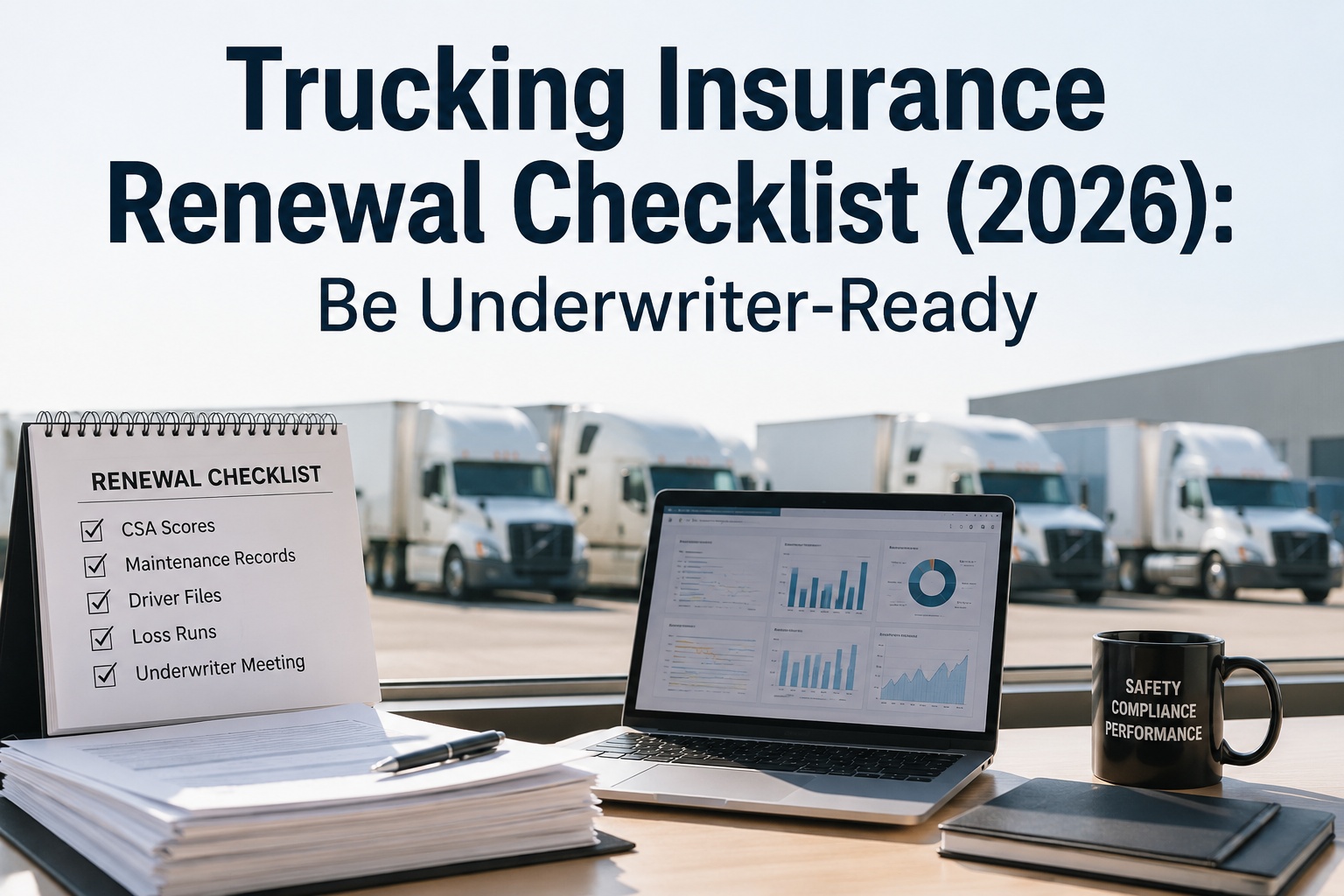
Fleet insurance quoting isn't about the truck. It's about the record. Underwriters at every top-10 carrier work through roughly the same six data sources before pricing a policy. Book a demo to see the exact records HVI produces for each of these categories.
How to Look Better to UnderwritersFive practical moves before the next renewal application
Paper DVIRs are the single most common gap on maintenance review. Digital inspection records with photos, timestamps, and signatures answer the underwriter question before it's asked.
Meter-based or calendar-based PM schedules with a completion rate above 90% signal a well-managed operation. Show the report, not a promise.
Underwriters don't just look at current scores — they look at trend. Six months of declining Vehicle Maintenance BASIC beats a lower absolute number with no direction.
Fleets with formal driver scorecards, coaching cadence, and documented remediation reduce claim frequency measurably. Carriers price accordingly.
Complete post-accident files — FMCSA test results, ECM downloads, dashcam preserved, DVIR audit trail intact — are the single strongest defense against nuclear-verdict exposure. Every carrier prices for this.
Try HVI free and the compliance record for each of the five moves ships pre-built. Underwriter data package generation is a single-click export.
Quick Questions
Which commercial fleet insurance company is the largest in the U.S.?
Progressive Commercial is the largest commercial auto insurer in the United States by fleet count and market share. They quote nearly every equipment type — including specialty categories many carriers decline — and support fleet sizes from single owner-operator up through large motor carriers. Progressive is typically the first quote on the comparison sheet for that reason alone. Whether they're the best fit depends on the specific risk profile: clean-record established fleets often see competitive rates, while higher-risk profiles may find better fit at specialists like Canal Insurance.
How much does commercial fleet insurance cost per truck?
Baseline range for a single-truck owner-operator with 2+ years experience and a clean driving record is roughly $8,000 to $18,000 annually. Larger fleets typically see lower per-unit rates through scale and multi-line discounts, but the variance is high. Key price drivers include equipment type (dump truck vs sleeper cab vs cargo van), commodities hauled, operating radius, garaging state, loss history, MVR quality, and CSA BASIC scores. New authorities under two years typically pay materially more — sometimes 2–3× the established-fleet rate — until they build a clean record.
What's the difference between a trucking specialist and a general commercial insurer?
A trucking specialist — Great West Casualty, Sentry, or Northland — has an entire commercial auto division built around commercial trucking, with underwriters, claims adjusters, and loss-control staff who work only in this segment. A general commercial insurer like Progressive or Nationwide writes trucking as one line among many. The specialist advantage is depth: better claims handling on complex fatality or nuclear-verdict cases, more sophisticated safety consulting, and pricing calibrated to industry-specific risk data. The general-market advantage is speed and price accessibility, especially for smaller or mixed-equipment operations.
Can digital maintenance records lower fleet insurance premiums?
Directly and indirectly, yes. Directly: underwriters at every major carrier discount for documented safety programs, digital inspection records, and telematics adoption. Indirectly — and this is the larger effect — digital records reduce actual claim frequency by catching defects before they cause breakdowns and accidents. Lower claims mean better loss runs, and better loss runs drive the biggest single price improvement at renewal. Fleets that switch from paper to digital DVIR typically see the loss-run improvement show up 12 to 24 months later in the form of stabilized or reduced premiums.
What if my fleet has poor loss history — can I still get coverage?
Yes, but through non-standard markets. Canal Insurance is the most established name in this space for commercial trucking, quoting operators that preferred carriers decline. Expect materially higher premiums — often 30–60% above standard-market pricing — and stricter underwriting terms. The strategic move is treating non-standard coverage as a bridge: use the 12–36 months of non-standard coverage to build clean digital records, tighten CSA BASICs, and improve the loss run, then move the account back to preferred markets on the next renewal cycle. Non-standard is where the record gets rebuilt, not where a fleet lives long-term.
Look like the fleet the underwriter wants to renew.
HVI produces the digital compliance record every top-10 carrier looks for — DVIR audit trail, PM compliance history, driver scoring, post-incident documentation, and CSA-relevant reports — on one platform. The renewal application prep that used to take a week runs in an afternoon.