You booked a load at $2.10 a mile and felt good about it — until the week ended and the truck barely broke even. The rate was fine. The 140 deadhead miles to reach it weren't. That gap is why a load board comparison can't stop at "who has the best rates." DAT, Truckstop, Uber Freight, and Amazon Relay each find freight a different way, and the right mix depends on your lanes, equipment, and what a load actually costs you to run. This guide breaks down all four, then shows the economics that decide profit. Book a demo to see your true cost per mile in HVI.
Load Board Comparison 2026: DAT vs Truckstop vs Uber Freight vs Amazon Relay
Four different freight models. No universal winner. Here's how to build the right mix for your fleet.
First, a myth to kill: no single platform universally has the best rates or the most loads for everyone. Rates and volume swing by lane, equipment type, season, and your carrier profile. What actually separates these four is the model — open marketplace, digital matching, or captive shipper freight — and how each one fits your operation. Let's start there.
Four models, not four brandsthe distinction that changes your strategy
Lumping these together as "load boards" hides the real differences. Two are traditional boards; two aren't boards at all. Understanding which is which tells you how to use each one.
DAT & Truckstop
Marketplaces where thousands of brokers post freight. You search, you call or book, you negotiate. Highest raw volume and price transparency, but broker margins sit between you and the shipper, and shipper quality varies.
Uber Freight
An app-based broker with algorithmic pricing. You see an upfront rate, book in a tap, skip the phone haggling. Fast and clean, with quick-pay options — but the rate is set by the algorithm, not your negotiation.
Amazon Relay
Not a board — direct access to Amazon's own freight, warehouse to DC. Free to use, transparent upfront pay, weekly settlement, heavy on drop-and-hook and contracts. But it's one shipper, with strict entry rules.
The practical upshot: DAT and Truckstop are your open-market engine, Uber Freight is a speed-and-convenience supplement, and Amazon Relay is a stability layer if you qualify and run near its hubs. Most healthy small fleets run a mix, not a single source — and the only way to know which mix pays is to book a demo and see which sources actually keep your trucks loaded and profitable
The head-to-headhow the four stack up in mid-2026
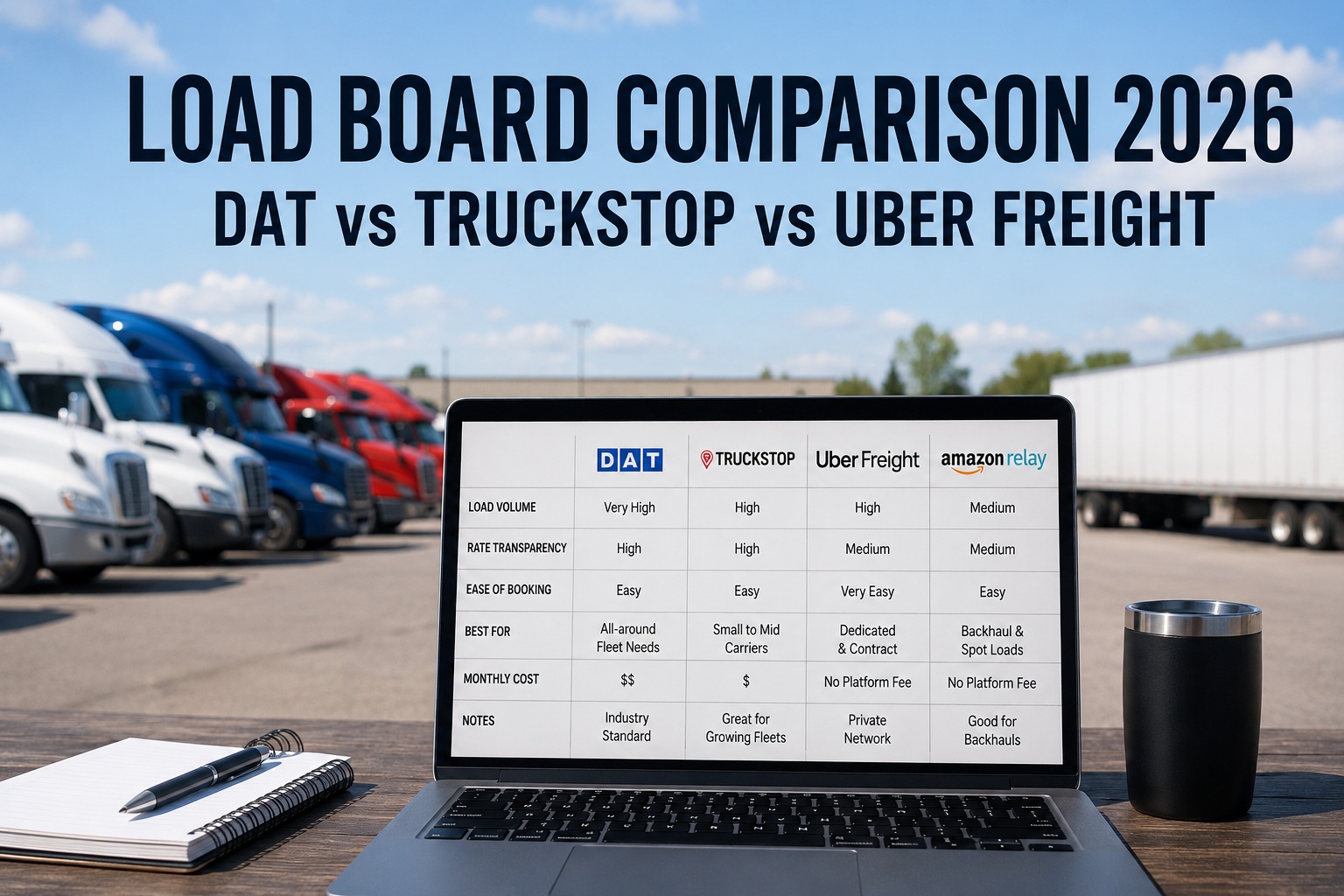
Here's the honest side-by-side. Pricing is approximate, verified against multiple 2026 sources, and moves — spot markets and subscription tiers change, so confirm live figures with each provider before you commit.
| Factor | DAT | Truckstop | Uber Freight | Amazon Relay |
|---|---|---|---|---|
| Model | Open board | Open board | Digital matching | Captive freight |
| Carrier cost | ~$45–200+/mo tiers | ~$39–150+/mo tiers | Free app | Free |
| Load volume | Largest, all types | Very large, strong flatbed | Growing, van/reefer | Amazon-only |
| Rate data | RateView (benchmark) | Rate Insights | Upfront algo rate | Upfront pay shown |
| Instant booking | Book It Now (tiers) | Book It Now (all tiers) | In-app tap | Book in app |
| Negotiation | Yes, broker-direct | Yes, digital counter | Limited (algo) | Limited; auctions/bids |
| Payment | Broker terms / factoring | Broker terms / factoring | Quick-pay ~2.5% fee | Weekly |
| Entry barrier | Subscription | App fee + subscription | Low | ~180-day authority |
| Best as | Primary open-market source | Primary / flatbed source | Convenience supplement | Stability layer |
Notice DAT and Truckstop both use tiered pricing — entry plans start under $50/month, and the rate-analytics features most carriers actually want sit a tier or two up. Many serious carriers subscribe to both to see the maximum freight, since some loads post to only one. Start free on HVI and track which source each booked load came from, so you know where your money actually originates.
Which fits your operation?owner-operator vs small fleet vs larger carrier
The best load board for a solo owner-operator isn't the best one for a 30-truck fleet. Here's the plain read by carrier profile — and remember, "best" almost always means a combination.
Start with one open board at the entry tier to learn to read loads and vet brokers, add Uber Freight for quick app books, and layer Amazon Relay if you qualify and run near a hub. Watch subscription cost against loads booked, and book a demo to confirm each source clears your cost per mile before you commit to it.
Both DAT and Truckstop usually earn their keep now — different loads on each, plus rate data to negotiate from. Relay contracts can stabilize a few trucks with predictable lanes. The priority shifts from finding any load to keeping every truck utilized without chasing deadhead.
Premium tiers, API integrations, and Relay contract auctions come into play. At this scale the load board is one input to a utilization strategy — the real question is fleet-wide cost per mile and asset uptime, not any single booking.
Across every profile, the pattern holds: diversify freight sources rather than depending on one, and judge each source by what it nets after costs, not its sticker rate. Book a demo to compare profitability by lane and by truck
The economics that actually decide profitwhy the posted rate is only the starting number
Here's the part load boards can't help with. Two carriers can book the identical load off the same board and end the week in opposite places — one profitable, one underwater — because gross revenue is where the analysis starts, not where it ends.
Deadhead is the silent killer — a great rate on a load 150 empty miles away can net less than a modest rate you're already positioned for. Maintenance and downtime are the slow killers: a truck that's earning today but skipping PM is borrowing against next quarter. This is exactly why the economics of a load and the health of the asset have to be read together. Start free and put real cost-per-mile numbers behind every freight decision.
From a small-fleet owner who runs all four
I used to chase the highest posted rate on DAT and feel like a genius. Then I actually costed it out. Half those "great" loads had me running 120 empty to get there, and my best-earning truck was the one quietly skipping oil changes to stay loaded.
Now I run DAT and Truckstop for open freight, Uber Freight when I want to book fast off the app, and Relay contracts to keep two trucks steady. But the real change was tracking cost per mile and maintenance per truck. The load board tells me what pays. My own numbers tell me what profits.
The bottom line on this load board comparisonbuild a mix, then measure it
There's no universal winner in this load board comparison, and any guide that crowns one is ignoring how much results swing by lane, equipment, season, and carrier profile. DAT leads on volume and its RateView benchmark. Truckstop counters with all-tier Book It Now and strong flatbed representation. Uber Freight wins on app speed and upfront pricing. Amazon Relay offers free, stable, drop-and-hook freight if you clear its entry bar. Most profitable carriers run a combination and let each source do what it's best at.
But the platform is only half the decision. The other half — the half that actually determines whether you keep the money — is what each load costs you after deadhead, fuel, maintenance, tires, repairs, and downtime. That's where HVI comes in: tracking utilization, operating cost, maintenance cost, and true cost per mile by vehicle, so you can tell whether one more load makes you money or just makes you tired. Book a demo and connect your freight decisions to your real fleet economics.
Frequently asked questions
Which load board is best in 2026 — DAT, Truckstop, Uber Freight, or Amazon Relay?
There's no single best load board for every carrier, and results vary by lane, equipment type, market conditions, carrier profile, and time of year. Each platform uses a different model. DAT and Truckstop are open load boards with the largest volume and broker variety — DAT is generally considered the volume leader with its RateView rate benchmark, while Truckstop is strong on flatbed and includes Book It Now instant booking across its tiers. Uber Freight is a digital freight-matching app with algorithmic upfront pricing and fast in-app booking. Amazon Relay is free access to Amazon's own captive freight, favoring contracts and drop-and-hook, but with strict entry requirements. Most successful carriers don't pick just one — they run a mix, using open boards for volume, Uber Freight for convenience, and Relay for stability. The right combination depends on your equipment, lanes, and how each source nets out after your operating costs.
How much do DAT and Truckstop cost carriers per month?
Both use tiered subscriptions, and published 2026 figures vary by source and plan, so treat these as approximate and confirm live pricing directly with each provider. DAT generally runs from roughly $45 per month at the entry level up to $200 or more for higher tiers that include full RateView analytics and advanced features. Truckstop typically starts around $39 to $50 per month for its Basic plan (which includes Book It Now), with mid tiers roughly $79 to $150 and specialized or premium options higher; a non-refundable application fee may also apply, often credited toward the first month. Truckstop is frequently a bit cheaper tier-for-tier. Annual billing usually trims the monthly cost. Uber Freight and Amazon Relay have no subscription fee — Uber Freight monetizes through broker margin and optional quick-pay (around a 2.5% fee for fast payment), while Amazon Relay is free but pays through weekly settlement on its own freight.
Does Amazon Relay pay less than regular broker freight?
Carriers frequently report that Amazon Relay rates run somewhat below comparable broker freight on similar lanes — observations often cite roughly $200 to $300 per load less — though this varies by lane, season, and market conditions and isn't universal. What Relay offers in exchange is a different value package: zero subscription cost, transparent upfront pay, reliable weekly payment from a shipper that won't disappear, heavy drop-and-hook efficiency that reduces detention uncertainty, and carrier discount programs on fuel and insurance that can offset some of the rate gap. The tradeoffs are real too: you generally need around 180 days of operating authority to qualify, and relying on Relay alone can trap carriers in a low-rate cycle without broker relationships. The consensus is that Relay works best as a supplement or stability layer rather than a sole freight source. As with any platform, judge it on all-in trip profitability, not the posted rate alone.
How do deadhead and empty miles affect load board profitability?
Deadhead — the empty miles you run to reach a load or return from one — is one of the biggest hidden drains on load board profitability, because those miles burn fuel, add wear, and pay nothing. A load posted at an attractive rate can actually net less than a lower-rated load you're already positioned for, once you subtract the cost of repositioning to it. That's why comparing loads purely by posted rate per mile is misleading: a $2.50/mile load 150 empty miles away may lose to a $2.00/mile load at your current location. Smart carriers factor deadhead into every booking decision and try to chain loads to minimize empty repositioning. Measuring your empty-mile percentage and its cost across the fleet turns deadhead from an invisible leak into a managed number. Fleet analytics that track loaded versus empty miles, fuel, and cost per mile by vehicle let you see which freight sources and lanes actually keep your trucks earning rather than repositioning.
How can fleet software help me choose better loads?
Fleet software doesn't find loads — that's the load board's job — but it answers the question the load board can't: was the load actually worth running? A CMMS and fleet-analytics platform like HVI tracks vehicle utilization, mileage, loaded versus empty miles, operating cost, maintenance cost, downtime, and true cost per mile by vehicle. That lets dispatch and fleet teams evaluate gross freight revenue against the full cost of earning it — deadhead, fuel, driver cost, maintenance, tires, repairs, and downtime — so you know whether an additional load improves fleet profitability or just adds wear and hours. Over time you can see which freight sources, lanes, and trucks are genuinely profitable versus which just look busy. It also keeps preventive maintenance on schedule so the trucks you're loading heavily don't fail and turn a profitable week into an expensive one. You can start free and connect freight decisions to real operating economics in one platform.
Measure whether every load actually improves fleet profitability
HVI tracks utilization, mileage, empty miles, operating cost, maintenance cost, downtime, and cost per mile by vehicle — so dispatch and fleet teams can see past the posted rate to real profit. Connect your freight decisions to the economics of running the truck. One platform, mobile-first, live in under two weeks.
No credit card · Works with any load board · Cost-per-mile analytics on day one