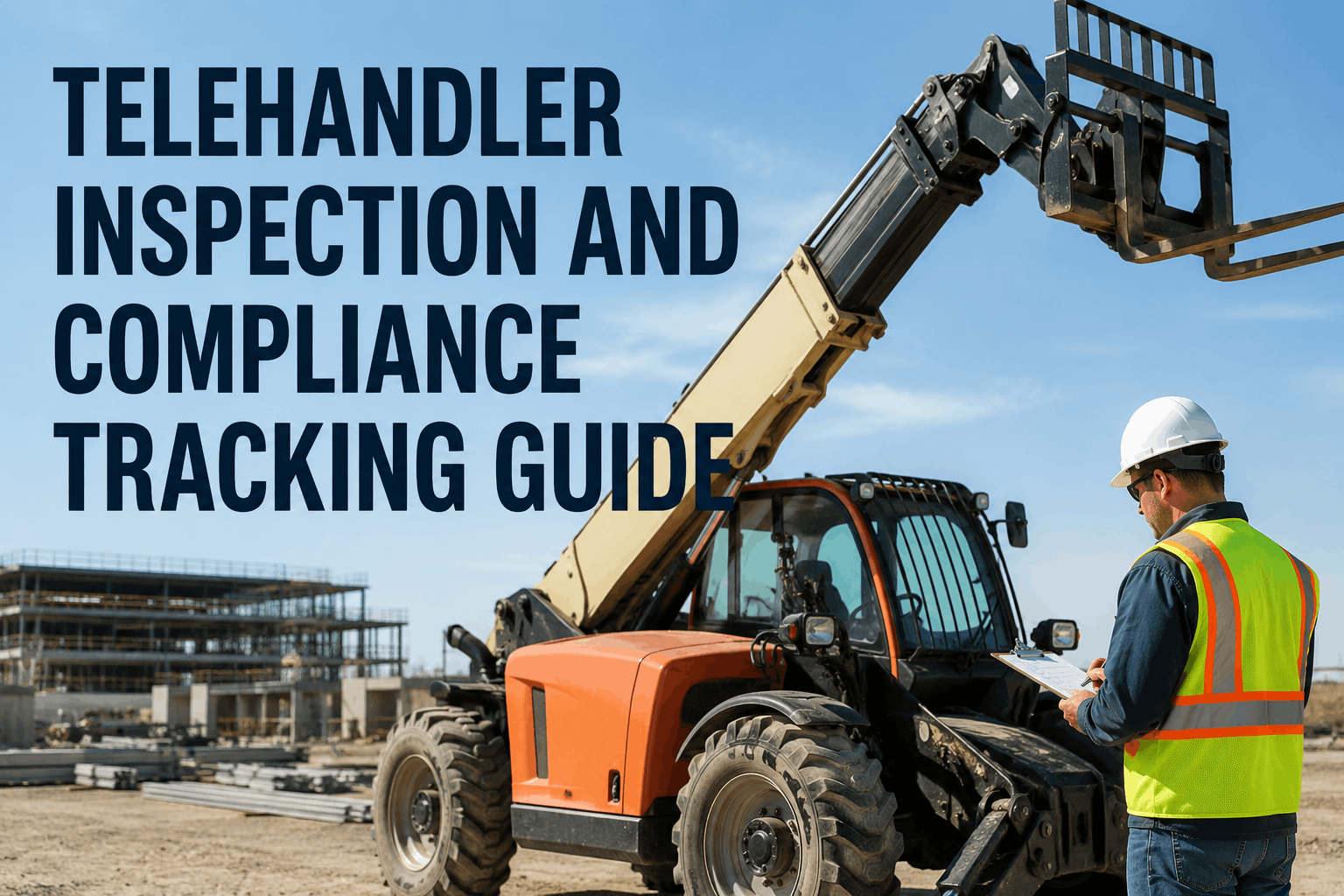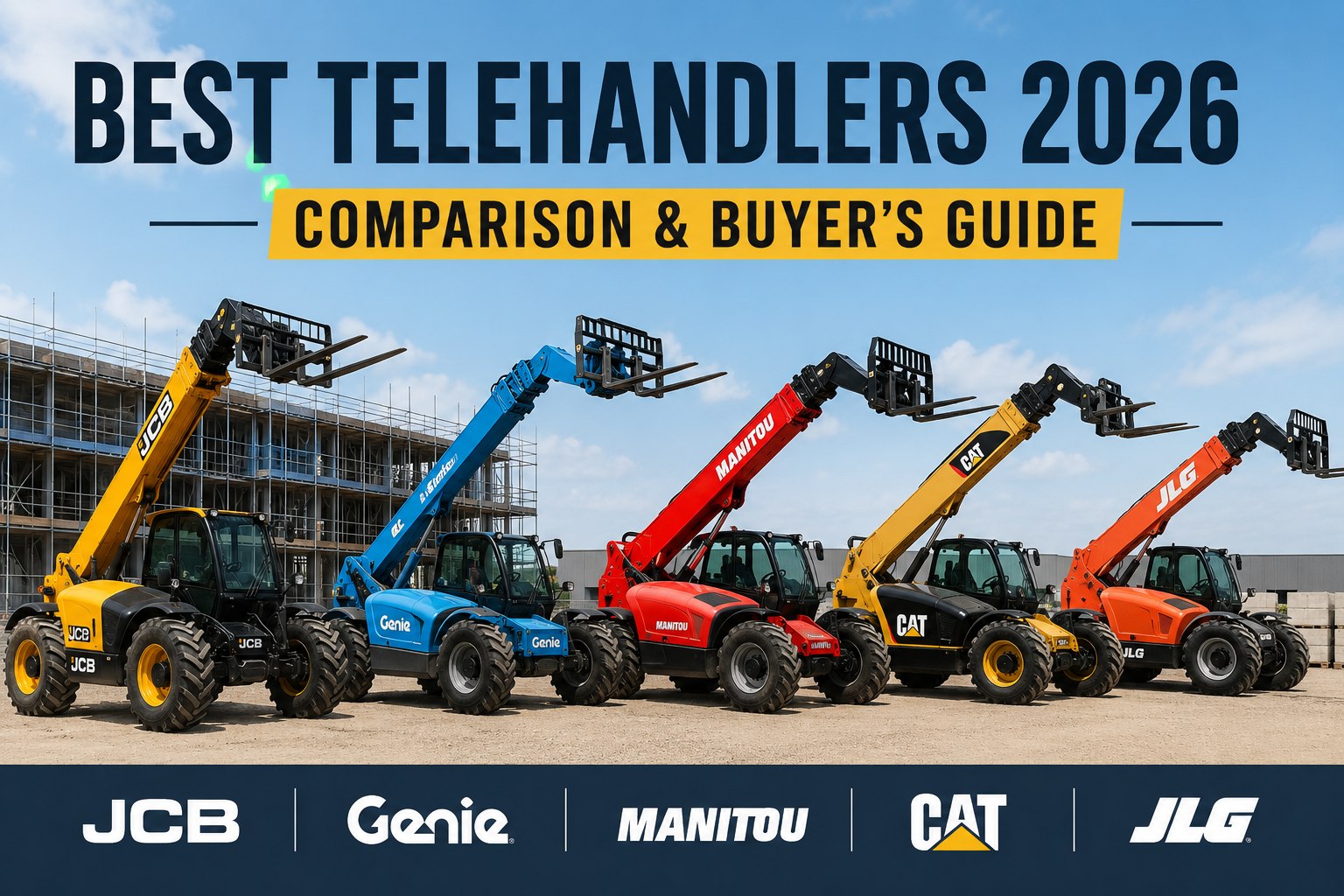
You're standing on a jobsite watching three telehandlers work — one hoisting drywall to a fifth floor, one running masonry pallets across mud, one placing rooftop HVAC. All three have telescopic booms. All three cost between $60,000 and $200,000. And every one of them was picked for a different reason. That's the honest starting point when you're choosing among the best telehandlers of 2026: there's no single winner. There is a right machine for your lift heights, your load weights, your terrain, your service radius, and your inspection discipline — and a wrong one that sits in the shop three weeks a year eating your margin. This guide walks you through the five brands buyers actually shortlist — JCB, Genie, Manitou, Cat, and JLG — how their popular models stack up, and how to keep whichever one you buy running once it's on your yard. Book a demo after you've picked yours.
The five brands that hold the North American market
Combined, these five names take roughly 80% of new and resale telehandler volume. Ranked by 2026 share estimates.
Share estimates blended from EquipmentWatch resale data and 2026 market intelligence reports. Skytrak (JLG-owned) and Gehl (Manitou-owned) are counted under their parent brands.
Before you pick a brand, you have to pick a spec. Buyers who reverse this order — brand first, then spec — are the ones who end up renting a second machine six months in because the first one couldn't reach a mezzanine or couldn't fit through a warehouse door. Start here.
Before you compare brandsthe 5 numbers to lock down first
Lift capacity at max reach
The sticker capacity is at the boom's shortest length. At full forward reach, most machines drop to 25–40% of that number. A 10,000 lb telehandler often lifts only 3,500 lb at 40 feet out. Look at the reach chart, not the model badge.
Max lift height
Match this to the tallest wall or the tallest roof pitch you regularly service. Light-duty units top out around 19–22 feet. Mid-duty runs 42–56 feet. High-cap and rotating units reach up to 97 feet. Overbuying height costs fuel and turning radius.
Terrain & steering modes
Rough ground needs permanent 4WD and three steering modes (front, four-wheel, crab). Smooth-yard operations can survive with less. Ground clearance under 15 inches becomes a real problem on wet excavation work.
Attachment ecosystem
A telehandler is a platform. Forks, buckets, jibs, grapples, sweeper brooms, work platforms — the machine's real ROI is its attachment library. Quick-attach standards vary by brand, so pick a coupler system before you pick the machine.
Service network & parts pipeline
This is the number that doesn't show up on a spec sheet and quietly decides whether the machine makes money. A brand with three dealers within your radius will out-earn a "better" machine that has one dealer 400 miles away. Ask for the parts fill-rate before the price.
Once you've locked in the target for all five — capacity, height, terrain, attachments, service radius — brand comparison actually becomes simple. You're just choosing between the two or three models across brands that actually meet your spec. That's usually a shortlist of three or four machines, not ten. Book a demo to see how HVI tracks each of these against inspection and maintenance data
The five brands, one at a timewhat each is genuinely good at
Every brand has champions, and every brand has a duty cycle where it stops making sense. Here's the honest read on where each one wins.
JLG + SkyTrak
Hagerstown, MD · USABest for: Commercial construction, rental fleets, high-reach masonry and steel erection, and jobs that need one supplier covering everything from a 5,500 lb compact to a 26,000 lb rotator.
The edge: JLG owns SkyTrak, giving buyers two badge options on similar mid-range machines. The R-series rotating telehandlers deliver 360-degree upper-frame rotation for tight-quarter placement. The 1644, 1732, and 2733 high-capacity units cover heavy industrial lifting where competitors run out of steam.
The trade-off: JLG uses a componentized supply chain (third-party engines, axles, transmissions). Great for parts pricing, but service diagnostics can bounce between vendors. Dealer coverage is broad but not always deep on parts stock.
Caterpillar Cat TH-series
Peoria, IL · USABest for: Owner-operators and fleets where dealer density, parts availability, and residual value matter more than niche features. Cat telehandlers hold roughly 15% more resale value than the segment average across a 5-year lifecycle.
The edge: The new TH-series replaces the older TL lineup with a Cat-built C3.6TA 74 HP engine (115 HP option available), rearview cameras standard, operator-presence seat switches, and multi-operator security codes for up to 50 users. Cat Product Link telematics feed data directly into fleet dashboards.
The trade-off: Narrower spec envelope than JLG or Manitou — only 7 models, capped at 12,000 lb and 55 ft. If you need higher reach or a rotating boom, Cat isn't in the room.
Genie by Terex
Redmond, WA · USABest for: Rental yards, urban commercial sites, and mid-size contractors who value operator familiarity and easy field serviceability. GTH-5519 is one of the most rented telehandlers in North America.
The edge: Rental-ready controls layout — the operator interface has stayed intentionally consistent across model years so drivers who trained on one Genie can jump into another and be productive in minutes. Service access is unusually open for a machine this size.
The trade-off: Genie doesn't compete in the high-capacity or rotating segments. If a job routinely needs more than 15,000 lb or more than 56 ft of reach, you're shopping elsewhere.
JCB
Rocester, Staffordshire · UKBest for: Buyers who value integrated engineering — JCB builds engines, transmissions, and axles in-house, which means one warranty, one parts book, one diagnostic tree. The DualTech VT hybrid transmission bridges hydrostatic and powershift efficiencies on rough terrain.
The edge: The Tier 4 Final EcoMAX engine hits emissions targets without needing diesel exhaust fluid. Naming is transparent: the JCB 510-56 lifts 10,000 lb to 56 feet — the numbers tell you the spec.
The trade-off: Dealer density is thinner in North America than JLG or Cat. In regions with strong JCB dealer presence this is a non-issue; in regions without one, parts wait times can matter.
Manitou + Gehl
Ancenis · France (US production: Yankton, SD)Best for: Any operation that runs mixed duty cycles. Manitou's catalog spans agricultural handlers (MLT), rotating construction booms (MRT), heavy-duty industrial (MHT), and the new North American-built MTA series — so a single supplier can cover a diversified fleet.
The edge: The 2025-launched MTA 1242 Max adds heavy-duty outriggers that increase mid-range lifting capacity by 2,500–4,000 lb versus the previous generation, and the perpendicular engine mounting on new MTA models opens both sides of the engine for service — a real difference on fleet maintenance time.
The trade-off: A catalog of 52 models means the sales conversation takes longer. Pin down your spec before you walk in or you'll get pitched three machines in three price tiers.
Head-to-headpopular mid-range models compared
Every buyer eventually lands in the 8,000–12,000 lb, 40–56 ft range — the sweet spot for general contracting, framing, roofing, and mixed material handling. Here's how the five brand's most popular machines in that segment line up.
| Spec | JLG 1055 | Cat TH1055 | Genie GTH-1056 | JCB 510-56 | Manitou MTA 1242 Max |
|---|---|---|---|---|---|
| Max lift capacity | 10,000 lb | 10,000 lb | 10,000 lb | 10,000 lb | 12,000 lb |
| Max lift height | 55 ft | 55 ft | 56 ft | 56 ft | 42 ft |
| Max forward reach | ~42 ft | ~42 ft | ~42 ft | ~43 ft | ~30 ft |
| Engine power | 117 HP | 74 / 115 HP | 117 HP | 109 HP EcoMAX | 74 HP (E74) / 130 HP |
| Transmission | Powershift | Powershift | Powershift | DualTech VT | 5-speed auto |
| Steering modes | 3 | 3 | 3 | 3 | 3 |
| Outriggers | Yes | Yes | Yes | Optional | Yes (HD) |
| Est. new price (2026) | $110K – $135K | $115K – $140K | $100K – $125K | $105K – $130K | $120K – $150K |
Pricing is indicative for new units at typical U.S. dealer configuration; exact quotes vary by attachments, cab spec, and dealer region. Reach charts drop lift capacity sharply at maximum forward extension — always consult the manufacturer chart before spec'ing a job.
The specs cluster tightly on paper because this is a mature segment — every brand engineers to the same real-world job. The differentiation shows up in operator ergonomics, dealer support, and total cost of ownership, which is what the next section is about. Start free and track spec-vs-actual performance for every unit in your fleet
Match the machine to the joba quick decision guide by project type
Spec sheets only get you to the shortlist. Duty cycle picks the winner. Here's the fastest way to narrow it down.
General contracting & framing
Palletized drywall, framing bundles, roof trusses, HVAC placement to 5 stories.
Heavy commercial & steel erection
Structural steel, precast panels, curtain-wall glass, high-elevation material placement.
Agriculture & livestock
Round bales, silage, feed handling, machinery yard work, mixed-attachment duty year-round.
Rental & multi-operator fleets
Rotating operators, no dedicated driver, high machine turnover, easy service critical.
Mining & industrial yards
Heavy raw material, tire handling, plant maintenance, punishing duty cycles.
Tight urban & rotating work
Confined sites, placing loads over obstacles, working around traffic, mixed-angle lifts.
Notice how much overlap there is at the top-three level — that's what your final decision usually comes down to: local dealer support, financing terms, and what you already have in-shop parts and technician training for. Book a demo to see the fleet-composition dashboard
Sticker price is 15% of what you'll spendthe total cost of ownership breakdown
Two identical telehandlers with identical sticker prices can differ by $80,000–$120,000 across a 7-year life — before resale. Here's where the real money goes, and where inspection and maintenance discipline changes the number the most.
The three lines that inspection and maintenance software directly moves — maintenance, unplanned downtime, and compliance — add up to roughly half of total cost of ownership. That's why fleets running digital inspections, meter-based preventive maintenance, and centralized work-order tracking consistently report around 25% lower annual maintenance cost within the first year of adoption.
Under OSHA 1910.178(l), any authorized inspector can drop in and check whether operators have current training — and telehandler-related tip-overs account for a significant share of construction site fatalities. Missed maintenance citations under 29 CFR 1926 typically run $7,000–$15,625 each; serious violations tied to fatalities can reach $156,259. That's the "compliance" line quietly ticking up every day a fleet runs on paper. Book a demo to see how HVI turns the compliance line from risk into evidence
From a fleet manager who runs the shortlist
We used to run all-JLG because that's what we started with. Two years ago we added a couple of Cat TH1055s for a project in a region where the JLG dealer was three hours out and Cat had a shop 40 minutes away. The Cats aren't better machines — they're similar — but our uptime on that side of the fleet jumped noticeably because a same-day part is a same-day part.
What actually changed our numbers wasn't the brand mix, though. It was moving inspections off paper. Once the operators started running the pre-shift on a phone with photos on defects, the shop stopped guessing. Small hydraulic leaks got flagged before they became boom-cylinder rebuilds. That's the money.
Frequently asked questions
Which telehandler brand is best for construction in 2026?
There isn't a single "best" brand — each of the top five (JLG, Cat, Genie, JCB, Manitou) leads in a different lane. For commercial construction with mixed lift heights, JLG's model breadth is hard to beat; for owner-operators focused on resale value and dealer density, Cat's TH-series is a strong pick; for rental fleets and urban commercial work, Genie GTH models are the familiar workhorses; for buyers who want in-house drivetrain integration, JCB stands alone with its EcoMAX engine and DualTech VT transmission; and for mixed-duty fleets that need everything from ag to heavy industrial in one supplier, Manitou's 52-model catalog covers the widest ground. The best answer for your specific operation depends on required lift capacity and height, terrain, attachment ecosystem, and — often the deciding factor — how close and how well-stocked the nearest dealer is.
How much does a new telehandler cost in 2026?
New telehandler pricing in 2026 typically runs from around $59,500 for the smallest compact models (5,000–5,500 lb capacity, 18–22 ft lift height) up to over $200,000 for large rotating and high-capacity units. The sweet spot for general construction — a 10,000 lb, 55-foot mid-range machine like the JLG 1055, Cat TH1055, Genie GTH-1056, or JCB 510-56 — generally lists between $100,000 and $140,000 depending on brand, cab specification (open vs. enclosed with AC), attachments, and dealer region. High-capacity units (17,000–27,000 lb) and rotating telehandlers can run $180,000–$300,000+. Remember that acquisition is only about 15% of 7-year total cost — fuel, maintenance, downtime, and compliance carry the other 85%.
Do telehandler operators need OSHA certification?
Yes. Under OSHA standard 1910.178(l), telehandlers are classified as Class 7 powered industrial trucks, and operators must complete formal instruction, hands-on practical training, and an employer-led operator evaluation before they can operate one on the job. Certification must be renewed every three years, and additional retraining is required after any observed unsafe operation, near-miss, or accident. Certified operators are typically issued a wallet-sized operator card. Employers are legally responsible for providing this training and for documenting completion — missing paperwork is one of the most common OSHA citations found during unannounced construction site inspections. Under 29 CFR 1926, individual violations can run from around $7,000 up to $156,259 for serious violations.
How often should a telehandler be inspected?
Telehandler inspections follow a multi-tier schedule. Pre-shift daily inspections are required before every use under OSHA 1910.178 — typically a 10–15 minute walk-around covering tires, hydraulics, forks, boom, controls, safety systems, and fluid levels. Periodic inspections (monthly or quarterly) go deeper into hydraulic components, electrical connections, and structural components. Annual comprehensive inspections should be performed by a qualified third party and documented with formal certification — retained on file for at least three years. Special inspections are required after any incident, contact with electrical lines, or significant repair. Daily inspections alone can catch approximately 60% of potential equipment failures before they become operational issues.
What's the difference between a telehandler and a forklift?
A traditional forklift has a fixed vertical mast — it lifts loads straight up, in a warehouse or on a smooth loading dock, and can't reach outward. A telehandler (also called a telescopic handler, boom forklift, or reach forklift) has an angled telescoping boom that extends both up and forward, giving it far more reach and letting it place materials at height and at a distance from the machine itself. Telehandlers are also built for rough terrain — four-wheel drive, high ground clearance, and often multiple steering modes (front, four-wheel, crab). That's why forklifts dominate warehouses while telehandlers dominate construction sites, farms, and outdoor material yards. The trade-off: telehandlers cost significantly more, require different operator certification, and have more complex maintenance profiles — especially the hydraulic and boom systems.
Whichever telehandler you buy in 2026, HVI keeps it earning
Digital pre-shift inspections from the operator's phone. Meter-based preventive maintenance schedules per manufacturer specs. Work orders auto-generated from failed inspection items. OSHA-defensible documentation across every site. HVI works with JCB, Cat, Genie, JLG, Manitou — and every other brand in your yard. Live in under two weeks.
No credit card · No hardware · Telehandler-ready templates on day one