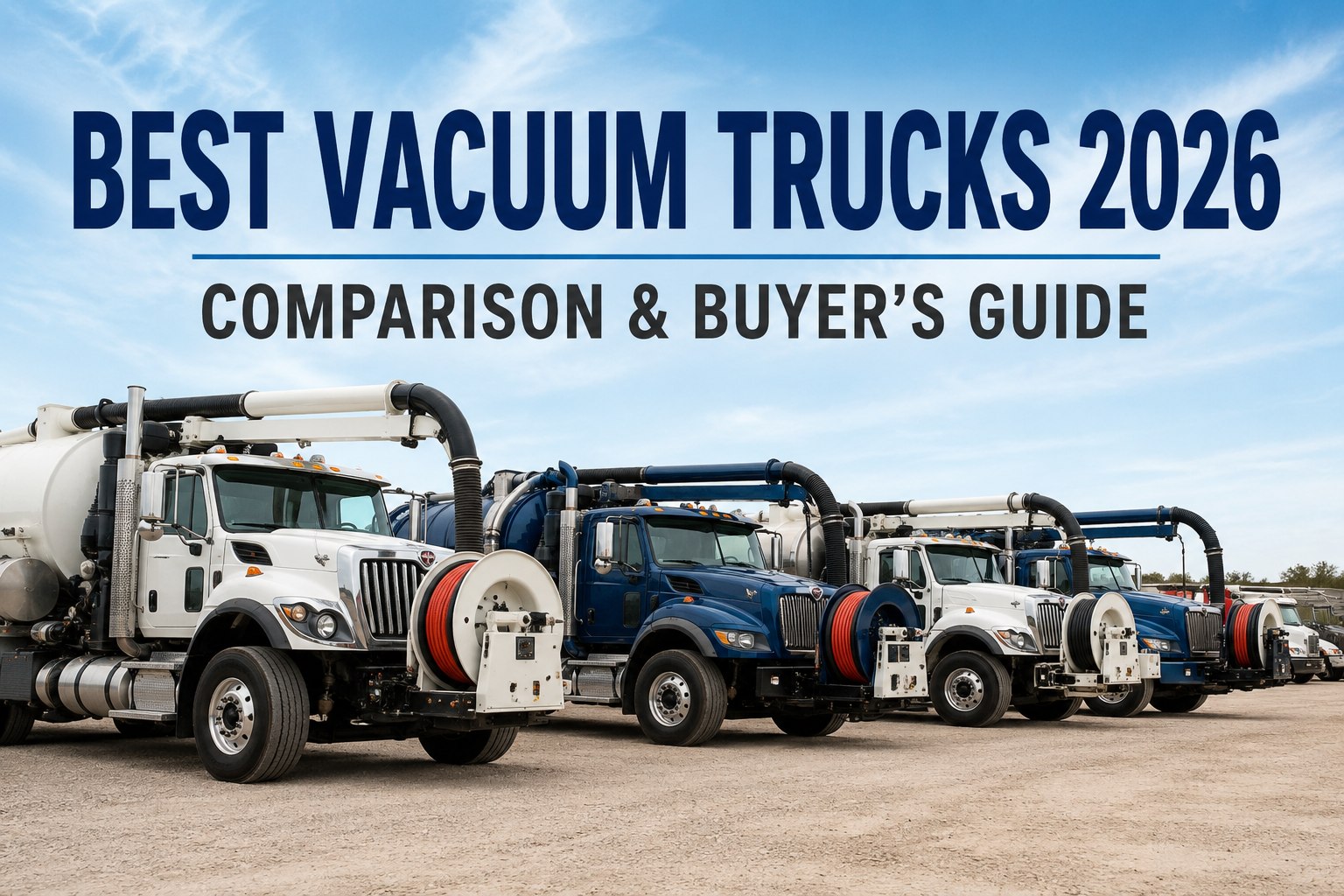
The best vacuum trucks of 2026 vary meaningfully by what you're cleaning up — a municipal storm-sewer maintenance program has a very different capability set from utility hydro excavation crews exposing gas lines or industrial contractors handling refinery cleanup. Five vacuum truck categories dominate the 2026 commercial market — combination sewer cleaners, hydro excavation trucks, air excavation trucks, industrial vacuum trucks, and liquid vacuum tankers — served primarily by four manufacturers (Vactor, Vac-Con, Vermeer, Super Products) with meaningfully different specialty focus, tank capacities, and dealer support networks. This best vacuum trucks 2026 buyer's guide walks the five categories with tank and suction specs, an application-to-spec requirements matrix, a head-to-head brand comparison table, the leading manufacturers detailed, and the mistakes municipal and industrial fleets make when spec'ing vacuum trucks. Book a demo to see vacuum truck inspection, PM scheduling, and DOT compliance on the HVI dashboard.
A vacuum truck is a commercial vehicle mounted with a heavy-duty vacuum system, debris tank, and (in most configurations) a water tank for material transport. The five dominant categories in 2026 are combination sewer cleaners (jet + vac for municipal sewer work), hydro excavation trucks (water + vacuum for utility digging), air excavation trucks (compressed air alternative to hydro), industrial vacuum trucks (refinery and heavy cleanup), and liquid vacuum tankers (septic and industrial liquid transport). All fall under DOT regulation and typically require CDL-holding operators.
5 Vacuum Truck Categories in 2026
Every buyer decision starts with the category. Application, spec requirements, and regulatory context drive the choice before brand enters the conversation.
Jet + vacuum in one unit. Industry standard for municipal sewer and storm cleaning.
Water-jet digging + vacuum extraction. Non-destructive utility exposure.
Compressed air digging + vacuum. Preferred where wet spoil is problematic.
Heavy-duty wet/dry vacuum. Handles hazardous cleanup and refinery work.
Basic vacuum tanker for liquid pickup and transport. Simplest configuration.
The five categories above are the shortlisting starting point. Below is the application-to-spec requirements matrix, the head-to-head manufacturer comparison, brand detail, application-based recommendations, and the recurring mistakes municipal and industrial fleets make on vacuum truck purchases.
Vacuum truck spec requirements matrix by application
Match your primary application to the spec priorities below. Undersize any critical spec and productivity suffers on every call; oversize and you're paying for capability you never use.
| Application | Debris tank | Water tank | Suction (CFM) | Boom reach | Hose diameter |
|---|---|---|---|---|---|
| Sewer/storm cleaning | 10–16 cy | 1,000–1,500 gal | 4,500–5,500 | Not required | 8" |
| Hydro excavation | 8–18 cy | 1,500–3,000 gal | 5,000–6,500 | 25–32 ft | 6"–8" |
| Air excavation | 10–16 cy | Small (rinse only) | 5,000–6,000 | 25–32 ft | 6"–8" |
| Industrial cleanup | 15–27 cy | Optional | 18,000–27,000 | Not required | 8"–10" |
| Septic pumping | Not required | Not required | 3,000–4,000 | Not required | 4"–6" |
| Catch basin cleaning | 10–14 cy | 500–1,000 gal | 4,000–5,000 | Optional | 8" |
The single biggest spec mismatch across the industry is undersizing debris tank on hydro excavation trucks. Crews finish 40–60% of the productive day driving to and from the dump site because the tank fills too quickly. Right-sized tank capacity pays back through billable-hour capture, not sticker-price savings. Book a demo to see per-truck productivity tracking
Vactor vs Vac-Con vs Vermeer vs Super Products — brand comparison
The 2026 head-to-head: Vactor leads the combination sewer cleaner market. Vac-Con offers strong full-line competition. Vermeer specializes in hydro excavation. Super Products is premium-tier hydro exc and sewer.
| Attribute | Vactor | Vac-Con | Vermeer | Super Products |
|---|---|---|---|---|
| Market position | Sewer market leader | Full-line competitor | Hydro exc specialist | Premium hydro/sewer |
| Parent company | Federal Signal | Holden Industries | Vermeer Corp | Federal Signal |
| Sewer cleaner range | 2100 / 2115 series | V-390, X-Cavator | Not offered | Camel series |
| Hydro exc range | HXX ParaDIGM | X-Cavator | VXT300, XR2 | Mud Dog series |
| Max debris tank | 16 cy | 16 cy | 18 cy | 27 cy |
| Max water tank | 1,500 gal | 1,500 gal | 1,600 gal | 3,000 gal |
| Dealer network (NA) | Largest | Very large | Very large (agri + utility) | Regional |
| Typical pricing tier | Premium | Premium | Mid to premium | Premium+ |
| Best fit | Municipal sewer fleets | Full-service ops | Utility contractors | Large-tank hydro/sewer |
Note that Vactor, Guzzler, and Super Products are all Federal Signal Environmental Solutions Group brands — they share some parts availability and dealer network overlap. Vac-Con and Vermeer operate independently. Cross-shopping across parent companies is standard on any purchase above $400,000. Book a demo to see multi-brand vacuum fleet tracking
4 leading vacuum truck manufacturers — detailed
Chassis choice matters as much as body brand. Freightliner M2 112, International HV/HX Series, Peterbilt 348/337, and Kenworth T370/T880 are the common chassis platforms upfitted with vacuum bodies. Local dealer support for chassis AND body determines post-sale reliability. Start free and add multi-brand vacuum fleet tracking
Application-based vacuum truck recommendations
Match the application to the category first, then the category to the brand. Buying based on brand loyalty before understanding application creates the highest-regret vacuum truck purchases in municipal and industrial fleets.
5 mistakes fleets make when buying vacuum trucks
Undersizing debris tank on hydro excavation trucks
Fleet buys 8 cy debris tank to save capex on hydro exc truck. Crews finish 40–60% of the day driving between jobsite and dump. Billable-hour capture collapses. Right-sized tank would have paid back within 8 months.
Wrong category for actual work mix
Municipality buys industrial vacuum truck expecting to use it for sewer work. Suction is too aggressive for sewer flow, boom reach isn't there, jet capability isn't included. Wrong-category truck sits underused.
Ignoring EPA waste disposal integration
Fleet buys vacuum truck without a documented waste disposal plan (approved dump sites, manifest tracking, spill response protocols). First EPA audit or spill incident exposes the operational gap and creates liability.
Skipping chassis compatibility check with body brand
Buyer picks chassis from one manufacturer and body from another without confirming compatibility. Body upfit requires expensive chassis modifications or void chassis warranty coverage.
No inspection/PM system planned before purchase
Fleet buys vacuum trucks but has no digital system for DOT pre-trip inspections, vacuum pump PMs, hose inspections, or work orders. Compliance drifts to paper logs that get lost. DOT audit or EPA inspection exposes the gap.
Every mistake above shows up within the first year of operation, either on productivity metrics, EPA/DOT audits, or unplanned downtime. Get the category, tank sizing, disposal plan, chassis compatibility, and inspection framework right at shortlisting, and the truck pays back consistently. Book a demo to see vacuum truck workflow — or start free and deploy this week .
Related vacuum truck questions buyers ask
What's the difference between hydro and air excavation?
Hydro excavation uses high-pressure water plus vacuum to expose buried utilities. Air excavation uses compressed air (185+ CFM) plus vacuum. Hydro is faster in most conditions but produces wet spoil. Air produces dry spoil suitable for reuse and works in freezing conditions where hydro doesn't.
Do vacuum truck operators need special certification?
DOT/CDL required for any truck above 26,001 lb GVWR (all commercial vacuum trucks). Confined space entry certification required for sewer work under OSHA 29 CFR 1910.146. HAZWOPER training required for hazardous cleanup. Utility hydro exc operators often carry 811 (Call Before You Dig) certification.
How much does a hydro excavation truck cost?
New hydro excavation trucks in 2026 range $400,000–$750,000 depending on tank sizing, chassis, and options. Entry-level 8 cy debris tank on smaller chassis lands near $400K; premium 18 cy debris + 3,000 gal water on Class 8 chassis with tandem axle exceeds $700K. Used trucks 3–5 years old typically 50–65% of new price.
Vactor vs Vac-Con — which brand is better?
Both are premium-tier combination sewer cleaner manufacturers with strong dealer networks. Vactor is the market leader in municipal sewer with the largest dealer network. Vac-Con offers competitive full-line coverage and strong X-Cavator hydro excavation option. Choice often depends on local dealer support and existing fleet standardization.
What DOT and EPA rules apply to vacuum trucks?
DOT: pre-trip DVIR under 49 CFR 396, HOS rules above 26,001 lb GVWR, CDL required, annual DOT inspection. EPA: waste manifest tracking under 40 CFR 262 for hazardous debris, spill response plan required, dump site approval by state agency, chain of custody documentation. State-level permit requirements vary widely.
From a utility contractor who spec'd 5 hydro exc trucks last year
Our first two hydro exc purchases three years ago were 8 cy debris tank on Class 7 chassis — the "starter spec" the dealer recommended. Reality hit fast. Crews were running to the dump 3 times a day on productive sites. On billable-hour math, we were losing 30–40% of the day to transit.
Last year we replaced them with 16 cy tandem-axle Vermeer XR2 units. Trips to dump dropped to once a day, sometimes zero on shorter jobs. Billable hours per truck per week jumped 35%. On a 5-truck order that math paid for the tank upgrade inside 9 months. The lesson is simple: on hydro exc, buy the biggest debris tank the chassis can carry, not the smallest one that fits budget.
Frequently asked questions
What are the best vacuum trucks to buy in 2026?
There is no single "best" vacuum truck — the right choice depends on application, tank sizing, and duty cycle. Five body categories cover the 2026 commercial market: combination sewer cleaners (municipal sewer/storm, jet + vacuum), hydro excavation trucks (utility potholing with water + vacuum), air excavation trucks (compressed air alternative to hydro), industrial vacuum trucks (refinery and spill response), and liquid vacuum tankers (septic and industrial liquid). Four body manufacturers dominate North America: Vactor (market leader in sewer cleaners, owned by Federal Signal), Vac-Con (full-line competitor owned by Holden Industries), Vermeer (hydro excavation specialist), and Super Products (premium hydro exc and sewer, also Federal Signal). Cross-shop the top three brands in whatever category matches your primary work mix. Chassis brand (Freightliner M2 112, International HV, Peterbilt 348, Kenworth T370/T880) matters as much as body brand for post-sale reliability.
What's the difference between a combination sewer cleaner and a hydro excavation truck?
Combination sewer cleaners are optimized for cleaning inside pipes and manholes: they combine a high-pressure water jet (typically 60–80 GPM at 2,000–2,500 PSI) with vacuum extraction and a debris tank in the 10–16 cy range. The jet loosens material, the vacuum extracts it. Best for municipal sewer maintenance, storm drain cleaning, and catch basin work. Hydro excavation trucks are optimized for digging holes to expose buried utilities without damaging them: they use lower-pressure water (8–15 GPM at 1,500–3,000 PSI) plus vacuum, with a longer boom reach (25–32 ft) and larger water tank (1,500–3,000 gal) because the crew is on the ground working from the boom. Best for utility potholing, daylighting gas and electric lines, and non-destructive digging where mechanical excavation could damage buried infrastructure. Some manufacturers (Vac-Con X-Cavator, Vactor HXX Prodigy) offer combo units that handle both applications reasonably well but neither optimally.
How much does a new vacuum truck cost in 2026?
Vacuum truck pricing in 2026 varies significantly by category and tank sizing. Combination sewer cleaner: $350,000–$650,000, with premium Vactor 2100 Plus configurations reaching the top of the range. Hydro excavation truck: $400,000–$750,000, driven primarily by debris tank size and chassis choice. Air excavation truck: $400,000–$600,000 depending on compressor package. Industrial vacuum truck: $300,000–$550,000, though HAZWOPER-configured units for hazardous cleanup can exceed $700K. Liquid vacuum tanker: $150,000–$350,000 as the simplest configuration. Heavy-duty large-tank hydrovacs (tandem-axle, 18+ cy debris, 3,000+ gal water) can exceed $1 million with premium options. Chassis choice adds meaningful variation: Class 7 chassis typically $30–50K less than equivalent Class 8. Financing terms typically 60–84 months for standard configurations; 84–120 months for high-capex hydrovac purchases. Used trucks 3–5 years old typically 50–65% of new price.
What DOT and EPA compliance rules apply to vacuum trucks?
Vacuum trucks fall under multiple regulatory frameworks. DOT requirements: USDOT number registration, daily pre-trip DVIR inspection under 49 CFR 396.11, Hours of Service (HOS) rules apply above 26,001 lb GVWR (all commercial vacuum trucks), CDL Class B minimum required, annual DOT inspection with certified inspector, drug and alcohol testing program for CDL drivers. EPA requirements: waste characterization before disposal, manifest tracking under 40 CFR 262 for hazardous debris, approved dump site documentation, chain-of-custody records retention (typically 3–5 years by state), spill response plan required. OSHA requirements: confined space entry certification under 29 CFR 1910.146 for manhole and vault work, HAZWOPER training for hazardous cleanup, LOTO procedures for pump maintenance. State-level permit requirements often add: municipal waste hauler permits, industrial discharge permits, specific route restrictions. Best-in-class fleets track all three compliance frameworks in an integrated software platform to avoid drift and audit exposure.
Should I buy a new or used vacuum truck?
Depends on utilization and cash position. New vacuum trucks deliver full warranty coverage on both chassis and body (typically 1–2 years comprehensive plus extended powertrain), latest efficiency and safety features, longer expected service life (10–15 years on chassis, 8–12 on high-wear body components), and easier parts availability. Used vacuum trucks 3–5 years old typically retail at 50–65% of new price and often carry clean maintenance history from municipal or fleet ownership — that's often the sweet spot for used purchases. Older trucks (7–10 years) carry higher risk on vacuum pump, PTO, and hydraulic system condition; those components are the most expensive rebuilds. Best-in-class buyers finance new for high-utilization units (1,500+ hours/year), consider 3–5 year used for occasional-use or fleet additions, and avoid units beyond 8 years unless full mechanical inspection confirms clean condition. Utilization above 2,000 hours/year almost always favors new purchase economics.
Related HVI guides for vacuum truck and heavy equipment fleets
Whatever vacuum trucks you buy, HVI runs the inspection and compliance
HVI captures DOT pre-trip DVIR inspections, vacuum pump PM schedules, hose and boom inspection intervals, waste disposal tracking, and repair work orders per unit. Multi-brand vacuum fleets tracked in one platform. Live in under two weeks — typical municipal and industrial fleets recover software cost from downtime reduction alone within the first quarter.
No credit card · No hardware · DOT-compliant DVIR templates ready day one