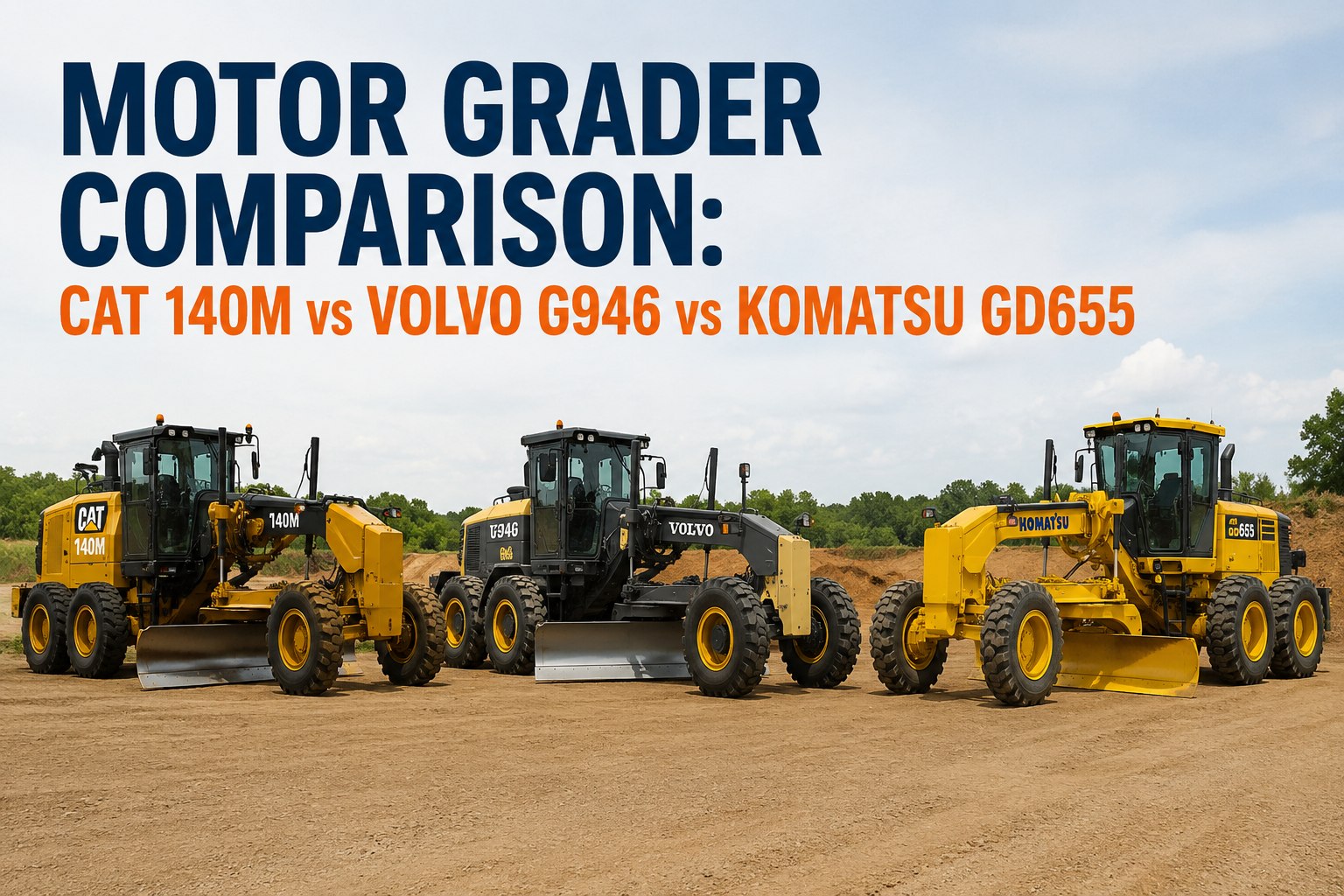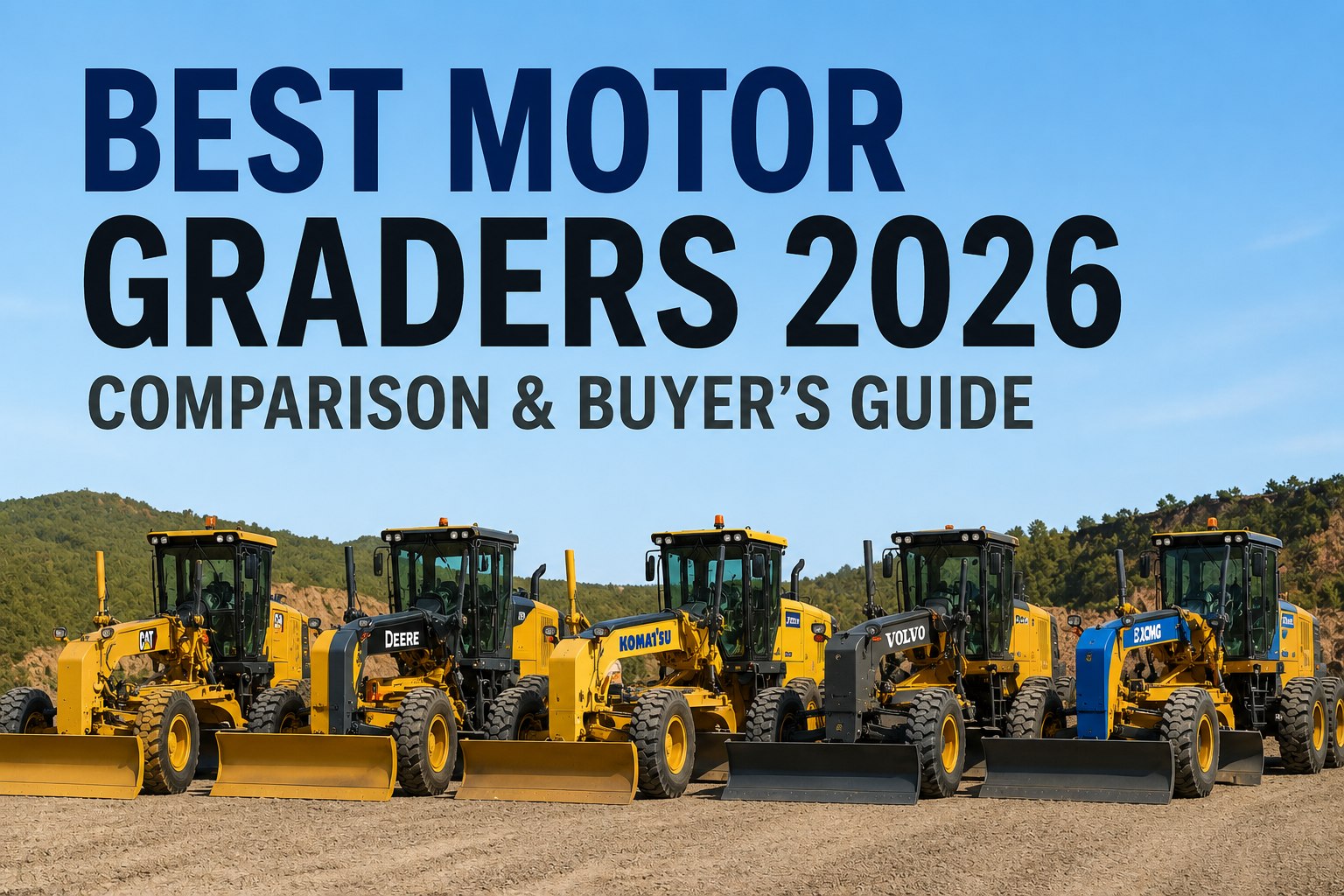
The best motor grader in 2026 depends less on the brand you buy than on the work you buy it for. A city plowing snow, a highway contractor cutting subgrade, a mining operation maintaining haul roads, and a road maintenance crew touching up existing pavement all need dramatically different graders — even though the same five brands (Cat, John Deere, Komatsu, Volvo, XCMG) build machines for every one of those jobs. This buyer's guide organizes the market by application first, then by class, then by brand. Class 2 (140-180 HP) is where most contractors land because it covers the widest range of road construction work while staying transport-friendly on standard lowboys. Match the application to the class, then compare five equivalent machines within the class. That's the decision most buyers can actually make. Book a demo to see the inspection, PM, and compliance layer that keeps a grader fleet earning revenue rather than parked for unplanned service.
The Application-First Grader Buyer's Map
Motor graders are chosen by the work, not by the brand. Pick the application quadrant, then compare within class.
Municipal & Snow
Road Construction
Heavy Subgrade
Mining Haul Roads
Class 2 dominates unit sales. Roughly half of every motor grader purchased in North America falls in the 140-180 HP range because it handles the broadest range of real-world work — road maintenance, general construction, moderate subgrade, moderate snow — while still fitting on a standard lowboy without special permits. If your work profile isn't sharply defined toward mining or toward light municipal use, Class 2 is where the comparison starts.
The 4 numbers that define the motor grader market in 2026
These four data points explain why the motor grader category rewards application-first shopping over brand loyalty and why the five dominant manufacturers all maintain lineups across the full HP spectrum.
- Class 2 140—180 HP class captures roughly half of North American grader sales
- 130—550 HP Full engine power range across all four application classes
- 12—16 ft Blade (moldboard) width spectrum — the primary work-output specification
- $200K—$1M+ Price spectrum from municipal Class 1 to mining Class 4 flagships
The $800,000+ spread between the smallest municipal grader and the largest mining flagship makes class selection the single most consequential decision. A contractor overshopping into Class 3 for work that Class 2 handles pays a six-figure acquisition premium and produces transport, operator training, and PM cost profiles they didn't need. Undershopping in the opposite direction produces a machine that finishes half the jobs at 90% and stalls on the other half. Book a demo to see class-specific PM tracking per machine
The 5 brand DNA cards — what each manufacturer does best
Every brand builds motor graders across every application class, but each has a distinct reputation and specialization. Here's the honest brand-level positioning based on what each does genuinely well.
Caterpillar
DNA: Market leader across all four classes. M Series graders (120M through 16M) plus the Cat 24 mining flagship at up to 550 HP. Cat Grade with Cross Slope, AccuGrade, and Cat Payload standard on newer M models.
Best for: Contractors prioritizing precision grade tech; large fleets standardizing on Cat platform; mining operations where the Cat dealer network provides the fastest downtime response.
John Deere
DNA: G-Series lineup (620G through 872G) plus newer 470/570 P-Tier for the light class. SmartGrade integrated 3D grade control (Topcon partnership) as factory option; industry-first automated blade positioning on select G-Series models.
Best for: Contractors running mixed Deere fleets; strong dealer coverage in agricultural + construction markets; SmartGrade appeals to precision road construction operators.
Komatsu
DNA: GD series (GD675-5 through GD955-5). Integrated Komatsu machine control on newer models; strong reputation for durability in mining and heavy-duty applications. Common in Latin American and Asian-market fleets.
Best for: Mining operations requiring extreme-duty reliability; contractors already running Komatsu excavators and dozers; markets with strong Komatsu dealer presence.
Volvo
DNA: G-Series graders (G930 through G976) known for cab comfort, low sound levels, and fuel efficiency. Volvo Co-Pilot with Load Assist and Compact Assist tech packages. Strong European heritage in road construction applications.
Best for: Long-shift operators where cab environment matters; road construction contractors; markets where Volvo compact and full-size equipment ecosystems already exist.
XCMG
DNA: Chinese OEM with fast-growing North American presence. GR series graders (GR215A through GR300). Emerging global player with meaningful price advantages and improving product quality year over year.
Best for: Value-focused buyers where acquisition cost dominates the decision; rental fleets deploying disposable-service-life economics; contractors with lower brand-loyalty and higher price sensitivity.
None of these five is objectively best. Cat wins on precision-tech maturity, Volvo on operator comfort, Komatsu on extreme-duty reliability, Deere on integrated 3D grade control, XCMG on acquisition value. The right brand for you is the one whose specialty matches your predominant application — and that's why organizing by application matters more than organizing by brand loyalty. Start free and manage multi-brand grader fleets on one inspection platform
The Class 2 head-to-head — the decision most contractors face
Class 2 (140-180 HP) is where the market concentrates. Five brands, five representative models, one specification comparison. If your grader shopping starts here, this table matters most.
All five machines cut the same subgrade profile for the same money in the hands of the same operator. The differentiation lives in tech package, cab environment, brand ecosystem, and acquisition price. Match the specific advantage to your predominant work profile rather than defaulting to whatever brand you already run. Book a demo to see multi-brand grader PM on one unified dashboard
The 8 buying criteria that separate a great spec from a compromised one
Beyond application class and brand choice, these eight specifications separate a motor grader that fits your operation from one that doesn't. Every one is decided at order stage.
The two amber-highlighted criteria — blade width vs application match and AWD decision — account for the majority of "I wish I'd spec'd it differently" complaints from first-time grader buyers. Get those right and the remaining six become straightforward optimization. Start free and get application-specific PM intervals loaded per machine
From a contractor who runs graders across three application classes
We run five graders. A Deere 620G for municipal snow contracts, three Cat 140s for our highway construction work, and a Cat 16M for a mining haul road contract. Different classes, different brands where the strengths fit, different work profiles.
What I learned running mixed brands: the Deere 620G is better at municipal snow than a Cat 120 would be at the same job, and the Cat 16M does mining haul road maintenance that no Deere G-Series can touch at the same class. Application drives the spec. Brand loyalty is what fills gaps in strengths you didn't need. Nine years running this fleet and I still don't have a single "brand of choice" — I have five specific tools for five specific jobs.
Frequently asked questions
Which motor grader brand is best in 2026?
There is no single best brand — the five dominant motor grader manufacturers each specialize in different strengths, and the right choice depends on your predominant application. Caterpillar leads the market with the deepest technology integration (Cat Grade with Cross Slope, AccuGrade, Cat Payload) across its M Series (120M through 16M) plus the Cat 24 mining flagship at up to 550 HP, making it the default choice for contractors who prioritize precision grade tech and for mining operations that value the Cat dealer network response time. John Deere's G-Series (620G through 872G) plus the newer 470/570 P-Tier line offers SmartGrade integrated 3D grade control as a factory option and appeals to contractors already running Deere equipment. Komatsu's GD series (GD675-5 through GD955-5) has a strong reputation for extreme-duty reliability, particularly in mining. Volvo's G-Series (G930 through G976) is known for cab comfort, low sound levels, and fuel efficiency, appealing to long-shift road construction operators. XCMG has emerged as a value-focused option with the GR series (GR215A through GR300), offering meaningful acquisition-cost advantages for rental fleets and price-sensitive buyers. The optimal brand depends on your class need, your predominant work profile, and your existing fleet composition — no purchase should be made on brand loyalty alone.
What HP motor grader do I need?
HP class follows application. Class 1 (sub-140 HP) motor graders like the Cat 120, John Deere 620G, Komatsu GD675-5, Volvo G930, and XCMG GR215A handle municipal work, light road maintenance, snow removal, and residential-scale grading with 12-foot moldboards typical. Class 2 (140-180 HP) is the market sweet spot for general road construction, moderate subgrade prep, and mixed municipal-plus-construction work, with 14-foot blades standard — this class captures roughly half of North American grader sales. Class 3 (180-220 HP) handles heavy subgrade, deep grading, and larger highway construction with 14-foot blades and heavier operating weights around 44,000-50,000 lb. Class 4 (220+ HP, up to 550 HP on the Cat 24) is dedicated to mining haul road maintenance and extreme-duty applications with 14-16 foot blades and operating weights above 50,000 lb. If your work isn't defined enough to place you in a specific class, start with Class 2 — it covers the widest range of practical jobs while staying transportable on standard lowboys without oversize permits. Overshopping a class up costs six figures in acquisition premium and produces transport, operator training, and PM cost profiles you may not need.
Do I need all-wheel drive (AWD) on a motor grader?
AWD adds roughly 15-25% to acquisition cost but genuinely transforms performance in specific conditions. If your work regularly involves mud, deep snow, steep grades, or unimproved surfaces, AWD produces meaningful productivity gains that pay back the premium — municipal snow contractors in northern markets, mountain-region road construction operators, and site development contractors working on unfinished ground routinely justify AWD. If your work stays predominantly on packed surfaces, established road grades, or dry conditions, AWD often can't earn back the premium — highway construction contractors in flat-terrain markets, precision subgrade specialists working on prepared ground, and municipal maintenance crews in dry climates commonly skip it. The intermediate case is regional variability: contractors working across mixed terrain and mixed seasons should look carefully at how many hours per year their work would benefit from AWD, versus how many hours would not. Retrofit is expensive and often impractical, so the decision needs to be made at order stage. If the answer isn't clearly yes or clearly no, most experienced fleet owners default to including AWD on the primary grader in a mixed-terrain fleet and skipping it on secondary units.
How much does a motor grader cost in 2026?
Motor grader pricing in 2026 spans roughly $200,000 for entry-level Class 1 municipal machines to well over $1 million for mining Class 4 flagships with full tech packages. Class 1 (sub-140 HP) municipal-focused units typically run $200,000-$350,000 depending on brand, configuration, and cab package. Class 2 (140-180 HP) road construction models run approximately $300,000-$500,000 for base configurations and $450,000-$700,000 with tech packages including 3D grade control, premium cab, and AWD. Class 3 (180-220 HP) heavy-duty models push $500,000-$850,000 with typical tech packages. Class 4 (220+ HP) mining-grade machines like the Cat 24 exceed $1 million with full precision-control packages. Beyond acquisition, budget for attachments (front dozer blade $15K-$30K, side wing $25K-$45K, snow packages $30K-$60K), operator training ($1,500-$5,000 per operator for grade-tech-equipped machines), transport equipment if your existing lowboy doesn't handle the chosen class ($20K-$80K), and 3D grade control retrofit if not factory spec'd ($40K-$120K). Financing typically runs 4-6% APR through manufacturer credit programs with 48-84 month terms. The used market is less liquid than for smaller equipment — 3-6 year old machines with 4,000-8,000 hours retain significant value but move slowly, making initial spec accuracy more important than for higher-volume equipment categories.
How does HVI help contractors manage a motor grader fleet?
Motor graders present a distinct inspection and maintenance profile that differs from on-road CMV compliance and from simpler compact equipment. Every machine needs pre-shift inspections covering hydraulic system pressure and temperature trends, moldboard and circle wear, articulation joint condition, tandem drive lubrication, cooling system integrity, and blade wear-part condition. PM scheduling runs by engine hours — typical intervals include 250-hour fluid and filter changes, 500-hour hydraulic system service, and 2,000-hour major overhauls. HVI centralizes all of it: photo-verified pre-shift inspections from operator phones with make/model-specific templates for Cat, John Deere, Komatsu, Volvo, and XCMG; PM scheduling triggered by engine hours with automatic 90/60/30-hour advance alerts; hydraulic system pressure and temperature trend tracking for early failure detection; moldboard and blade wear photo documentation with grease-interval reminders; work orders auto-generated from every reported defect with mechanic sign-off enforced; audit-ready records covering OSHA and site safety requirements for jobsite inspections. The specification decisions in this guide happen once at purchase. The daily inspection and maintenance workflow happens every shift. HVI makes that daily layer background — go live in under two weeks and see your motor grader fleet's compliance and PM cadence running from day one.
The right grader is the one that keeps earning hours. HVI makes sure it does.
HVI runs the pre-shift inspection, PM scheduling, hydraulic monitoring, and defect-to-repair workflow that keeps every motor grader in your fleet cutting grade instead of sitting for unplanned service. Make/model-specific templates for all five major brands. Engine-hours PM cadence built in. Audit-ready records generated automatically. Live on your fleet in under two weeks.
No credit card · No hardware · Multi-brand grader management day one