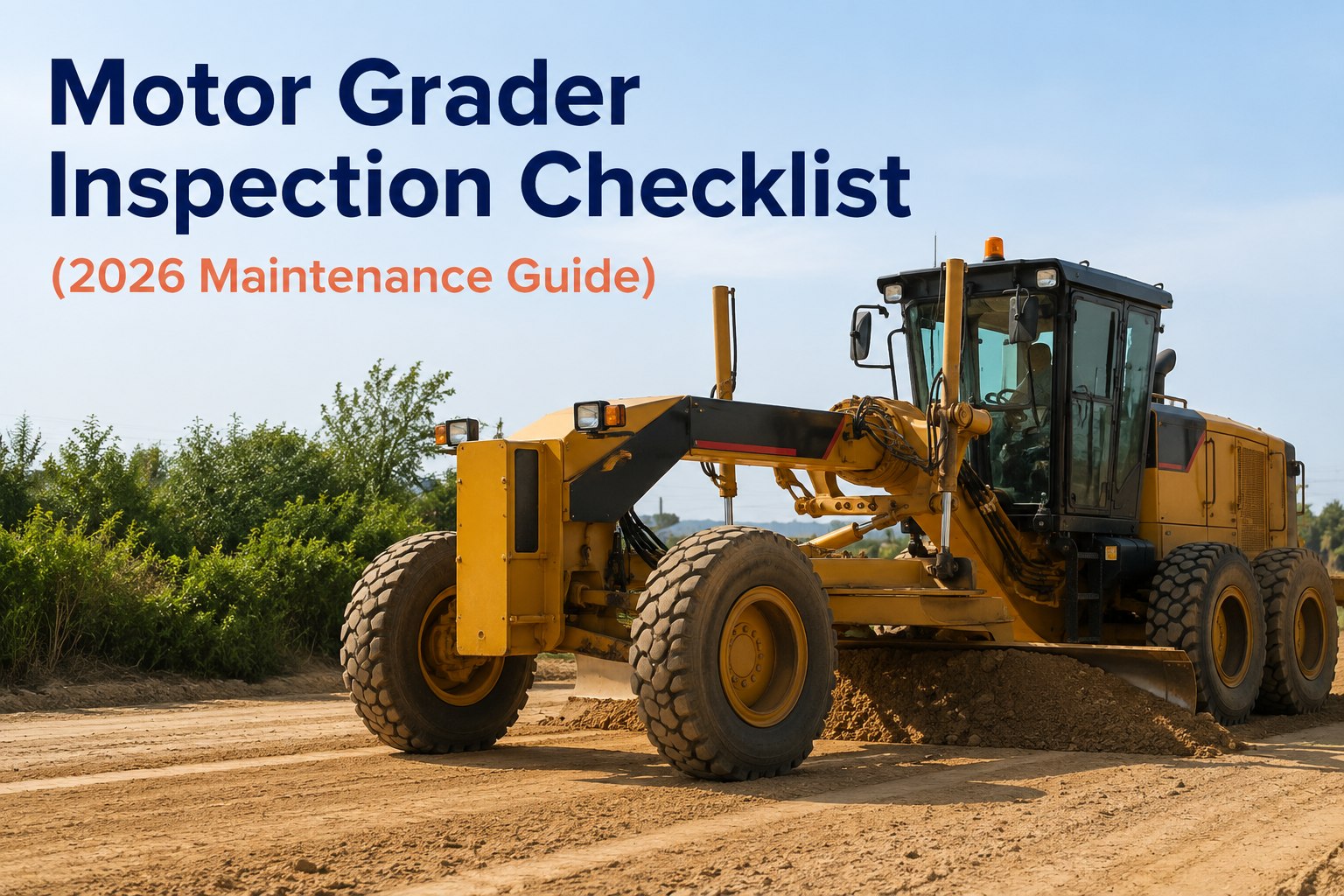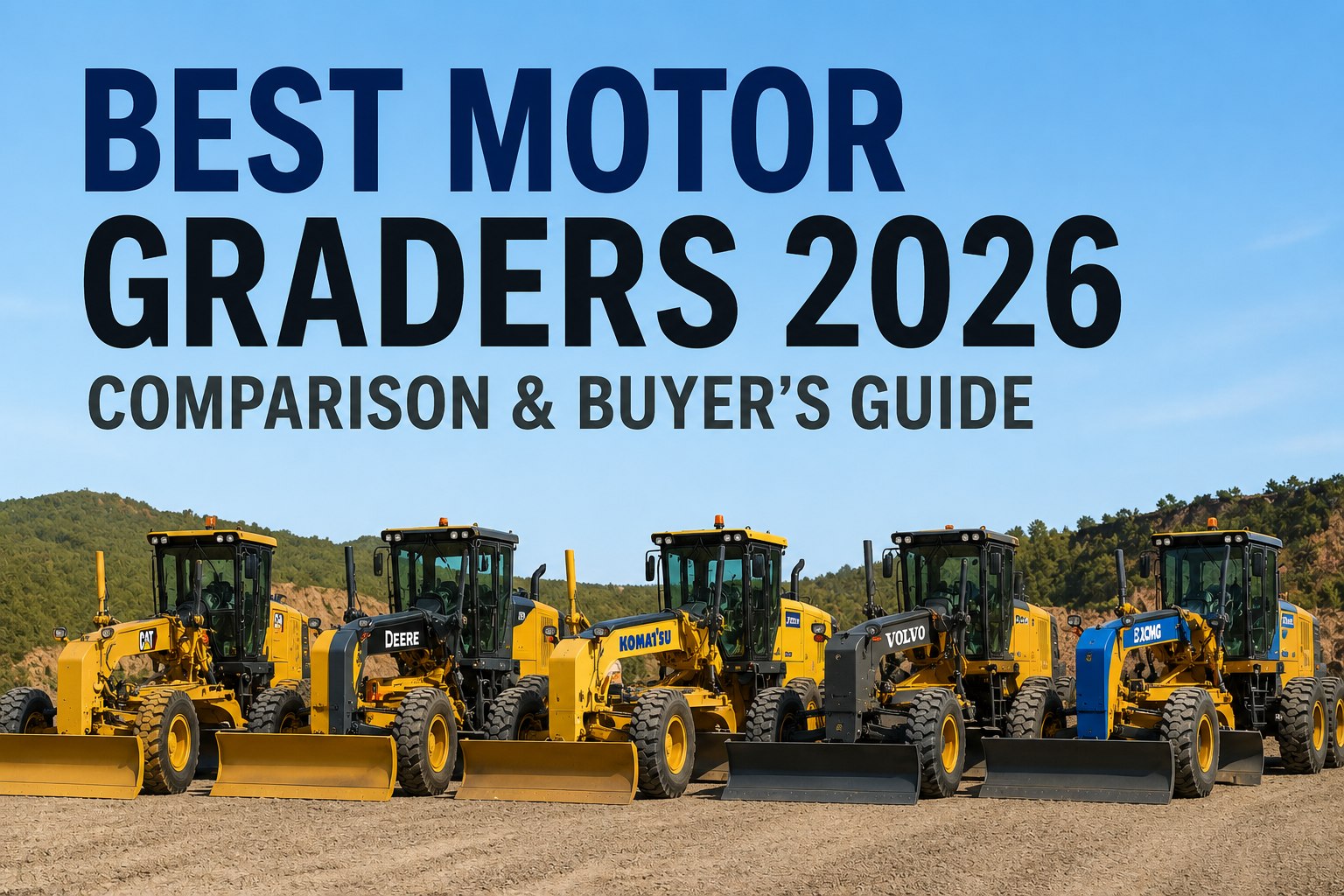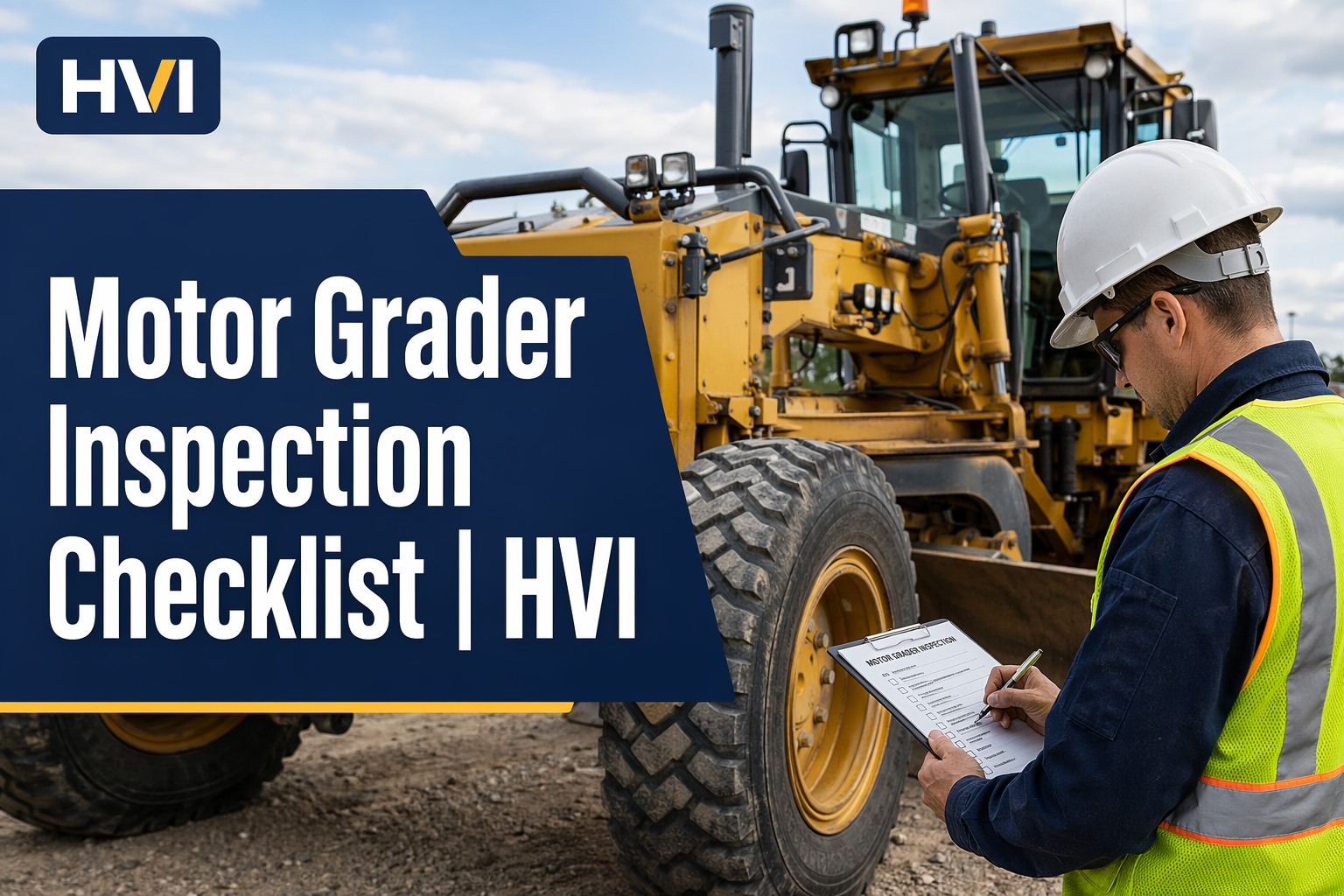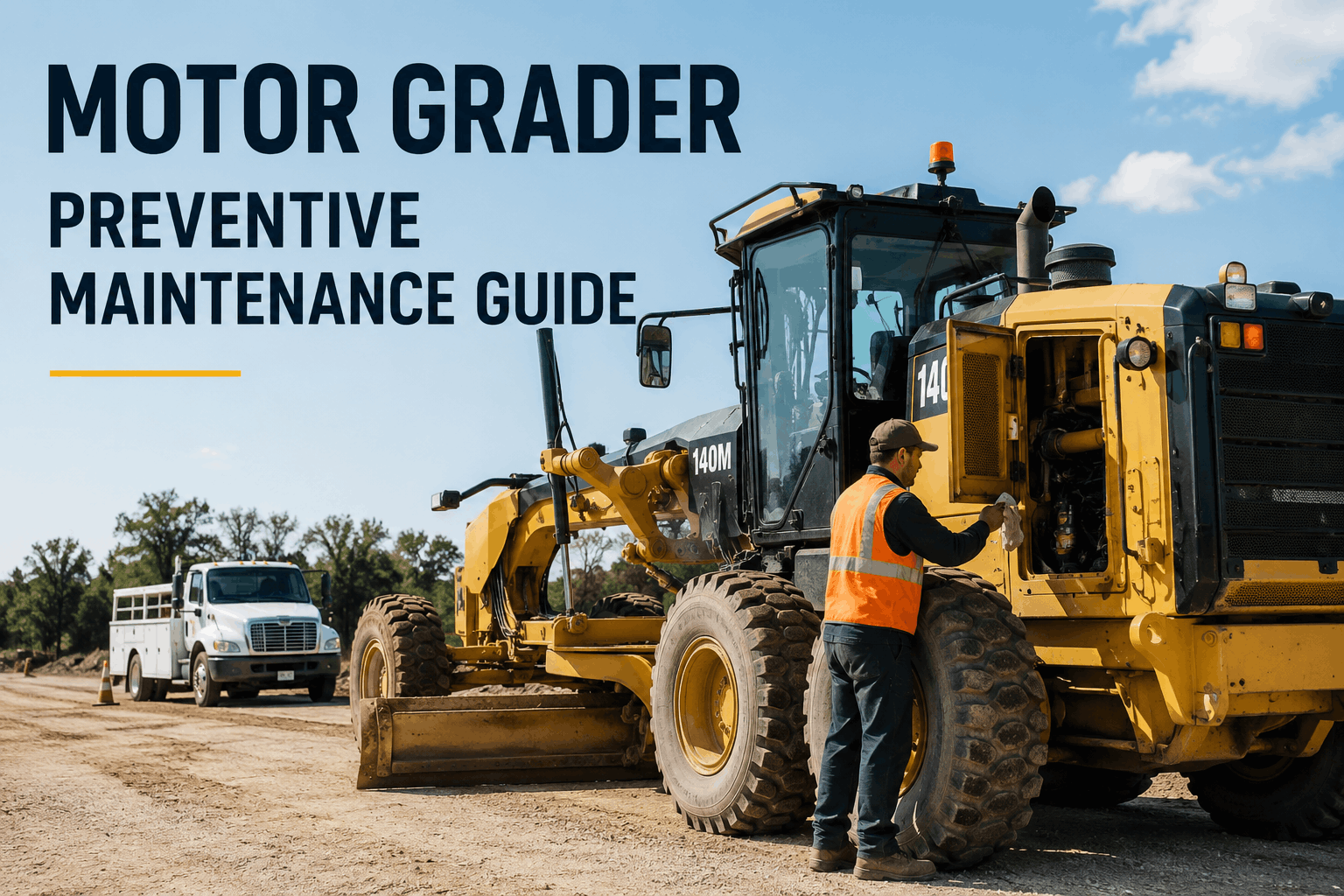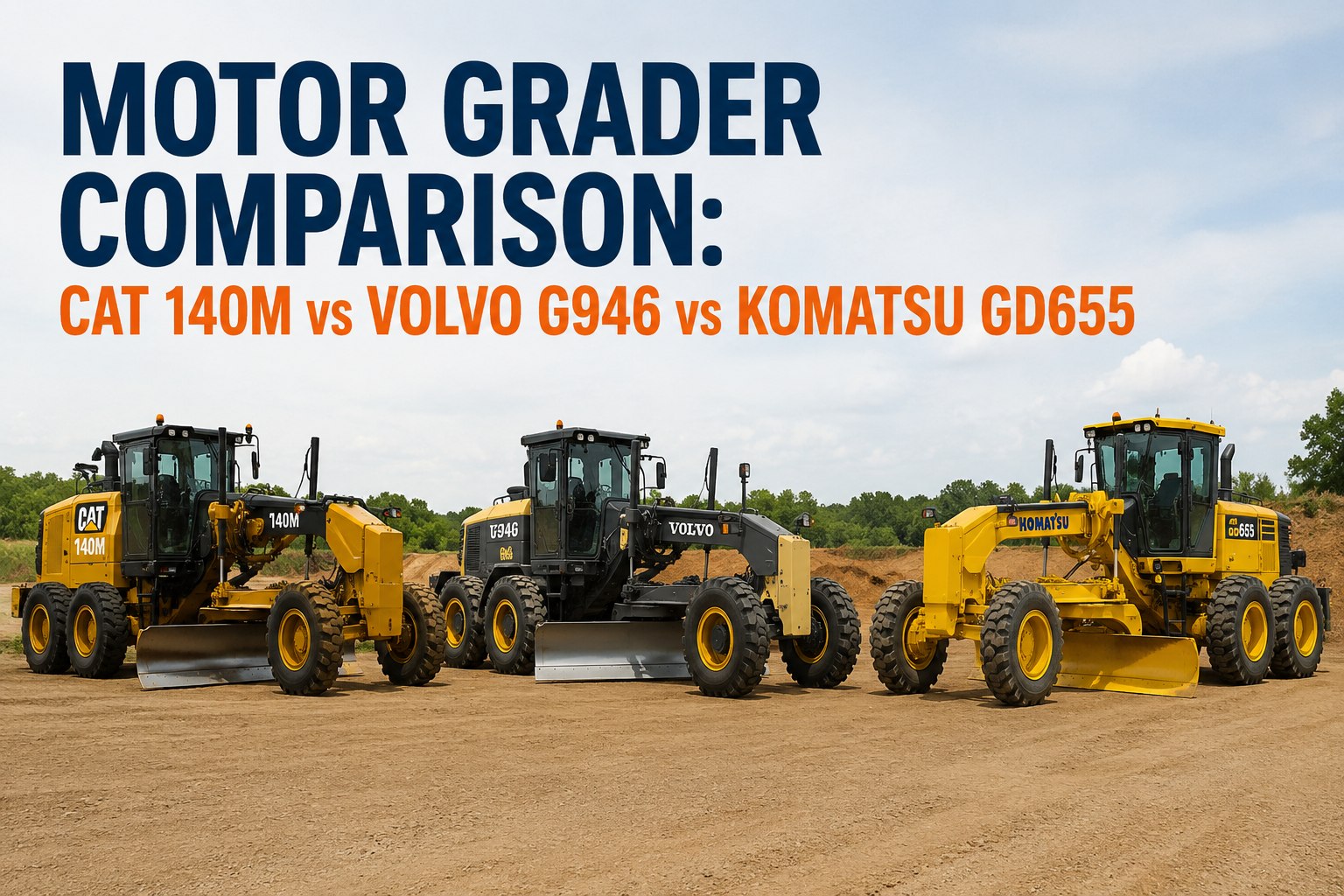
Picking a motor grader is the kind of decision your fleet lives with for 15,000 hours. This motor grader comparison puts the three machines most equipment managers shortlist — the Cat 140M, Volvo G946, and Komatsu GD655 — side by side on the numbers that actually decide long-term cost: horsepower, weight class, blade capability, drive layout, and the maintenance and inspection profile that follows each one. Book a demo
Cat 140M vs Volvo G946 vs Komatsu GD655 — the honest side-by-side
Three graders every equipment manager considers. Similar weight class, different drivetrain philosophies, and very different maintenance profiles.
Any of these three will grade a road. The real question isn't which is best in a spec sheet — it's which best matches your application, terrain, and maintenance capability. A machine that fits your operation drops cost per hour for 10 years. A machine that doesn't costs money quietly every shift. That's what the sections below break down.
Full specification comparison — the numbers that matter
Beyond horsepower and weight, the decisions that show up on the maintenance line are drivetrain type, transmission speeds, blade pull, and engine emissions tier. Here's the full side-by-side.
Three quick reads from the table. The Volvo carries the highest raw horsepower and blade pull, and is the only one with true 6x6 AWD. The Komatsu is the only Tier 4 Final machine, which matters where emissions regs are tightening. The Cat's joystick control and Cat Grade integration remain the class benchmark for finish grading. Book a demo to see full spec & PM records per unit on one dashboard
Cost per hour — where the money actually goes
Any grader in this class runs roughly $65–$110 per operating hour once you fold in fuel, tires, wear parts, planned maintenance, operator wages, and capital recovery. The exact number depends on your acquisition price, hours per year, application, and how well you run PM — but the shape of the number is stable across the industry. Here's how it breaks down.
The largest line by a wide margin. Whatever machine you pick, its productivity per operator-hour is what actually moves this number.
6–10 gph at typical duty cycles. Idle discipline and load-matching (VHP / dual-mode transmissions) drive real savings here.
Depreciation and financing spread over operating hours. Higher availability spreads this line over more billable hours — a direct hourly-cost reduction.
Filters, fluids, cutting edges, hoses, wear items. Where PM discipline lands directly — and where paper-based programs bleed money quietly.
17.5R25 or 14.0R24 tire pressure, rotation and running temperature. On abrasive material, this line jumps materially without discipline.
Two things that don't change regardless of which machine you buy. First: fuel + maintenance + tires together are close to 50% of the number, and every one of those lines responds to PM discipline — not to spec-sheet horsepower. Second: an emergency repair costs roughly 4.8 times the same job done planned. Any machine, well maintained, beats a better machine run reactively. Start free and get cost-per-hour tracking with fuel, parts and PM all rolled into one view
Which grader for which job — the application decision matrix
Spec-sheet strength doesn't equal jobsite fit. Each of these three machines has an application it's genuinely built for — and applications it's simply oversold on. The decision map below pairs your primary use case with the machine that typically wins the total-cost-of-ownership battle over a 10-year hold.
Why: Cat's joystick control and Cat Grade Cross Slope integration lead the class for precision finish work — up to 40% material savings on grade with the integrated Cross Slope system.
Watch out: Lower base horsepower and blade pull vs the Volvo means it's the wrong choice if your primary work is heavy cut or bulk material moving.
Why: 6x6 AWD plus the industry-leading blade pull (32,908 lb) and blade down force (19,035 lb) makes the G946 the machine of choice when traction and pull matter more than surface finish.
Watch out: AWD adds mechanical complexity — hydrostatic front-drive components need PM discipline and a shop familiar with the system.
Why: Only Tier 4 Final of the three — matters where emissions regs are enforced. Dual-mode transmission with stall prevention makes it forgiving for varying operator skill.
Watch out: Tier 4 Final aftertreatment (DPF regen, DEF consumption) adds a maintenance category the Tier 3 machines don't have. Higher complexity in the emissions system.
Why: Cat's snow wing / v-plow attachment ecosystem is deep. Volvo's AWD helps on packed snow. Both beat the Komatsu on cold-weather starting and snow attachment availability.
Watch out: Whichever you pick, salt-spec undercoating and heated cab options are worth the money — corrosion is what actually retires winter graders.
The pattern above holds because the same disciplines land differently on each machine. No spec sheet captures whether your local shop can service AWD hydrostatic front drives, whether your emissions district is enforcing Tier 4, or whether your operators can hit tight finish tolerances with joystick vs lever controls. The right question isn't "which is best" — it's "which is best for what you actually do."
The maintenance profile behind each machine
Under the same PM discipline, each of these graders behaves differently. Here's what your maintenance manager needs to know before signing the order.
Two decisions worth thinking through before you commit. First: the Tier 4 emissions burden on the Komatsu is real and ongoing — DEF, DPF regen cycles, and NOx-sensor faults are their own maintenance category. Great engine, more moving parts. Second: the Volvo's AWD system is a genuine advantage in the applications that need it and a genuine PM burden in the applications that don't. Match the machine to the actual duty cycle, not the aspirational one. Book a demo to see per-machine maintenance history across mixed OEM fleets
From an equipment manager running all three
We run five 140Ms on road jobs, three G946s on the mining haul roads, and two GD655-7s on the municipal contract. Anyone who tells you one brand wins across every application has never actually run mixed OEM. They're all good machines — the difference is whether you spec'd the right one for the work.
What actually killed us for years wasn't the machine choice — it was tracking maintenance across three different service manuals, three different parts networks, and three different dealer portals. Getting all of it into one CMMS was the single biggest reliability win we've had. Same techs, same trucks, better information. Availability across the whole grader fleet climbed about 6 points in the first year.
Frequently asked questions
Which motor grader is best — Cat 140M, Volvo G946, or Komatsu GD655?
There's no universal winner. Each machine has an application where it produces the lowest total cost of ownership over a typical 10–15 year hold, and applications where it's genuinely oversold. The Cat 140M leads in fine grade, road construction, and finish work — its joystick controls and native Cat Grade Cross Slope integration are the class benchmark for precision, with material savings up to 40% on integrated systems. The Volvo G946 leads in heavy cut, muddy conditions, and mining haul road maintenance thanks to its 6x6 all-wheel drive, 32,908 lb maximum blade pull and 19,035 lb blade down force. The Komatsu GD655-7 leads for municipal fleets, mixed daily use, and jurisdictions where Tier 4 Final emissions certification is required — its dual-mode transmission with stall prevention makes it forgiving across a wide range of operator skill. For most equipment managers the honest answer is that the "best" grader is whichever one matches your primary duty cycle, your local dealer/parts network, and your shop's ability to maintain the machine's specific systems (AWD hydrostatics on the Volvo, Tier 4 aftertreatment on the Komatsu, Cat Grade electronics on the 140M).
What's the typical cost per hour to operate a Cat 140M, Volvo G946, or Komatsu GD655?
Fully burdened cost per hour on a 200–235 HP class motor grader typically lands between $65 and $110 per operating hour, with the range widening based on acquisition cost, annual utilization, fuel prices, operator wages and application. Cost breaks down roughly as: operator labor around 35%, fuel around 22% (6–10 gph at typical duty cycles), capital recovery around 18%, planned maintenance and parts around 15%, and tires/undercarriage around 10%. The three machines land close to each other on total cost when run under equivalent discipline — but diverge quickly when they're not. Emergency repairs run roughly 4.8 times the cost of the same work done as planned PM, so a well-maintained "second-tier" grader consistently beats a poorly maintained "best-in-class" one on total cost. The single biggest lever isn't the OEM choice — it's raising availability from a fleet-average 82–85% to a top-quartile 90%+ through disciplined PM, which spreads fixed costs (labor, capital, overhead) over more billable hours.
What maintenance considerations differ between these three graders?
Three areas where the machines diverge materially. First, emissions: the Komatsu GD655-7 is Tier 4 Final while the Cat 140M and Volvo G946 are Tier 3 / Stage IIIA. Tier 4 means a DPF (diesel particulate filter) with periodic regeneration cycles, DEF (diesel exhaust fluid) consumption, NOx sensors and a more complex aftertreatment system that needs its own maintenance category. Second, drive systems: the Volvo G946 comes standard with 6x6 all-wheel drive, which uses a hydrostatic front-wheel drive that adds hydraulic filters, pressure checks and a wear pattern the tandem-only machines don't have. The Cat 140M offers AWD as an option; the Komatsu doesn't. Third, grade-control integration: Cat Grade is native on the 140M and is generally the strongest integrated package; Volvo and Komatsu machines commonly run third-party grade control (Topcon, Trimble, Komatsu IMC) which works well but adds sensor calibration to the PM checklist. Standard engine oil intervals across all three land around 500 hours with SOS/oil-analysis-managed programs able to extend that further, but hydraulic filter, air filter, coolant and fuel filter intervals vary by machine and should be pulled from the specific OEM service manual, not memory.
Does Tier 4 Final add significant maintenance cost on the Komatsu GD655?
Yes, meaningfully — but manageably. Tier 4 Final aftertreatment introduces three ongoing cost categories that Tier 3 machines don't have. Diesel Exhaust Fluid (DEF) consumption typically runs 2–4% of diesel volume, so a grader burning 8 gph will burn roughly 0.2–0.3 gph of DEF alongside it. Diesel particulate filter (DPF) regeneration cycles happen automatically but require complete cycles to avoid soot buildup — extended idle patterns block regen and eventually lead to a forced service regen or DPF cleaning event that can cost $2,000–$5,000. NOx sensors, urea injectors and SCR components have finite service lives and add to the parts stock. Offsetting: Tier 4 engines are more fuel efficient than the Tier 3 machines they replaced (Komatsu documents up to 15% improved fuel efficiency vs the GD655-5), which partially offsets aftertreatment burden. Where emissions regulations are enforced, the Komatsu is often the only compliant new-machine choice, so the maintenance profile is table stakes rather than a discretionary trade-off. Where regs aren't enforced, the Cat 140M or Volvo G946 remain valid Tier 3 options with lower aftertreatment complexity.
How does HVI help manage maintenance across mixed-OEM motor grader fleets?
Mixed-OEM fleets are where a proper CMMS earns its keep fastest. Each brand has its own service manual, PM intervals, parts network and dealer portal — and trying to run all of them out of three different systems and a whiteboard is where availability leaks. HVI captures every machine on one platform: digital pre-shift DVIRs configured per machine model, PM intervals triggered by real engine hours from each unit (Cat, Volvo, Komatsu, or anything else), auto-opened work orders on flagged defects, SOS oil sample trending against each unit's history, and a single cost-per-hour and availability dashboard that lets an equipment manager compare a Cat 140M to a Volvo G946 to a Komatsu GD655 on identical metrics. The value scales fastest on mixed fleets because the alternative — keeping three parallel programs in sync manually — is where the small signals that predict failures get lost. Published customer data shows roughly ~25% lower annual maintenance cost after full deployment and a payback period around 3 months. On any grader fleet worth $2M+ in acquisition cost, that math works in the first quarter.
Whichever grader you buy, HVI is what keeps its cost per hour honest for 15,000 operating hours
HVI runs Cat, Volvo, Komatsu and any other OEM on one connected platform — digital DVIRs, hour-based PM, auto work orders, SOS trending, and a single availability + cost-per-hour dashboard. Fleets on HVI report ~25% lower annual maintenance cost and ~3-month payback. Configured for your fleet in under two weeks.
No credit card · No hardware · Multi-OEM dashboard ready on day one