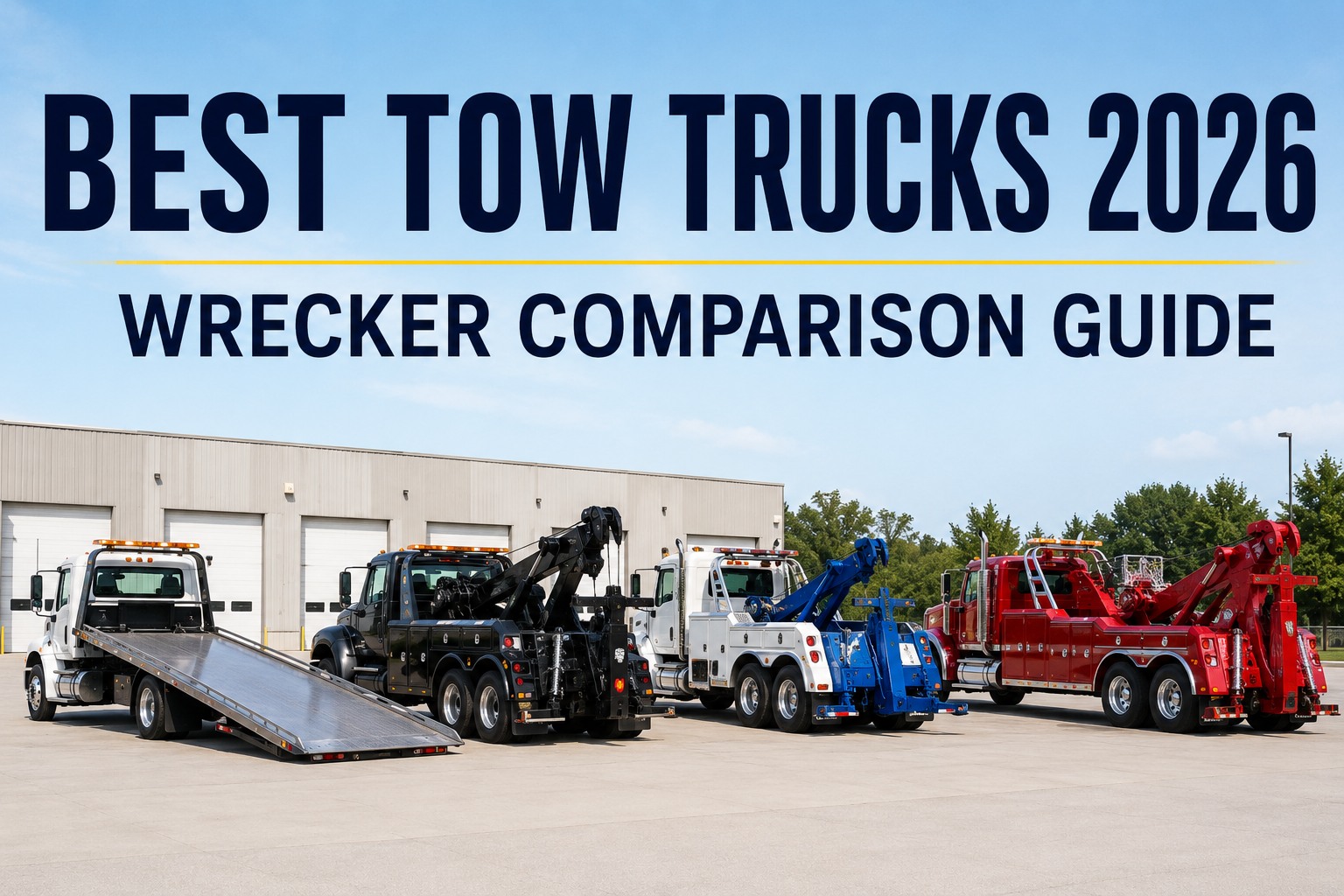
The best tow trucks of 2026 vary meaningfully by what you're recovering — pulling a stalled sedan off a suburban street is a completely different capability set from uprighting an overturned Class 8 semi on an interstate median. Five tow truck body types cover the 2026 commercial towing market — rollback flatbeds, wheel-lift trucks, integrated self-loaders, heavy-duty wreckers, and rotator recovery units — served by four dominant body manufacturers (Miller Industries, Jerr-Dan, NRC Industries, Dynamic Towing) mounted on Ford, Ram, Freightliner, International, Peterbilt, or Kenworth chassis. This best tow trucks 2026 buyer's guide walks the five body types with capacity ranges, a head-to-head manufacturer comparison table, duty class matching to application, spec priorities to evaluate on any candidate, and the mistakes towing companies make when spec'ing recovery vehicles. Book a demo to see tow truck inspection and DOT compliance run on the HVI dashboard.
A tow truck (or wrecker) is a commercial recovery vehicle purpose-built to move disabled, damaged, or improperly parked vehicles. Under FMCSA rules, any tow truck with GVWR above 10,000 lb is regulated as a commercial motor vehicle; heavy-duty units above 26,001 lb GVWR require CDL-holding operators. The five body types (rollback, wheel-lift, integrated, heavy-duty wrecker, rotator) exist because each recovery scenario has distinct load, angle, and terrain requirements.
5 Tow Truck Body Types in 2026
Every buyer decision starts with the body type. Application, load class, and recovery scenario drive the choice before chassis or brand enters the conversation.
Tilting flat deck. Vehicle winched or driven onto deck. Safest for undrivable cars.
Hydraulic yoke lifts drive wheels only. Fast hook-up, minimal setup time.
Combined boom + wheel-lift on one chassis. Handles most medium-duty recovery.
Class 7–8 chassis with extending boom. Handles Class 8 semi recovery.
360-degree rotating boom on stabilized base. Uprighting and multi-angle recovery.
The five body types above are the shortlisting starting point. Below is how to match duty class to application, the head-to-head manufacturer comparison table, the leading brands detailed, spec priorities to evaluate, and the recurring mistakes towing companies make on tow truck purchases.
Match tow truck duty class to your recovery application
Duty class is determined by GVWR — the truck's Gross Vehicle Weight Rating. Four tiers cover the commercial towing market, each aligned to specific recovery scenarios.
Buy for the heaviest realistic scenario you'll handle regularly, plus a 20% capacity buffer. Light-duty rollbacks make excellent daily-use trucks but stall out on anything above 19,500 lb GVWR — if you occasionally recover box trucks or RVs, buy medium-duty. Recovery scenarios above 26,000 lb GVWR require heavy-duty wreckers or partner referrals. Book a demo to see per-truck duty class tracking
Miller vs Jerr-Dan vs NRC vs Dynamic — full comparison table
The 2026 head-to-head: Miller Industries is the largest manufacturer with broadest brand portfolio. Jerr-Dan leads on rollback design and dealer network. NRC Industries specializes in heavy-duty and rotator. Dynamic Towing offers competitive value across categories.
| Attribute | Miller Industries | Jerr-Dan | NRC Industries | Dynamic Towing |
|---|---|---|---|---|
| Market position | Largest manufacturer | Rollback leader | Heavy-duty specialist | Value contender |
| Brand portfolio | Century, Vulcan, Chevron, Holmes | Jerr-Dan (single brand) | NRC (single brand) | Dynamic (single brand) |
| Rollback range | 17–28 ft deck | 17–30 ft deck | Limited | 19–28 ft deck |
| Heavy-duty range | 25–75 ton boom | 25–60 ton boom | 25–80 ton boom | 25–50 ton boom |
| Rotator options | Century 1150, Vulcan V-100 | 50/60-ton rotator | NRC 60TR, 75TR | Limited |
| Dealer network (NA) | Largest | Very large | Regional | Mid-size |
| Typical pricing tier | Premium | Premium | Premium (heavy) | Value |
| Best fit | Full-line towing ops | Rollback-focused fleets | Recovery specialists | Cost-conscious buyers |
Cross-shopping the top three is standard practice on any commercial tow truck purchase over $100,000. Rotator and heavy recovery buyers often shortlist Miller Century and NRC as the two proven heavy-duty options. Rollback-focused fleets frequently compare Jerr-Dan against Miller's Century and Vulcan lines. Book a demo to see multi-brand tow truck fleet inspection
4 leading tow truck manufacturers — detailed
Four body manufacturers dominate the 2026 North American commercial towing market. Each has category strengths, chassis compatibility, and dealer coverage that matter in the buying decision.
Chassis choice matters as much as body brand. Ford F-550/F-750, Ram 4500/5500, Freightliner M2, International MV/HV, Peterbilt 337/348, and Kenworth T270/T370/T680 are the common chassis platforms upfitted with tow bodies. Local dealer support for both chassis and body determines post-sale reliability. Start free and add multi-brand tow fleet tracking
6 spec priorities to evaluate on any tow truck
Six specifications determine whether a tow truck fits your application, ranked here by evaluation priority. Get the top three right and the rest fall into place.
GVWR + chassis class
Determines what you can legally tow, licensing requirements, and DOT compliance category. Undersizing here is a legal and safety failure — not a cost optimization.
Boom capacity (SAE J2114)
Rated maximum lift capacity of the boom in lbs or tons. Determines what casualty weights you can recover safely. All ratings should meet SAE J2114 industry standard.
Wheel-lift / under-lift capacity
Rated maximum lift capacity of the wheel-lift or under-lift assembly. SAE J2853 governs under-lift ratings. Critical for daily towing where boom isn't used.
Recovery winch line pull
Rated line pull of the primary recovery winch (single-line pull). Matters for extraction from ditches, mud, ravines. Match to boom capacity or slightly above.
Deck length (rollback only)
Length of the flatbed deck in feet. Longer decks handle longer wheelbases and multiple vehicles. Common sizes 17, 19, 21, 22, 24, 26, 28, 30 ft.
Dealer network + parts availability
Local dealer coverage for both chassis and body determines post-sale reliability. A great truck with 3-week parts delivery costs more than a good truck with same-day parts.
Every spec above compounds with the others. Undersize any one and the whole truck's usable capacity is bottlenecked by that spec. Best-in-class buyers spec every dimension 20% above realistic worst-case use, not against the theoretical max. Book a demo to see per-truck spec tracking
5 mistakes towing companies make when buying tow trucks
Wrong body type for typical call mix
Operator buys a wheel-lift-only truck for a market where 70% of calls are undrivable vehicles that require a rollback. Every call becomes a scheduling mismatch or a refused job.
Undersizing GVWR to save money
Company buys Class 4 chassis when Class 5 or 6 is realistic for the mix. Result: illegal overload situations, increased breakdown rate, chassis warranty voided when overweight.
Ignoring SAE compliance on boom and under-lift
Buyer skips verification that boom meets SAE J2114 and under-lift meets SAE J2853. Insurance and liability exposure if a failure occurs during recovery on rated capacity work.
No inspection/PM system planned before purchase
Fleet buys tow trucks but has no digital system for DOT pre-trip inspections, boom/winch PMs, or work orders. Compliance drifts to paper logs that get lost. DOT audit or accident exposes the gap.
Buying on sticker price without weighing dealer support
Operator picks lowest bid without checking local dealer network. First major breakdown reveals 3-week parts delivery on chassis or body. Revenue-generating downtime eclipses savings within year one.
Every mistake above shows up on the P&L or the DOT file within a year of purchase. Get the call-mix data, GVWR, SAE compliance, and dealer coverage right at shortlisting, and the truck pays back consistently across its service life. Book a demo to see tow truck inspection workflow — or start free and deploy this week .
Related tow truck questions buyers ask
What's the difference between a wrecker and a tow truck?
The terms are used interchangeably in the industry, though "wrecker" typically implies a boom-equipped recovery truck (integrated, heavy-duty, or rotator) while "tow truck" is the broader term covering all five body types including rollback and wheel-lift.
Do tow truck operators need a CDL?
Depends on the truck's GVWR. Any tow truck with GVWR above 26,001 lb requires a CDL (Class B or A depending on trailer combinations). Below 26,001 lb, standard driver's license typically suffices, though state rules vary and many states require additional endorsements for commercial towing.
How much does a new tow truck cost in 2026?
Light-duty rollback: $80,000–$120,000. Medium-duty integrated: $120,000–$180,000. Heavy-duty wrecker (25–50 ton): $250,000–$450,000. Rotator recovery (50–75 ton): $500,000–$900,000+. Prices vary by chassis choice, body brand, and options.
What DOT rules apply to tow trucks?
Tow trucks above 10,000 lb GVWR fall under FMCSA regulations: DOT number required, pre-trip DVIR inspections mandatory, HOS rules apply above 26,001 lb, CDL required above 26,001 lb, annual DOT inspections required. Recovery vehicles have some state-level exemptions in emergency scenarios.
Rollback vs wheel-lift — which is better?
Depends on call mix. Rollback (flatbed) is safer for undrivable vehicles, all-wheel-drive cars, and low-clearance vehicles — but slower to load. Wheel-lift is faster hook-up for driveable-but-disabled vehicles, repos, and illegal parking removal. Most successful towing fleets operate both types.
From a towing company owner who spec'd 6 new trucks last year
We ran the exercise on our last 6 truck purchases: pulled 24 months of call data first, categorized by body type needed, then spec'd against that mix instead of intuition. Turned out our real call volume was 55% rollback, 30% wheel-lift, 15% integrated for larger vehicles. We'd been overweighting wheel-lift on prior purchases because they hooked up faster on the calls we did take.
Ended up buying 3 Jerr-Dan rollbacks (17 ft light + 21 ft mid), 2 Miller Century integrateds, and 1 heavy-duty Century 1075. Fleet spend was 12% below budget vs the "everything's a wheel-lift" plan we started with. Downtime dropped roughly 40% year over year because we stopped forcing wrong-body-type trucks onto every call.
Frequently asked questions
What are the best tow trucks to buy in 2026?
There is no single "best" tow truck — the right choice depends on your call mix, duty class needs, and budget. Five body types cover the 2026 commercial towing market: rollback flatbeds (safest for undrivable cars), wheel-lift trucks (fastest hook-up for repos and quick tows), integrated self-loaders (combined boom + wheel-lift for medium-duty), heavy-duty wreckers (Class 7–8 with 25–50 ton booms), and rotator recovery units (30–75 ton, 360-degree boom rotation). Four body manufacturers dominate the North American market: Miller Industries (largest, owns Century/Vulcan/Chevron/Holmes brands), Jerr-Dan (rollback leader), NRC Industries (heavy-duty specialist), and Dynamic Towing (value contender). Cross-shop the top three brands in whatever body category matches your dominant call type. Chassis choice (Ford, Ram, Freightliner, International, Peterbilt, Kenworth) matters as much as body brand for post-sale reliability.
Rollback vs wheel-lift tow truck — which should I buy?
Depends on call mix. Rollback (flatbed) tow trucks are safer for undrivable vehicles, all-wheel-drive cars that can't be towed on wheels, low-clearance sports cars, and multi-vehicle loads — but they're slower to load on a scene. Wheel-lift trucks offer faster hook-up (2–4 minutes vs 8–15 for rollback) making them ideal for repos, illegal parking removal, and driveable-but-disabled recoveries. Most successful commercial towing fleets operate both body types and dispatch based on call type. Rule of thumb: if more than 40% of your calls are undrivable, all-wheel-drive, or low-clearance, rollback should be your primary purchase. If your market is repo-heavy or municipal parking enforcement, wheel-lift wins on turnaround time. Track your actual call mix for 6–12 months before spec'ing the next truck purchase to remove intuition-based bias from the decision.
How much does a heavy-duty tow truck cost?
Heavy-duty tow truck pricing in 2026 varies widely by capacity and configuration. A 25-ton heavy-duty wrecker on a Class 7 chassis typically runs $200,000–$280,000. A 35–50 ton heavy-duty wrecker on Class 8 chassis lands in the $280,000–$450,000 range. Rotator recovery units (50–75 ton, 360-degree boom rotation) start around $500,000 and can exceed $900,000 for high-capacity configurations with hydraulic outrigger stabilization, side puller, and specialty recovery equipment. Prices include chassis (typically Peterbilt 389, Kenworth T880, Freightliner 122SD) plus body manufacturer upfit. Add 10–15% for premium options: hydraulic pole boom, higher line pull winches, aluminum body, custom paint, LED emergency lighting packages. Financing terms typically 60–84 months for heavy-duty; 84–120 months for rotator purchases given the higher acquisition cost.
What DOT compliance rules apply to tow trucks?
Tow trucks with GVWR above 10,000 lb are classified as commercial motor vehicles under FMCSA regulations. Requirements include: USDOT number registration and display on the vehicle; pre-trip DVIR inspection required daily under 49 CFR 396.11; Hours of Service (HOS) rules apply above 26,001 lb GVWR; CDL (Class B minimum, Class A for tractor-trailer combinations) required above 26,001 lb; annual DOT inspection with certified inspector, records retained 14 months; drug and alcohol testing program for CDL drivers; annual MCS-150 update. Recovery vehicles operating in emergency response have some state-level exemptions for HOS during active recovery, but base DOT compliance still applies. State-specific requirements often add signage rules, insurance minimums, and towing licenses beyond federal DOT rules. HVI-style inspection and compliance software captures the DVIR, PM, and audit trail requirements automatically.
Miller Industries vs Jerr-Dan — which brand should I choose?
Both are premium-tier tow body manufacturers with strong dealer networks and industry reputations. Miller Industries is the largest single manufacturer and owns four brand names: Century (full line including heavy-duty and rotator), Vulcan (heavy-duty and rotator focus), Chevron (mid-duty rollbacks and wreckers), and Holmes (traditional wrecker line). Miller's advantage is portfolio breadth — you can standardize across duty classes within one manufacturer relationship. Jerr-Dan (owned by Oshkosh Corporation) is the market leader in individual truck sales and particularly strong on rollback design and light/medium-duty innovation. Jerr-Dan's advantage is depth of engineering in the rollback and wheel-lift categories. For a rollback-focused fleet, Jerr-Dan is often the shortlist leader. For a full-service towing operation running everything from wheel-lift up to heavy recovery, Miller's Century + Vulcan combination is often preferred. Local dealer support quality typically matters more than brand differentiation for post-sale reliability — test the dealer response question before signing.
Related HVI guides for tow truck and recovery fleets
Whatever tow truck you buy, HVI runs the inspection and DOT compliance
HVI captures DOT pre-trip DVIR inspections, boom and winch PM schedules, annual inspection records, and repair work orders per unit. Multi-brand tow fleets tracked in one platform. Live in under two weeks — typical towing operations recover the software cost from downtime reduction alone within the first quarter.
No credit card · No hardware · DOT-compliant DVIR templates ready day one