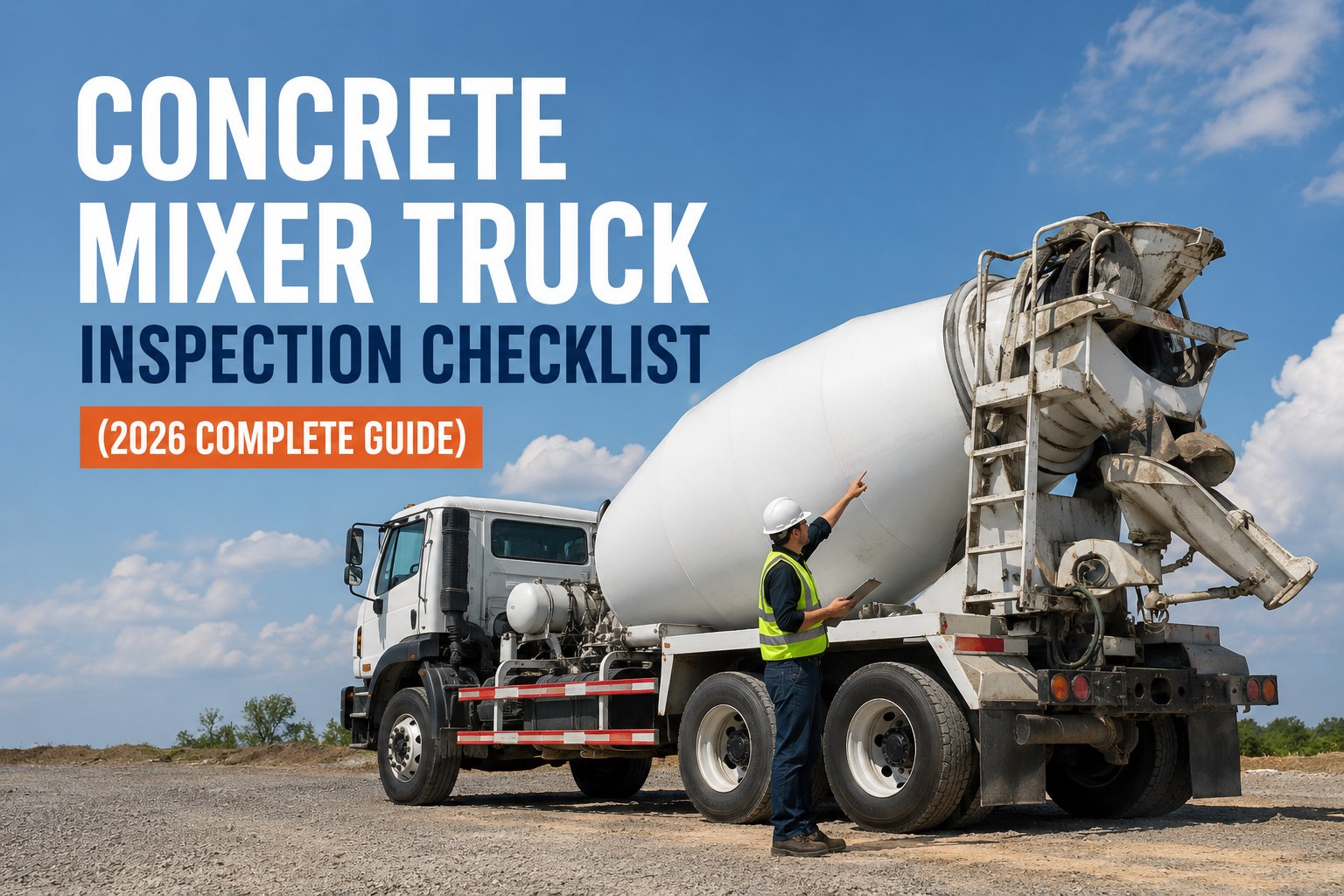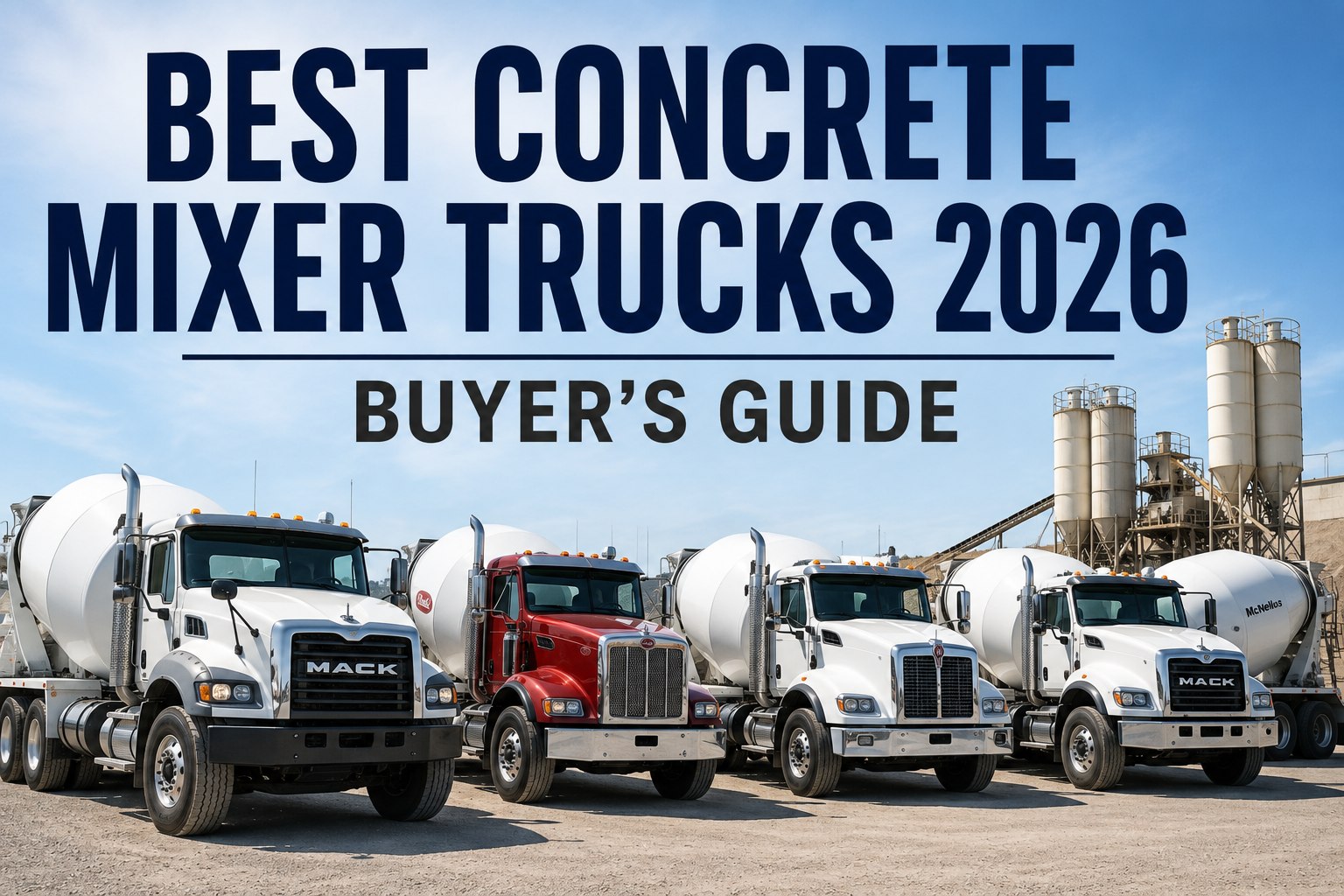
The best concrete mixer trucks in 2026 are combinations, not single products. Every ready-mix truck on the road is a chassis brand paired with a mixer body brand — two separate purchasing decisions that many fleet buyers treat as one. The three chassis platforms dominating the market are Mack Granite (all-new 2026 generation), Peterbilt 567, and Kenworth T880. The two dominant mixer body manufacturers are McNeilus (Bridgemaster series) and Con-Tech (BridgeKing series). Six combinations are possible; each gets specific things right. This buyer's guide covers each chassis's real strengths, each mixer body's design characteristics, the 8 buying criteria that separate good specifications from bad ones, and the total-cost-of-ownership factors that reveal themselves in year three, not at delivery. Book a demo to see the DOT inspection, PM scheduling, and compliance layer that keeps a mixer fleet earning miles instead of parked.
The Chassis × Mixer Body Buyer's Map
Two decisions, not one. Pick a chassis, pick a mixer body, choose the combination that matches the work.
Ready-mix concrete is unforgiving on equipment. Drum rotation is constant. Weight is always at chassis limits. Job sites deliver debris, mud, and uneven ground that punish suspension and driveline components. A well-spec'd mixer truck runs a 10-to-15-year primary service life; a poorly-spec'd one costs the same money and lasts half as long. The difference is almost always at the specification stage — chassis, mixer body, engine, transmission, and axle choices made before delivery decide the truck's economics until it's sold off. This guide is the specification framework that turns a spec sheet into an operational asset.
The 4 numbers every mixer buyer should know before spec'ing
Concrete mixer trucks compete on a narrow set of specifications. These four ranges shape the entire buying decision — get comfortable with them before you look at any single truck.
- 8—11 yd³ Standard drum capacity range — 10.5 yd³ is the modern industry baseline
- 66,000—92,000 lb GVW range across configurations — bridge law limits the upper end
- 325—540 HP Engine power spectrum — Class 8 vocational trucks span a 200+ HP range
- 10—15 yr Primary service life — specifications made at delivery decide the tail end
The 66,000-92,000 lb GVW range is where most spec errors happen. Under-spec'd axles or wheelbase for the mixer body size produces a truck that hauls at bridge-law penalty rates or requires special permits per load. Once delivered, the fix is expensive; at the order stage, it's a checkbox. Book a demo to see how HVI tracks each spec's compliance implications per truck
The 3 chassis options — deep-dive
Chassis choice sets the foundation. Engine, transmission, suspension, and driver interface all come from the chassis manufacturer. Here's what each of the three dominant chassis brands actually does best.
Mack Granite
- Engine
- Mack MP7 (325—425 HP); new MP13 up to 540 HP for 2027; Cummins X10 option
- Transmission
- Allison 4500 RDS or Mack mDRIVE HD 12-speed automated manual
- Config
- 6x4, 8x6 tridem — up to 92,000 lb GVW on four axles
- Telematics
- Mack GuardDog Connect + Mack OneCall 24/7 service dispatch
- Strength
- Vocational heritage since 2001; extensive dealer network in construction markets; new-gen safety (Mack Protect radar/camera, ImpactShield windshield, galvanized steel cab)
Peterbilt 567
- Engine
- PACCAR MX-13 (455—510 HP); Cummins X15 available up to 605 HP
- Transmission
- PACCAR TX-18 automated, Eaton Fuller manual, Allison 4500 RDS
- Config
- Set-forward or set-back front axle; 6x4 and 8x6 mixer configurations
- Telematics
- PACCAR SmartLINQ connected services with remote diagnostics
- Strength
- Driver comfort remains best-in-class in cab and visibility; custom spec build for exact operational fit; strong resale value on secondary market
Kenworth T880
- Engine
- PACCAR MX-13 (455—510 HP), MX-11 (355—395 HP); Cummins X15 option
- Transmission
- PACCAR TX-18 or PACCAR TX-12 automated; Eaton or Allison options
- Config
- Standard set-forward front axle; heavy-duty mixer configuration standard
- Telematics
- PACCAR SmartLINQ connected services (shared with Peterbilt)
- Strength
- Long service life reputation; broad dealer coverage; strong resale value; PACCAR MX-11 option provides efficient power for lighter mixer configurations
Peterbilt and Kenworth share the PACCAR powertrain and telematics platform — the differentiation between them lives in cab configuration, sheet metal, and specific dealer/regional strengths. Mack is the outlier: a proprietary engine and transmission stack with a specific vocational reputation and its own dealer network. Neither approach is objectively better; the question is which fits your operations profile. Start free and track your chassis-specific PM intervals automatically
The 2 mixer body options — deep-dive
The mixer body is what turns the chassis into a concrete truck. Two manufacturers dominate the North American market: McNeilus and Con-Tech. Both produce rear-discharge mixers in the 10—11 yd³ standard capacity range, with distinct engineering choices.
McNeilus Bridgemaster
Design characteristics: Bridge-formula optimized drum geometry; standard steel drum construction; Standard Frame (SF) and Standard Bridge (SB) options for different chassis wheelbase configurations. Multiple discharge chute configurations available for job-site flexibility.
Fit profile: Ready-mix operators standardizing one mixer body brand across a multi-chassis fleet — the Bridgemaster mounts consistently across Mack, Peterbilt, and Kenworth platforms, simplifying parts inventory and technician training on the mixer body side.
Capacity: 10—11 yd³ typical; 8 yd³ available for smaller-chassis configurations. Standard steel drum with wear-resistant discharge components.
Con-Tech BridgeKing
Design characteristics: Engineered for highway-legal capacity at bridge-law compliant weight distribution; steel drum with wear-resistant blades; both rear discharge and front discharge options available. Frequently paired with Mack Granite in factory or dealer bundles.
Fit profile: Operators where bridge-law compliance drives every load calculation — the BridgeKing's engineering emphasis on weight distribution can allow marginally more revenue-yard capacity per legal load compared to non-optimized alternatives.
Capacity: 10.5—11 yd³ standard configurations. Steel drum construction with hardened blade sets. Front discharge variants available for operations where cab-forward material placement matters.
Both mixer bodies work across all three chassis brands. The choice comes down to operational priorities: standardization across the fleet (McNeilus) versus capacity-per-legal-load optimization (Con-Tech). Neither is objectively better on paper; both are proven in North American ready-mix service. Book a demo to see mixer-body-specific PM intervals tracked separately from chassis intervals
The 8 buying criteria that separate specifications
Beyond chassis and mixer body brand choice, these eight specifications separate a well-configured truck from a poorly-configured one. Any single one wrong at the order stage compounds through the ownership lifecycle.
The two amber-highlighted criteria — drum-to-GVW match and terrain-appropriate engine — account for the majority of "I wish I'd spec'd it differently" complaints in the first two years of ownership. Get those two right and the remaining six become easier to optimize. Start free and get chassis + body-specific PM schedules loaded per truck
The TCO reality check — 4 factors that change the math
Sticker price is the smallest number in the ownership equation. Four operational factors shift the true cost of ownership more than any $10,000 line item at the dealer.
Mixer duty cycles produce 3—4 MPG effective fuel economy under load. Over a 10-year life at 40,000—60,000 miles per year, fuel dominates ownership cost. Engine + transmission match to duty cycle affects lifetime fuel spend by 8—15%. Automated manual transmissions (mDRIVE HD, PACCAR TX-18) can capture 3—5% of that gap for operators willing to accept the driver-adaptation curve.
A parked mixer truck loses roughly $1,200—$2,000 in daily revenue depending on market. Aftertreatment issues (DPF regen problems), transmission failures, and driveline components are the top downtime drivers. Manufacturer proactive telematics (GuardDog Connect, PACCAR SmartLINQ) reduce unplanned downtime by scheduling maintenance around forecasted failures rather than reacting to them.
Peterbilt and Kenworth typically hold 5—10% higher secondary market value than comparable Mack Granites at similar mileage and condition. That gap is real but often overstated by dealers — the resale premium doesn't always cover the higher acquisition cost or the shorter dealer network in certain regions. Do the math per your market.
DOT annual inspections, roadside enforcement, DVIR compliance, and CSA scoring are non-negotiable overhead across all chassis brands. The variable is how efficiently a fleet handles them — paper-based compliance produces $7,000+ per finding at audit; digital inspection + DVIR + PM tracking produces near-zero findings and turns the compliance layer from cost center to background process.
Every one of the four factors above is more consequential than the $8,000—$25,000 sticker-price difference between comparable chassis specifications. Buyers who fixate on acquisition price and skip TCO analysis routinely spec themselves into 10-year cost commitments that don't match their operational profile. Book a demo to see per-truck TCO tracked continuously from day one
From a fleet manager who spec'd both sides of the market
We ran a mixed fleet for years — started as an all-Mack shop, added Peterbilts in 2019, and put in three Kenworth T880s in 2023 to test operator preference. Same routes, same mixer bodies (McNeilus Bridgemaster across the fleet), same duty cycle.
The MPG spread was tighter than dealers claimed — about 0.3 MPG across brands. The real difference showed up in year 4 and 5: the trucks with automated manuals had 12% lower maintenance spend than the Allison RDS trucks over five years, but the drivers preferred the Allisons. The trade-off was real. Our next 15 orders came in as a mix — Allison for the veteran drivers, mDRIVE HD for the new hires. The specifications finally matched the operations.
Frequently asked questions
What is the best concrete mixer truck brand in 2026?
There is no single "best" brand — the concrete mixer truck market is fundamentally a two-part decision (chassis + mixer body), and the right combination depends on operational profile. On the chassis side, Mack Granite (all-new 2026 generation with MP7/MP13 engines up to 540 HP), Peterbilt 567 (PACCAR MX-13 platform, driver-comfort leader), and Kenworth T880 (PACCAR MX-13/MX-11 platform, strong resale) are the three dominant options in the North American market. Mack has the deepest vocational heritage and a proprietary powertrain; Peterbilt and Kenworth share the PACCAR MX engine and SmartLINQ telematics platform and differentiate primarily on cab configuration and dealer network. On the mixer body side, McNeilus Bridgemaster and Con-Tech BridgeKing are the two dominant manufacturers, both producing rear-discharge units in the 10-11 yd³ capacity range, with McNeilus favored by fleets standardizing across chassis brands and Con-Tech favored where bridge-law compliance drives capacity optimization. The optimal combination depends on your terrain (flat metropolitan vs. mountainous), duty cycle (short delivery vs. long haul to pour), operator profile (veteran drivers preferring Allison vs. newer drivers on automated manuals), and geographic dealer network — no purchase should be made on brand loyalty alone.
What is the typical drum capacity of a concrete mixer truck?
Standard drum capacity for modern rear-discharge concrete mixer trucks in North America ranges from 8 to 11 cubic yards, with 10.5 yd³ emerging as the industry baseline for most ready-mix operations. Smaller 8 yd³ configurations are typically paired with smaller Class 8 chassis for weight-restricted routes or specific job-site access requirements. Larger 11 yd³ configurations require specific chassis specifications — longer wheelbase, appropriate axle ratings, and bridge-formula compliant weight distribution — to legally transport a full load. Front-discharge mixers typically carry 9-11 yd³ but come at a 30-40% price premium over rear-discharge and see a thinner secondary market at resale. Actual concrete carrying capacity is limited by the federal bridge formula and state weight regulations, not just drum volume. A drum with nominal 11 yd³ capacity paired with an under-spec'd chassis may only legally transport 9-10 yd³ of concrete without bridge-law penalty. Match the drum to the chassis GVW at spec, not to marketing capacity claims.
Should I choose an automated manual or Allison RDS transmission for a mixer truck?
Both transmission types are proven in mixer service; the right choice depends on driver profile and cost priorities. The Allison 4500 RDS is a torque-converter automatic that has been the North American mixer truck standard for decades. It is highly reliable, requires no driver adaptation, handles the constant torque demands of mixer duty cycles well, and typically produces easier resale on the secondary market where operators expect it. Its downsides are 3-5% lower fuel economy compared to modern automated manuals and slightly higher acquisition cost. The Mack mDRIVE HD and PACCAR TX-18 are automated manual transmissions that shift gears without a clutch pedal, produce meaningfully better fuel economy over long life, and require some driver adaptation. Fleet data suggests automated manuals produce roughly 12% lower maintenance spend over 5-year windows compared to Allison RDS, though this varies by operator behavior. The practical answer for most fleets is a mixed order: Allison for veteran drivers who prefer familiar operation, automated manual for newer drivers or fleets prioritizing lifetime cost. Neither is objectively wrong; both should be evaluated on operational fit, not category preference.
How long does a concrete mixer truck last?
Primary service life for a well-maintained concrete mixer truck runs 10 to 15 years in North American ready-mix service, with total mileage typically reaching 400,000-600,000 miles before major overhaul or retirement to lighter secondary service. Key life-limiting factors include: aftertreatment system service (DPF/SCR components often require significant maintenance at 500,000+ miles), transmission wear (automated manuals and Allisons both, with different failure profiles), rear axle service life on tridem configurations, and mixer body drum wear (steel drums typically require blade replacement or drum rebuild between years 6-10 in continuous service). Fleets that follow manufacturer PM intervals, run photo-verified daily pre-trips catching defects at pre-trip stage, and treat the mixer body as a separate maintenance category from the chassis routinely reach the upper end of the service life range. Fleets that skip PMs, defer defect repairs, or treat the truck as one integrated system without distinguishing chassis service from mixer body service typically retire trucks 3-5 years earlier at similar mileage. The specification made at delivery determines the ceiling; the maintenance discipline determines whether you reach it.
How does HVI help concrete mixer fleets stay compliant and productive?
Concrete mixer fleets face a unique compliance and maintenance profile: DOT annual inspections on the chassis (49 CFR §396.17), separate inspection tracking on the mixer body (drum condition, hydraulic system, discharge assembly), FMCSA driver qualification requirements including Clearinghouse queries, PM scheduling that respects both chassis manufacturer intervals AND mixer body service specifications, and CSA score exposure from every roadside inspection. HVI centralizes all of it: guided pre-trip DVIRs from operator phones covering both chassis and mixer body items; PM scheduling per unit tracked against odometer, engine hours, and calendar; DOT annual inspection scheduling with automatic 60/30/7-day expiration alerts; mixer-body-specific inspection templates separate from chassis templates; work orders auto-generated from every reported defect with mechanic sign-off enforced; audit-ready compliance exports covering every 49 CFR requirement. The specification decisions covered elsewhere in this guide happen once at purchase; the compliance and maintenance decisions happen every day. HVI makes that daily layer background — go live in under two weeks and see chassis + mixer body compliance running on your fleet from day one.
The specification is the ceiling. The maintenance is what you actually keep.
HVI runs the DOT inspection, PM scheduling, DVIR, and compliance layer that turns your specification decisions into the lifetime ROI your P&L needs. Chassis intervals tracked separately from mixer body intervals. Photo-verified pre-trips from operator phones. Audit-ready records built into every workflow. Live on your fleet in under two weeks.
No credit card · No hardware · Fleet compliance live day one