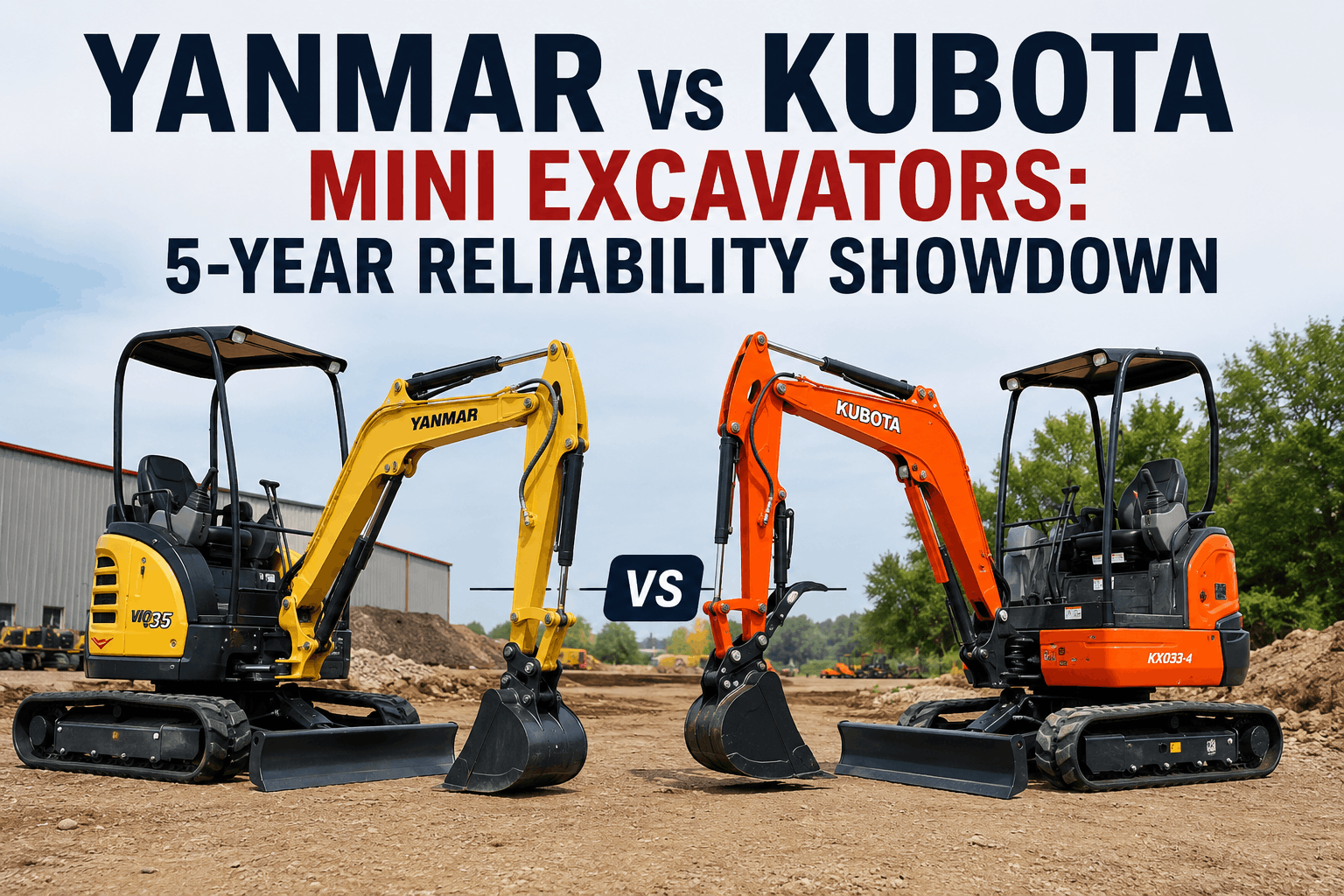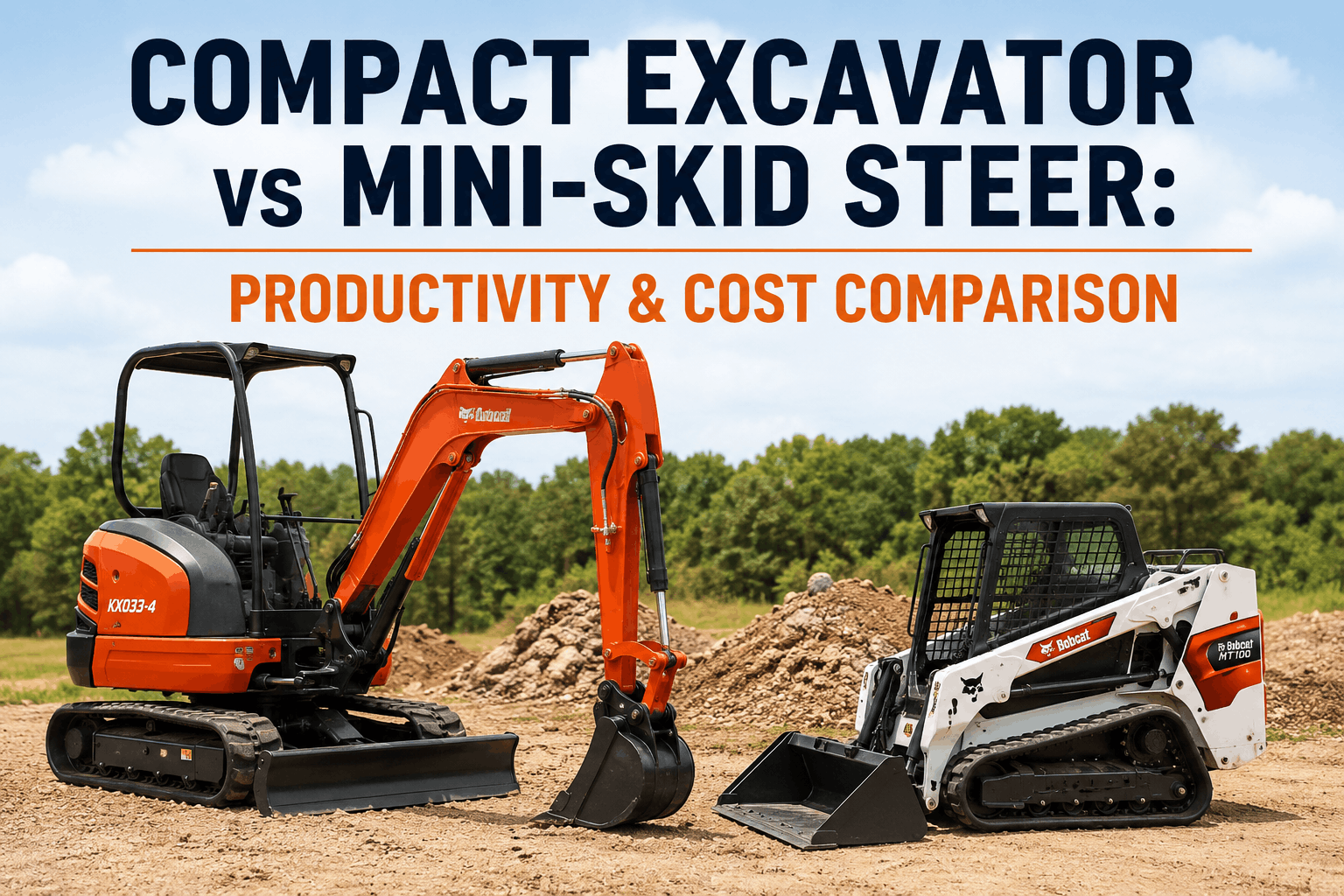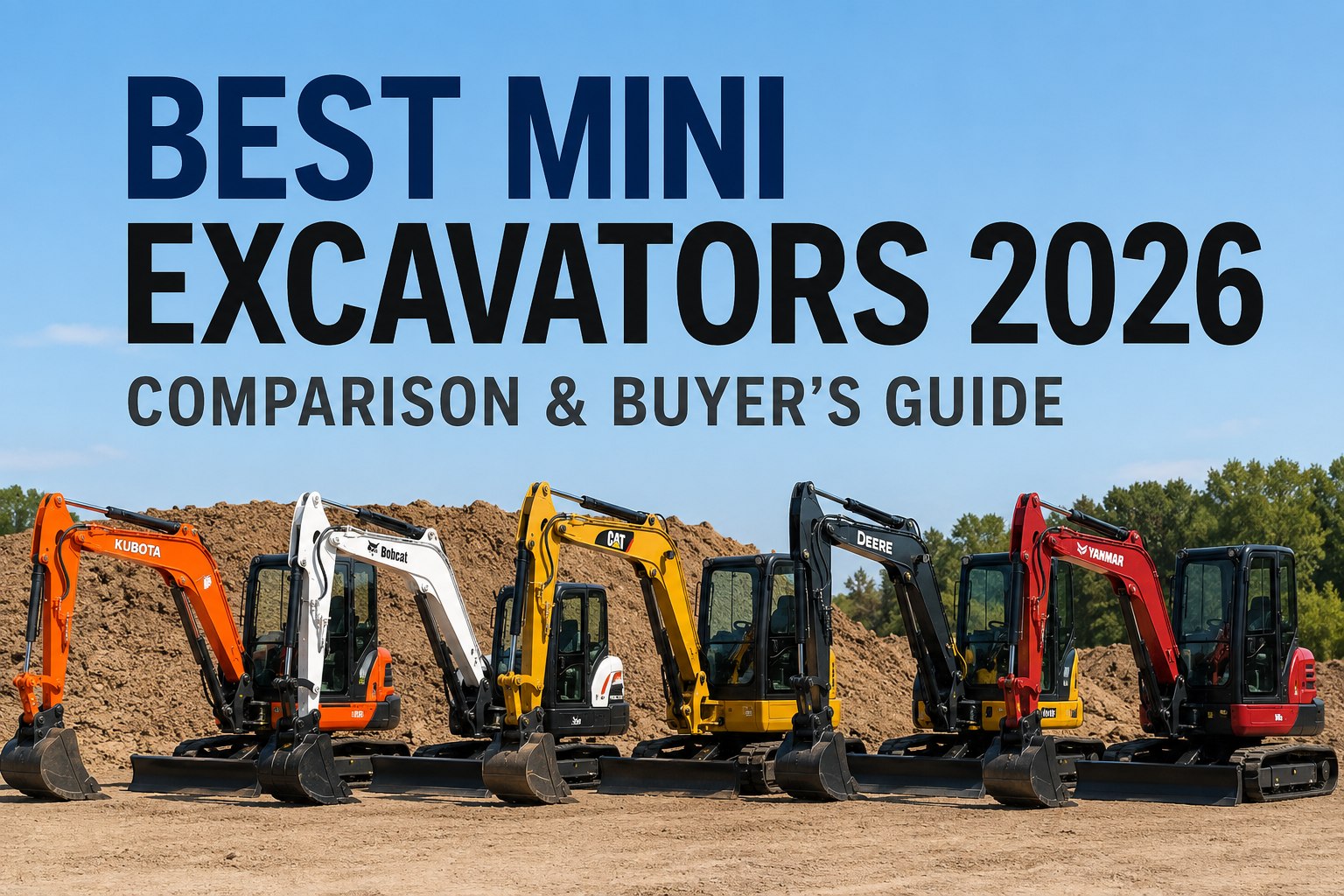
The best mini excavator in 2026 depends less on the brand you pick than on the weight class you shop first. Every serious mini excavator manufacturer — Kubota, Bobcat, Cat, John Deere, Yanmar — builds machines across four weight classes: sub-2 ton, 3 ton, 5 ton, and 8-ton-plus. The 3-ton class alone accounts for the majority of the 33,442 new financed compact excavators sold in North America last year, making mini excavators the second-most-popular construction equipment category behind only compact track loaders. This buyer's guide organizes the market the way experienced contractors actually shop it: choose the class first, then compare five equivalent machines head-to-head. Kubota U27 vs. Cat 302.5 CR vs. Bobcat E35 vs. John Deere 26 P-Tier vs. Yanmar ViO27 — that's a decision you can actually make. Book a demo to see the inspection, PM, and compliance layer that keeps a mini fleet earning revenue instead of parked in the shop.
The 4-Class Mini Excavator Selection Ladder
Pick the class first. Then compare five equivalent machines. That's how the market actually shops.
The 3-ton class is where the market concentrates. Roughly half of compact excavators sold every year in North America fall between 2.5 and 4 metric tons because that weight covers the widest range of practical jobs — residential foundations, utility trenching, general site work — while still fitting on a standard trailer without special permits. If your work profile isn't defined enough to know which class you're shopping, start with the 3-ton class. If your work sits outside that footprint, the ladder above tells you where to look.
The 4 numbers that shape the mini excavator market in 2026
These four data points explain why the mini excavator category has become the second-most-competitive construction equipment segment and why every serious manufacturer now maintains a full lineup across all four weight classes.
- 33,442 New financed compact excavators sold in North America in 2025
- #2 Category rank — behind only compact track loaders in equipment sales
- 5—15 ft Dig depth range across weight classes — residential to full-utility
- $40K—$120K Price spectrum from sub-2T canopy to 8T+ cab with tech package
The $80,000 price gap between the smallest and largest classes explains why weight-class selection is the most consequential decision in the buying process. Overshopping into a heavier class costs 2-3x the acquisition price and produces trailer, transport, and operator considerations you may not need. Undershopping produces a machine that stalls on jobs it wasn't spec'd to handle. Book a demo to see equipment-hours PM scheduling for each class of machine
The 5 brand DNA cards — what each manufacturer does best
Every brand covers all four weight classes, but each has genuine specializations and reputational strengths worth understanding before you narrow your comparison. Here's the honest brand-level positioning.
Kubota
DNA: #1 US market share in compact construction equipment. Deep K series (standard swing) and U series (zero/tight swing) coverage — 17 models total spanning every weight class.
Best for: Fleet standardization; parts availability; strong resale. The U27 (3T zero tail swing) and KX040-4 (mid-class) are workhorse choices with proven track records.
Bobcat
DNA: US pioneer of compact excavator production; owned by Doosan Bobcat. Recently rolled out two new zero-tailswing minis (Oct 2025) with more power and lift capacity for tight spaces.
Best for: Contractors already running Bobcat compact track loaders — the parts ecosystem, dealer network, and operator familiarity make the E35 the highest-volume single mini excavator model in the US market.
Caterpillar
DNA: Next Generation mini excavator line with the deepest technology integration — Cat Grade with Assist, Cat Payload, integrated telematics. CR (Compact Radius) designation on short tail swing models.
Best for: Larger contractors already on Cat equipment for full-size work; utility contractors needing precision grade functionality; operators willing to invest in the tech premium.
John Deere
DNA: P-Tier lineup with newly redesigned cabs on 26 P-Tier and 17 P-Tier — standard heat + A/C, Bluetooth radio, LED lighting, mechanical suspension seat. 8 models topping at 85 P-Tier (9-metric-ton).
Best for: Operator comfort priority; contractors valuing cab environment for long-shift work; existing Deere fleet operators consolidating parts and service on one brand.
Yanmar
DNA: Zero tail swing pioneer — ViO series was among the first to bring zero-swing engineering to the US market. SV series adds swing-boom capability for offset trenching along walls and foundations.
Best for: Landscape contractors; work in constrained spaces (retaining walls, existing structures); operators who value the swing boom's offset digging capability.
None of the five brands is objectively "best" — each has a genuine specialization. The question is which specialization matches your predominant work profile. A landscape contractor working in tight yards gets more value from Yanmar's swing boom or Bobcat's zero-tailswing than from Cat's tech package. A utility contractor cutting precise grade profiles gets the opposite. Start free and get make/model-specific PM intervals loaded per machine
The 3-ton class head-to-head — the actual decision most buyers face
The 3-ton class is where roughly half the market concentrates. Five brands, five equivalent models, one comparison. If you're shopping mini excavators without a fixed class requirement, this is the table that matters.
All five machines will dig the same trench for the same money. The differentiation lives in the specific workflow — tail-swing type for constrained sites, cab comfort for long shifts, tech package for grade-critical work. Match the specific feature to your predominant job profile rather than defaulting to a brand loyalty from other equipment. Book a demo to see multi-brand fleet management with unified PM intervals
The 8 buying criteria that separate a great spec from a compromised one
Beyond weight class and brand, these eight specifications separate a mini excavator that fits your work from one that doesn't. Each is a decision at order stage, not a fixable feature at delivery.
The two amber-highlighted criteria — tail swing type and weight-class match — are the two decisions most owners wish they had researched more before ordering. Get those right and the remaining six become straightforward optimization. Start free and get make/model-specific pre-use checks running from day one
From a contractor running a 6-machine multi-brand mini fleet
We run six minis. Two Kubota U27s, two Cat 302.5 CRs, a Bobcat E35, and a Yanmar ViO35. Every one was bought for a specific reason — the Yanmar for a landscape crew that works around walls, the Cats for a grader-tied utility contract, the Kubotas because our lead operator trained on them, the Bobcat because we already ran three Bobcat compact track loaders and consolidating parts saved us real money.
What I learned in years 2 and 3: brand loyalty isn't a spec strategy. Every one of those machines earns its money. The mistake I stopped making was buying a brand because the last one worked — the U27 the U27 does a specific thing better than the E35 for one reason, and the E35 wins on a different job for a different reason. Match the machine to the work, not to the previous purchase.
Frequently asked questions
What is the best mini excavator brand in 2026?
There is no single best brand — the mini excavator market has five dominant manufacturers (Kubota, Bobcat, Caterpillar, John Deere, Yanmar) plus strong competition from Case, Volvo, Takeuchi, Komatsu, Hitachi, JCB, and others. Each of the top five specializes in different strengths. Kubota holds the #1 US market share in compact construction equipment with 17 mini excavator models across K series (standard tail swing) and U series (zero/tight tail swing). Bobcat pioneered US compact excavator production and its E35 is the top-selling single mini excavator model in North America. Caterpillar's Next Generation mini excavators integrate the deepest technology stack (Cat Grade with Assist, Cat Payload, integrated telematics) and typically appeal to larger contractors already running Cat equipment. John Deere's newly-redesigned P-Tier cabs offer standard climate control, Bluetooth radio, and LED lighting, targeting operator-comfort priority. Yanmar's ViO series pioneered zero tail swing engineering in the US market and the SV series adds swing-boom capability for offset digging. The right brand depends on your predominant work profile — landscape contractors, utility contractors, tech-forward operators, and cab-comfort-priority buyers each have a different objectively-best choice.
What size mini excavator do I need?
Size follows work profile. The four weight classes serve distinct applications. Sub-2 ton mini excavators (Kubota K008-5, Bobcat E10, Cat 300.9D, Deere 17 P-Tier, Yanmar ViO17) are best for access-restricted work, residential yards, interior demolition, and light landscaping — they can fit through 3-foot gates and even pass through some doorways. 3-ton class mini excavators (Kubota U27, Bobcat E35, Cat 302.5 CR, Deere 26 P-Tier, Yanmar ViO27) are the general-purpose sweet spot, handling residential foundations, utility trenching, and general site work with roughly 8-10 feet of dig depth. 5-ton class (Kubota KX057-5, Bobcat E50, Cat 305 CR, Deere 50 P-Tier, Yanmar ViO50) covers heavy trenching, foundation work, and demanding attachment use with 11-12 feet of dig depth. 8-ton-plus class (Kubota KX080-5, Bobcat E85, Cat 308, Deere 85 P-Tier, Yanmar ViO80) delivers near-full-size performance with 14-15 feet of dig depth for deep foundation and utility mainline work. If your work isn't defined enough to place you in a specific class, start with the 3-ton class — it covers the widest range of practical jobs while still fitting on a standard trailer without special transport permits.
What's the difference between zero tail swing, compact radius, and conventional tail swing?
Tail swing type describes how far the rear of the excavator extends beyond the tracks when the upper structure rotates. Zero tail swing means the counterweight stays within the width of the tracks throughout rotation — safest for work in tight spaces, alongside walls, or in traffic, because the operator does not need to worry about the tail striking obstacles. Compact radius (Cat CR designation, similar terms from other brands) means the tail extends slightly beyond track width but by a much smaller margin than conventional models, offering a compromise between confined-space maneuverability and improved digging geometry. Conventional tail swing means the counterweight extends significantly beyond the track width during rotation, requiring workspace clearance behind the machine, but delivering the strongest digging force and reach because the mass distribution favors it. Choose based on predominant job site constraints. Zero tail swing is essential for landscape contractors working alongside houses and walls, for utility work in traffic, and for demolition inside standing structures. Conventional tail swing is fine — and often preferable — for open-site construction, road work, and jobs where digging performance matters more than rear clearance. Compact radius splits the difference and has become the default choice for general contractors.
How much does a mini excavator cost in 2026?
Mini excavator pricing in 2026 spans roughly $40,000 to $120,000 depending on class, configuration, and technology package. Sub-2 ton canopy models start around $40,000-$50,000 for basic configurations. 3-ton class models typically run $55,000-$75,000 for canopy configurations and $75,000-$95,000 for cab models with hydraulic quick coupler and dual auxiliary hydraulics. 5-ton class runs approximately $85,000-$110,000 depending on cab, tech package, and attachment inclusions. 8-ton-plus models push $95,000-$120,000+ with tech-forward configurations. Beyond acquisition cost, budget for attachments (buckets, breakers, augers) at $2,000-$25,000 per, quick coupler retrofit if not spec'd at order (~$3,000-$5,000), operator training (~$500-$1,500 per operator), and transport trailer if not already owned ($5,000-$25,000 depending on capacity). Financing typically runs 4-6% APR through manufacturer credit programs for qualified buyers, with 36-72 month terms common. Used market for 3-6-year-old machines with 1,500-3,000 hours is very active and often the best value for contractors who prioritize acquisition price over warranty and latest technology.
How does HVI help contractors manage a mini excavator fleet?
Mini excavator fleets face specific inspection and maintenance requirements that differ from on-road CMV compliance. Every machine needs pre-use inspections covering hydraulic system integrity, undercarriage wear, coolant and DEF levels, safety devices, and quick coupler function. PM scheduling runs by engine hours (typically 250-hour intervals for fluid changes, 500-hour for hydraulic filters, 1,000-hour for major service) rather than calendar dates or odometer readings. HVI centralizes all of it: photo-verified pre-use inspections from operator phones with make/model-specific templates for Kubota, Bobcat, Cat, John Deere, and Yanmar; PM scheduling triggered by engine hours with automatic 90/60/30-hour advance alerts; hydraulic system monitoring for pressure and temperature trends; undercarriage wear tracking with photo verification; work orders auto-generated from every reported defect with mechanic sign-off enforced; audit-ready records covering OSHA and site safety requirements. The specification decisions in this guide happen once at purchase. The inspection and maintenance workflow happens every day. HVI makes that daily layer background — go live in under two weeks and see your mini fleet's compliance and PM cadence running from day one.
The right machine is the one that earns hours. HVI keeps it earning.
HVI runs the pre-use inspection, PM scheduling, and defect-to-repair workflow that keeps every mini excavator in your fleet earning hours instead of sitting for unplanned repairs. Make/model-specific templates for all five major brands. Engine-hours cadence built in. Audit-ready records generated automatically. Live on your fleet in under two weeks.
No credit card · No hardware · Multi-brand fleet management day one