Every landscape and utility crew hits the same crossroads at some point — your team is outgrowing rentals, the next contract needs depth or precision a wheelbarrow can't deliver, and the decision comes down to two machines that look interchangeable on a dealer lot but absolutely are not on a jobsite: a compact (mini) excavator or a mini-skid steer. The wrong call here costs more than the wrong purchase price — it costs cycle time on every project for the next five years. This guide breaks down the productivity data, fuel burn, attachment flexibility, and total-ownership cost both machines actually carry into 2026, so you can pick the one that fits your work, then keep it inspection-ready and audit-clean with HVI's fleet inspection and maintenance software. Start your free HVI trial to digitize daily inspections and maintenance logs for your compact equipment fleet, or book a demo to see how HVI tracks utilization, PM intervals, and compliance across mixed machine types.
The 2026 buying rule, in one line
If you mostly dig, buy the excavator. If you mostly carry, buy the mini-skid.
DIG = Compact Excavator
Trenches · footings · utility lines · stump removal · grave digging · drainage · 4–14 ft depths
CARRY = Mini-Skid Steer
Mulch · sod · pavers · gravel · debris hauling · grading · post-hole augers · 1,000+ attachments
Spec showdown — the head-to-head
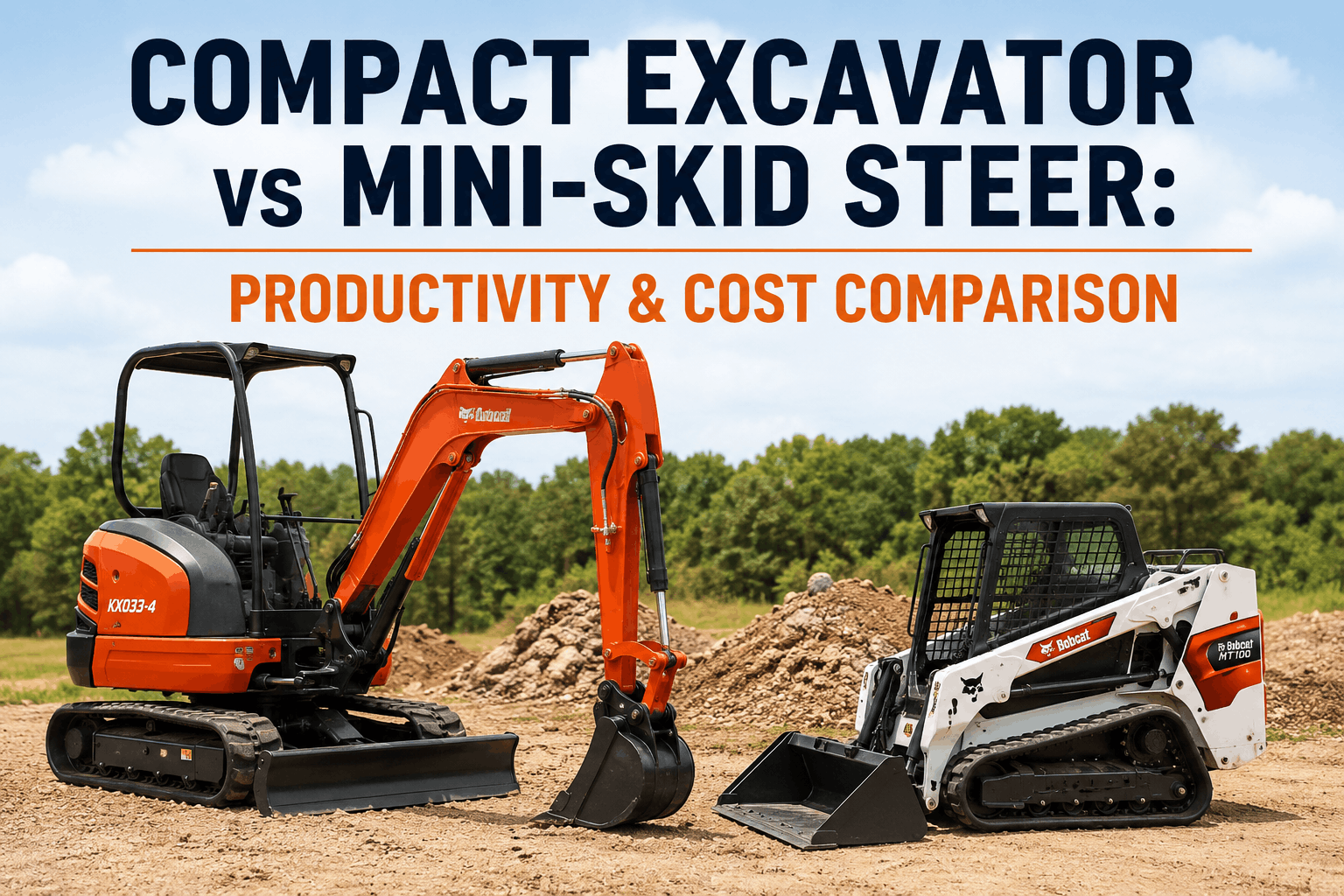
Before the productivity, fuel, and cost numbers, here is what each machine actually is. The comparison below uses two of the most-shopped models in 2026: a popular 3.5-ton compact excavator (Bobcat E35-class) and the best-selling 1,500-lb-class mini-skid (Ditch Witch SK1550-class). Other brands sit in similar ranges.
Compact (Mini) Excavator
3.5-ton class · Bobcat E35-type
Operating weight7,700 lb
Engine25–30 HP diesel
Dig depth10 ft 4 in
Reach17 ft
Cab rotation360° (zero-tail-swing)
Travel speed2.8 mph
Bucket force7,200 lb
Fuel burn (avg)1.2–2.0 gph
Mini-Skid Steer
1,500-lb class · Ditch Witch SK1550-type
Operating weight4,200 lb
Engine44 HP turbo diesel
Lift capacity (ROC)1,558 lb
Hinge-pin height94 in
Cab rotationNone (skid-turn)
Travel speed4.7 mph
Hydraulic to attachment34.5 HP
Fuel burn (avg)1.5–3.5 gph
The headline difference is geometry, not horsepower. The excavator's 360-degree house rotation and 10-foot dig depth give it precision below grade that no mini-skid can match. The mini-skid's 4.7 mph travel speed and 1,558-lb operating capacity make it nearly twice as fast for carrying anything anywhere on a site. Track either one inside HVI — sign up free and you can log engine hours, PM schedules, and operator inspections for your full equipment fleet from day one.
Cycle-time matrix — same task, two machines
Here is how each machine performs across eight tasks landscape and utility crews run every week. Times are estimated for an experienced operator under normal conditions for one full task cycle.
Task
Compact Excavator
Mini-Skid Steer
Winner
100 ft of 36-in deep trench
Excavator
Loading 10 cu yd of mulch
Mini-skid
Stump removal (12-in dia.)
Excavator
Grading 2,000 sq ft area
Mini-skid
12 fence-post holes (12-in)
Mini-skid
Sod transfer (1,000 sq ft)
Mini-skid
Footing (8 ft × 4 ft × 4 ft deep)
Excavator
Pallet of pavers across site
Mini-skid
3
Tasks where the compact excavator wins outright
Anything below grade or requiring depth & precision
5
Tasks where the mini-skid wins outright
Anything that moves material across the site
Fuel burn & cost-per-hour breakdown
Fuel is the single biggest operating-cost line item for either machine. Here is what 2026 diesel prices ($3.85/gal national average) work out to per operating hour for both — across light, normal, and heavy-load conditions.
Compact Excavator
25–30 HP class
Light digging
1.2 gph · $4.62/hr
Normal duty
1.6 gph · $6.16/hr
Heavy load
2.0 gph · $7.70/hr
Mini-Skid Steer
44 HP class
Light hauling
1.5 gph · $5.78/hr
Normal duty
2.5 gph · $9.63/hr
Heavy attachment
3.5 gph · $13.48/hr
The compact excavator wins clear on fuel — roughly 30–40% less burn at comparable utilization. But the mini-skid's higher hydraulic output is the reason for its burn rate, and it is exactly what makes the 1,000+ attachment ecosystem possible. Whichever you buy, tracking actual fuel-per-hour over time is how you catch developing engine issues early. Schedule a quick HVI demo to see how the platform logs fuel, engine hours, and PM intervals together so you can spot abnormal burn patterns before they become repair bills.
Attachment ecosystem — where the mini-skid pulls ahead
This is the single biggest reason mini-skids dominate landscape contracts: 1,000+ attachments work with the universal mini-skid mounting plate, against roughly 30–40 specialized attachments for a compact excavator. Both are versatile, but the depth of choice is in a different league.
~30
Compact Excavator Attachments
Buckets (digging, grading, tilt, ditch)
Augers (6"–30" diameter)
Hydraulic breakers / hammers
Thumbs & quick couplers
Compaction wheels & plates
Rippers, rakes, grapples
Specialized for excavation work; depth-and-force tasks.
1,000+
Mini-Skid Steer Attachments
Buckets, grapples, forks, blades
Trenchers & vibratory plows
Augers, post-pounders, soil conditioners
Brooms, rotary brushcutters, stump grinders
Tillers, sod cutters, harley rakes
Snow blowers, snow blades, salt spreaders
Concrete mixers, pavers, leveler bars
Tree spades, cement breakers, planers
Versatile across landscape, utility, snow, demo, ag.
5-year total ownership cost — the real number
Purchase price is just the start. Here is what each machine actually costs over a 5-year ownership horizon at 700 operating hours per year — purchase, fuel, maintenance, insurance, and depreciation factored in.
Compact Excavator (3.5-ton)
$48,000Purchase price
$7,000Fuel (5 yr)
$5,500Maintenance
$4,000Insurance (5 yr)
–$22,000Resale (yr 5)
Net 5-yr cost: ~$42,500
$12.14/operating hour
Mini-Skid Steer (1,500-lb)
$42,000Purchase price
$11,000Fuel (5 yr)
$6,500Maintenance
$3,500Insurance (5 yr)
–$18,000Resale (yr 5)
Net 5-yr cost: ~$45,000
$12.86/operating hour
The cost gap is smaller than the price tag suggests. The mini-skid is cheaper to buy but burns more fuel, depreciates slightly faster, and racks up more attachment-related wear. Over 5 years the cost-per-hour difference is under a dollar. Buy the machine that matches your work — not the one with the lower sticker.
The decision matrix — which one is right for your crew?
If your project mix tilts heavily in one direction, the choice is straightforward. Here is a clean decision framework.
Pick the Compact Excavator if...
- Underground utility work is your main contract type
- You dig trenches deeper than 3 ft regularly
- Footings, drainage, basement work, septic systems
- Tree & stump removal is a recurring service
- You work on finished landscapes — turf protection matters
- Precision below-grade work pays your invoices
- You work in tight backyards with zero-tail-swing access
Pick the Mini-Skid Steer if...
- Landscape installs are your main contract type
- You move bulk material (mulch, gravel, sod, pavers) daily
- You run a wide variety of attachments across job types
- Snow removal is a winter revenue stream
- Site grading and finish work are on every project
- You haul to trucks or trailers many times per shift
- Job sites tend to be flatter, larger open areas
Pro contractor move: Own one, rent the other. Most established landscape and utility crews own the machine they use most days (typically the mini-skid for landscape, the excavator for utility) and rent the other for specific jobs. This keeps capital tied up only in the machine that actually pays for itself in utilization.
Either machine, one fleet maintenance system — that's HVI
The machine you choose is a 5-to-10-year commitment. The maintenance program you put around it determines whether you hit that lifespan with healthy resale value or limp through it with chronic downtime. HVI is built to run inspections, work orders, and maintenance records for any mix of heavy equipment — compact excavators, mini-skids, dump trucks, trailers, you name it — in one platform.
01
Daily inspections on a phone
Operators run guided pre-shift inspections on the HVI mobile app — photo-verified, GPS-stamped, vehicle-locked. Works for an excavator, a mini-skid, or any other piece of compact equipment in the fleet.
02
PM intervals on actual hours
HVI tracks engine hours per machine and fires PM reminders at every service interval. Oil changes at 250 hrs, hydraulic filter at 500, tracks at 1,000 — automated, not from memory.
03
Work orders link to inspections
Any defect flagged in an inspection auto-creates a maintenance work order tied to the machine, the photo, and the operator. Closed work orders link back to the original inspection — full audit trail.
04
Utilization data per machine
HVI shows you hours run, fuel logged, and downtime per machine. The data that tells you whether to keep, sell, or rent each unit — without spreadsheets.
Whether you go with the excavator, the mini-skid, or both, your maintenance and inspection records belong in one system that follows OSHA expectations and protects resale value. Start your free HVI trial and have your equipment profiles set up in under an hour — no hardware, no IT lift, no per-vehicle setup fees.
Frequently asked questions
QCan a mini-skid steer replace a compact excavator for most landscape work?
For surface-level landscape work — sod, mulch, grading, pavers, planting — yes, comfortably. A mini-skid will out-cycle a compact excavator on those tasks by a wide margin and the attachment ecosystem covers practically every landscape application. The moment work moves below grade — trenches over 3 ft, footings, drainage, utility tie-ins — a mini-skid cannot substitute. Its practical digging limit with a bucket is about 2–3 feet, against the excavator's 10+ feet.
Book a demo to see how HVI tracks utilization data so you can prove which machine actually pays for itself on your project mix.
QWhat is the real fuel cost difference between the two over a year?
At 700 operating hours per year and $3.85/gal diesel, a 3.5-ton compact excavator burns roughly $1,400 in fuel annually. A 1,500-lb mini-skid running attachments under normal load burns about $2,200. The roughly $800 annual fuel difference is meaningful but is rarely the deciding factor — it is dwarfed by the productivity-cost-per-task gap between the machines. Pick on application fit first, fuel economy second.
QWhich holds its resale value better — a compact excavator or a mini-skid?
Compact excavators historically hold value slightly better — typically 45–50% of purchase price at the 5-year mark vs. 40–45% for mini-skids. The reason is application diversity: an excavator's resale market includes utility, septic, plumbing, demolition, and residential construction buyers, while mini-skids primarily sell back to landscape contractors. Good maintenance records (the kind HVI's digital logbook generates automatically) add another 5–8% to resale on either machine.
Start a free HVI trial and your machines build verifiable maintenance history from day one.
QHow tough is a mini-skid on finished turf compared to a mini excavator?
Both are gentler than wheeled equipment, but a mini excavator on rubber tracks distributes ground pressure even more evenly than a mini-skid with comparable tracks — typically 3–4 psi vs. 5–6 psi. For finished landscapes where turf damage means callbacks, the excavator is marginally safer. That said, modern mini-skids on wide tracks are good enough for almost all installation work. The real turf killer is operator behavior, not machine choice — tight turns and aggressive direction changes do more damage than ground pressure.
QIs rental still a better option than buying for an early-stage contractor?
If you are using a machine fewer than 25–30 days per year, rental is almost always cheaper. The crossover point is typically around 400–500 operating hours per year, beyond which ownership cost-per-hour drops below rental rates. Most established crews hit that threshold on at least one machine type within the first two seasons.
Schedule a demo and HVI's team can walk through how the platform tracks utilization across owned and rented equipment, helping you decide when to flip from renting to owning.
QWhat inspection and maintenance records should I keep for either machine?
At minimum: daily operator pre-shift inspection, engine-hour log, PM service records at each manufacturer interval (50, 250, 500, 1,000 hrs), hydraulic system service history, undercarriage/track inspection records, and any repair work orders with parts replaced. These records satisfy OSHA expectations, protect you in any incident investigation, and add real resale value when you sell the machine in 5 years. HVI generates and stores all of these automatically — daily inspections, PM triggers on real hours, defect-to-work-order chains, and a searchable equipment history file per machine.
Pick the right machine. Run it on the right maintenance system. HVI keeps both honest.
Whether your next purchase is a compact excavator, a mini-skid steer, or one of each, HVI keeps daily inspections, PM intervals, and work orders in one platform — for any mix of compact and heavy equipment. No hardware, no IT lift, audit-ready from day one.
No credit card required · Multi-equipment fleet ready · Inspection + maintenance in one platform