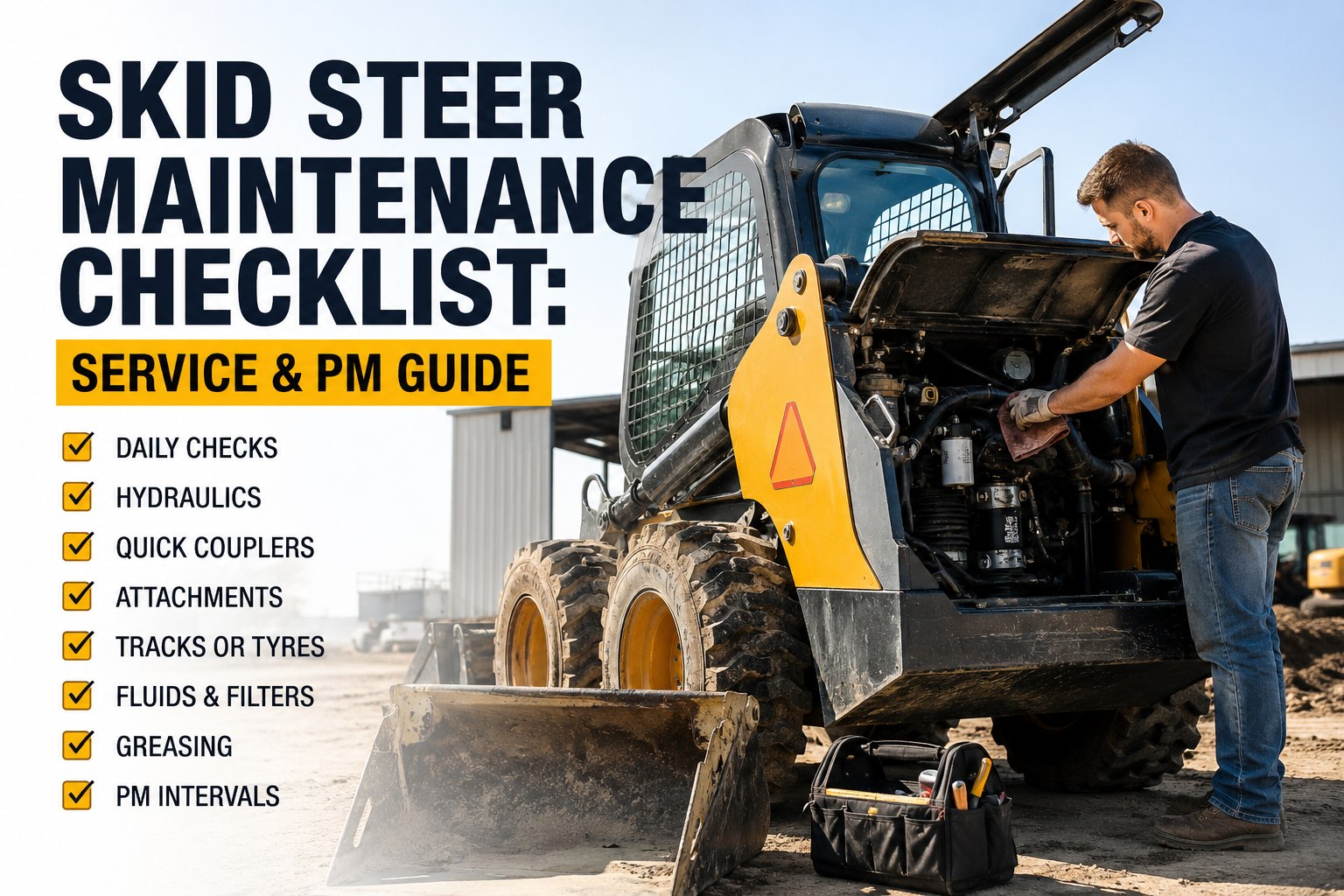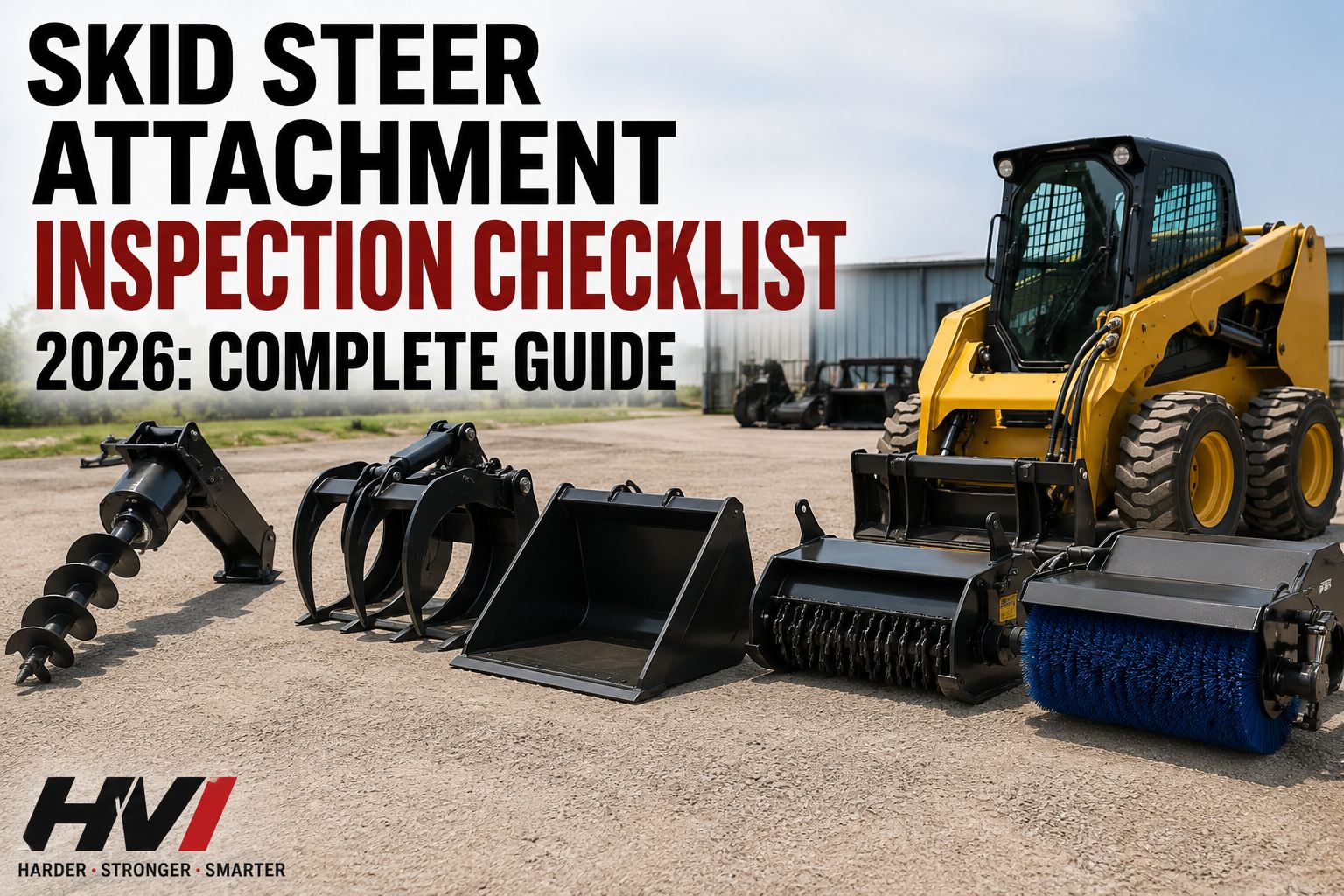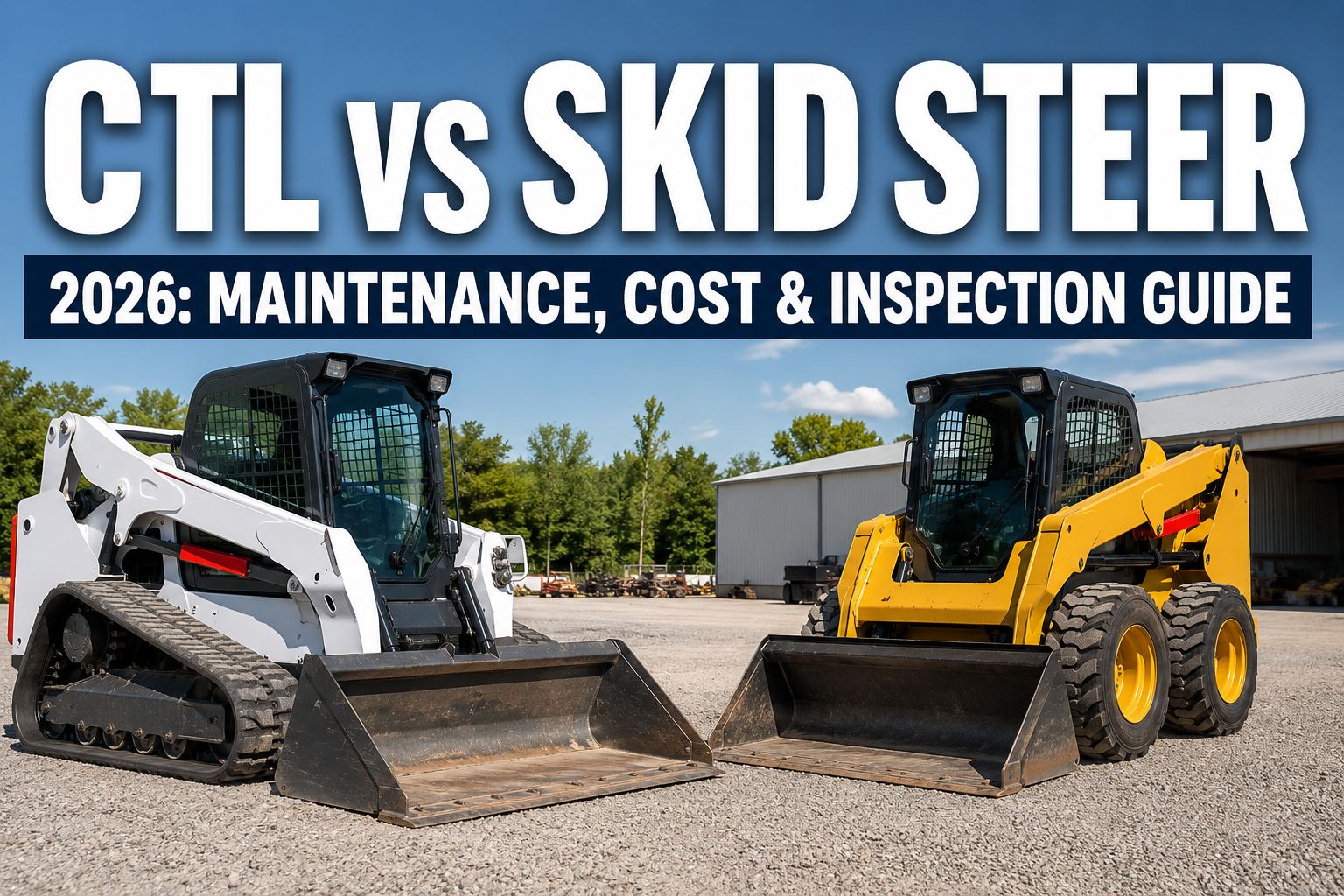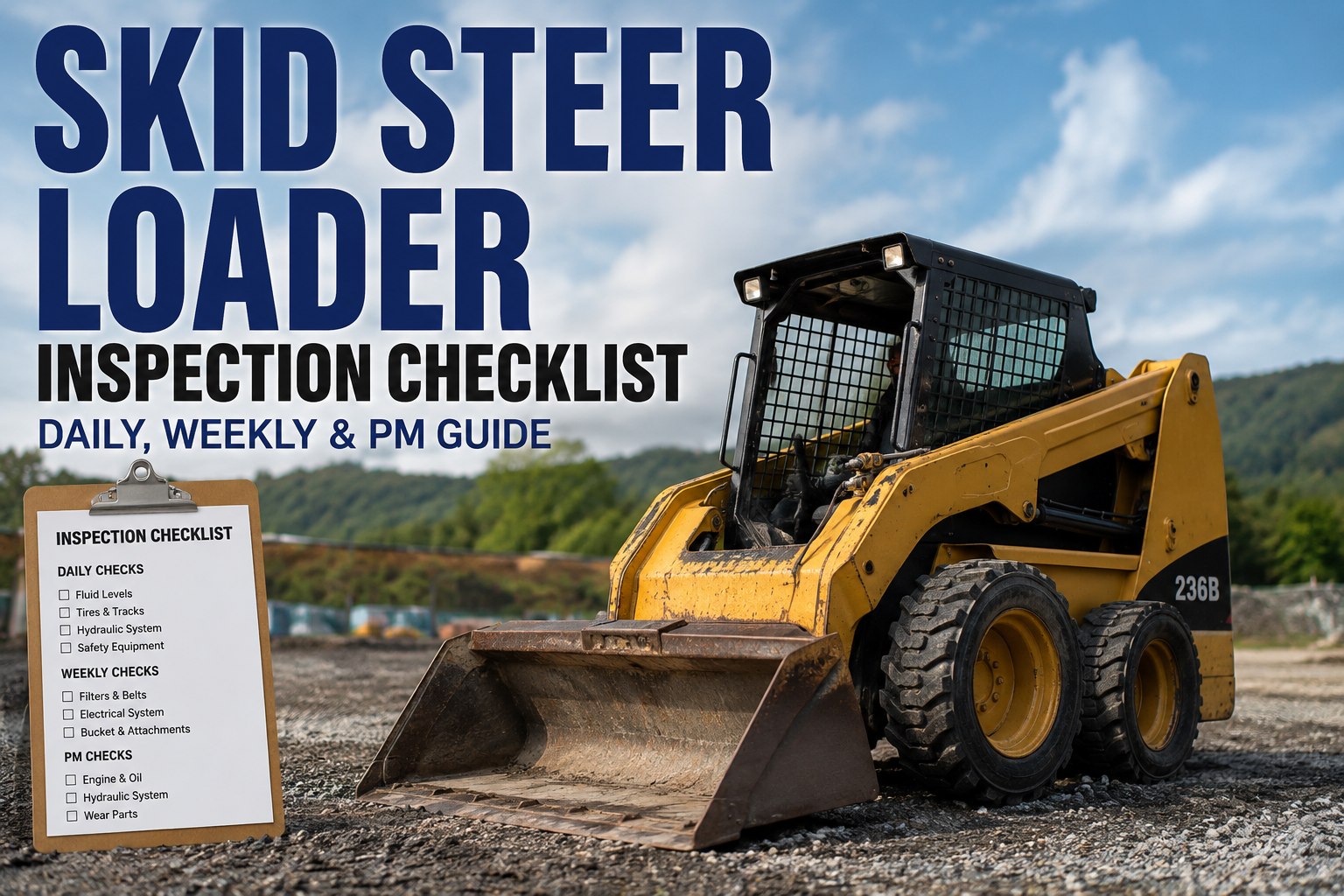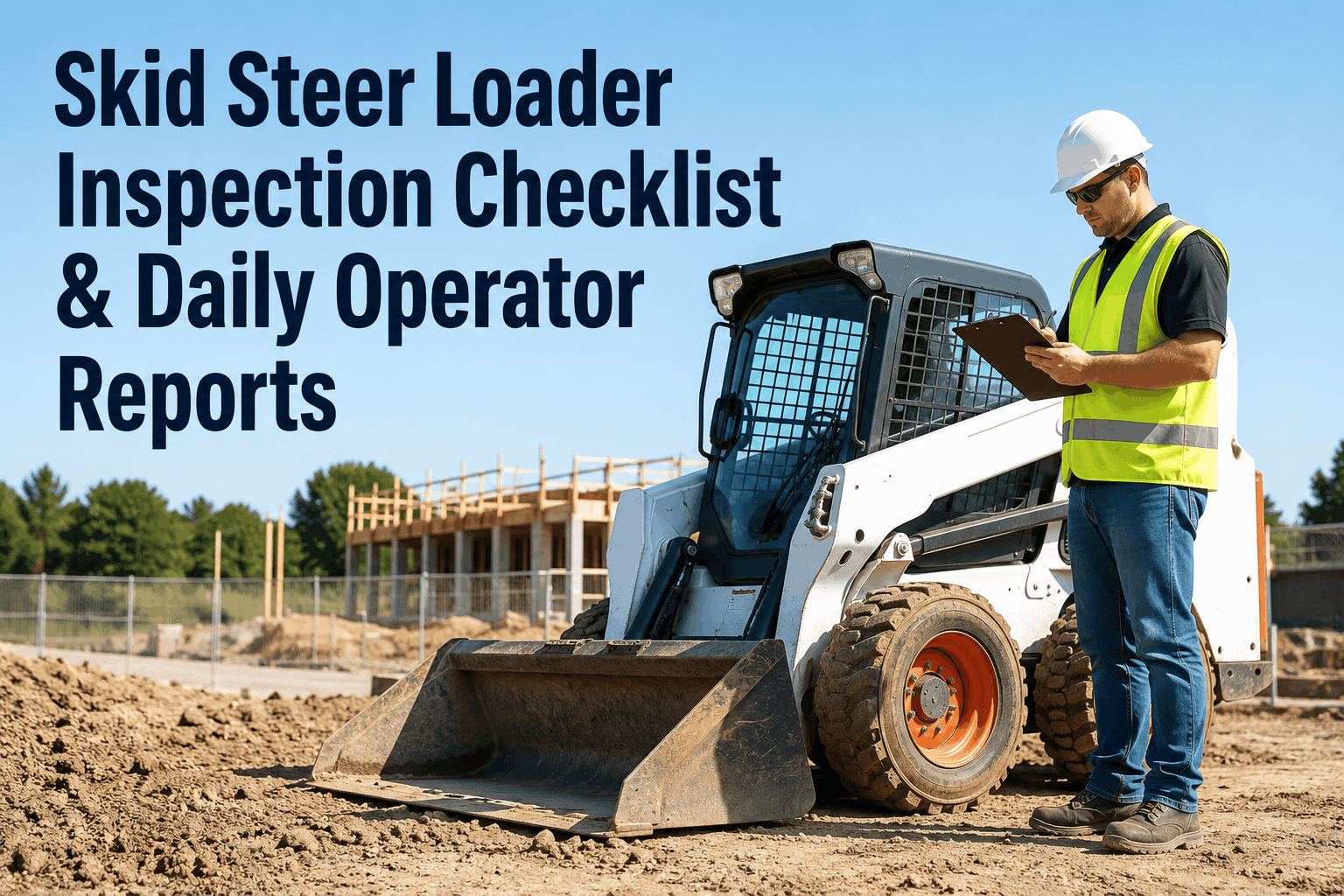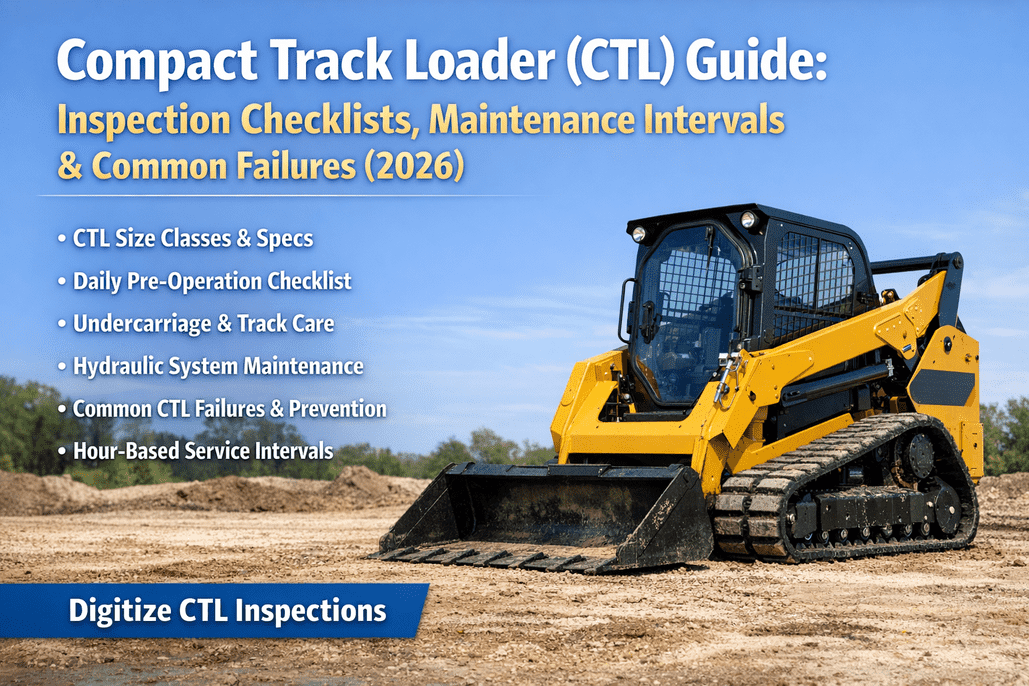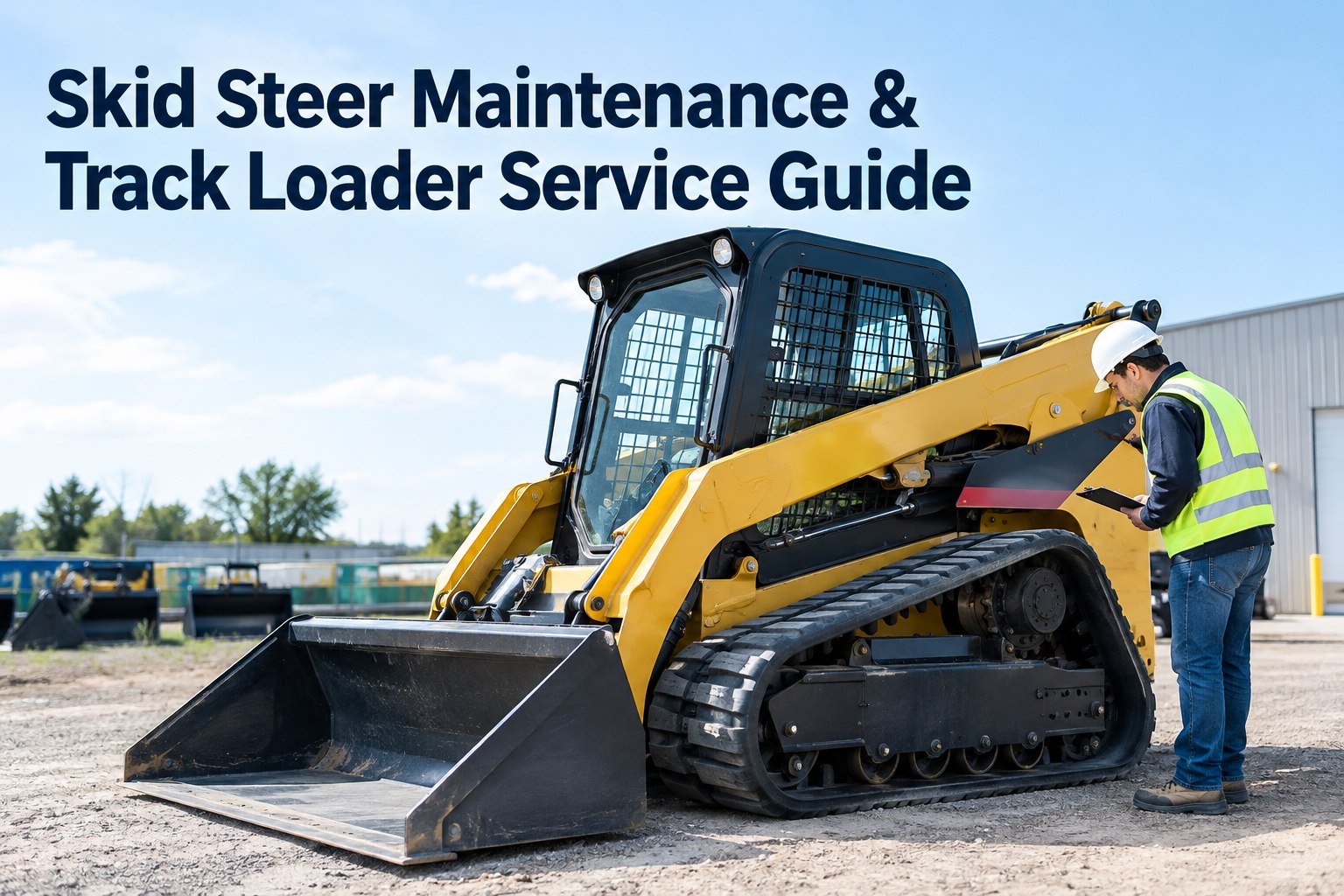
A skid steer feels like the simplest machine on the yard — no air brakes, no annual sticker, climb in and go. That's exactly why its maintenance goes informal and why the coupler that drops an attachment or the interlock somebody bypassed becomes the incident nobody documented. A real skid steer maintenance programme is built on records, because on this machine the paperwork is the safety control. See mixed-asset PM in HVI
A Skid Steer & Track Loader Maintenance Programme That Actually Gets Followed
High cycle rates, attachment cross-contamination, and interlocks that get bypassed — the three things that quietly wreck compact loaders. On this machine, the record is the control.
Skid steers and compact track loaders work harder per operating hour than almost any machine on site, and their maintenance is frequently informal because they feel simple. This programme covers the seven things that actually decide the outcome — the attachment coupler as a safety item, hydraulic contamination through the coupler, the interlock system, the lift-arm support device, undercarriage service on tracked variants, chain case or final drive, and filtration loading in dust — and how a records-based programme keeps every one of them from slipping.
The Attachment Coupler Is a Safety Item Firsta dropped attachment is a crushing injury, not a maintenance inconvenience
Everything else on this list matters for cost. The coupler matters for whether someone goes home. The quick-attach plate connects a bucket, grapple, or breaker to the loader arms, and its locking pins must be fully engaged and visually verified every single time an attachment is mounted — not felt, not assumed, seen. A pin that looks seated from the cab but hasn't fully dropped is exactly how an attachment lets go under load.
Recording the pin verification isn't bureaucracy — it's what turns a habit into an accountable step. When the coupler check lives on a logged inspection tied to the operator and the machine, a skipped verification is visible instead of invisible. See the coupler lock verification captured on every attachment change.
Every Attachment Swap Is a Contamination Eventthe hydraulic coupler is where dirt gets into the main circuit
Here's the part most operators never connect: swapping attachments repeatedly is one of the biggest sources of hydraulic contamination on a skid steer. Every time the hydraulic coupler faces are exposed to mud, grit, or crop dust and then connected, that contamination gets seeded straight into the main hydraulic system — and hydraulic contamination is behind most compact-loader hydraulic failures.
Poppet-style couplers and unwiped faces trap and introduce debris on every connection. On a machine that changes attachments several times a day, that's a constant contamination feed into the return filters and pump.
Flat-face couplers, which mate cleanly with minimal spillage, plus a strict wipe-the-faces-before-connecting habit. Return filters changed on schedule — commonly around 500 hours — to catch what still gets through on its way back to the tank.
None of that discipline sticks without a record that the wipe-down and the filter interval actually happened. Treating clean-coupler practice as a logged maintenance step — not an assumed one — is what makes flat-face couplers and clean handling a genuine hydraulic-life factor instead of a good intention.
Interlocks Are Not Optional — and Never a Workaroundbypassed safety systems are a repeat finding in fatal-incident investigations
The seat bar and presence sensors that stop the loader arms and drive functions when the operator isn't properly seated exist because skid steers have a specific, deadly failure mode: an operator leaning out of the cab while functions are live. OSHA and NIOSH investigations into fatal skid steer incidents repeatedly cite bypassed or non-functioning safety interlocks as a contributing factor — a switch that sticks in cold weather is a safety inspection item, not a maintenance afterthought.
Zip-tied seat bars, defeated presence switches, and disconnected sensors are among the most frequent — and most dangerous — things an inspection turns up on compact loaders. The interlock test belongs on every service, and a failed or defeated interlock should hold the machine, not get noted and ignored.
This is where a maintenance programme becomes a safety programme. When the interlock function test is a required, logged inspection item — and a failure can flag the machine out of service until it's fixed — a bypassed interlock stops being an invisible shortcut. See the interlock test as a required inspection item that can hold a machine.
The Lift-Arm Support Device Is Non-Negotiableno service under raised arms without it
Any work under raised loader arms — greasing, hydraulic inspection, clearing a jam — requires the machine's lift-arm support device engaged. Hydraulics can bleed down, a hose can fail, a control can be bumped; the mechanical support is what stands between a technician and a multi-thousand-pound arm coming down.
A bled-down cylinder, a failed hose, or a bumped control drops the arms — with someone underneath. It's a fatal-injury mechanism, not a maintenance risk.
The support device engaged and verified on the service procedure — a checked item, not an assumed one, so it can't get skipped under time pressure.
It's a simple step that gets skipped under time pressure, which is exactly why it belongs on the service procedure as a checked item.
Undercarriage: Track Loader Maintenance's Biggest Hidden Costskip it and you're only tracking half the machine
On compact track loaders, the undercarriage is the single highest-cost system — and the cheapest to protect if you catch wear early. It follows excavator undercarriage principles at a smaller scale: track tension, roller and idler wear, and sprocket condition all move together. An under-tensioned track or a worn roller doesn't fail quietly; it chews the sprocket and idler on the way down, turning what could have been a small tension adjustment into a multi-thousand-dollar undercarriage rebuild.
On skid-steer (tired) variants the equivalent is tyre condition and the chain case or final drive depending on type — different components, same principle: measure the wear, trend it, and plan the replacement instead of discovering it. See undercarriage wear trended so replacement is planned, not sprung.
The Hour-Based PM Schedulemeter hours, not a monthly guess — because these machines cycle hard
Because skid steers and CTLs rack up hard hours unpredictably, a calendar schedule either over-services a light-use machine or dangerously under-services a heavy one. Hour-based intervals are the only honest schedule. Here's a realistic framework — always confirm against your machine's manual and duty cycle, and shorten every interval in heavy dust.
None of these intervals matter if they live in a paper logbook that stays in the cab. A PM schedule tied to actual meter hours — with multi-interval tracking so the 50-, 250-, and 500-hour clocks all run independently — is what turns this timeline into something that gets followed. See hour-based, multi-interval PM run on every compact loader.
Why the Record Is the Controlon a machine with no annual sticker, documentation is the whole system
A truck has a DOT annual and a windshield sticker forcing a yearly reckoning. A skid steer has none of that — which means the only thing standing between "we maintain these" and "we assume someone does" is the record. The coupler verification, the interlock test, the filter interval, the undercarriage measurement: each is only a control if it's captured, tied to the machine and operator, and retrievable when something goes wrong.
That's also what makes this manageable across a mixed fleet. When compact loaders, attachments, trucks, and trailers all live in one system — each on its own clock — the equipment manager sees one dashboard instead of a clipboard per machine. HVI's preventive maintenance scheduling runs the hour-based intervals, and the same history feeds safety management reporting, so a pattern of bypassed interlocks or coupler defects surfaces across the fleet instead of hiding on one machine.
From an equipment manager who stopped treating skid steers as "simple"
We treated our skid steers like hand tools for years — no schedule, just run them till something broke. The wake-up call was a compact track loader that needed a full undercarriage rebuild at 1,800 hours because nobody ever checked track tension. That's a machine we basically wore out at half its life. We put every compact loader on hour-based PM in the same system as our trucks, and started tracking each attachment as its own asset. The undercarriage failures stopped, and honestly the bigger win was the interlock and coupler checks finally being on a record instead of in someone's head.
The Skid Steer & CTL Service Checklistthe safety-critical and cost-critical items, in one pass
Every point on this page comes down to a set of checks that either protect a person or protect a high-cost component. Keep this on the phone at the machine — the whole programme in eight lines.
- Both coupler locking pins fully dropped and visually verified
- Seat bar and presence interlocks tested, never bypassed
- Lift-arm support device used for any work under raised arms
- Attachment guards, hoses, and lock/tilt functions sound
- Track tension and undercarriage wear within spec (CTL)
- Coupler faces wiped; flat-face couplers, no visible contamination
- Hydraulic and return filters on their hour-based interval
- Any out-of-spec item photographed, logged, and work-ordered
Eight checks between "it feels fine" and a documented, defensible service record. Use this skid steer service checklist online free, with photo evidence and hour-based reminders on every machine.
Frequently Asked Questions
What should a skid steer maintenance programme include?
A complete skid steer maintenance programme covers daily pre-start checks (fluids, coupler pin verification, tyre or track condition, interlock test), greasing of pins and bushings around every 50 hours, engine oil and filter around 250 hours, hydraulic fluid and return-filter service around 500 hours, and periodic undercarriage or final-drive service on tracked variants. Critically, it treats the attachment coupler as a safety item, the interlock system as a required test, and every interval as hour-based rather than calendar-based, since these machines cycle hard and unpredictably.
Why is the attachment coupler a safety item, not just maintenance?
The quick-attach coupler holds a bucket, grapple, or breaker to the loader arms, and if its locking pins aren't fully engaged, an attachment can drop under load — a serious crushing hazard. That's why the pins must be fully dropped and visually verified at the plate on every attachment change, not just felt or assumed from the cab. Recording that verification against the machine and operator turns a habit into an accountable step, so a skipped check becomes visible rather than invisible.
How do attachment changes cause hydraulic contamination?
Each time you connect a hydraulic attachment, the coupler faces — often exposed to mud, grit, or crop dust — introduce that contamination into the main hydraulic circuit. On a machine that changes attachments several times a day, this becomes a steady contamination feed that hydraulic contamination is behind most compact-loader hydraulic failures. Flat-face couplers, which mate with minimal spillage, plus a habit of wiping the faces before connecting and changing return filters on schedule (commonly around 500 hours), are the practical controls.
Why should skid steer PM be hour-based instead of monthly?
Skid steers and compact track loaders accumulate operating hours very unevenly depending on the job, so a fixed calendar schedule either over-services a lightly used machine or dangerously under-services a heavily used one. Tying PM to actual meter hours means each machine is serviced on its own real workload. Multi-interval tracking matters too, since the daily, 50-, 250-, and 500-hour clocks all run independently and shouldn't be collapsed into one date.
What's the most expensive thing to neglect on a compact track loader?
The undercarriage. Track tension, rollers, idlers, and the sprocket all wear together, and an under-tensioned track or worn roller accelerates damage to everything around it — turning a small, cheap tension adjustment into a multi-thousand-dollar undercarriage rebuild. Because undercarriage wear is gradual and measurable, trending it across inspections lets you plan replacement around your jobs instead of discovering it as a breakdown. It's the highest-cost system on the machine and the cheapest to protect early.
The Takeaway
Skid steers and track loaders earn their "simple machine" reputation right up until an attachment drops, an interlock that was bypassed lets go, or an undercarriage nobody measured needs a rebuild at half its life. The programme that prevents all three isn't complicated — hour-based PM, the coupler and interlock treated as safety items, the undercarriage measured and trended — but it only works if it lives on a record instead of in someone's head. On a machine with no annual sticker forcing the issue, documentation is the control. Start free and put every compact loader and attachment on one hour-based programme.
Run Your Compact Loaders on a Programme, Not a Guess
HVI schedules hour-based, multi-interval PM on skid steers and CTLs, tracks every attachment as its own asset, makes the coupler and interlock checks required inspection items, and works offline in the yard — all alongside the trucks and trailers in the same fleet.