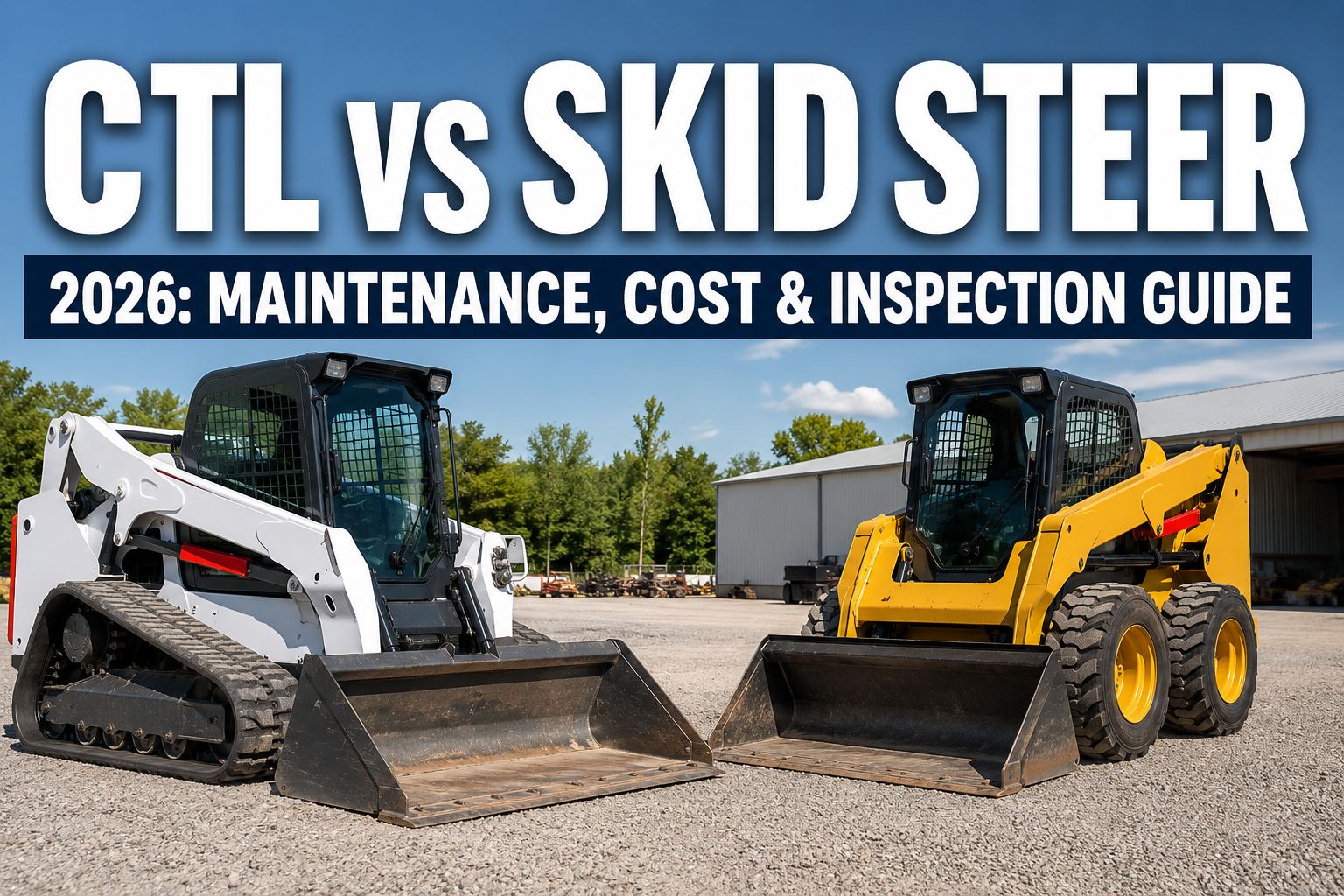
Compact track loader vs skid steer is the equipment decision facing every construction, landscaping, and site-prep operation buying compact machinery in 2026. The two look almost identical from the operator seat but diverge sharply on purchase price ($30K-$80K skid steer vs $100K+ CTL), undercarriage economics ($200-$600 per tire vs $4,000-$10,000 per track pair), and terrain performance. Compact track loaders now represent over 70% of new compact loader sales, driven by soft-ground applications and turf-friendly work. Book an HVI demo to manage inspection and PM across both types.
Same operator seat. Very different economics. Very different ideal jobsites.
The undercarriage is the only real difference — but it cascades into purchase price, fuel burn, daily maintenance minutes, terrain access, and total cost of ownership. Get the decision right and both machines earn out. Get it wrong and one sits idle while the other burns money.
The undercarriage economics that drive the whole decision
Every meaningful difference between compact track loader vs skid steer economics traces back to one design choice: wheels or tracks. The undercarriage cascades through purchase price, replacement cost, daily maintenance time, dealer dependence, and terrain access. Understanding this cascade is the difference between buying the right machine and buying the wrong one.
Skid steer tires cost $200-$600 each depending on size and type (pneumatic vs solid rubber). A full set of four runs $800-$2,400, and a competent operator can swap all four in one to two hours with basic shop equipment. Track replacement on a CTL runs $4,000-$10,000 per pair, typically requires specialized tools and dealer involvement, and takes considerably longer to complete. Track wear runs on 1,200-1,500 hour cycles for undercarriage service — adding $2,000-$5,000 in maintenance costs across the interval. Daily care follows the same pattern: tire pressure and visual checks take 5-10 minutes; track debris removal, tension adjustment, and undercarriage cleaning take 20-30 minutes. Over a machine's 5,000-8,000 hour service life, that daily-time difference alone accumulates into hundreds of hours of undercarriage-specific labor. Book an HVI demo to see PM interval templates that catch undercarriage issues before they escalate
Where each machine wins — application-specific breakdown
The right machine is entirely job-dependent. A CTL on paved yards burns money on premature track wear. A skid steer on wet spring soil spins tires and wastes hours. Match the machine to the actual working environment, not to what the salesman is pushing.
The market has voted. Compact track loaders now represent over 70% of new compact loader sales per Association of Equipment Manufacturers (AEM) data — a reflection of both softer-ground applications gaining share and the increasing preference for CTLs in landscaping, site prep, and utility work where terrain is unpredictable. Skid steers remain the right buy for specific hard-surface applications — but the industry buying signal has clearly shifted. Try HVI free to manage inspection templates for both types across a mixed fleet.
True cost of ownership — the numbers over 5,000 hours
Purchase price is the biggest number on day one but rarely the biggest number over the life of the machine. Fuel, undercarriage, hydraulic service, and downtime all add up. Here's a realistic 5,000-hour cost comparison for a mid-size skid steer vs a mid-size compact track loader running in mixed conditions.
The CTL costs approximately $68,000 more over 5,000 hours — roughly $13.60 per operating hour above the skid steer. That premium is easily justified when the CTL is genuinely more productive in the environment (a Minnesota contractor reported 30% faster grading with a track machine, which offsets the premium and produces net higher profitability). It's poorly justified when the CTL sits on pavement half the time and the tracks wear prematurely against nothing but abrasion. Match machine to environment — the numbers respect that. Try HVI free to track per-machine ownership costs and prove which loader is actually cheapest to run in your operation.
Maintenance and inspection schedule differences
Both machines share many maintenance intervals — hydraulic filter and fluid at 500 hours, engine oil and filter at 250 hours, engine air filter at 500 hours, cooling system service annually. The divergence lives in the undercarriage.
Digital inspection management for compact loader fleets
Fleets running mixed CTL and skid steer inventories face the same operational challenge either way: keeping every machine inspection-ready, tracking PM intervals against actual operating hours (not calendar days), catching wear before it becomes downtime, and building the compliance record that protects insurance renewal and OSHA response. Digital inspection platforms turn what's typically a paper-and-clipboard exercise into a systemized operational discipline.
HVI's compact loader templates support both machine types with type-specific checkpoints: tire condition and pressure for skid steers; track tension, debris, and roller inspection for CTLs. Photo-verified pre-shift walk-arounds capture visual evidence at every check. Meter-based PM scheduling triggers work orders at the actual hour mark rather than approximating from calendar days. Undercarriage cost tracking per machine builds the historical dataset that answers "which loader is actually cheapest to run in our operation" — the question every fleet manager wants answered but almost none can quantify with paper records. Book an HVI demo to see mixed-fleet compact loader management deployed end-to-end.
From an equipment manager running a mixed 34-machine compact loader fleet
We run 22 CTLs and 12 skid steers across landscaping, site prep, and light construction work. Different projects call for different machines — and the paper-based inspection system we ran through 2024 couldn't handle the type mix. We were losing track of PM intervals, missing track debris cleanings, and putting tires on machines that should have been on tracks. Costs were climbing.
Deployed HVI with type-specific templates. CTLs get 20-minute track walk-arounds with photo checkpoints. Skid steers get quick tire-and-hydraulic checks. Meter-based PM triggers work orders when actual hours hit, not calendar days. Fleet uptime up 22%. Undercarriage costs per CTL down 18% because track debris gets caught daily now. And we finally have data showing which machines earn out in which applications — three CTLs got reassigned to soft-ground projects only, and three skid steers took over the hard-surface work they should have been doing all along.
Frequently asked questions
Should I buy a compact track loader or a skid steer?
The decision comes down to the terrain you actually work on more than half the time. Buy a skid steer if your operation is primarily on hard, established surfaces — paved yards, concrete, compacted gravel, established landscape sites, and warehouse or urban work where tight-space maneuverability matters. Skid steers cost $30,000-$80,000 new, burn 2-3 gallons per hour, and run tire replacements at $800-$2,400 per set that a competent operator can swap in one to two hours with basic shop tools. Buy a compact track loader if your work regularly involves soft ground, uneven terrain, turf-sensitive surfaces, slopes, deep snow off-pavement, or heavy-duty attachments like forestry mulchers and trenchers. CTLs cost $80,000-$120,000+ new, burn 2.5-3.5 gallons per hour, and run track replacements at $4,000-$10,000 per pair with dealer-required labor. The CTL premium over a comparable skid steer runs approximately $13.60 per operating hour across a 5,000-hour service life — easily justified when the machine is genuinely more productive in its environment (a contractor grading soft soil is 30% faster with a CTL than a skid steer), poorly justified when the CTL spends most of its time on pavement wearing tracks against nothing but abrasion. The market signal is clear: compact track loaders now represent over 70% of new compact loader sales per Association of Equipment Manufacturers data, driven by soft-ground applications gaining share. But that doesn't automatically make CTL right for your specific operation — match the machine to the actual working environment.
Are compact track loaders more expensive to maintain than skid steers?
Yes, meaningfully so — and the difference concentrates almost entirely in the undercarriage. Skid steer tires cost $200-$600 per tire, $800-$2,400 for a full set of four, and can be replaced in one to two hours with basic shop equipment by a competent operator. Compact track loader track replacement runs $4,000-$10,000 per pair, typically requires specialized tools and dealer involvement, and takes considerably longer to complete. Daily undercarriage care follows the same pattern: skid steer tire pressure and visual checks take 5-10 minutes; CTL track debris removal, tension adjustment, and undercarriage cleaning take 20-30 minutes. Every 1,200-1,500 hours of CTL operation triggers a full undercarriage service cycle costing $2,000-$5,000 in parts and labor. Beyond the undercarriage, most maintenance items are similar: hydraulic fluid and filter changes at 500-hour intervals for both machines, engine oil and filter every 250 hours, cooling system service annually, lubrication of grease fittings and pivot points every 50 hours. Fuel consumption is roughly 20% higher for CTLs (2.5-3.5 gph vs 2-3 gph for skid steers). Across a 5,000-hour service life, the total cost of ownership for a mid-size CTL runs approximately $68,000 more than a comparable skid steer — about $13.60 per operating hour premium. The premium is justified in environments where the CTL is genuinely more productive; it's not justified when the machine could have been a skid steer working on hard surfaces.
How long do compact track loader tracks last?
Compact track loader tracks typically last 1,200-2,000 operating hours in mixed-application service, though several variables move that range significantly. Track life varies primarily based on operating surface, operator technique, track tension maintenance, and machine matching. Operating surface is the biggest factor. Tracks used primarily on soft ground, turf, and unpacked terrain often reach 2,000+ hours because the surface doesn't abrade the rubber compound. Tracks used on abrasive surfaces like fresh concrete, hot asphalt, or gravel with sharp edges can wear out in 800-1,000 hours — premature failure that represents thousands of dollars in avoidable replacement cost. Operator technique matters second-most. Three-point turns wear tracks more evenly than pivot turns; pivot turns on hard surfaces cause premature side-wall wear. Steady acceleration and deceleration reduces track slippage that grinds against the drive sprocket. Track tension is the invisible killer of track life. Overtightened tracks — a common mistake — increase stress on rollers, idlers, and the drive motor while accelerating internal cord fatigue. A little looseness (approximately 1-2 inches of deflection when checked at the midpoint) protects the entire undercarriage and extends track life measurably. Machine-application matching is the fourth factor: CTLs run in appropriate environments (soft ground, turf work, site prep on unpacked surfaces) consistently outlast CTLs run in wrong environments (paved yards, hard-surface work that should have been done with a skid steer). Fleets that maintain track inspection discipline — daily debris removal, weekly tension checks, monthly wear measurement — consistently extend track life 20-30% beyond fleets running paper-based or ad-hoc inspection routines.
Which is better for landscaping — CTL or skid steer?
For most landscaping applications a compact track loader is the better choice, though specific segments still favor skid steers. The CTL wins in general landscaping because ground pressure of 4-5 PSI (versus 30-40 PSI for a skid steer) minimizes turf damage on both new sod installations and established landscape sites. Rubber tracks won't dig, rut, or tear grass the way spinning tires do. This is critical for finished landscape work where turf preservation is part of the deliverable — and increasingly demanded by residential and commercial clients. CTLs also perform better on the uneven, soft, and often wet conditions common in landscape construction: grading, planting bed preparation, and material handling on soil that hasn't been fully compacted. Heavy-duty landscaping attachments — forestry mulchers for lot clearing, brush cutters, stump grinders — work better on the more stable CTL platform. Skid steers still win for specific landscape segments. Hardscape work (patio installation, retaining wall construction, driveway installation) usually happens on compacted base material or existing pavement where skid steers travel faster, cost less, and don't wear tracks unnecessarily. Snow removal on paved commercial lots favors skid steers for the same reasons. Small residential contractors doing primarily maintenance work on established properties may find the skid steer's lower purchase and operating costs the better economic fit even if a CTL would occasionally be nicer to have. The industry buying signal reflects this: CTLs now dominate new compact loader sales in landscaping segments where soft ground and turf work dominate. But rental fleets show the split remains meaningful in specific applications.
Can inspection software manage both CTLs and skid steers?
Yes — and mixed-fleet operations benefit substantially from type-specific inspection templates rather than generic checklists that treat every compact loader the same. Digital inspection platforms designed for compact loader fleets provide separate template libraries for skid steers and compact track loaders while maintaining unified reporting, PM scheduling, and cost tracking across the mixed inventory. Skid steer templates emphasize the daily checks that matter for wheeled machines: tire pressure per OEM spec (typically 35-50 PSI), visual inspection for cuts and sidewall damage, tread depth measurement, wheel torque check on lug nuts. Compact track loader templates emphasize the daily checks that matter for tracked machines: track debris removal and cleaning, tension measurement (with the correct 1-2 inch deflection target), roller condition, sprocket wear, drive motor mounting integrity. Shared checkpoints across both types cover hydraulic fluid levels, engine oil, coolant, safety systems, ROPS, seat belt operation, and quick-attach coupler condition. Meter-based PM scheduling triggers work orders when actual operating hours hit the OEM interval rather than approximating from calendar days — critical for accurate maintenance timing on rental fleets and mixed-utilization operations. Photo-verified pre-shift walk-arounds capture visual evidence of undercarriage condition, attachment coupling, and safety-critical items. Cost tracking per machine builds the historical dataset that answers the question every fleet manager wants answered but almost none can quantify with paper records: which specific machine is actually cheapest to run in our operation across all cost categories. Mixed-fleet operations running digital inspection consistently report 15-25% uptime improvements and 15-20% reductions in undercarriage-related costs within the first two quarters after deployment.
Manage both types under one system — deployed in 5-7 days.
HVI ships with type-specific inspection templates for both skid steers and compact track loaders. Tire and undercarriage tracking. Meter-based PM triggers. Photo-verified pre-shift walk-arounds. OEM-aligned intervals for Bobcat, Cat, John Deere, Kubota, CASE, Takeuchi, ASV, and JCB. Machine-level cost tracking so you can answer "which loader is cheapest to run in our operation" with data instead of guessing. Live for your fleet in 5-7 days.
All major OEM templates · Mixed-fleet management · Meter-based PM · SOC 2 Type II