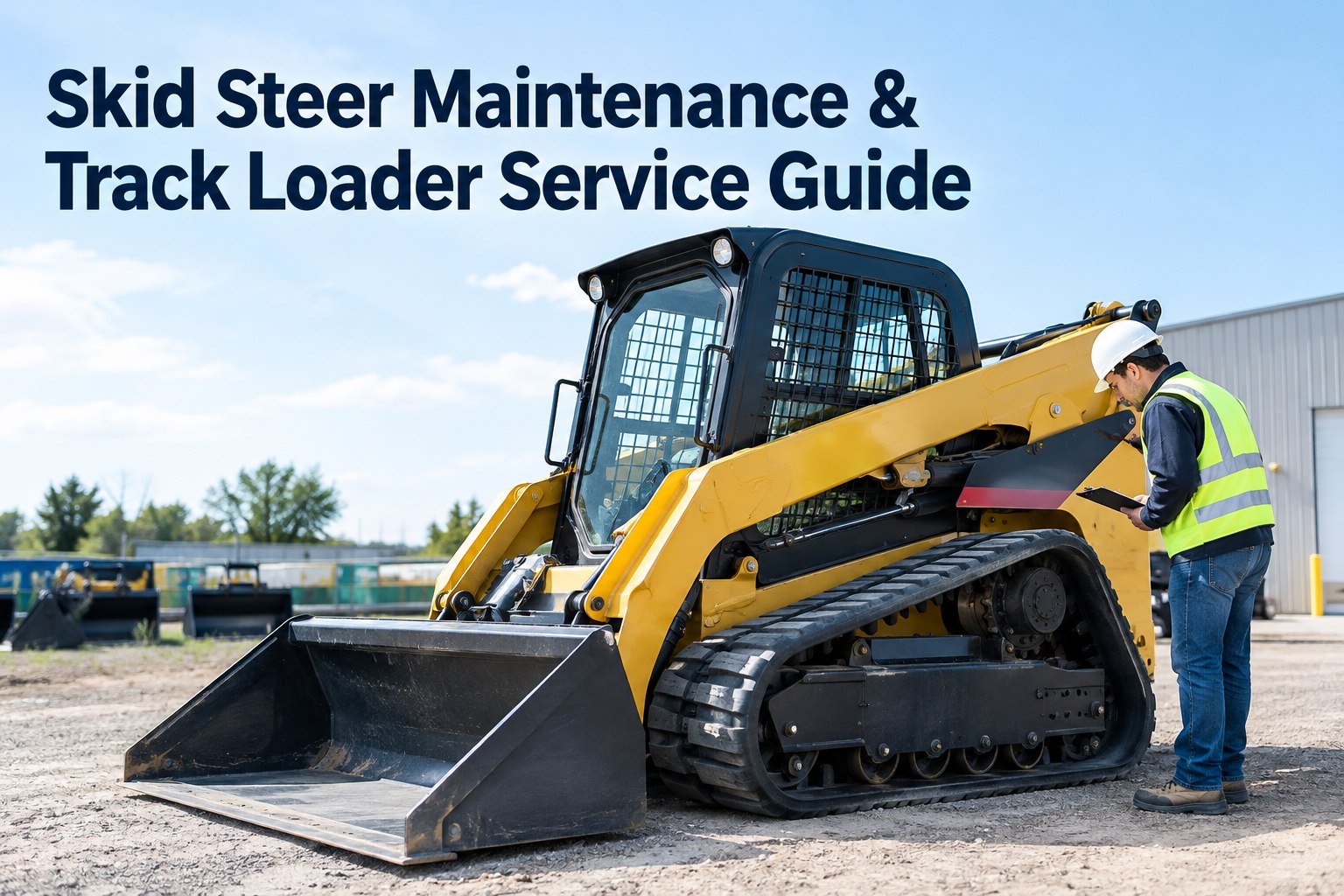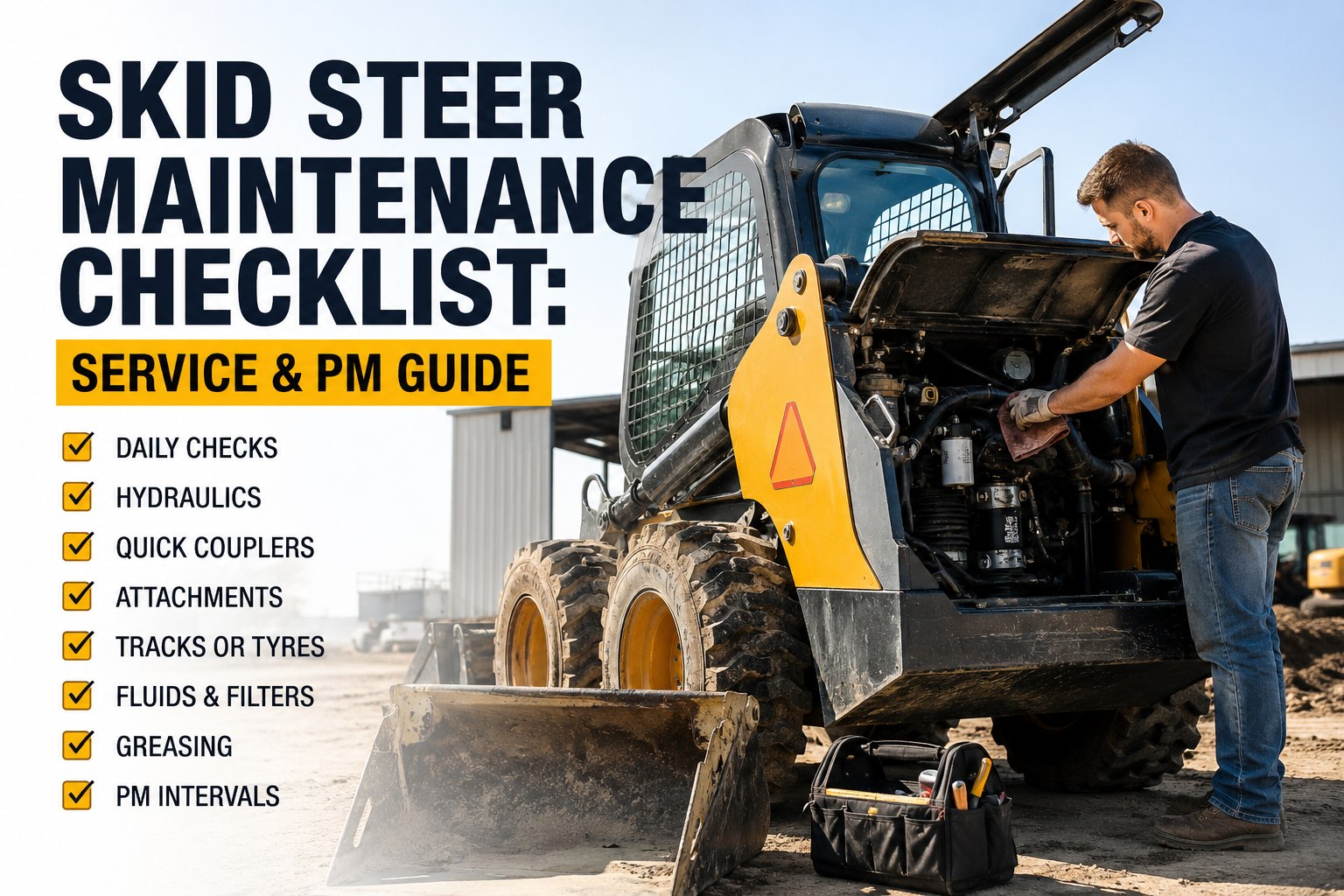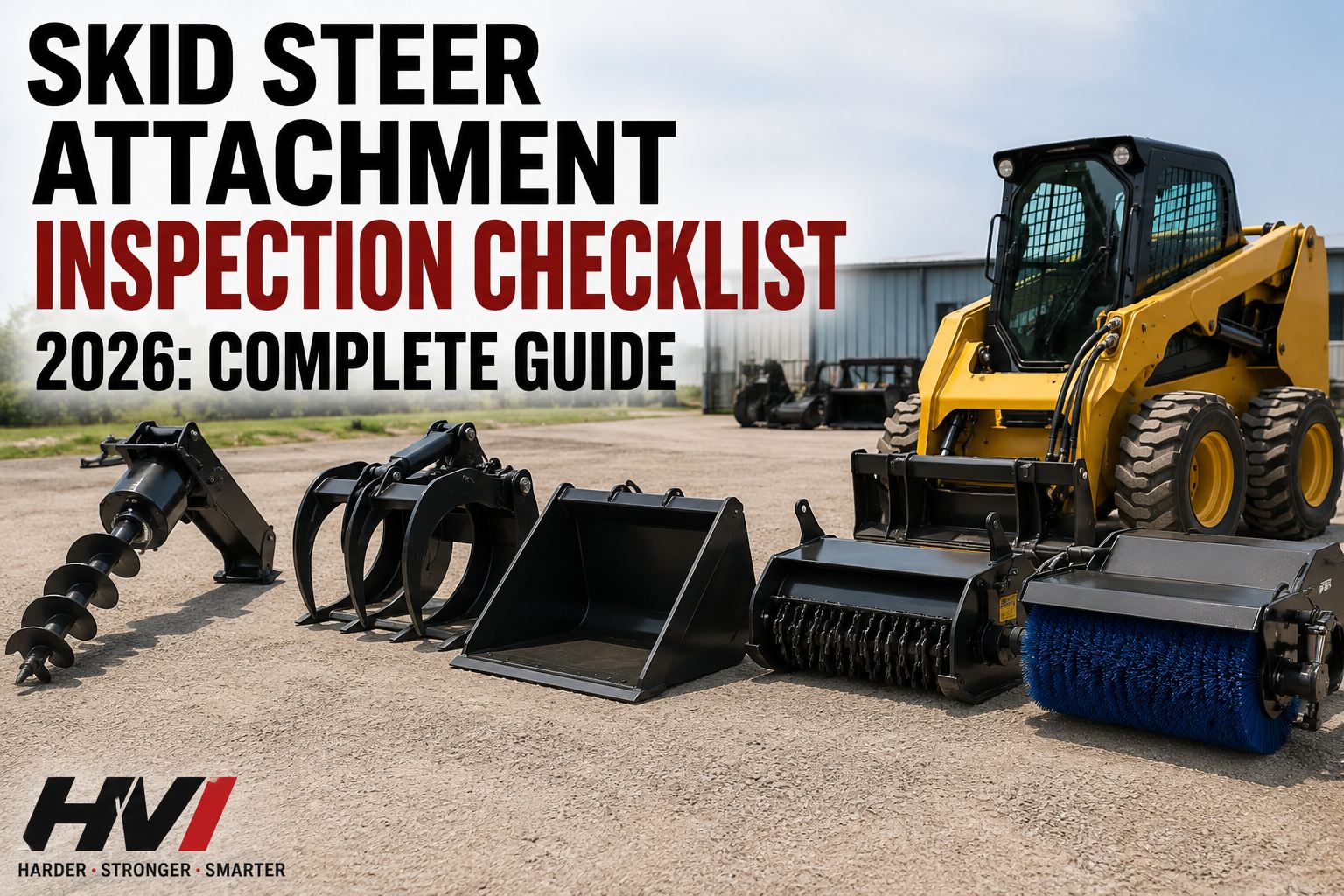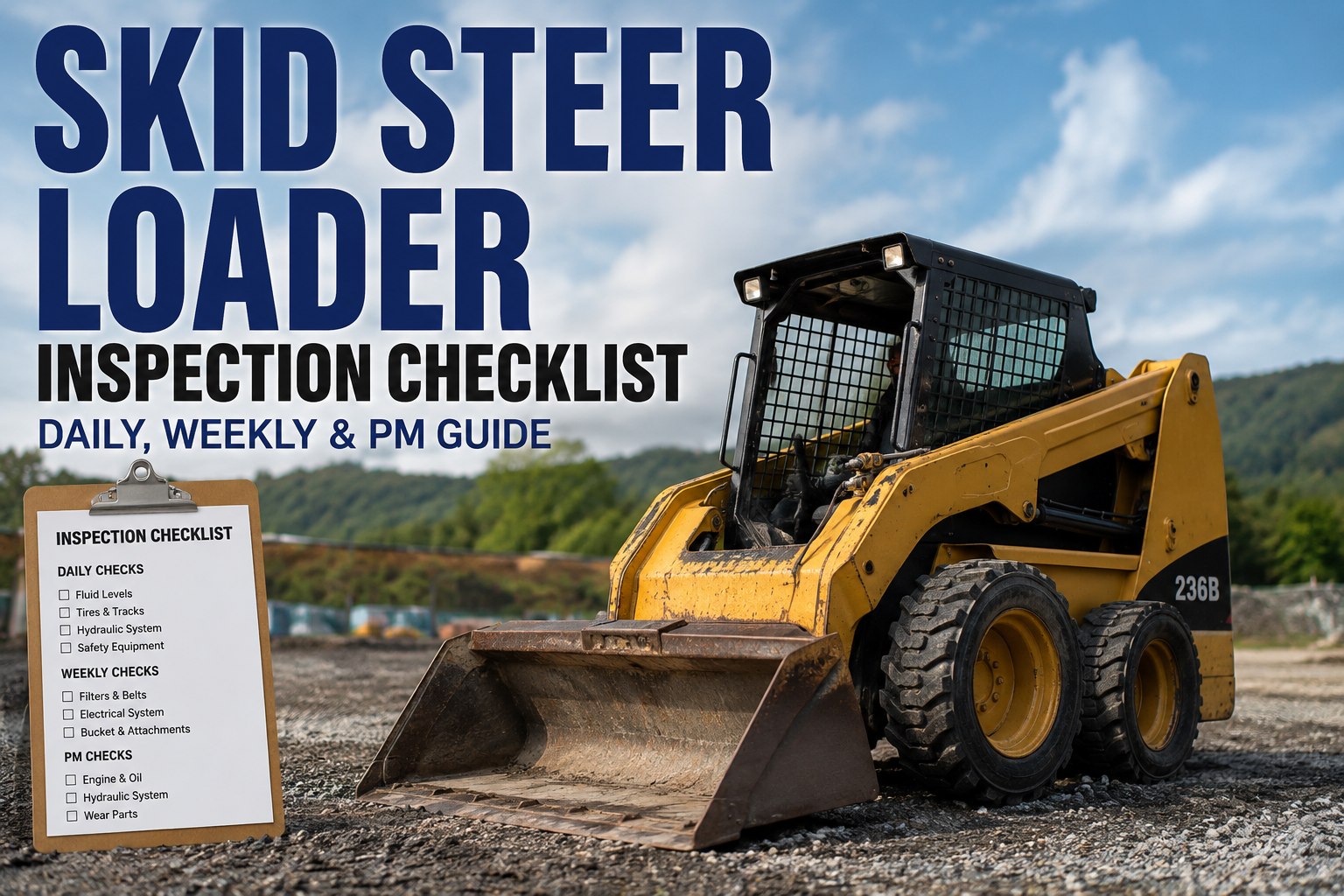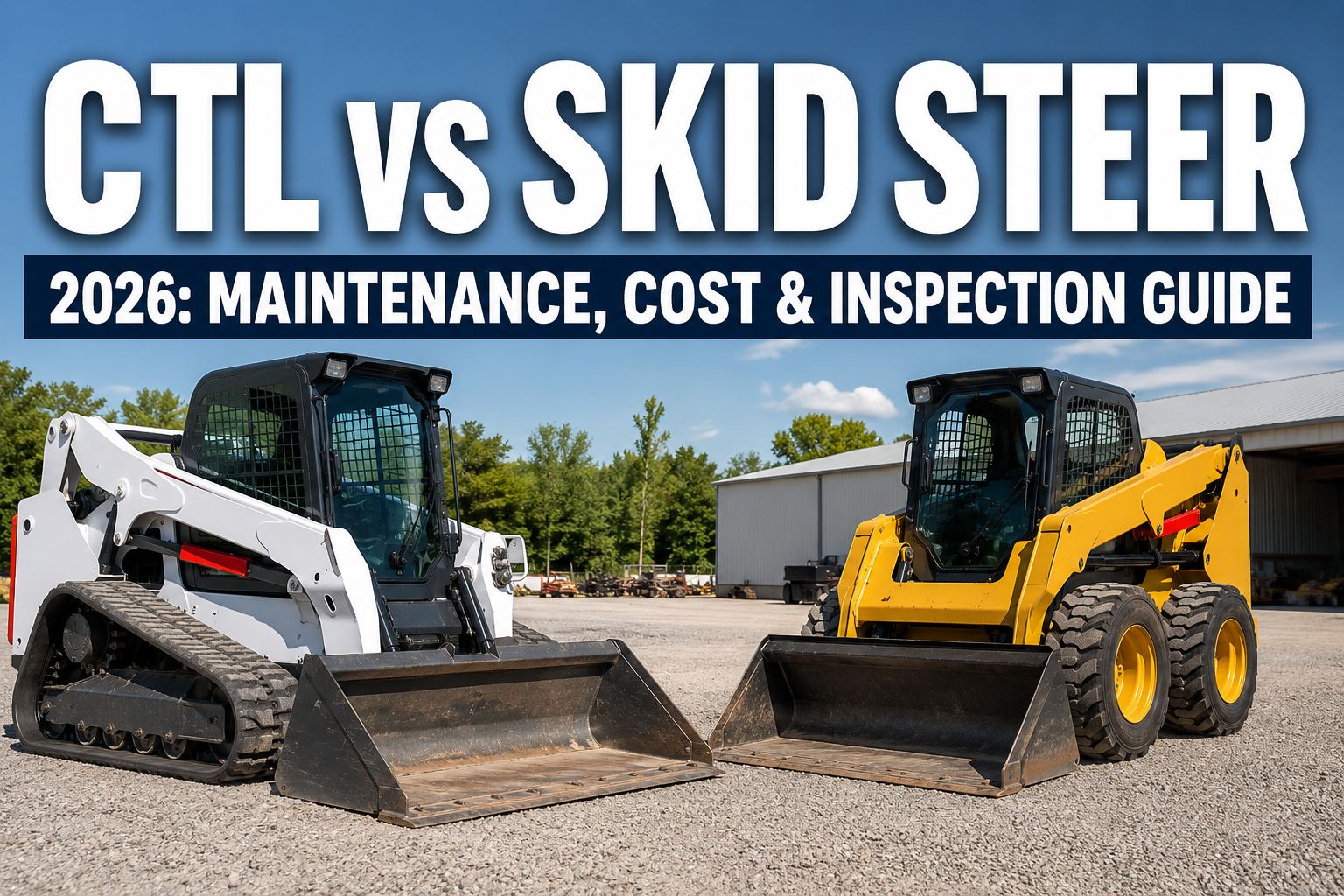
The compact track loader vs skid steer decision costs contractors somewhere between $20,000 and $80,000 in wrong-machine mistakes every year — not because either machine is bad, but because the two answer completely different questions. Tracks own soft ground, snow, and turf; wheels own hard surfaces, speed, and low operating cost. This guide breaks down the real maintenance, cost, wear, and inspection differences — or book a 15-min HVI demo and we'll show you both machine types tracked in one dashboard.
CTL vs Skid Steer — The Real Scoreboard
Same operator, same jobsite, same bucket. Different machine underneath. Here's what actually differs.
A compact track loader (CTL) uses rubber tracks for better traction, flotation, and grading precision on soft, wet, or sensitive ground. A skid steer loader (SSL) uses tires for lower purchase price, cheaper operating cost, and better speed on hard surfaces. Skid steers cost 40–60% less to buy and roughly 20–30% less to run per hour. CTLs cost more, but on jobs where a wheeled machine sinks, spins, or damages turf, the CTL earns back the difference before the invoice clears. Choose by jobsite, not brand loyalty.
The tell-tale sign that a contractor picked the wrong machine: a CTL running full-time on gravel driveways (chewing tracks at 800 hours), or a skid steer stuck in a muddy lot at 8am on a job that needed to be done by noon. Both are common. Both are expensive. The rest of this guide walks each round of the scoreboard in detail so the machine that shows up on your next jobsite is the one that actually fits it.
The 6 Rounds, ExplainedWhy each machine wins where it does — and what it costs on the wrong side
New skid steers land between $30,000 and $80,000 depending on size and cab options. New CTLs start where skid steers end and often clear $100,000. On a mixed fleet, the price gap alone funds a full year of PM on the skid steer — book a demo to see per-machine lifecycle cost tracked automatically.
Tracks generate friction. Wheels don't. Skid steers typically burn 2–3 gph. CTLs typically burn 2.5–3.5 gph under similar loads. Multiplied across a 1,500-hour year at $3.85 diesel, that's $2,300–$4,300 more fuel per CTL, per year.
This is the round that flips the whole comparison. A skid steer on wet clay sinks and spins. A CTL glides over it. Ground pressure on a CTL is 3.5–5 PSI vs 25–30 PSI on a skid steer — roughly a 6x difference. On landscaping, wet grading, and reclaimed lots, that's the difference between working and waiting for the ground to dry.
Concrete, asphalt, and compacted gravel are murder on rubber tracks. Abrasive surfaces cut track life from 1,400 hours to under 800. A CTL on a gravel driveway is burning $4 per hour of track that a skid steer wouldn't spend at all.
A CTL undercarriage needs debris removed, track tension checked, and rollers/idlers inspected every shift — 20 to 30 minutes. A skid steer needs tire pressure checked. 5 to 10 minutes. Across a 200-day work year, that's 60–80 labor hours per CTL that a skid steer doesn't cost you — book a demo to see the daily check flow that trims 15 minutes off every shift.
Wider footprint. Lower center of gravity. Grip on slopes, snow, ice, and loose material that skid steers can't touch. The single biggest reason CTLs took over the compact loader market: they don't get stuck, don't slip, and don't tip on grades a wheeled machine can't hold.
The Full ComparisonEvery category side-by-side
| Category | Compact Track Loader | Skid Steer Loader |
|---|---|---|
| Undercarriage | Rubber tracks, rollers, idlers, sprockets | Four rubber tires, chain-driven axles |
| Purchase price (new) | $60K–$110K+ | $30K–$80K |
| Fuel burn | 2.5–3.5 gph | 2–3 gph |
| Ground pressure | 3.5–5 PSI | 25–30 PSI |
| Top travel speed | ~7 mph | ~12 mph (2-speed) |
| Wear component life | Tracks: 1,200–1,600 hrs avg | Tires: 2,000+ hrs |
| Wear replacement cost | Tracks $2,500–$4,000/set; UC rebuild $4K–$8K | Tires: $600–$1,600/set |
| Daily inspection | 20–30 min (debris + tension + UC) | 5–10 min (pressure + visual) |
| Best terrain | Soft, wet, turf, snow, slopes, sensitive surfaces | Hard, dry, paved, gravel, mixed sites |
| Operating cost share (wear) | 20–50% (undercarriage-heavy) | 5–10% (tires only) |
Undercarriage vs TiresThe single biggest cost gap between the two machines
A CTL undercarriage is 5 wear systems working together: rubber tracks, drive sprockets, rollers, idlers, and tensioner. All of them wear. Neglect any one and the others cascade downward.
- Tracks: 1,200–1,600 hrs typical (400 on abrasive, up to 2,000 on soft ground)
- Track set replacement: $2,500–$4,000
- Full UC rebuild: $4,000–$8,000 every 1,200–1,800 hrs
- Daily requirements: Clear debris, check tension, inspect for cuts
- Kills tracks fastest: Counter-rotation turns on abrasive surface
A skid steer's tire replacement is a 20-minute job at any tire shop. No specialized undercarriage tooling, no tension calibration, no roller inspection sequence — just four tires and a torque wrench.
- Tire life: 2,000+ hrs on typical mixed use; 3,000+ on paved
- Tire set replacement: $600–$1,600 depending on solid vs pneumatic
- No UC rebuild: Chain-driven axles rarely need service under 5,000 hrs
- Daily requirements: Air pressure check, visual for cuts & sidewall damage
- Kills tires fastest: Curb strikes, punctures on jobsite debris
PM Schedule — Side by SideWhere the two schedules converge, and where they diverge
Above the undercarriage, CTLs and skid steers share almost the same preventive maintenance schedule. Everything below the frame is where the two diverge sharply. Here's what each machine actually needs, at each interval.
- Every 10h (daily): Fluid levels, cooler debris, visual damage walkaround
- Every 50h: Grease loader arm pivots, quick-attach pins, cylinder bearings
- Every 250h: Engine oil sample, fuel filter, air filter check, drive belt
- Every 500h: Engine oil & filter, hydraulic return filter, cooling system check
- Every 1,000h: Transmission service, axle fluid, full hydraulic inspection
- Every 2,000h: Hydraulic oil change, coolant replacement (or 4yr calendar)
- Every 10h: Clear debris from tracks and undercarriage cavity
- Every 10h: Track tension check (spec varies by OEM — 1½" to 2" sag)
- Every 50h: Visual inspection of tracks for cuts, chunks, exposed cords
- Every 250h: Roller and idler inspection for wear, oil leaks at seals
- Every 500h: Drive sprocket wear measurement (replace at 25% wear)
- Every 1,000–1,500h: Full undercarriage assessment; plan track replacement
- Every 10h: Tire pressure check — single most-skipped SSL PM item
- Every 50h: Visual for sidewall cuts, punctures, uneven wear pattern
- Every 250h: Wheel torque check — loose lugs eat tire life fast
- Every 500h: Drive chain tension check on chain-driven axles
- Every 1,000h: Rotate tires side-to-side if uneven wear is developing
- Every 2,000h: Chain and axle service (rarely needed before this)
Both machines share 90% of their maintenance calendar. The 10% that's different is where all the CTL-vs-SSL cost gap lives. Track the shared items on both machines, then layer the machine-specific items on top — that's how a single system covers both.
Which One Belongs on Your JobApplication-by-application — not marketing talk, real jobsite fit
- Landscaping, sod installation, or turf-sensitive lots
- Grading wet or freshly disturbed dirt
- Snow removal on residential drives
- Slopes over 15° and hillside work
- Year-round contractor needing 6–8 extra weeks per season
- Precision grading where flotation matters more than speed
- Concrete, asphalt, or hard-surface work (75%+ of hours)
- Demolition and mixed debris cleanup
- Fast-cycle loading of trucks on paved sites
- Rental fleet targeting max hours between service
- Owner-op under $80K budget with mostly dry sites
- Long travel distances between work zones
Bobcat T76 vs S76The most common named head-to-head in the class
Same 74-hp engine. Same R-Series lift arms. Same cast-steel construction. What separates the two is what's under the machine — and that changes almost every real-world cost.
| Spec | Bobcat T76 (CTL) | Bobcat S76 (SSL) |
|---|---|---|
| Undercarriage | Rubber tracks, 5-Link torsion optional | Four rubber tires, chain-driven |
| Engine | 74 hp inline diesel | 74 hp inline diesel |
| Lift path | Vertical (R-Series) | Vertical (R-Series) |
| Rated operating capacity | ~3,325 lb (50% tip) | ~3,000 lb (50% tip) |
| Ground pressure | ~4.4 PSI | ~28 PSI |
| Typical new price | $80K–$105K | $55K–$75K |
| Best fit | Soft, wet, turf, slopes | Hard, dry, paved, mixed |
Same operator can run both. The difference on the P&L is what the undercarriage costs to keep alive: a T76 on the wrong surface can eat a $3,500 track set every 800 hours; an S76 on the same surface runs 2,000+ hours on a $1,200 tire set. The T76 wins the jobs the S76 physically can't do. That's the whole equation — book a demo to see both machines tracked side by side in one dashboard.
From a rental yard manager who runs both
Our T76s get rented for grading, landscaping, snow. Our S76s get rented for concrete work, demo, and anything that starts with "I need it now, doesn't matter how, just for the day." Different customers. Different jobs. Same yard.
The CTLs cost us 3x in undercarriage over a year. But they rent at $325/day when the skid steers rent at $265, and they rent five extra weeks in spring because the ground's soft. Once we started tracking wear-hour by machine type, we stopped guessing at which one to buy next. Now the decision matches the demand.
Frequently asked questions
Which is better, a compact track loader or a skid steer?
Neither is universally better — the right machine depends on the ground you work on. A compact track loader (CTL) is better on soft, wet, turf-sensitive, or sloped terrain because rubber tracks distribute weight over a larger footprint (4–5 PSI ground pressure versus 25–30 PSI for a skid steer). A skid steer is better on hard surfaces like concrete, asphalt, and compacted gravel because tires last longer than tracks in abrasive conditions, cost less to replace, and use less fuel. Skid steers are also 40–60% cheaper to buy new. CTLs now account for more than 70% of new compact loader sales in the U.S. — not because they're universally better, but because most contractors face at least some soft-ground work each year and can't afford to be sidelined when it happens.
Is a compact track loader more expensive to maintain than a skid steer?
Yes — typically 2 to 4 times more expensive on wear components alone. A CTL undercarriage (tracks, sprockets, rollers, idlers, tensioners) represents 20–50% of total operating cost, while skid steer tires represent only 5–10%. Tracks cost $2,500–$4,000 per set and last 1,200–1,600 hours in typical mixed use; tires cost $600–$1,600 per set and last 2,000+ hours. A full CTL undercarriage rebuild every 1,200–1,800 hours runs $4,000–$8,000, while a skid steer chain drive rarely needs service under 5,000 hours. Daily inspection time is also 3 to 6 times longer on a CTL (20–30 minutes vs 5–10 minutes). The cost difference is real, but on jobs a skid steer can't reach, the CTL still wins economically because it can bill hours the SSL couldn't.
What wears out fastest on a compact track loader?
Rubber tracks wear out first — usually between 1,200 and 1,600 hours in typical mixed use, dropping to under 800 hours on abrasive surfaces like gravel or broken concrete, or extending to 2,000+ hours on consistently soft terrain. After tracks, the next wear items in order are the outer track rollers, the drive sprockets, and the front idlers. Counter-rotation turns (spinning in place) are the single biggest track killer — each aggressive pivot pushes debris into the undercarriage cavity, packs the track grooves, and accelerates every downstream component's wear. Fleets that document daily undercarriage cleaning and enforce forward-motion turns typically hit the high end of the track life range; those that don't hit the low end.
How often should skid steers be serviced?
Skid steers follow a 10 / 50 / 250 / 500-hour service cadence. Daily (every 10 hours): check tire pressure, fluid levels, visual damage inspection, clean debris off cooler. Every 50 hours: grease all pivot pins on loader arms and quick-attach. Every 250 hours: engine oil sample, replace fuel filter, check drive chain tension. Every 500 hours: engine oil and filter change, hydraulic filter change, air filter replacement, cooling system check. Every 1,000 hours: transmission and axle service, full hydraulic system check. Every 2,000 hours: hydraulic oil change, coolant replacement (or 4 years, whichever comes first). Skid steers are notably easier to service than CTLs because the undercarriage has no track-specific inspection steps — just tires and chains.
What is the actual difference between a tracked loader and a skid steer?
The difference is the undercarriage. A compact track loader (CTL) rides on two rubber tracks around a system of rollers, idlers, and sprockets — distributing machine weight across a large footprint (4–5 PSI ground pressure) for excellent traction on soft ground, snow, and slopes. A skid steer loader (SSL) rides on four rubber tires driven by chains through the axles — concentrating weight at four points (25–30 PSI) for faster travel, lower fuel burn, and cheaper wear cost on hard surfaces. Above the undercarriage the two are nearly identical: same lift arms, same hydraulics, same operator controls, same attachments. That's why the Bobcat T76 (CTL) and S76 (SSL) share a 74-hp engine and R-Series cab — only what's under the machine differs, and that alone changes almost every operating cost.
Related HVI guides
Whichever machine you run — track it right
HVI ships with pre-built inspection templates for both CTL undercarriages and skid steer tires, generates work orders per hour-meter interval, and stores every wear photo, PSI reading, and track tension check in searchable history. Bobcat, Cat, Kubota, Case — multi-brand fleets in one dashboard. Live in under two weeks.
No hardware · Multi-OEM · Mobile-first