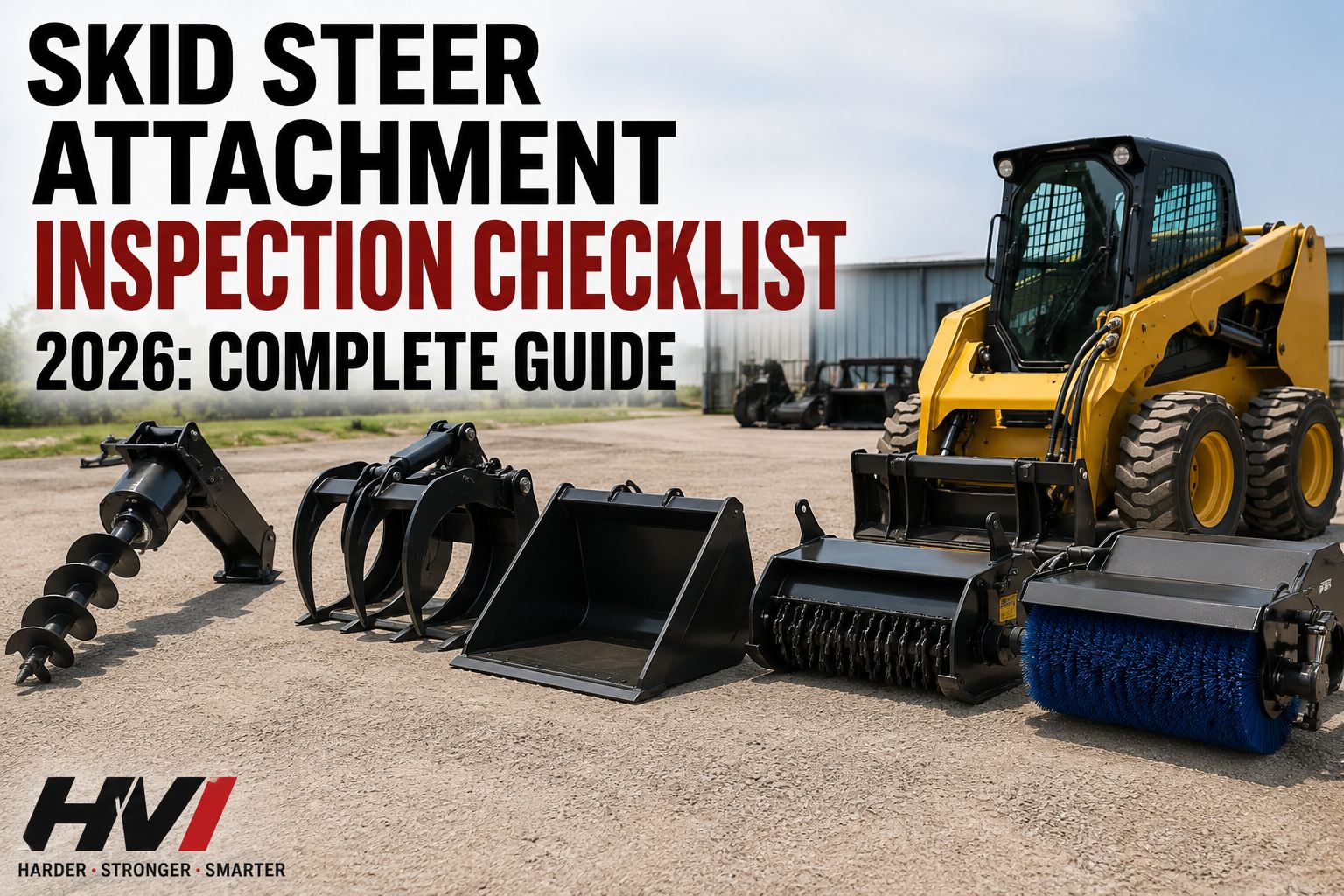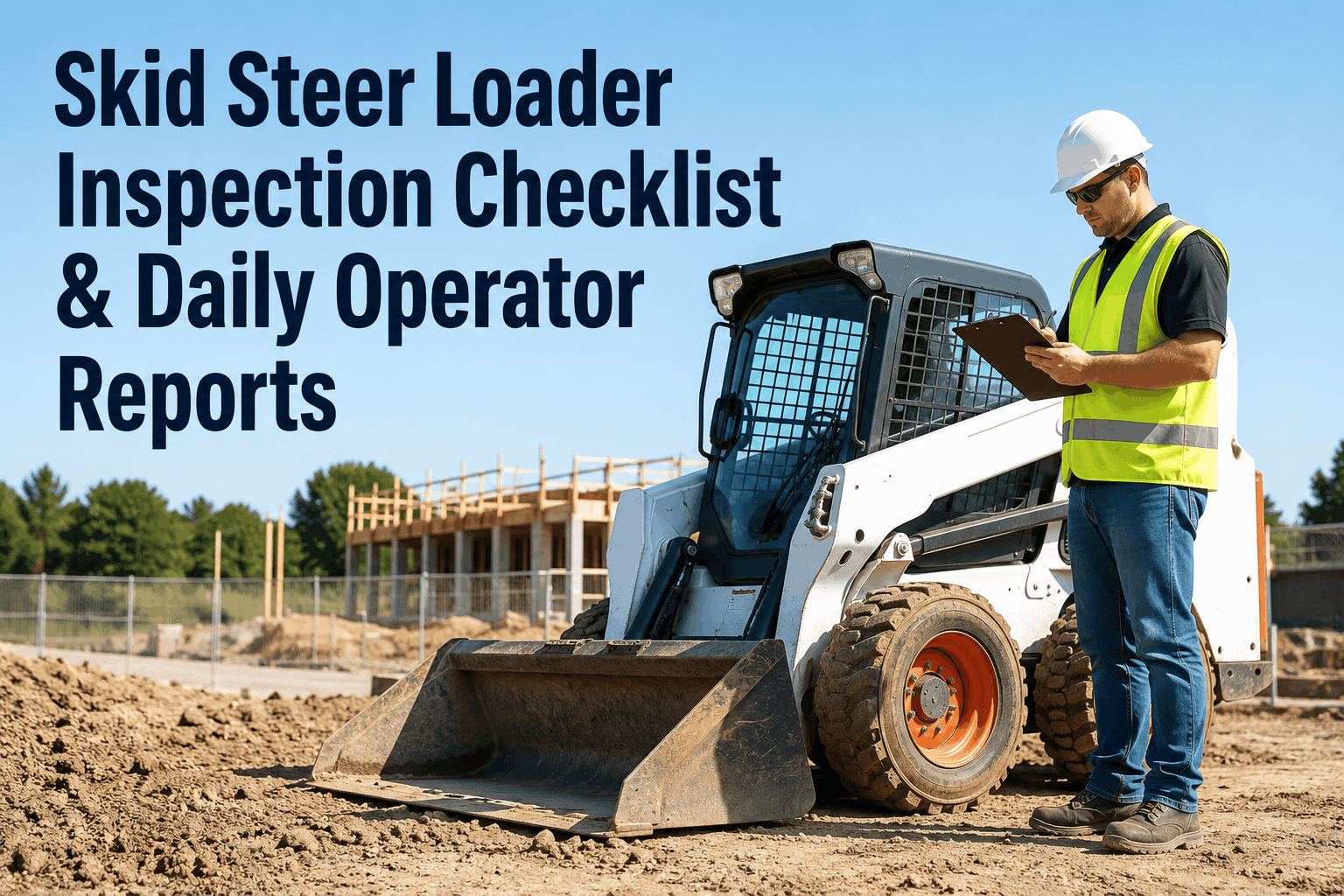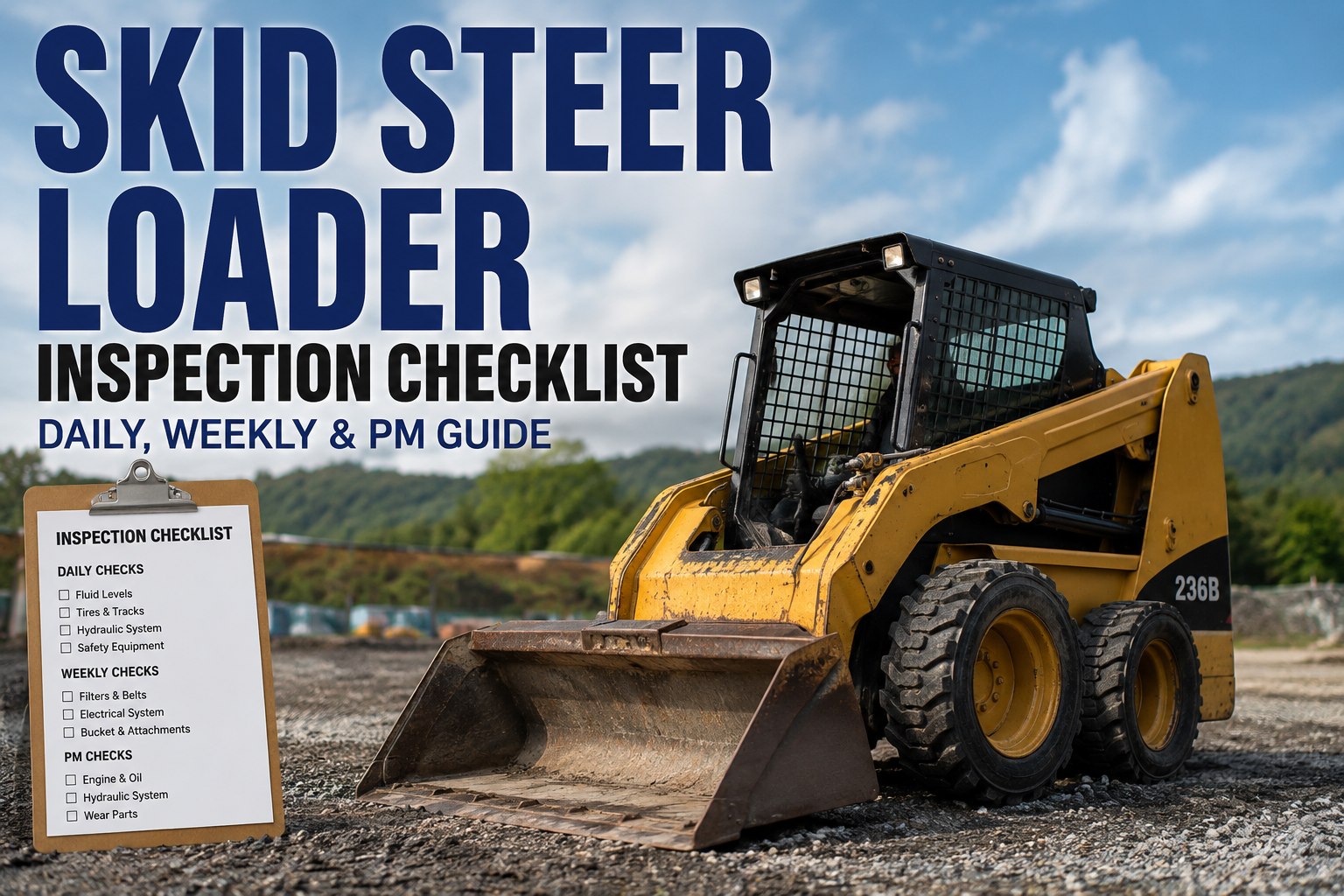
A proper skid steer inspection checklist isn't a single form — it's a hour-indexed sequence that triggers at four different intervals. Daily walkaround before every shift catches immediate safety issues. Weekly service at 50 hours maintains fluids and wear surfaces. PM at 250, 500, 1000, and 2000 engine hours addresses deeper mechanical needs. Skip any tier and downtime compounds; run all four and equipment life extends 30-40%. Book an HVI demo for hour-based skid steer PM scheduling.
Six service milestones. From pre-shift to 2,000 hours.
Every skid steer runs on engine hours — and every serious fleet program runs a service checklist that triggers at each milestone. Miss the milestone, own the downtime.
Why skid steer inspection differs from every other equipment class
Skid steers occupy a unique operational profile that doesn't map cleanly onto excavator, wheel loader, or backhoe inspection routines. Four differences drive the specialized inspection program.
Skid steers rack up engine hours faster than most jobsite equipment — a rental unit at 8 hours/day hits 2,000 hours in a year. PM schedules are indexed on hours because calendar dates lie about actual wear. Any fleet program that tracks "annual service" instead of "1,000-hour service" is guessing.
The universal skid-steer plate accepts 100+ attachments — buckets, forks, augers, snow blades, brush cutters, grapples, and cold planers. Each attachment adds its own inspection points, hydraulic quick-couplers, and wear surfaces. Attachment inspection is not optional.
Older and mid-range models use chain-drive systems requiring chaincase oil checks and chain tension verification. Newer premium models are fully hydrostatic. Inspection scope differs meaningfully — a chaincase oil check on a hydrostatic unit is the wrong thing to look for.
Bobcat and Case offer both radial (SR series) and vertical (SV series) lift-path variants; Cat and Kubota lean vertical. Lift-path geometry affects wear patterns on loader arms, cylinder mounts, and pivot pins. Inspection focus shifts by variant.
These four differences translate directly into what needs to be checked at each service milestone. The blog below breaks down the checklist for each interval. Book an HVI demo to see hour-triggered skid steer inspection templates
The pre-shift daily walkaround — 15 checkpoints in under 10 minutes
Every shift starts with the same 15-point pre-shift inspection. This is the operator's responsibility and the frontline defense against catastrophic in-shift failures. Total time: 8-10 minutes when done properly.
A failed checkpoint tags the machine out-of-service pending correction. Rental fleet operators know: the 8 minutes spent here on a pre-shift walkaround saves the average $1,200-$3,500 in in-shift breakdown recovery costs. Start a free trial to configure this 15-point walkaround as a digital template on your fleet.
The 50-hour weekly service — 12 checkpoints beyond the walkaround
Every 50 engine hours, the daily walkaround extends into a weekly service that catches wear signatures beyond immediate safety issues. On heavy-use rental machines this triggers weekly; on jobsite units it may be every 10-14 days. Track by hours, not the calendar.
- Engine oil condition — visual check for contamination
- Hydraulic oil — check for color darkening or milkiness
- Air filter — clean or replace pre-filter per hour meter
- Fuel/water separator — drain water if present
- Loader arm pivot pins — grease at each Zerk
- Bucket & attachment pivot pins — grease service
- Quick-attach coupler — grease and function test
- Steering / drive components as per OEM spec
- Battery terminals — corrosion, tight connections
- Belt tension & condition (engine and drive belts)
- Radiator & oil cooler fins — visible debris removal
- Chaincase oil level check (chain-drive models)
The 4 PM milestones — what changes at each hour interval
Beyond the daily walkaround and weekly service, four preventive maintenance milestones trigger at 250, 500, 1000, and 2000 engine hours. Each addresses a distinct wear category. Following the OEM-published schedule is the difference between 12,000-hour equipment life and 6,000-hour equipment life.
- Engine oil & filter change
- Full grease service at all pivot points
- Hydraulic filter inspection (replace if OEM specifies)
- Fuel filter primary element check
- Cooling system inspection & cleanout
- Battery load test & terminal service
- Engine oil & filter (again)
- Fuel filter primary & secondary replacement
- Air filter primary element replacement
- Hydraulic screen cleaning
- Full chassis grease service
- Belt condition & tension verification
- Hydraulic oil complete change
- Hydraulic filter replacement
- Chaincase oil change (chain-drive models)
- Air filter secondary element replacement
- DPF ash service (Tier 4 machines)
- Complete visual inspection & measurement of wear items
- Coolant complete flush & refill
- Valve lash adjustment (engine-dependent)
- Injector inspection & test
- Alternator & starter bench test
- Drive motor & pump inspection
- Full instrumentation & sensor calibration check
Skipping a scheduled PM to keep the machine on a job saves 4 hours of downtime today and costs $6,000-$18,000 in accelerated wear over the next 1,000 hours. The math never favors skipping. Book an HVI demo to see PM auto-triggered by engine hours
OEM-specific inspection quirks — Bobcat, Cat, Kubota, Case
The universal daily and PM framework applies to every skid steer. Each OEM adds specific service-point locations, indicator layouts, and access details that operators moving between brands need to know.
- Bob-Tach quick-attach — Verify Bob-Tach handles are fully seated and locking pins engaged before every attachment change
- Deluxe Instrument Panel (DIP) — Check fault codes on startup; DIP shows service reminders by hour interval
- Seat bar interlock — Verify operator restraint bar interlock activates hydraulic controls only when seated
- Chaincase oil (older models) — S650 chain-drive units require chaincase oil check per 500-hour schedule
- Advanced Display touchscreen — Check for pending fault codes and service reminders on startup display
- Product Link telematics — Verify cellular reporting on VisionLink or equivalent Cat fleet portal
- H-Bar loader design — Cat's H-Bar creates distinct pivot points that require grease service per Cat schedule
- Torsion axles — Cat wheeled models use torsion axles requiring alignment check per 1000-hour schedule
- Tilting cab access — SSV75's tilting cab provides direct access to engine and hydraulic components; verify cab lock before service
- Yellow drive motors — Kubota color-codes drive motors yellow for quick visual identification during service
- 2-speed travel — Verify high/low travel switch operation and check for hydraulic pilot pressure
- DPF ash accumulation — Kubota V3800 Tier 4 requires DPF ash service at OEM-specified interval
- H-Link boom system — Case's H-Link creates specific pivot geometry; grease and inspect per Case schedule
- Radial vs Vertical (SR vs SV) — Model designation indicates lift path; SR is radial, SV is vertical — wear patterns differ
- SiteWatch telematics — Verify SiteWatch reporting; check for pending service reminders on cluster display
- Ride Control — If equipped, verify Ride Control accumulator pressure & function per shift on rough terrain
The 5 most common skid steer failure modes
Rental fleet return inspections, warranty claim data, and OEM service bulletins converge on the same five failure modes accounting for most unplanned skid steer downtime. Every one is preventable with disciplined hour-based inspection.
Contaminated hydraulic oil is the leading cause of premature pump failure on skid steers. Cost of ignoring the 1000-hour hydraulic service: $4,000-$8,000 pump replacement. Catch signature: hydraulic oil darkening from amber to brown, sluggish loader arm response.
Chain-drive skid steers running out of chaincase oil experience chain stretch, sprocket wear, and eventual chain jump. Cost: $2,500-$5,000 to repair chaincase. Catch signature: unusual noise from chaincase, uneven drive response, contaminated chaincase oil.
Missed grease service on loader arm pivot pins accelerates wear and eventual bushing replacement. Cost: $800-$2,000 per pivot depending on OEM. Catch signature: audible clunk during loader arm cycle, visible arm play when unloaded.
Tier 4 emissions systems require periodic DPF ash service. Missed service triggers derate mode and eventual DPF replacement. Cost: $4,500-$9,000 for DPF replacement. Catch signature: engine derate warnings on startup, DPF regen frequency increase.
Universal skid-steer plate wear from repeated attachment changes eventually leads to loose engagement and attachment dropping during operation. Cost: $600-$1,500 for coupler rebuild plus potential attachment damage. Catch signature: play between machine and attachment, coupler pins showing wear grooves.
Every failure mode on the list is caught by disciplined hour-indexed PM. The four PM milestones exist precisely because these five failure signatures develop at predictable hour intervals. Start a free trial to configure failure-mode-aware PM templates for your skid steer fleet.
From a Rental Fleet Manager running 84 skid steers across Bobcat, Cat, and Kubota
We run 84 skid steers across three OEMs in a rental fleet — 42 Bobcats, 28 Cats, 14 Kubotas. Before we digitized, our PM adherence was around 62%. Machines were coming in at 350 hours needing a 250-hour service — sometimes 400 hours needing a 500-hour service. Rental margins evaporated because we were absorbing accelerated wear on machines going straight from the rental yard to major repair.
We rolled out hour-triggered digital PM with telematics sync. When a unit crosses a service milestone, it auto-generates a work order and the yard supervisor can't dispatch it back to a customer until the PM is signed off. PM adherence hit 96% in the first quarter. Unplanned downtime dropped 41%, and repair cost per fleet-hour dropped from $12.80 to $7.20. That's the entire margin structure of a rental fleet, right there in the hour meter.
Frequently asked questions
What does a proper skid steer inspection checklist cover?
A complete skid steer inspection program covers six hour-indexed service milestones. Pre-shift walkaround (every 10 hours or every shift) covers 15 checkpoints: engine oil, coolant, hydraulic oil, fuel level, air filter indicator, tire pressure & sidewall (or track tension on CTLs), loader arms & cylinders, attachment quick-attach latch, hoses & fittings, seat belt & operator restraint bar, controls smooth & responsive, horn/backup alarm/lights, ROPS/FOPS & door, ground under machine. 8-10 minutes total. Weekly service (every 50 hours) adds 12 checkpoints covering fluid condition assessment, grease service at pivot points, and mechanical inspections including battery, belts, radiator, and chaincase. 30 minutes total. Beyond weekly, four PM milestones trigger at hour intervals: 250-hour first scheduled service (engine oil & filter, full grease service, hydraulic filter check, fuel filter primary, cooling inspection); 500-hour major service (fuel filter primary & secondary, air filter primary, hydraulic screen, chassis grease, belt check); 1000-hour hydraulic service (hydraulic oil complete change, hydraulic filter, chaincase oil, air filter secondary, DPF ash on Tier 4, wear measurement); 2000-hour powertrain service (coolant flush, valve adjustment, injector inspection, alternator/starter test, drive motor/pump inspection, sensor calibration). Following this framework across the full 6,000-12,000 hour equipment life is what separates a well-managed fleet from a fleet that treats skid steers as disposable.
How often should a skid steer be serviced?
Service intervals are indexed on engine hours, not calendar dates — this is the single most important operational discipline in skid steer fleet management. Pre-shift walkaround happens every shift the machine operates (typically every 8-10 engine hours). Weekly service happens every 50 engine hours — on a rental machine running 60 hours/week this means every calendar week, but on a lightly-used jobsite machine it may mean every 10-14 days. Major PM milestones are at 250, 500, 1000, and 2000 engine hours. A rental fleet machine running 2,000 hours/year hits every milestone in 12 months; a jobsite unit running 800 hours/year takes 2-3 years to cycle through the same intervals. Fleets tracking service by calendar date rather than hour meter systematically overservice under-utilized units (wasted money) and underservice high-utilization units (accelerated wear and premature failure). Modern telematics integration syncs engine hours automatically into fleet management software, which auto-triggers work orders at each milestone — removing the calendar-vs-hours guesswork entirely. Fleets moving to hour-triggered digital PM typically see PM adherence rise from 60-75% under calendar systems to 95%+ under hour-based systems, driven by the elimination of "we forgot" as a valid excuse.
How is Bobcat skid steer inspection different from Cat or Kubota?
The universal daily walkaround and hour-indexed PM framework applies across all major OEMs — Bobcat, Cat, Kubota, Case — but each brand has specific service-point layouts, indicator systems, and access details that operators need to know. Bobcat S650/S66/R-Series adds: Bob-Tach quick-attach verification (proprietary Bobcat coupler), Deluxe Instrument Panel (DIP) fault code check on startup, seat bar interlock verification (Bobcat's operator-restraint safety system), and chaincase oil check on older chain-drive models like the S650. Cat 262D3/272D3 adds: Advanced Display touchscreen fault code review, Product Link telematics verification with VisionLink or equivalent fleet portal, H-Bar loader design pivot point grease service, and torsion axle alignment check on wheeled models per 1000-hour schedule. Kubota SSV75/SVL Series adds: tilting cab access verification (Kubota's distinctive tilting cab provides direct engine and hydraulic component access), yellow-color-coded drive motor identification, 2-speed travel switch and hydraulic pilot pressure check, and DPF ash service on V3800 Tier 4 engines. Case SR/SV Series adds: H-Link boom system pivot service, model designation awareness (SR=radial lift, SV=vertical lift — wear patterns differ), SiteWatch telematics verification, and Ride Control accumulator pressure check on equipped units. Fleets running mixed OEMs benefit meaningfully from digital templates that present the correct OEM-specific overlay for the selected machine.
What's the difference between weekly service and PM at 250 hours?
Both are recurring hour-indexed service events but they cover different scopes with different tools and different personnel. Weekly service (every 50 engine hours) is an inspection and light-maintenance touch — the operator or yard technician performs fluid condition assessment, grease service at pivot points, air filter cleaning/pre-filter check, fuel/water separator drain, battery terminal check, belt tension verification, radiator fin cleaning, and chaincase oil level check on chain-drive models. 30 minutes typical. No filters replaced, no oil changes, no fluid dumps. PM at 250 hours is the first true service event where consumables are replaced — engine oil and filter change, full grease service at all pivot points, hydraulic filter inspection (replace if OEM specifies), fuel filter primary element check or replace, cooling system inspection and debris cleanout, battery load test and terminal service. 90-120 minutes typical, usually performed in the shop by a technician. The weekly-vs-250-hour distinction exists because engine oil starts breaking down around 250 hours of continuous use — earlier than that and you're wasting oil; later than that and you're accelerating engine wear. The interval is calibrated to the actual chemistry of modern low-ash Tier 4 diesel engine oils in the operating temperature range of a skid steer.
Can one digital template cover Bobcat, Cat, Kubota, and Case skid steers?
A single universal template covers the base 15-point daily walkaround, 12-point weekly service, and the four hour-indexed PM milestones that apply across all major OEMs. But the OEM-specific service points — Bob-Tach quick-attach, Bobcat DIP, Cat Advanced Display, Cat H-Bar loader design, Kubota tilting cab access, Kubota 2-speed travel, Case H-Link boom, Case SR-vs-SV lift-path distinctions — don't fit a generic template without becoming unusable. Fleets running mixed skid steer rosters have two workable options. Option 1: Universal template plus operator training on OEM-specific service points. Simpler to maintain but relies on operator memory and discipline for the machine-specific items — which is where inspection programs typically break down. Option 2: OEM-specific digital templates that ship with the universal framework plus the machine-specific overlay pre-configured for each OEM. The operator selects the machine at pre-shift, engine hours sync from telematics automatically, and the correct template presents itself with both universal checkpoints and OEM-specific overlays. This is where digital fleet inspection platforms deliver clear value over paper — paper checklists can't be that granular without becoming impossible to use, but a digital platform presents the right template for the right machine at the right time based on hour meter data. Rental fleets moving from calendar-paper to hour-triggered digital typically see PM adherence rise from 60-75% to 95%+ within the first quarter, driven by workflow enforcement and telematics sync.
Track every skid steer through every service milestone — automatically.
HVI's fleet inspection module ships with hour-triggered PM templates for Bobcat, Cat, Kubota, and Case skid steer platforms. Engine hours sync from telematics or manual entry. Daily walkaround, weekly service, and PM milestones at 250h/500h/1000h/2000h auto-trigger as work orders. OEM-specific service points present automatically based on the machine selected. Live for your fleet in under two weeks.
Pre-loaded OEM templates · Hour-meter telematics sync · Auto work-order routing · PM history for equipment life