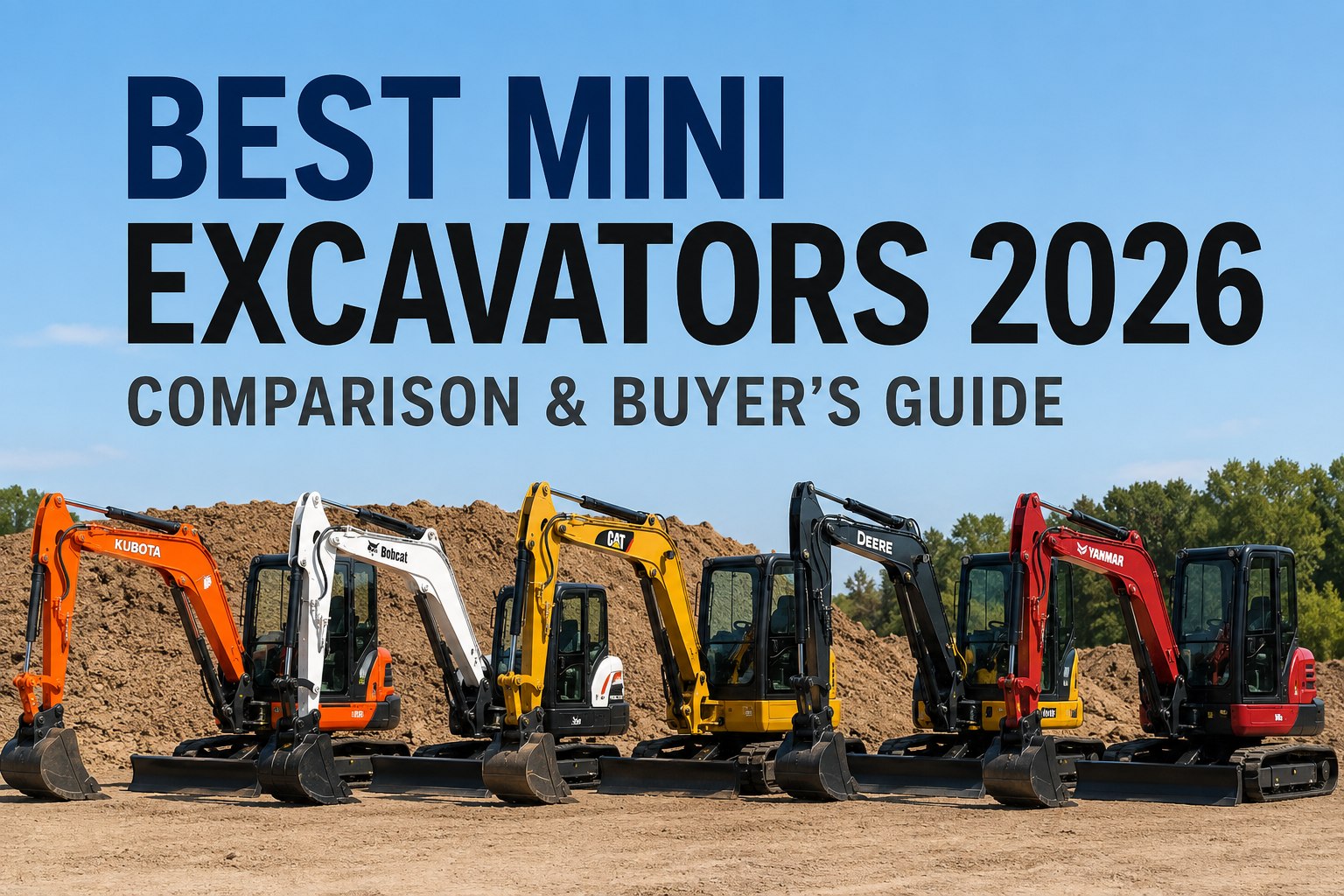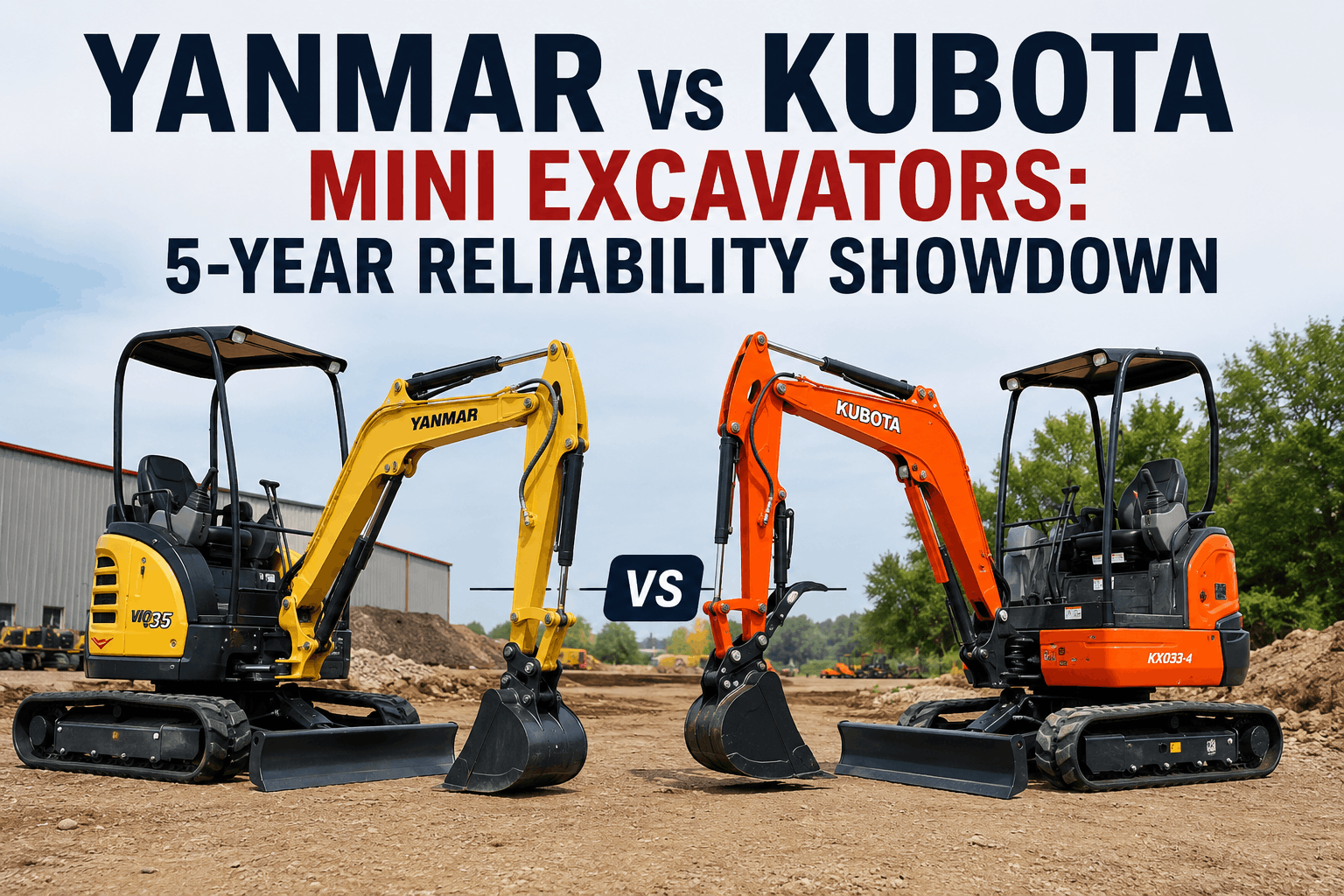
Yanmar and Kubota dominate the global mini excavator market — both Japanese, both Tier 4 Final compliant, both with decades of engineering pedigree. But for a contractor signing a $60,000+ purchase order or running a fleet that will work 1,500–2,000 hours per year, the choice between them comes down to specific operational trade-offs: Yanmar's precision-engineered fuel economy and class-leading 4-year/4,000-hour warranty, versus Kubota's heavier dealer network, higher resale value retention, and slightly more rugged engine architecture. This guide breaks down the head-to-head reality in 2026 — flagship model specs, 5-year ownership cost math, real-world reliability patterns, dealer support coverage, resale value data, and a use-case-specific decision framework for landscaping, utility, and general construction operations. For contractors running mixed brand fleets across job sites, Start your free HVI trial to put PM intervals and daily inspections on every machine regardless of OEM — or book a demo to see how HVI tracks Yanmar and Kubota service schedules per VIN.
The engine philosophy split — two different design priorities
Both brands meet the same emissions standards using fundamentally different engineering priorities. Understanding this split is the foundation of every other comparison — fuel cost, maintenance cost, and dealer service patterns all flow from these choices.
Yanmar's design philosophy: deliver torque smoothly, maintain combustion stability, protect engine components from abuse. Fine-grained fuel injection timing and refined combustion design make Yanmar engines exceptionally good at low-speed digging, trenching, and precision grading — especially when hydraulic demand fluctuates constantly.
Kubota's design philosophy: produce slightly higher horsepower per displacement, tolerate rough usage and inconsistent maintenance, prioritize raw mechanical capability. Engines often deliver more aggressive torque at higher RPMs — better suited for production digging and heavy-duty cycles.
Picking the right engine philosophy for your operational profile shapes 5 years of fuel and repair costs. Schedule a 30-minute call with the HVI team to walk through which philosophy fits your specific work mix and see how HVI tracks both brands side by side.
Flagship 3.5–4 ton head-to-head — Yanmar ViO35-7 vs Kubota KX040-5
The 3.5–4 ton class is the sweet spot for contractor mini excavator purchases. Both manufacturers' best-sellers compete here. Specs compared below from each OEM's current-generation production model.
| Spec | Yanmar ViO35-7 | Kubota KX040-5 |
|---|---|---|
| Operating weight | 3.5 metric tons | 4.0 metric tons |
| Engine | Yanmar 3TNV88F | Kubota D1803 |
| Horsepower | 24.4 HP | 40.3 HP |
| Max dig depth | 11'3" | 11'2" |
| Hydraulic flow (aux) | 17.0 GPM | 17.2 GPM |
| Pump configuration | 3-pump system | 3-pump system |
| Tail swing | True zero tail swing | Conventional swing |
| Eco mode | Standard + auto-deceleration | Standard |
| Cab protection | ROPS + FOPS | ROPS + OPG (Level I) |
| Warranty | 4 yr / 4,000 hr | 2 yr standard |
5-year total cost of ownership — the commercial buyer's math
Sticker price is a fraction of the decision. The real comparison is what each machine costs across 5 years and ~7,500 operating hours of work. Here's the line-by-line breakdown for the 3.5–4 ton class at typical contractor utilization.
Reliability head-to-head — the specific patterns owners report
Both brands are highly reliable by industry standard — that's not the question. The question is which specific reliability patterns matter for your operation. Here's the head-to-head breakdown across the dimensions that actually drive downtime.
Both: 8,000–10,000+ hour engine life with proper maintenance. Yanmar's smoother torque delivery is gentler on long-running components; Kubota's more robust architecture tolerates inconsistent oil intervals slightly better.
Yanmar's high compression ratio + efficient glow plug system: northern operators report reliable sub-zero starts. Kubota performs well too but may need longer warm-up; some models include block heaters as standard.
Both use 3-pump systems with similar flow. Yanmar's electronic load-sensing reacts faster to fluctuating demand; Kubota's hydraulics are more forgiving of rougher operation but slightly less precise under variable load.
Both Tier 4 Final. Sub-25 HP models on both brands typically skip DPF/SCR (under regulatory threshold). 40 HP+ models have similar aftertreatment service demands — DPF regen burden roughly equivalent.
Yanmar offers a 4-year / 4,000-hour warranty across most of the ViO and SV line — double the industry standard and Kubota's 2-year baseline. This is the single biggest reliability-related advantage in Yanmar's column.
Kubota's larger US dealer network (2,000+ vs Yanmar's ~250 dealers) translates directly to faster parts availability. In rural or remote markets, this gap can mean 1-day vs 5-day downtime on a stocked part.
The reliability comparison cuts both ways depending on what matters most for your operation. Book a 30-min consultation for a region-specific dealer-support and reliability analysis tailored to where you actually operate.
Dealer network — the factor buyers underestimate
The fanciest spec sheet doesn't matter if you can't get a part for three weeks. Dealer network density is the most underweighted factor in mini excavator purchase decisions — and it's where Kubota holds a decisive structural advantage in North America.
- Strong in major metro and coastal markets
- Limited rural and Midwest presence
- Service responsiveness varies by region
- Parts availability typically 2–5 business days
- Yanmar's ReadyDig and similar programs help bridge the gap with 24-hr response guarantees in select regions
- Dense coverage across all 50 states + Canada
- Significant rural and small-town presence
- Most contractors within 50 miles of a Kubota dealer
- Parts availability typically 1–2 business days
- Larger dealer body means more financing options and trade-in opportunities
Resale value reality — where Kubota structurally wins
Five-year resale value is where Kubota's market position translates into real dollar retention. The brand consistency, dealer network depth, and broader buyer recognition all reinforce a structurally higher resale market. Yanmar machines hold value well, but Kubota tends to lead by ~10% at 5 years.
Resale data on paper is one thing — what your specific machines will hold at trade-in 5 years from now depends on PM compliance and inspection records. Schedule a walkthrough to see how HVI's per-VIN service history protects resale value across both brands.
Real-world verdict by use case — which one fits your operation
The brand isn't universally "better." Each suits different operational profiles. Here's the use-case fit for the three most common contractor scenarios.
True zero tail swing is the differentiator — critical for fenced backyards, between-house access, and urban hardscape work. Yanmar's fuel efficiency edge matters on shorter, more variable duty cycles common in landscape work.
Production digging in trench applications rewards Kubota's raw horsepower and dealer-network reliability for fleet operations. Yanmar's warranty is attractive for owner-ops; Kubota's parts availability matters for utility fleets running 5+ units.
Higher horsepower handles hydraulic breakers, augers, and grapples more confidently. Conventional swing offers slight stability edge for heavy side-loading. Resale value matters more on machines that get traded every 3–5 years.
Once you know which brand fits your use case, the next step is setting up the inspection and PM workflow before the machine arrives. Book your demo to see how HVI onboards a new Yanmar or Kubota into the fleet in under an hour with OEM-specific service templates.
Decision matrix — choose by what matters most
Distilling everything above into the cleanest decision framework: rank the factors by your priority, and the right answer becomes clear.
- Fuel cost is a high priority (precision work + 5–12% efficiency edge)
- Warranty matters more than dealer count (4 yr / 4,000 hr coverage)
- You work in tight urban or residential spaces (true zero tail swing)
- Cold-climate operation is routine (cold-start reliability edge)
- You're an owner-operator planning to keep the machine 7+ years
- You have a strong local Yanmar dealer within reasonable distance
- Smooth, controlled operation matters more than raw power output
- You're in a rural market or work across multiple regions (dealer density)
- Resale value at 3–5 year trade cycle is a primary metric
- You need maximum horsepower per dollar for production digging
- You run heavy hydraulic attachments routinely (breakers, augers)
- Your fleet has variable operator skill levels (more forgiving design)
- Parts availability speed is critical (1–2 day vs 2–5 day)
- You value brand consistency for a fleet of 5+ machines
Still weighing the decision? Reserve a 30-minute slot with the team to walk through your operational profile and get a no-pressure recommendation — including how to set up PM tracking from day one regardless of which brand you choose.
How HVI keeps both platforms on-schedule across mixed fleets
The hardest part of running a mixed Yanmar and Kubota fleet isn't picking the brand — it's tracking which machine is due for which service interval, with which OEM-specific parts, on which date. Paper logs and spreadsheets miss intervals; HVI's PM tracking puts both brands' schedules side by side and fires reminders on actual engine hours.
Pre-loaded service intervals for Yanmar ViO/SV and Kubota KX/U series. PM alerts fire on actual engine hours per VIN — never miss a 250-hr oil change or 1,000-hr hydraulic filter.
Operators run a guided walk-around on the HVI mobile app — coolant, oil, hydraulic levels, undercarriage, fluid leaks. Photo-verified, GPS-timestamped, archived against the VIN.
Any "Fail" tap creates an instant work order with photo and machine ID. Yanmar dealer or Kubota service partner gets the alert before the issue cascades into a bigger repair.
Every PM service, part used, technician hour, and outside-vendor invoice logged against the machine. Real cost-per-hour per brand surfaces — informing the next purchase decision with data.
Contractors running mixed Yanmar and Kubota mini excavators on paper or spreadsheets miss the data that would actually inform their next purchase decision. Start your free HVI trial and put PM schedules, inspection records, and cost tracking for both brands on one platform.
Frequently asked questions
Yanmar or Kubota — the right answer is operational, not spec-driven. The fleets that win track both brands on one platform.
HVI tracks Yanmar and Kubota PM schedules side by side, fires alerts on actual engine hours, captures daily inspections on the smartphones operators already carry, and logs cost-per-VIN over time. No hardware, no IT lift, measurable ROI within 30 days.
No credit card required · OEM-specific PM templates for Yanmar & Kubota · Per-VIN cost tracking from day one