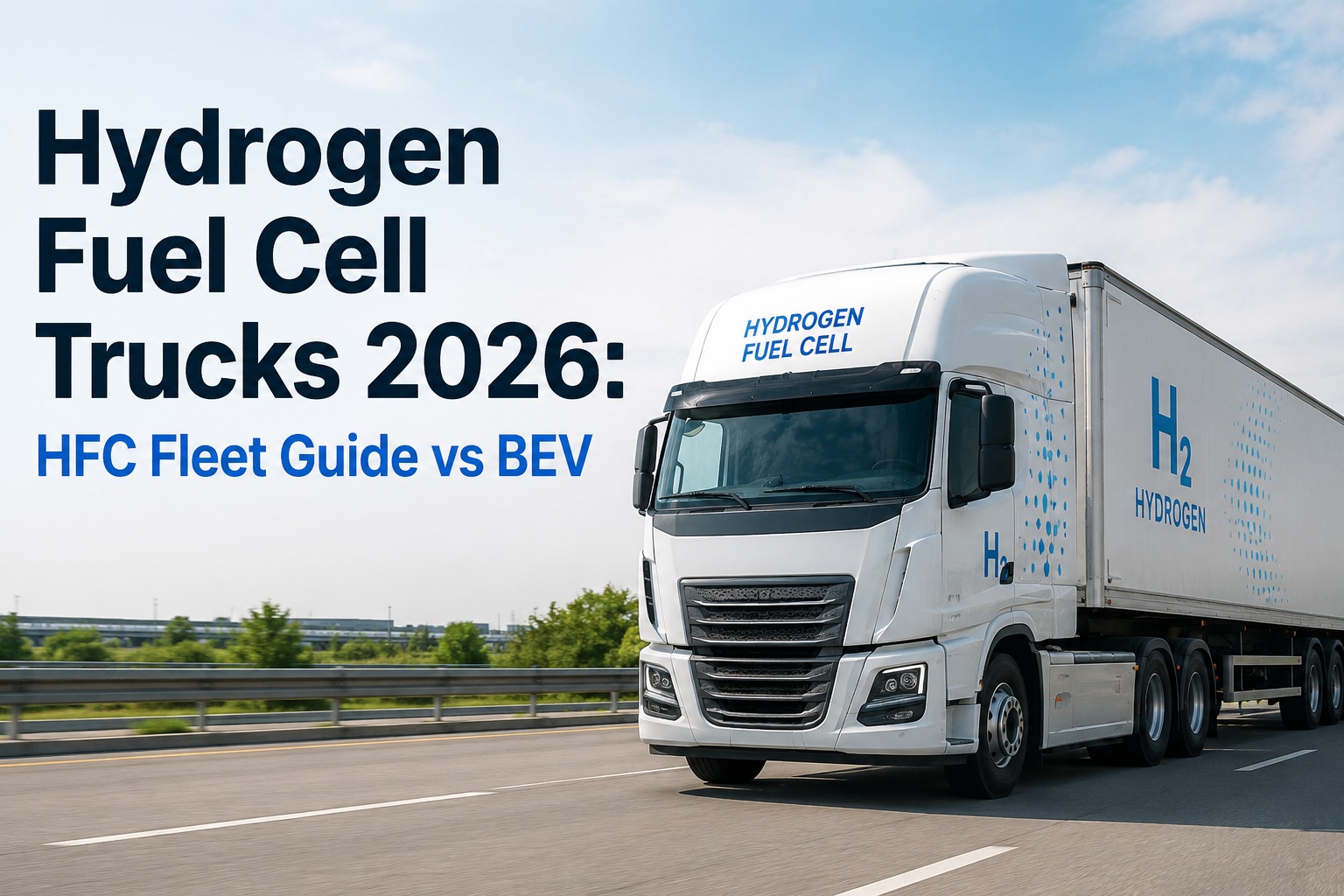
Hydrogen fuel cell truck inspection introduces workflows that no diesel fleet has ever run before. High-pressure carbon-fiber tanks storing hydrogen at 700 bar. Fuel cell stacks that don't burn fuel — they react it electrochemically. Leak detection that catches something invisible, odorless, and lighter than air. As Class 8 FCEVs move from pilot programs into revenue-generating fleets, the inspection playbook is being written in real time. Here's what every fleet planning FCEV adoption needs to understand. Book an HVI demo →.
Five new inspection zones diesel fleets have never touched. Map them before your first FCEV shows up.
A hydrogen fuel cell truck has almost nothing in common with a diesel Class 8 under the sheet metal. Five entirely new systems need documented inspection workflows. Below is where each one lives on the truck — and what makes it different.
Class 8 hydrogen storage tank
Type IV composite pressure vessel
per single hydrogen refill
Why hydrogen fuel cell truck inspection is fundamentally different
A diesel Class 8 truck stores fuel in a low-pressure aluminum tank, burns it in a compression-ignition cylinder, and moves exhaust through an aftertreatment system. Inspection focuses on injectors, valves, aftertreatment, and mechanical driveline. A hydrogen fuel cell truck stores fuel at 700 bar in a carbon-fiber composite pressure vessel, converts it electrochemically in a fuel cell stack, buffers electricity through a lithium-ion battery, and delivers power to electric traction motors. The failure modes are different, the safety hazards are different, and the inspection tools are different.
Three categories of inspection risk emerge. First: pressure-vessel integrity. A Type IV hydrogen tank operating at 700 bar stores meaningful potential energy; visual damage or thermal exposure requires the tank to be pulled from service. Second: hydrogen leak detection. Hydrogen is invisible, odorless, and disperses upward through the smallest openings; detection requires specialized sensors, not the "smell for diesel" approach mechanics grew up with. Third: high-voltage electrical hazards. FCEV electrical systems operate at 400-800 volts DC; contact with an energized circuit is fatal, and inspection procedures require lockout-tagout protocols closer to industrial electrical work than typical diesel service. Book an HVI demo to see FCEV-specific inspection templates ready for pilot fleets.
Type IV hydrogen storage tank inspection
The Type IV pressure vessel is the highest-value, highest-safety-consequence component on the truck. It's a carbon fiber composite cylinder with a polymer liner, engineered to hold hydrogen at 700 bar over a 15-year certified service life. Federal regulations under FMVSS 304 (US) and ECE R134 (Europe) govern its construction, inspection, and replacement.
Every inspection event on a hydrogen tank should be captured with photo evidence, technician credentials, and serial-number-level tracking. When a tank reaches the end of its 15-year certified life, or fails inspection at any interval, it is replaced — not repaired. The documentation trail is what defends the fleet if a tank is ever questioned by regulators or insurers. Try HVI free to build the pressure-vessel service history from day one.
Fuel cell stack maintenance
The fuel cell stack is where hydrogen and oxygen react electrochemically to produce electricity and water vapor. Modern proton-exchange membrane (PEM) stacks are engineered for 25,000-30,000 hours of service life, which for a heavy-haul fleet running long-haul duty translates to roughly 500,000-700,000 miles before major overhaul.
Stack inspection is less about visual checks and more about performance-signature monitoring. Voltage per cell, coolant purity, humidification levels, and reactant utilization are all tracked as leading indicators of stack degradation. A fuel cell doesn't fail suddenly; it degrades gradually as the catalyst layer wears and membrane ionic conductivity drops. Fleets that miss the trend and let performance drop below OEM thresholds face expensive stack replacement instead of routine maintenance. Digital inspection workflows that capture stack telemetry at every service event are the standard modern approach; paper records simply can't hold the resolution required.
The four critical stack-maintenance items every FCEV service program covers: deionized coolant sampling and replacement per OEM interval, air filter and humidifier maintenance to protect the membrane, hydrogen recirculation system inspection for purge-valve health, and end-of-life planning as stack telemetry approaches the replacement threshold. Each of these has a distinct rhythm; running them on one cadence misses the point. Book an HVI demo to see stack telemetry logged per truck.
Hydrogen leak detection procedures
Hydrogen leak detection is the single most alien inspection procedure for technicians coming from diesel. The gas has three properties that break traditional diagnostic instincts: it's invisible, it's odorless, and it disperses upward through openings so small that soapy-water bubble testing is unreliable at working pressures.
Modern hydrogen leak detection uses one of three approaches. Electrochemical sensors detect hydrogen concentrations as low as a few hundred parts per million, calibrated to sound an alarm well before any explosive concentration is reached (hydrogen's lower flammability limit is 4% in air). Ultrasonic detectors listen for the high-frequency acoustic signature of gas escaping through small openings under pressure. Thermal-conductivity sensors detect hydrogen's disproportionate ability to conduct heat compared to air. Fleet inspection programs typically deploy all three, in overlapping coverage zones: cabin, tank compartment, fuel cell stack, and around fittings and valves.
Every leak-detection sweep should be documented with sensor model, calibration date, ambient conditions, and the specific zones checked. When a positive detection occurs, the truck goes out of service until the leak source is identified and repaired — and every previous truck fueled at the same station may need a supplementary check to rule out fuel-quality contamination as the root cause. Documentation matters here in ways that don't exist for diesel: hydrogen leak history is a permanent record that follows the vehicle. Try HVI free to log leak-detection sweeps with sensor readings and photo evidence.
Hydrogen vs diesel truck inspection — head-to-head
The workflow differences are substantial. This table maps the inspection categories that overlap versus the ones that are entirely new for FCEV.
Roughly 40% of the inspection workflow carries over from diesel unchanged — brakes, tires, lights, coupling, suspension, chassis, DVIR paperwork. The other 60% is entirely new: pressure vessels, fuel cell stacks, hydrogen leak detection, high-voltage systems, refueling interfaces. Fleets planning FCEV adoption need to plan for that 60% before the first truck arrives, not after. Book an HVI demo to see how mixed-fleet templates handle both worlds on one platform.
Leading hydrogen fuel cell truck manufacturers
The Class 8 FCEV production landscape in 2026 is narrower than it was three years ago. The early wave of pilot programs settled out into a smaller group of manufacturers with production or near-production trucks in customer hands.
Historical note: the Nikola Tre FCEV was an early Class 8 hydrogen production truck that shipped in limited volumes before Nikola Corporation filed for Chapter 11 bankruptcy in February 2025. Trucks in service continue to operate under warranty transition arrangements. Fleets with existing Nikola inventory should confirm parts and service pathways with the receiver. Hyzon Motors also faced financial distress in the same window; its fleet-operator customers similarly need continuity planning. The remaining active manufacturers listed above are the current basis for new fleet FCEV planning.
From a fleet sustainability lead running 8 XCIENT trucks at the Port of Oakland
The trucks themselves surprised us the least. We planned for range, we planned for refueling infrastructure, we planned for the electrical safety training. What we did not plan for was the inspection paperwork.
Every fuel cell service event has a documentation depth diesel never demanded. Tank serial numbers, sensor calibration records, coolant purity samples, technician credentials on every wrench turn. We were tracking it in three separate spreadsheets by month three. Moved everything into HVI in Q4 2024 — templates for diesel, BEV, and hydrogen all in one platform. Inspection completion time dropped 40%, and our first CARB compliance audit passed without a single documentation request going unanswered.
SNSarah N.Fleet Sustainability Lead · California drayage operation · 8 Hyundai XCIENT + 32 diesel Class 8
Frequently asked questions
How do you inspect a hydrogen fuel cell truck?
Hydrogen fuel cell truck inspection combines standard commercial vehicle checks (brakes, tires, lights, coupling, chassis, DVIR paperwork) with five new inspection zones unique to FCEVs: high-pressure hydrogen storage tanks (Type IV pressure vessels operating at 350-700 bar), the fuel cell stack itself (PEM technology with performance-signature monitoring), the high-voltage battery buffer system (400-800V DC), thermal management for stack and battery cooling loops, and the SAE J2601 refueling interface. Roughly 40% of the workflow carries over from diesel; the other 60% requires new procedures, calibrated leak-detection sensors, high-voltage lockout-tagout protocols, and technician certifications specific to hydrogen and high-voltage electrical work. Digital documentation captures the added depth these workflows demand.
How often should hydrogen storage tanks be inspected?
Type IV hydrogen storage tank inspection follows a four-tier cadence. Daily: visual external inspection during pre-trip DVIR, including mounting hardware and impact damage checks, plus cabin gauge readings. Quarterly: detailed visual inspection with calibrated hydrogen leak scan around fittings and valve assemblies, plus bracket torque verification per OEM specification. Every 3 years (or as specified by OEM): in-service pressure integrity test at an authorized service facility, with documentation attached to the tank serial number. Event-triggered: any collision, fire exposure, or significant impact triggers mandatory tank removal for OEM-authorized inspection, with no exceptions. Type IV vessels are certified for a 15-year total service life; at that point they are replaced rather than repaired regardless of apparent condition.
What is a Type IV pressure vessel?
A Type IV pressure vessel is the industry standard hydrogen storage tank used in Class 8 fuel cell trucks. It combines a polymer liner (impermeable to hydrogen at the molecular level) with an outer shell of carbon fiber composite (providing structural strength at working pressures up to 700 bar). Type IV construction offers the best weight-to-storage-capacity ratio of any pressure vessel technology, which matters critically for Class 8 trucks that need to store 40+ kg of hydrogen for 400-500 mile range. Regulatory frameworks in the US (FMVSS 304) and Europe (ECE R134) govern construction, testing, inspection, and end-of-life replacement requirements. Type IV vessels are certified for a 15-year service life and are replaced rather than repaired when they reach end of life or fail inspection.
Are hydrogen trucks safe for commercial fleets?
Hydrogen trucks are engineered to safety standards that meet or exceed diesel equivalents. Type IV tanks are pressure-tested well beyond working pressure, include thermally-activated pressure relief devices, and are engineered to fail-safe by venting rather than rupturing under extreme conditions. Hydrogen's property of dispersing upward through the smallest openings is actually a safety advantage compared to gasoline or diesel pools; leaks dissipate rapidly rather than collecting. The genuine risks come from insufficient inspection discipline, not the technology itself: undocumented leak-detection sweeps, missed pressure test intervals, or technicians working without hydrogen safety training. Fleets running FCEVs with proper inspection programs and certified service networks show operational safety records comparable to diesel. The risk profile is different, not necessarily higher.
How do fleets detect hydrogen leaks?
Hydrogen leak detection uses three complementary sensor technologies. Electrochemical sensors detect hydrogen concentrations from a few hundred parts per million upward, calibrated to alarm well before any explosive concentration (hydrogen's lower flammability limit is 4% in air). Ultrasonic detectors identify the high-frequency acoustic signature of gas escaping through small openings under pressure. Thermal-conductivity sensors leverage hydrogen's disproportionately high thermal conductivity compared to air. Fleet inspection programs typically deploy all three in overlapping coverage: cabin, tank compartment, fuel cell stack area, and around fittings and valves. Every leak sweep is documented with sensor model, calibration date, ambient temperature, and zones checked. Positive detections take the truck immediately out of service until the source is identified and repaired. Bubble testing with soapy water is unreliable at working pressures and is not the industry-accepted method.
Digitize hydrogen fuel cell truck inspections — the fleet after diesel.
HVI supports FCEV inspection templates alongside diesel and BEV templates in the same platform. Type IV tank serial-number tracking, pressure-test scheduling, fuel cell stack telemetry, leak detection logs with sensor calibration, and high-voltage lockout-tagout compliance workflows — all documented, all photo-verified, all audit-ready. Live for your fleet in 5-7 days.
FCEV · BEV · Diesel · Same platform · SOC 2 Type II