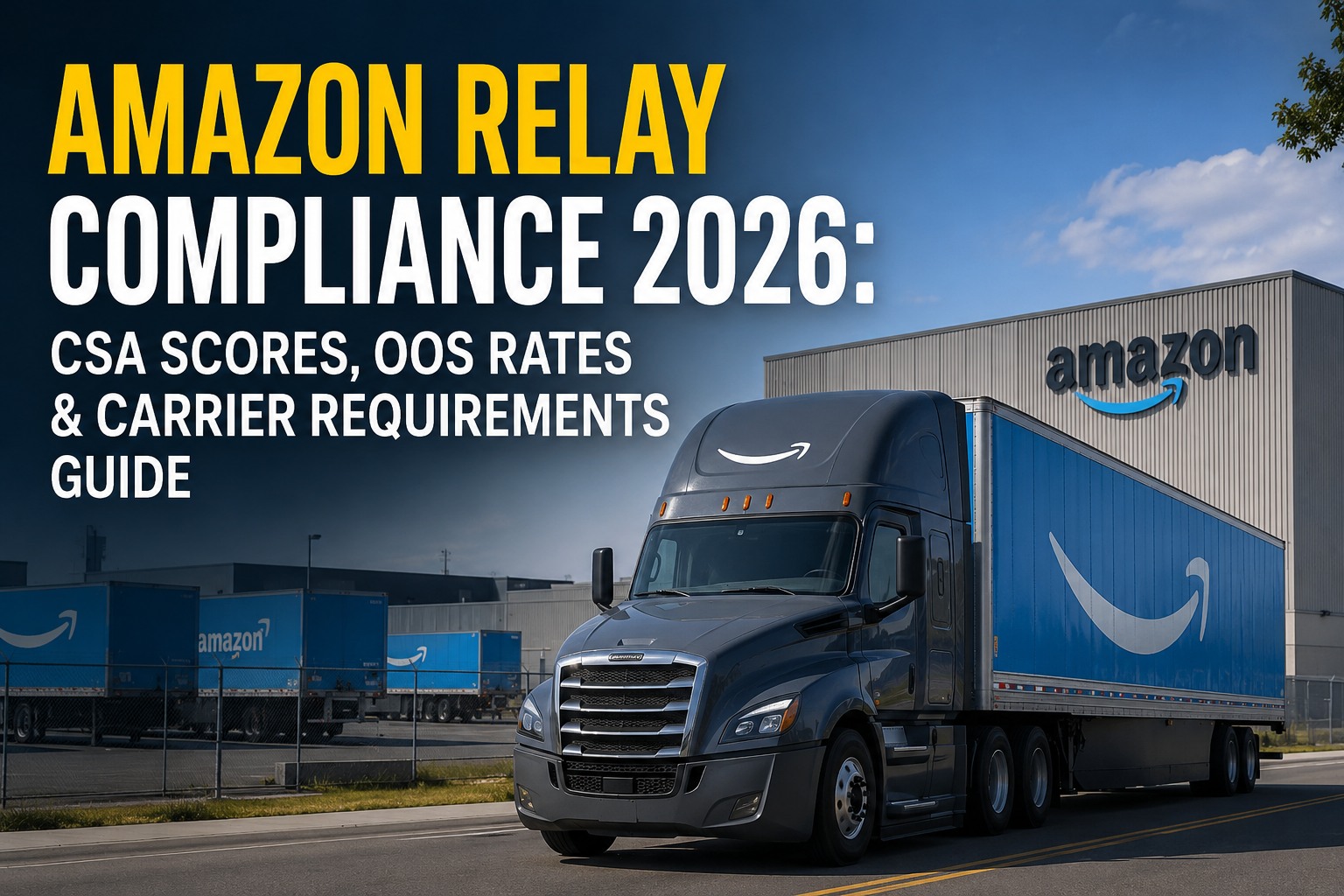
Losing Amazon Relay load access doesn't come with a warning email. It comes with an empty load board. Amazon Relay compliance in 2026 isn't a form you submit once — it's a rolling 12-month audit of every roadside inspection, every CSA BASIC movement, and every violation. The rules changed February 2026, adding two new violation rate metrics on top of BASIC. This guide is the operational playbook — the daily practices, documentation habits and recovery moves that protect your Relay status. Book a demo
The Amazon Relay eligibility zones — where your fleet actually sits
Amazon's thresholds are 5 points stricter than FMCSA's, and the enforcement is unforgiving. Know your zone before the loads disappear.
Two things about the table above matter more than the numbers themselves. First: the 3-strike enforcement mechanic has no appeal — three inspections above threshold in the rolling 12-month window and your Relay account stops showing loads. Second: OOS violations count double in the rate calculation. A single out-of-service defect that could have been caught at pre-trip inspection weighs as much as two moving-violation citations. The compliance conversation is a maintenance conversation in disguise.
How the 3-strike clock actually works
Understanding the enforcement timing is what turns Amazon Relay compliance from a mystery into a manageable metric. The 12-month window is rolling — not a calendar reset — and every roadside inspection either helps or hurts your score for a full year afterwards.
The compounding math is worth pausing on. A fleet with one strike in Month 1 has 11 months to prevent a second strike; a fleet already at two strikes is one bad inspection away from losing Relay for months. The difference between the two positions isn't luck — it's what happens between inspections. Book a demo to see rolling 12-month violation exposure tracked per truck
The daily operational routine that protects Relay status
Amazon Relay compliance is won and lost at four operational moments — and every strong compliance program builds a specific discipline around each one. Miss any single moment consistently and the violation rate creeps into warning territory faster than the calendar suggests.
The single highest-leverage compliance moment on the fleet. Every OOS defect caught at pre-trip is one that doesn't become a 2×-weighted violation at roadside. Digital DVIRs with photo evidence and signed audit trails carry weight both in Relay compliance and in FMCSA audits.
Vehicle Maintenance BASIC scores follow PM compliance almost linearly. Missed brake inspections, overdue lubrications, worn tire replacements — each shows up eventually at roadside. Documented, on-schedule PM is the biggest lever on the vehicle-side violation rate.
FMCSA lets carriers submit a DataQ challenge for inspections with documentation errors or misclassifications — but only inside a narrow window. Fleets that don't monitor CSA data weekly miss the challenge window and eat violations that were reversible.
Every inspection form, PM record, work order, and driver qualification file needs to be defensible on demand — not just for Amazon, but for FMCSA and insurance underwriters simultaneously. Paper files, spreadsheet trackers, and disconnected systems fail this bar under pressure.
None of these four moments alone protects Relay status. The failure mode is running three of them well and the fourth on paper. Compliance concentrates around whichever discipline is weakest — and the violation rate metric surfaces the weakness within two or three inspection cycles. Book a demo to see all four compliance moments in one operational view
Already in the warning zone? The 90-day recovery playbook
Fleets already tracking above threshold aren't automatically doomed — but the recovery window is narrow and the moves are specific. Here's the 90-day plan that consistently pulls fleets back into safe territory before the third strike lands.
-
Days 1–15Audit & DataQ every open violation
Pull the last 12 months of roadside inspections. For every violation, verify the inspection report, classify OOS vs non-OOS, and file DataQ challenges on any citation with documentation gaps or misclassification. Getting even one violation reversed can move the needle in a tight window.
-
Days 15–30Tighten pre-trip protocol on every unit
Convert every driver to digital DVIR with photo evidence, mandatory before dispatch. Set a 48-hour SLA on defect resolution. No unit leaves the yard with an unresolved critical flag. Simple, but this alone typically pulls the vehicle violation rate down within one inspection cycle.
-
Days 30–60Catch up PM and target the top violation categories
Pull the top 5 violation types from your DataQ history. Almost always: brake defects, lights and reflectors, tire condition, coupling devices, and driver medical certification. Prioritize PM and inspection focus on those specific items. The pattern repeats; break the pattern.
-
Days 60–90Driver coaching & documentation review
Weekly one-on-one with any driver who's contributed to a strike. Not punitive — targeted coaching on the specific pattern that produced the citation. Simultaneously, review every driver qualification file for missing medical cards, expired MVRs, or missing training records that could trigger a Driver Fitness violation.
The 90-day plan isn't dramatic — it's disciplined. Fleets that run it consistently pull their violation rates down 15–30 points inside a quarter and stay clear of the third strike. Fleets that treat compliance as a paperwork exercise instead of an operational discipline typically miss the recovery window. Book a demo to see the recovery workflow tracked per driver and per unit or start free and get the recovery infrastructure on day one
From a Safety Manager who pulled a fleet out of the at-risk zone in 71 days
We got the notice we were one strike from Relay removal on a Thursday. Two-thirds of our revenue was Amazon lanes. I had 24 tractors and roughly six weeks of runway if we lost access. That was the last time I ever ran compliance out of a spreadsheet.
We had a digital DVIR system running by the following Monday, PM records rebuilt within two weeks, and every open DataQ challenge filed inside 15 days. Two of the challenges got approved. Vehicle violation rate dropped from 54% to 39% in 71 days. We kept Relay access and, honestly, the fleet has never been in better shape — the crisis fixed a lot of things that had been broken for years and hidden under paper.
Frequently asked questions
What are the Amazon Relay compliance requirements for 2026?
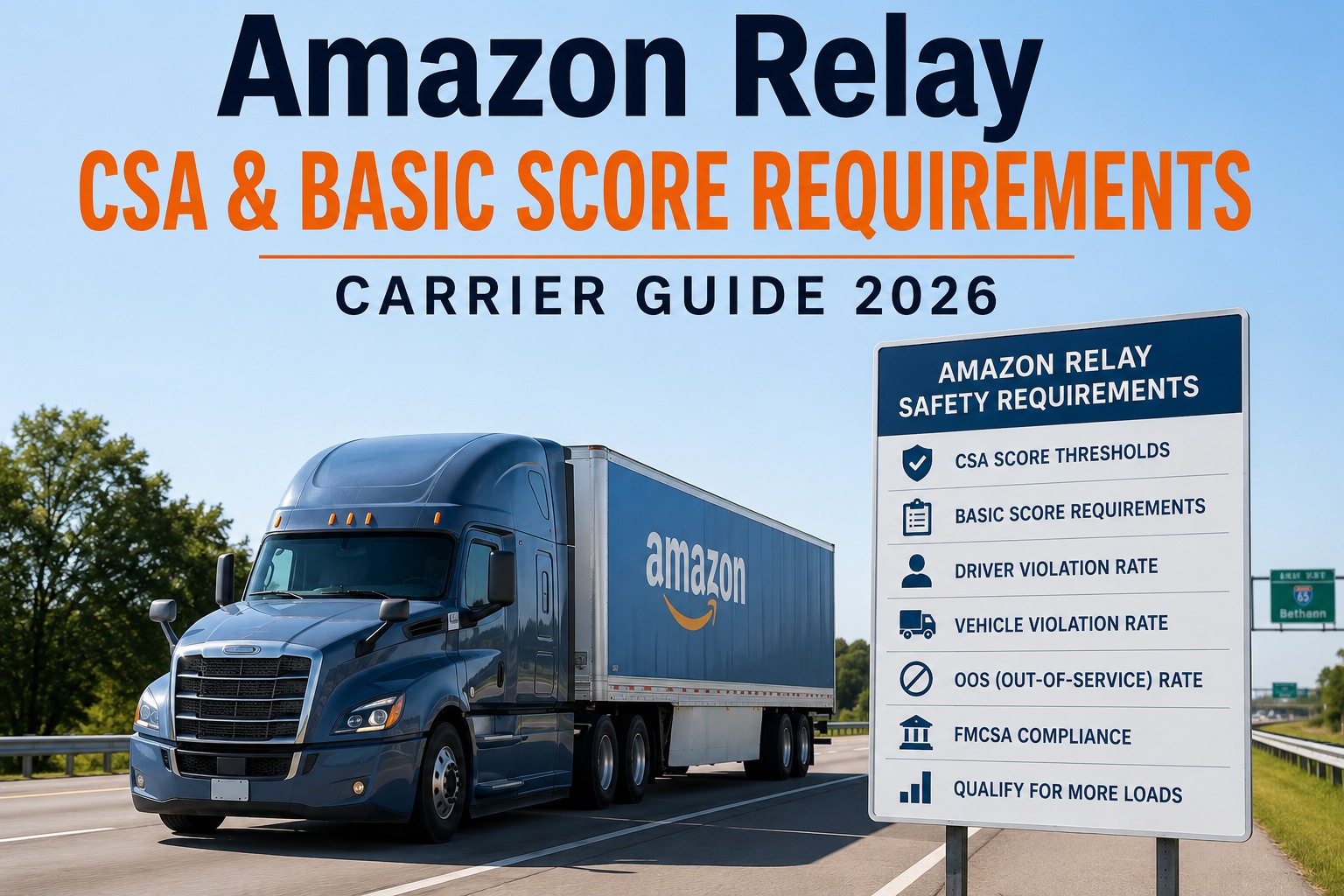
Amazon Relay compliance in 2026 has three layers. Layer one is basic eligibility: valid DOT and MC numbers, active for-hire interstate authority for at least 180 days, FMCSA safety rating of "Satisfactory," "None," or "Not Rated," and insurance above federal minimums (at least $1M auto liability including $50K trailer replacement coverage, $1M/$2M Commercial General Liability, and cargo coverage typically $100K minimum). Layer two is CSA BASIC compliance: Amazon's thresholds are 5 percentage points stricter than FMCSA's federal thresholds across every monitored category — Unsafe Driving below 60% (federal 65%), HOS Compliance below 60% (federal 65%), Vehicle Maintenance below 75% (federal 80%), Driver Fitness below 75% (federal 80%), and Controlled Substances below 75% (federal 80%). Layer three, added October 2025 and enforced for existing carriers starting February 2026, is two new violation rate metrics based on 12 months of roadside inspection data: driver violation rate must stay below 35% and vehicle violation rate below 50%. The rate formula weights out-of-service violations twice as heavily as non-OOS violations. Three or more inspections above threshold in the rolling 12-month window can result in Relay access being removed, with no appeal process. Equipment requirements include trucks generally under 10 years old and 53-foot dry van trailers as the standard configuration.
How does the Amazon Relay violation rate formula actually work?
Amazon calculates violation rates using a specific formula published on the Relay portal: (non-OOS violations + 2 × OOS violations) ÷ total inspections. The formula runs separately for driver-related violations and vehicle-related violations, producing two independent rates. Out-of-service violations count double because they represent higher-risk safety failures — a truck or driver taken out of service at roadside indicates a defect serious enough that the vehicle couldn't continue operating. The rolling 12-month window means every inspection in the last 365 days is included; violations don't reset on a calendar boundary. A worked example: a carrier with 20 total inspections in the last 12 months, 4 non-OOS violations and 3 OOS violations, calculates to (4 + 2 × 3) ÷ 20 = 10 ÷ 20 = 50% violation rate. That would place the carrier at the vehicle-side threshold ceiling. Two more OOS violations in that window and the rate crosses 60%, triggering strike counting. Because OOS violations weight double, catching a defect at pre-trip inspection (where it doesn't count) versus letting it be found at roadside (where it counts double) is the single highest-leverage compliance move a fleet can make. Every OOS-caliber issue caught at pre-trip is effectively worth two roadside-caught violations in avoided rate impact.
How can a fleet dispute a roadside inspection that hurts Amazon Relay status?
Fleets can challenge FMCSA roadside inspection records through the DataQ system (Data Quality Challenge), maintained by FMCSA at dataqs.fmcsa.dot.gov. DataQ challenges are used to correct documentation errors, disputed classifications, misidentified vehicles or drivers, and other factual issues in the roadside record. The system does not allow fleets to challenge violations on subjective grounds — the issue must be a factual or procedural error the state agency can verify. Successful DataQ challenges result in the violation being removed or reclassified in FMCSA's SMS data, which directly impacts CSA BASIC scores and, by extension, Amazon Relay compliance metrics. The practical protocol: pull CSA data weekly (not monthly, and definitely not quarterly) to catch new violations quickly; document your version of events at the inspection itself, including photos and driver notes; file DataQ challenges within 30 days when possible while facts are fresh; retain all supporting documentation (inspection reports, DVIRs, PM records, work orders) for at least five years. Fleets that don't monitor CSA data weekly consistently miss the practical DataQ window and let reversible violations accumulate. On average, industry data suggests 10–20% of roadside violations have factual or documentation issues that make them viable DataQ candidates — a meaningful lever for fleets already in the warning zone.
What happens when a carrier loses Amazon Relay access?
Amazon Relay access removal is a load-board level restriction, not a formal contract termination in most cases. The practical effect: loads simply stop appearing in the carrier's Relay app. There is no advance warning email, no appeal window, and no formal reconsideration process once the 3-strike threshold is crossed. For carriers with significant Amazon Relay exposure, this can be operationally catastrophic — some carriers run 40–80% of their revenue through Relay lanes, and the sudden absence of loads can create cash-flow pressure within days. Restoration paths exist but are slow: violations age off the 12-month rolling window one at a time from the inspection date, meaning the fastest restoration path is simply waiting for the oldest strike to drop off, then reapplying. During the waiting period, carriers typically need to rebuild freight relationships through brokers, non-Amazon shippers, and factoring arrangements to bridge the revenue gap. The prevention math is unambiguous: keeping violation rates in the safe zone (below 25% driver, below 40% vehicle) is dramatically cheaper than recovering from removal. Every fleet with meaningful Amazon exposure should be monitoring their rolling violation rate weekly, not waiting for the strike notification to appear.
How does HVI help fleets stay Amazon Relay compliant?
HVI addresses the four operational moments that determine Amazon Relay compliance: pre-trip inspection, preventive maintenance, roadside inspection response, and audit-readiness documentation. On pre-trip: HVI runs digital DVIRs with photo evidence and signed audit trails, mandatory before dispatch, with defect resolution SLA tracking that prevents units with unresolved critical flags from being cleared to run. Every OOS-caliber defect caught here is one that doesn't become a 2×-weighted roadside violation. On preventive maintenance: HVI schedules PMs by mileage, engine hours, or calendar with automatic due-date alerts and parts pre-ordering, keeping Vehicle Maintenance BASIC scores stable and the vehicle violation rate below threshold. On roadside response: HVI stores complete inspection and work-order histories for every unit, so when a DataQ challenge is filed, the supporting documentation (PM records, defect resolution history, driver qualification file) is one export away instead of a paper-file scramble. On documentation and audit-readiness: HVI holds all four record types (DVIRs, PMs, work orders, driver qualification files) on one platform with 5-year retention and single-export audit packages ready for FMCSA, insurance underwriters, and Amazon compliance reviews simultaneously. Published customer data shows fleets on HVI report approximately 25% lower annual maintenance cost and typical payback around 3 months — and the same operational discipline that produces those numbers also produces the CSA BASIC scores and violation rates Amazon Relay measures.
Amazon Relay compliance is an operational discipline. Make sure yours is systemized.
HVI runs the four operational moments Amazon Relay measures — pre-trip inspections, preventive maintenance, roadside response, audit documentation — on one platform, with the 12-month evidence trail your compliance case rests on. When Amazon pulls your data, your case is one export away.
No credit card · Digital DVIR & PM dashboards live on day one