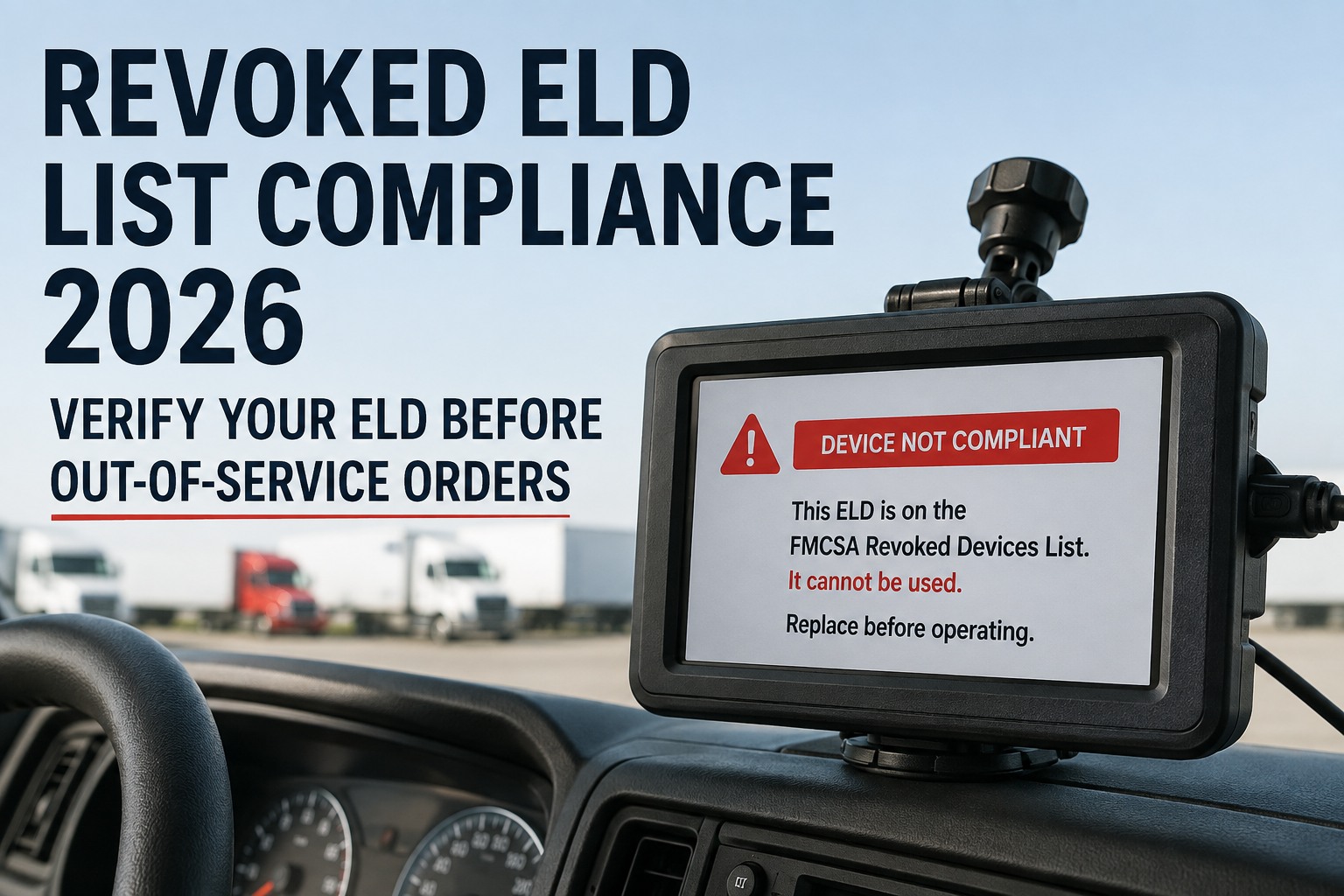
The moment your ELD lands on the FMCSA revoked list, a 60-day clock starts — and every hour past deadline is an out-of-service risk at the next roadside inspection. Revoked ELD list compliance in 2026 has moved beyond a reactive habit. FMCSA has removed 79+ devices since January 2025 and the pace is accelerating. This guide is the proactive vendor risk playbook: how to spot warning signs before revocation, how to diversify ELD risk, and the 24-hour migration plan if notice lands. Book a demo
The FMCSA revocation pace in 2026 — and why your vendor matters more than your device
Removals accelerated sharply through 2026. The pattern in the batches tells you where the risk sits.
The pattern in the batch data is the story. Removals grew from single-device actions in late 2025 to double-digit batches in mid-2026. That's not FMCSA becoming stricter — it's FMCSA getting faster at catching devices that never should have been self-certified in the first place. The practical implication for fleets: the risk isn't randomly distributed across ELD vendors. Certain vendor profiles show up on the revoked list disproportionately often. Knowing which profile your vendor fits is worth more than watching the list itself.
The vendor risk tier system — where does your ELD provider actually sit?
Not every ELD vendor carries the same revocation risk. The 79+ devices FMCSA has removed since January 2025 come predominantly from a specific segment of the market — and staying out of that segment is the highest-leverage move a compliance officer can make.
The tier distinction isn't about picking on smaller vendors — it's about matching contractual risk to operational stakes. A 12-truck owner-operator on a low-cost ELD is running different risk than a 500-truck refrigerated fleet running the same device on 500 lanes with time-critical delivery windows. Match your ELD tier to your operational exposure. Book a demo to see ELD status tracked per unit inside your fleet compliance dashboard
The 5 warning signs an ELD vendor is heading for revocation
By the time a device shows up on the FMCSA removal notice, the warning signs have almost always been visible for months. Here are the five that consistently precede revocation batches — and none of them require insider information to spot.
Deteriorating support responsiveness
The strongest leading indicator. When a support ticket that used to close in 4 hours now takes 4 days, and outages that used to trigger acknowledgment emails go silent, the operational team is under-resourced. Vendors under-resourcing support are typically under-resourcing compliance testing as well.
Firmware updates slowing or stopping
Every registered ELD requires ongoing firmware updates to address newly-discovered technical issues, security vulnerabilities, and FMCSA specification changes. A device that hasn't had a firmware update in 12+ months has a vendor that's either sold or shifted focus. Both scenarios elevate revocation risk.
Company website / documentation going stale
Broken links, outdated compliance documentation, missing SOC 2 or ISO certifications, generic "certified" claims without proof — these are visible signals the compliance program itself has degraded. Vendors serious about staying registered maintain public compliance evidence.
Pricing race-to-the-bottom or aggressive discounts
When an established ELD costs $25–$40/vehicle/month and a competitor offers the "same functionality" for $8–$12, the difference is coming from somewhere. Almost always: reduced compliance testing, minimal support staff, shortcuts on the technical spec. The Tier 3 batch removals of 2025–2026 were disproportionately deep-discount providers.
Absence from CVSA / industry conferences
Serious ELD vendors invest in Commercial Vehicle Safety Alliance engagement, industry conferences, roadside inspection partnerships, and law-enforcement training programs. When your vendor stops showing up at these events, they've lost the operational connection to how their device actually gets inspected. Revocation typically follows within 6–18 months.
None of these five signals guarantee a revocation. But when three or more are present simultaneously, contingency planning should already be in motion. The cost of preparing to switch vendors is trivial. The cost of switching under a 60-day FMCSA countdown while trying to keep drivers rolling is not. Book a demo to see vendor-independent compliance records that survive any ELD switch
The 24-hour vendor migration playbook — when notice lands on your desk
You get the FMCSA industry-wide email. Your ELD is on the removed list. The 60-day clock is running. What happens in the first 24 hours determines whether the migration is disciplined or chaotic. Here's the sequence that consistently keeps fleets rolling and out of OOS territory.
-
Hour 0–2Confirm the notice against the official FMCSA list
Cross-check the removal notice against the FMCSA ELD portal Revoked Devices list. Verify your specific device model number and ELD identifier. Do not act on unverified sources or vendor-side communications alone — the FMCSA list is the only authoritative source.
-
Hour 2–6Notify safety, operations, and finance simultaneously
Every stakeholder needs the same information at the same time. Safety needs to update the compliance calendar. Operations needs to plan driver-side communication. Finance needs to prepare replacement procurement. Sequential notification wastes the first 12 hours.
-
Hour 6–12Confirm interim compliance — paper logs or backup system
FMCSA explicitly instructs carriers to revert to paper logs or logging software during the replacement period. Print RODS templates, brief drivers on paper log requirements, ensure ELD display remains available as backup reference. The interim compliance window is where preventable violations sneak in.
-
Hour 12–18Select replacement vendor — verify Tier and Registered Devices list
Confirm the candidate replacement appears on the current FMCSA Registered Devices list. Prioritize Tier 1 or established Tier 2 vendors. Verify integration compatibility with your existing systems. Get pricing, availability, and installation timeline in writing before commitment.
-
Hour 18–24Schedule fleet-wide installation and driver training
Confirm installation slots for every affected unit within 45 days (leaving a 15-day buffer). Schedule driver training in parallel. Communicate expected transition dates. The 60-day window sounds generous but installation logistics on 50+ trucks eat two-thirds of it.
Fleets that treat the first 24 hours as a compliance emergency (which it is) consistently complete migration inside the FMCSA window. Fleets that treat it as a routine vendor swap almost always run over. The difference isn't the size of the fleet; it's the discipline in the first 24 hours. Book a demo to see migration workflow tracked per unit or start free and get vendor-independent compliance records on day one
From a Compliance Officer who migrated 47 tractors in 41 days
We had one of the Tier 3 devices that got hit in the May 20 batch. When the FMCSA email landed on Thursday morning, I had 47 tractors running the revoked device and a July 20 deadline. We'd been on the vendor for 14 months because they were $9/month cheaper than the alternatives. Do that math on 47 units and you see the appeal.
What saved us was that our inspection and maintenance records live in HVI, not in the ELD. When we switched vendors, the DVIRs, PMs, driver files, and 3 years of compliance evidence didn't move with the ELD change. All 47 tractors migrated to a Tier 1 replacement in 41 days. Zero OOS incidents at roadside. And the "cheaper" vendor cost us maybe 12x the annual savings in emergency migration overhead. That's the last time we chased ELD discount pricing.
Frequently asked questions
What is the FMCSA revoked ELD list and how do I check it?
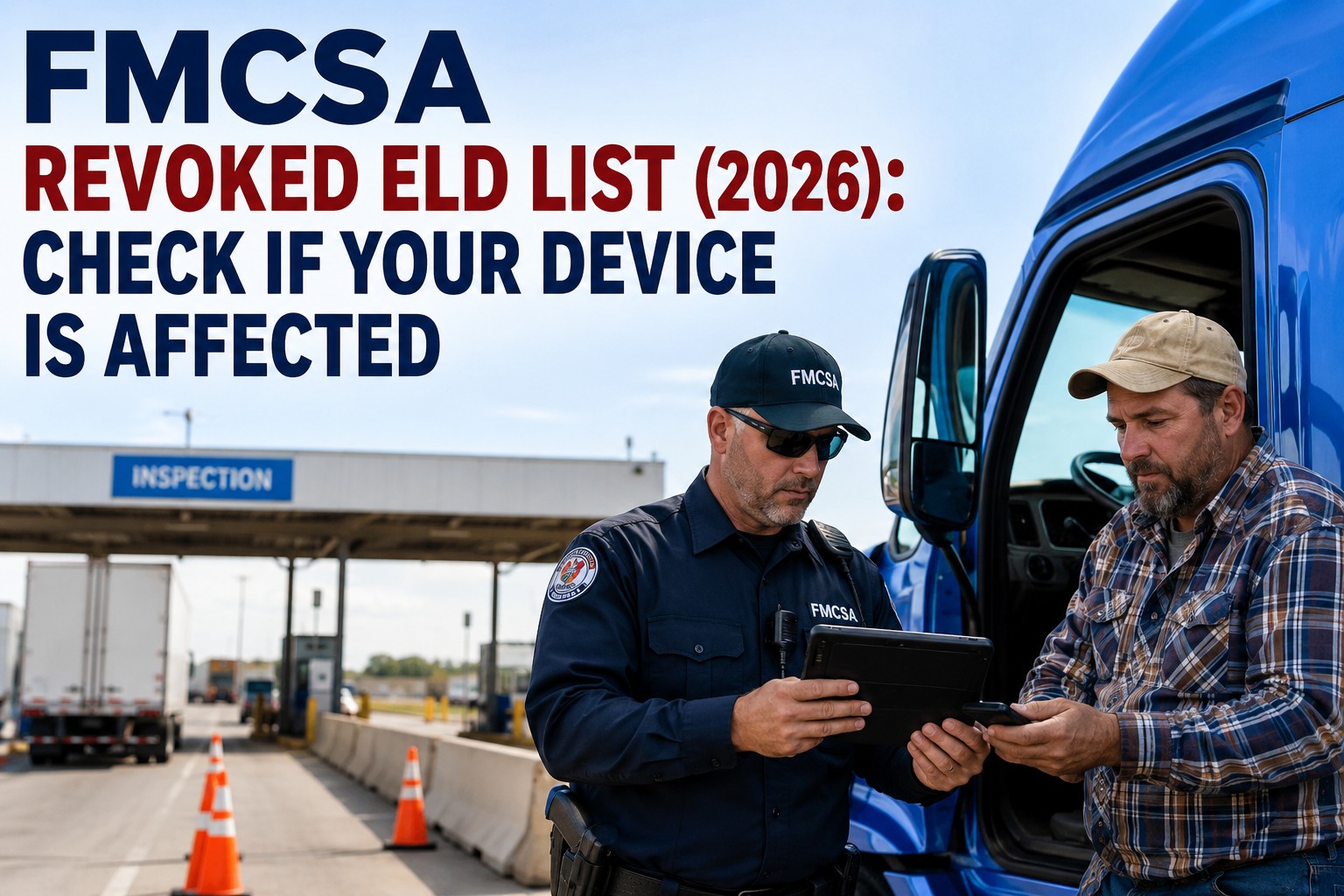
The FMCSA revoked ELD list is the official record of Electronic Logging Devices removed from the agency's Registered Devices list because the devices or their providers failed to meet minimum requirements under 49 CFR Appendix A to Subpart B of Part 395. Fleets can check the list at the official FMCSA ELD portal (eld.fmcsa.dot.gov), which displays both the Registered Devices list and the Revoked Devices list side by side. Every device carries three identifiers you can verify: ELD Name, Model Number, and unique ELD Identifier. Your device appears on exactly one list. Since January 2025, FMCSA has removed 79+ devices from the Registered Devices list, with the pace of removals accelerating through 2026 — recent batches include 9 devices in April 2026, 14 devices across two May 2026 actions (Safe ELD/MYLOGS plus a separate 12-device batch), and 10 additional devices in June 2026. Every fleet should check the revoked list at least monthly, and immediately whenever FMCSA issues an industry-wide email notification of new removals. The list is the only authoritative source — do not act on unverified secondary reports.
How long do fleets have to replace a revoked ELD?
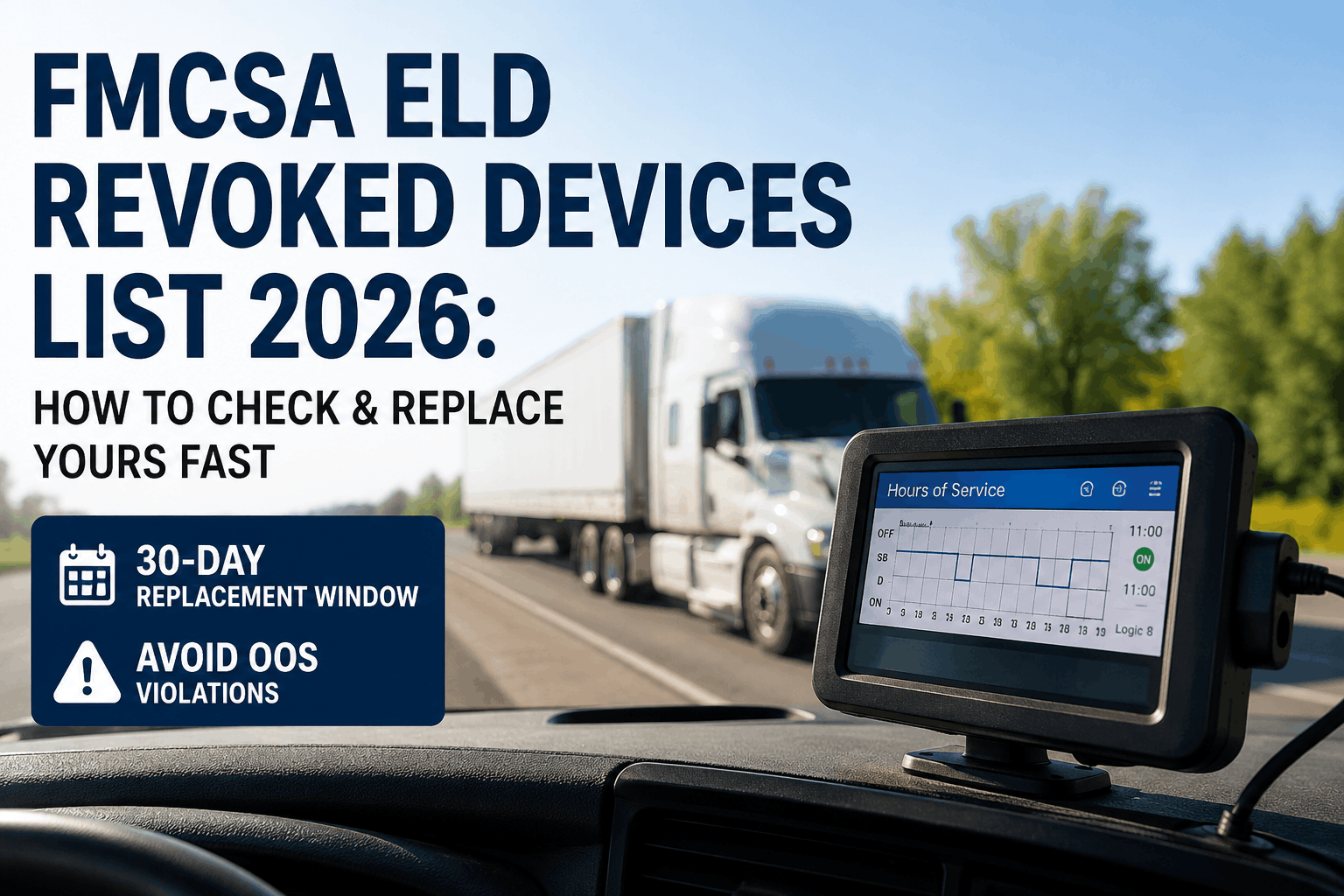
FMCSA gives motor carriers exactly 60 days from the revocation date to replace a decertified ELD with a compliant device from the Registered Devices list. This is the actual regulatory window — not the "30-day" figure that occasionally circulates in industry chatter, which is incorrect. During the 60-day replacement window, FMCSA instructs safety officials at roadside inspections not to cite drivers using the revoked device for 395.8(a)(1) "No record of duty status" or 395.22(a) "Failing to use a registered ELD." Instead, drivers should be prepared to present paper logs, logging software output, or use the ELD display as a backup method for hours-of-service review. FMCSA explicitly instructs carriers using revoked devices to either revert to paper logs or use logging software during this window. Beginning the day after the 60-day deadline, carriers who continue operating on the revoked device will be considered as operating without an ELD — a serious violation that triggers out-of-service placement under Commercial Vehicle Safety Alliance criteria. The clock is calendar-strict: a device revoked on January 13 must be replaced by March 15; a device revoked on May 20 must be replaced by July 20. There is no built-in extension mechanism.
What happens at roadside inspection if a driver is using a revoked ELD?
The consequences at roadside inspection depend entirely on whether the 60-day replacement window has expired. Before the deadline, safety officials are instructed not to issue ELD-specific citations for the revoked device. Drivers should present paper logs, logging software output, or the ELD display as backup for hours-of-service review. Documented interim compliance during this window generally avoids escalation. After the deadline, the situation changes dramatically. Safety officials will cite the driver under 49 CFR 395.8(a)(1) "No record of duty status" and place the driver out-of-service in accordance with CVSA Out-of-Service Criteria. Out-of-service means the driver cannot legally operate the vehicle until the compliance issue is resolved — typically requiring a compliant ELD replacement, restoration of hours-of-service data, and confirmation of the correction. The OOS citation itself feeds into the carrier's CSA BASIC scores, specifically Hours-of-Service Compliance, and appears on the carrier's public safety profile visible to shippers, brokers, and insurance underwriters. For carriers operating with Amazon Relay or other tight-compliance freight networks, an OOS citation can trigger cascading load-access consequences. The financial exposure includes the citation itself, the operational cost of the stopped truck, missed delivery penalties, and downstream CSA and insurance impact. Prevention through proactive vendor monitoring is dramatically cheaper.
How can fleets reduce the risk of ELD revocation surprises?
The most effective risk-reduction strategy is proactive vendor evaluation combined with vendor-independent compliance record-keeping. On vendor selection: assess ELD providers using a tiered risk framework. Tier 1 providers have 100,000+ vehicle fleet bases, established compliance teams, 24/7 support with published SLAs, and clean or immediately-corrected revocation histories. Tier 2 providers are viable but require quarterly monitoring and self-cert audit trail confirmation at contract renewal. Tier 3 providers — small fleet base, deep discount pricing, minimal support — carry elevated revocation risk and require active contingency planning. On warning signs, monitor for: deteriorating support responsiveness, firmware updates slowing or stopping, stale company website and documentation, aggressive discount pricing that undercuts established providers, and absence from CVSA and industry conference engagement. Three or more warning signs simultaneously should trigger vendor evaluation. On documentation architecture: keep compliance records (DVIRs, PM history, work orders, driver qualification files, inspection responses) on a platform independent from your ELD. When FMCSA revokes a device, the ELD data migrates but the surrounding operational evidence stays. Fleets whose compliance records live inside the ELD lose institutional history during vendor migration. Fleets whose records live independently keep the full audit trail across any number of ELD changes.
How does HVI help with revoked ELD compliance and vendor migration?
HVI addresses ELD revocation risk from the operational-records side rather than the ELD-vendor side, which is what makes the platform vendor-independent. HVI holds every DVIR (with photo evidence and signed audit trail), preventive maintenance record, work order, inspection response, driver qualification file, cost line per unit, and safety flag on one platform — separate from whichever ELD you're currently running. When FMCSA revokes a device and you enter the 60-day replacement window, the operational and compliance evidence that underpins your CSA BASIC scores, insurance underwriting readiness, Amazon Relay compliance, and FMCSA audit position doesn't move with the ELD change. It stays exactly where it is, ready for export or audit review at any moment. This architecture matters because carriers who consolidate too much compliance history inside a single ELD platform face a difficult migration problem: the historical data either has to be exported (often in formats that don't preserve context), reconstructed manually, or accepted as lost. Fleets running HVI alongside any registered ELD get the operational continuity that makes vendor migration a routine 60-day project rather than a scramble. Published customer data shows fleets on HVI report approximately 25% lower annual maintenance cost and typical payback around 3 months — and the vendor-independence value shows up most clearly when regulatory events force a change on someone else's timeline.
Your ELD vendor's revocation shouldn't cost you three years of compliance history
HVI holds DVIRs, PMs, work orders, and driver qualification records on one platform — independently of whichever ELD you're running this quarter. When FMCSA revokes your device, the compliance evidence that underpins your CSA scores, audit position, and insurance case doesn't move. It stays. Migrate ELDs on your schedule instead of theirs.
No credit card · ELD-independent architecture · Records dashboard live on day one