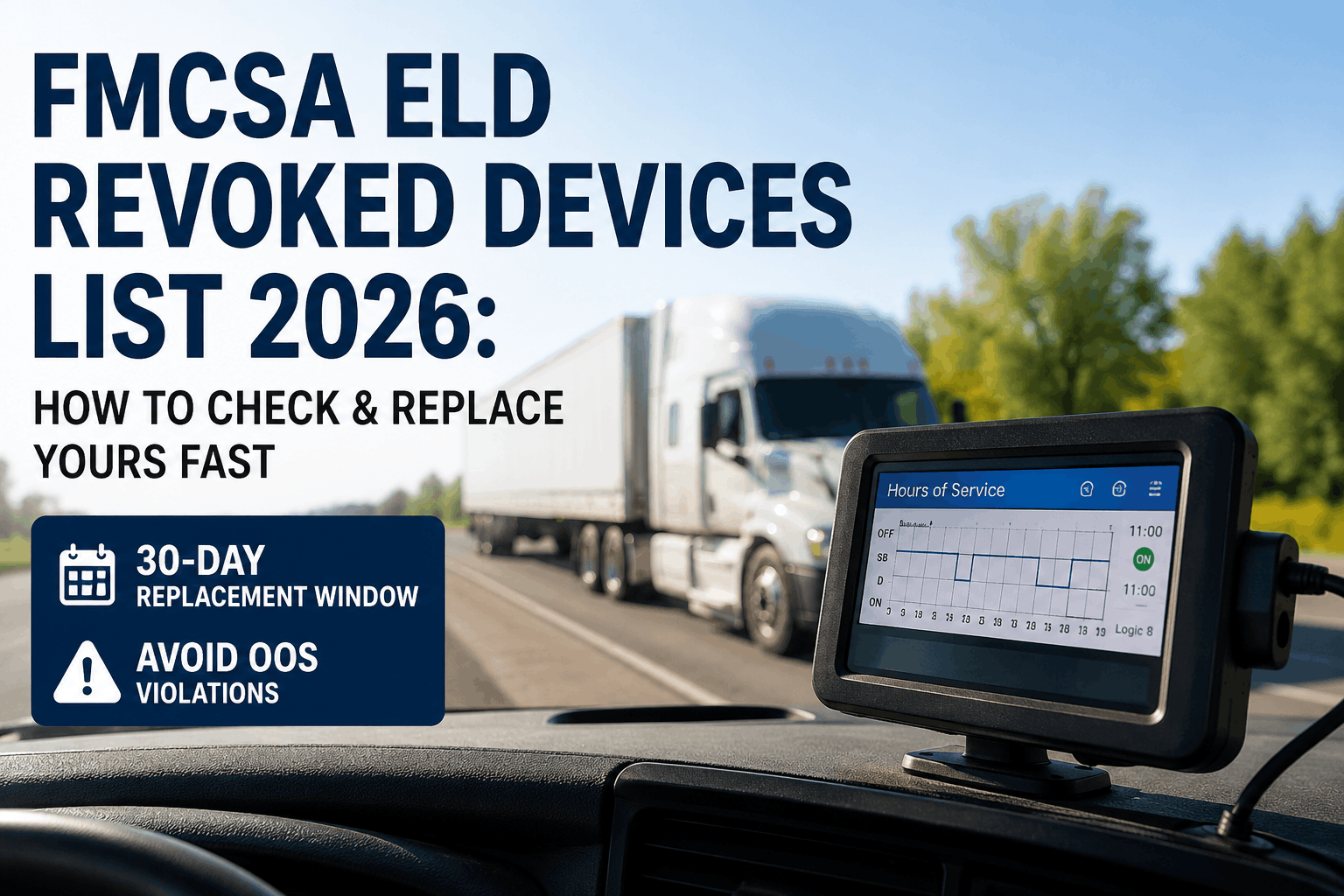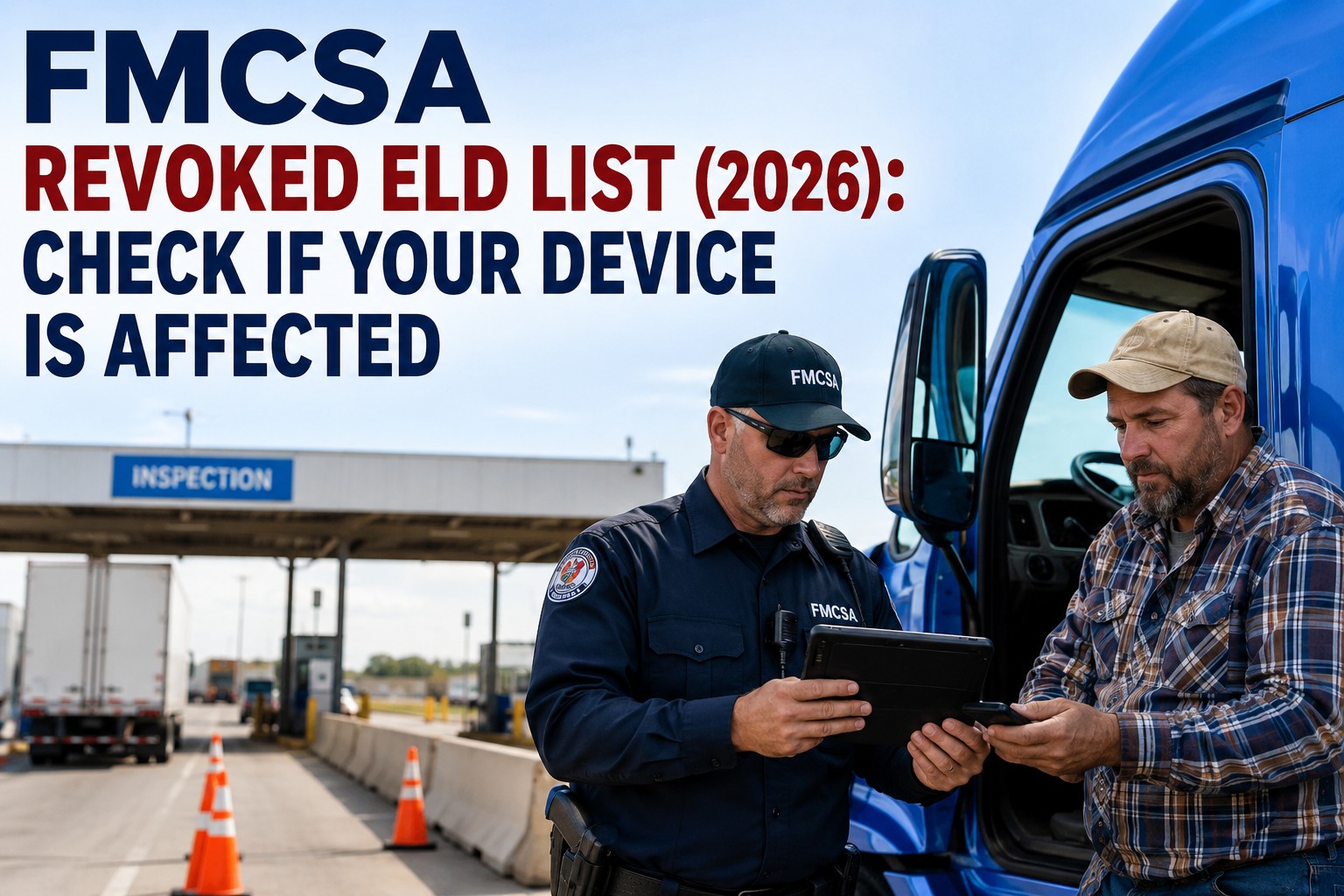
The FMCSA revoked ELD list is the official record of Electronic Logging Devices decertified for failing FMCSA compliance requirements. When your ELD lands on that list, you have 60 days to install a compliant replacement — after which every hours-of-service log recorded on the revoked device counts as a violation, roadside inspections escalate to out-of-service orders, and CSA scores tell regulators the story. Every fleet running an ELD needs to check this list on a routine cadence because revocations happen without much warning, and the 60-day clock starts the moment FMCSA publishes the notice. This page walks how to check the FMCSA revoked ELD list, what happens if your device is on it, the 60-day replacement roadmap, warning signs your provider might be next, and what to look for in a compliant replacement. Book a demo after you check the lookup card.
Is your ELD on the FMCSA revoked list?
FMCSA revokes ELDs on a rolling basis when they fail compliance requirements or providers voluntarily withdraw. If yours is on the list, the 60-day replacement clock is already running.
The lookup results above are illustrative — the actual FMCSA registry sits at fmcsa.dot.gov and is the only authoritative source. What's real is the mechanics: 60 days from revocation to replacement, escalating consequences after that, and no grace period beyond the initial window. Below is what happens on the timeline, exactly how to check the list, the warning signs that flag providers at risk before they get revoked, and the buyer's checklist for a replacement.
What happens if your ELD is on the revoked list — the 60-day timeline
ELD revocation isn't a suggestion or a warning — it's a hard clock. From the moment FMCSA publishes the revocation notice, you have exactly 60 days to install a compliant replacement across your fleet. The consequences escalate at defined checkpoints, and every day past day 60 that a driver operates on the revoked device is a citation-eligible violation.
Revocation published
FMCSA posts the revocation notice on the official registry. The 60-day clock starts immediately — regardless of whether your fleet noticed.
Grace period & procurement
Fleet still permitted to operate on the revoked device. Ideal window: evaluate 2-3 replacement providers, order new devices, begin driver notification.
Installation & training
Install replacement ELDs across the fleet in waves. Train drivers on new interface (typically 30 minutes per driver). Verify HOS data transfer.
Violation status
Any driver still logging on the revoked ELD is operating out of compliance. Roadside inspection can issue citations; repeat violations trigger out-of-service orders and CSA impact.
The 60-day window sounds generous until you count the operational reality: procurement lead time on ELD hardware is 2-3 weeks in normal conditions, longer during industry-wide revocation events when multiple carriers are competing for the same replacement stock. Fleets that don't move by day 15 typically end up cutting it dangerously close to the deadline. Book a demo to see the compliance workflow that catches revocations before they hit your fleet
How to check the FMCSA revoked ELD list — 5 steps
Checking whether your ELD is registered or revoked takes about two minutes on the official FMCSA registry. There's no substitute for going to the source — third-party lists lag behind. Below is the exact 5-step process every fleet manager should run on a monthly cadence.
Note your ELD details
Gather provider name, model number, firmware version, and registration ID from a truck's device or your provider's admin portal. Have this info ready before opening the FMCSA site.
Go to the FMCSA registry
Navigate to fmcsa.dot.gov/registration/eld — the only official source. Two lists are maintained: "Registered Devices" and "Revoked Devices." Check both.
Search by provider or model
Use the filter or search box on either list. Confirm your specific model appears on the registered list, or check whether it appears on the revoked list.
Verify firmware version
Some revocations apply to specific firmware versions, not the entire product line. Match your firmware against the registry entry. Older firmware may need updating even if the current version is registered.
Set a monthly reminder
Add the check to your compliance calendar — first of every month. FMCSA doesn't email carriers directly when their ELD is revoked. Discovery is your responsibility.
The two-minute monthly discipline is what separates fleets that catch revocations on day one from fleets that discover the problem 45 days in during a roadside inspection. Start free and get the compliance calendar built into your workflow
5 warning signs your ELD provider is at risk of revocation
Revocations rarely come out of nowhere — they follow a pattern of provider decline that's visible months in advance if you know what to look for. Five warning signs account for the majority of ELD provider failures. Two or more red flags = time to start evaluating replacements before FMCSA forces the decision.
Active FMCSA warnings on registration
FMCSA issues warnings before revocation. If your provider has open compliance notices on their FMCSA registration record, revocation typically follows within 90 to 180 days. Check quarterly.
Data sync failures or crashes rising
If drivers report the ELD dropping HOS data, crashing during log entry, or losing sync with the cab, the firmware may have fallen out of compliance with current FMCSA specifications. Escalating tickets signal deeper problems.
Firmware not updated in 12+ months
FMCSA specifications get periodic technical updates. Providers that don't push firmware updates at least once per year are falling behind on the underlying requirements — a strong signal they can't or won't invest in compliance.
Support quality dropping
Slow ticket responses, discontinued phone support, missed callback commitments, and staff turnover in customer success typically precede product-side deterioration by 6 to 12 months. If support declines, the product usually follows.
Small or undercapitalized provider
A 20-person ELD company can't absorb the cost of an FMCSA compliance overhaul. Larger providers with diversified revenue survive rule updates; small providers often fold. Check company size and funding history before signing a multi-year contract.
The pattern holds across every revocation event in the last five years: warnings first, then technical drift, then service decline, then the FMCSA notice. Fleets tracking these signals typically get 6 to 12 months of preparation time; fleets that don't get 60 days. Book a demo to see provider risk monitoring included in the compliance workflow
What to look for in a compliant replacement ELD
If your ELD is on the revoked list, the replacement decision is time-critical but not complicated. Six criteria separate durable replacement providers from the ones likely to end up on the revoked list themselves in a few years.
Currently FMCSA-registered
Verify on the official FMCSA registry before purchase — not the vendor's own marketing. Registration status changes, and vendors don't always update their websites promptly.
Established provider (5+ years)
ELD providers with 5+ years in the market have absorbed multiple FMCSA rule updates and survived. New providers may be cheaper up front but carry higher decertification risk over a 5-year contract.
Regular firmware updates
Ask for the firmware update history — quarterly cadence minimum signals an active engineering investment. Providers that update once a year are typically on the path to compliance drift.
24/7 driver support
Drivers get ELD questions at odd hours. A provider without 24/7 support forces drivers to work around missing help — sometimes by falsifying logs or ignoring alerts. Support quality is a compliance question, not just a service question.
Integrations with existing systems
Native integration with your telematics, fuel cards, DVIR, and maintenance software matters more than headline features. Standalone ELDs create data silos that break compliance workflows over time.
Automatic FMCSA rule updates
When FMCSA changes ELD specifications, the provider should push firmware updates automatically. Manual update workflows fail; automatic ones don't. This is what keeps a device on the registered list over time.
Six criteria, six checkboxes. Vendors that clear all six are the ones you can sign a 3-to-5-year contract with confidence. Vendors that miss two or more are the ones likely to end up on the revoked list themselves in a few years. Book a demo to see fleet-wide ELD monitoring in production — or start free and get the ELD compliance calendar live this week .
From a fleet manager who got caught by an ELD revocation
When our ELD provider got revoked last spring, we had 60 days to replace 47 units. We hadn't budgeted for it and we hadn't planned for the driver retraining. Cost us about $28,000 in device costs and another $12,000 in downtime while we did the switchover.
If we'd been paying attention to the FMCSA registration status quarterly, we'd have seen the warning signs and prepared. Now we check the revoked list on the first of every month. Takes 30 seconds.
Frequently asked questions
What is the FMCSA revoked ELD list?
The FMCSA revoked ELD list is the official public registry maintained by the Federal Motor Carrier Safety Administration of Electronic Logging Devices that have been decertified. FMCSA maintains two related lists at fmcsa.dot.gov/registration/eld: a Registered Devices list showing every ELD currently authorized for use on commercial motor vehicles subject to hours-of-service rules, and a Revoked Devices list showing every ELD FMCSA has decertified because it failed to meet compliance requirements or the provider voluntarily withdrew. When an ELD is revoked, fleets running that device have 60 days to install a compliant replacement or face out-of-service risk on roadside inspections. Revocations happen on a rolling basis and FMCSA does not directly notify affected carriers. Every fleet running any ELD is responsible for monitoring the list themselves, ideally on a monthly cadence during the routine compliance calendar. Missing a revocation notice doesn't stop the 60-day clock from running.
What happens if my ELD is on the revoked list?
If your ELD is on the FMCSA revoked list, you have 60 days from the revocation publication date to install a compliant replacement across your entire fleet. During the 60-day window, drivers are permitted to continue operating on the revoked device as a grace period, but the clock is running whether the fleet noticed the notice or not. After day 60, every hours-of-service log recorded on the revoked ELD is a violation. Roadside inspections can result in citations, driver out-of-service orders, and CSA score impact. Repeated violations trigger Safety Fitness Determinations. The practical timeline is tight: hardware procurement takes 2 to 3 weeks in normal conditions and longer during industry-wide revocation events; installation and driver training typically consumes another 3 to 4 weeks. Fleets that don't start replacement procurement by day 15 typically end up cutting it dangerously close to the deadline.
How often does FMCSA revoke ELDs?
FMCSA revokes ELDs on a rolling basis when compliance issues are identified or when providers voluntarily withdraw. There's no fixed schedule — revocations happen when the underlying technical or compliance triggers occur. Since the ELD mandate took effect in December 2017, dozens of ELDs have been decertified, with notable waves following major FMCSA specification updates. Some revocations affect a single model number within a larger product line; others affect an entire provider's portfolio. Voluntary withdrawals typically happen when a provider decides the cost of maintaining FMCSA compliance exceeds the revenue their ELD business generates — small providers with limited market share are the most common candidates. Involuntary revocations happen when FMCSA identifies specific compliance failures during routine review. Because the schedule is unpredictable, the only reliable defense is monthly monitoring of the registry — a two-minute check that catches revocations on day one rather than day 45.
How do I check if my ELD is FMCSA-registered?
Go directly to the official FMCSA registry at fmcsa.dot.gov/registration/eld — the only authoritative source. Two lists are maintained side by side: Registered Devices (currently compliant) and Revoked Devices (decertified). Gather your ELD details before opening the site: provider name, exact model number, firmware version, and registration ID (usually visible on the device itself or in your provider's admin portal). Search or filter both lists by provider name to confirm your specific model appears on the Registered list — not just the provider's other devices. Match firmware versions carefully because some revocations apply to specific firmware releases rather than the entire product line. If your device appears on the Revoked list, note the revocation publication date and start the 60-day replacement clock from that date. Do the check monthly on the first of the month as a compliance calendar item — FMCSA does not send direct notifications to affected carriers.
What should I look for in a replacement ELD?
Six criteria matter when picking a replacement ELD, and every credible provider clears them cleanly. First, currently FMCSA-registered — verify on the official registry rather than the vendor's marketing. Second, established provider with 5+ years in the ELD market and a history of surviving FMCSA specification updates. Third, regular firmware updates on at least a quarterly cadence, signaling active engineering investment. Fourth, 24/7 driver support to handle questions at odd hours. Fifth, native integrations with your existing telematics, fuel cards, DVIR, and maintenance software to avoid data silos. Sixth, automatic FMCSA rule update delivery so firmware stays current when specifications change. Beyond the six, ask for references from similar fleets, ask about the last three FMCSA rule updates and how the provider handled them, and ask what happens to your data if the provider decertifies. Shorter contracts (2 to 3 years) preserve flexibility.
Never get caught by an ELD revocation again
HVI includes ELD status monitoring as part of the fleet compliance workflow — monthly registry checks, alerting when your providers show warning signs, and rapid replacement rollout tracking if a revocation hits. Live in under two weeks — and typical fleets never get caught by a revocation after implementation.
No credit card · No hardware · Compliance calendar ready day one