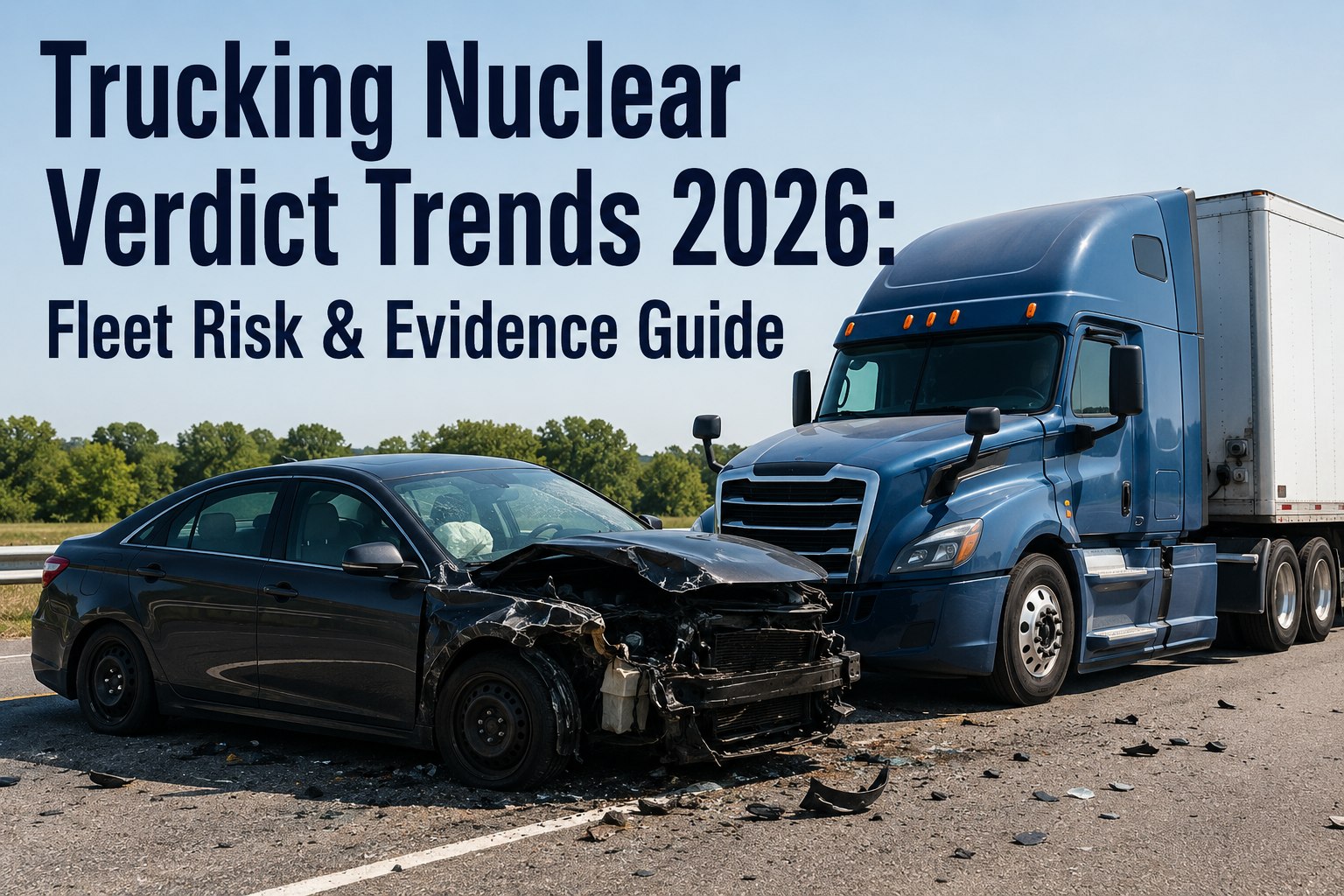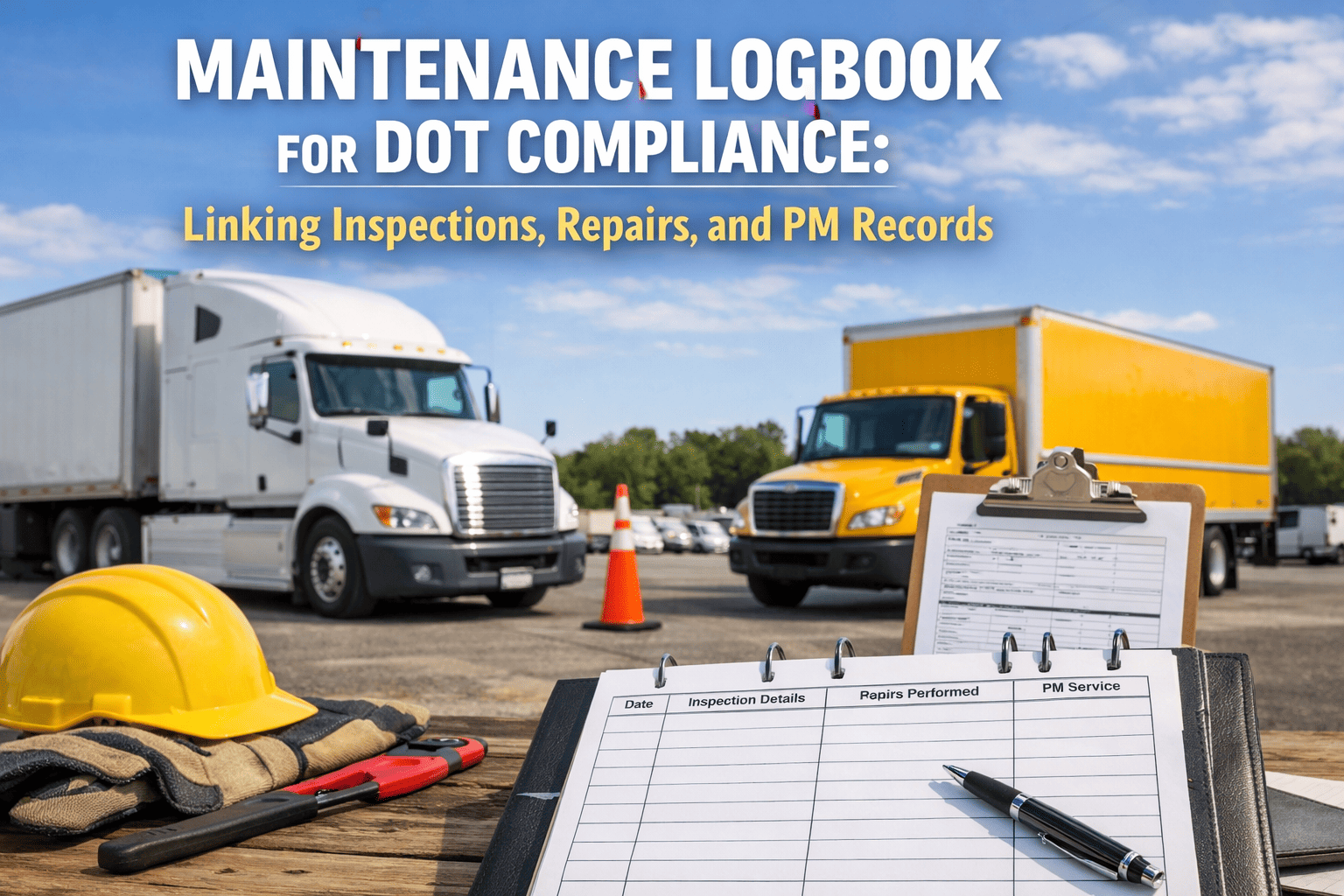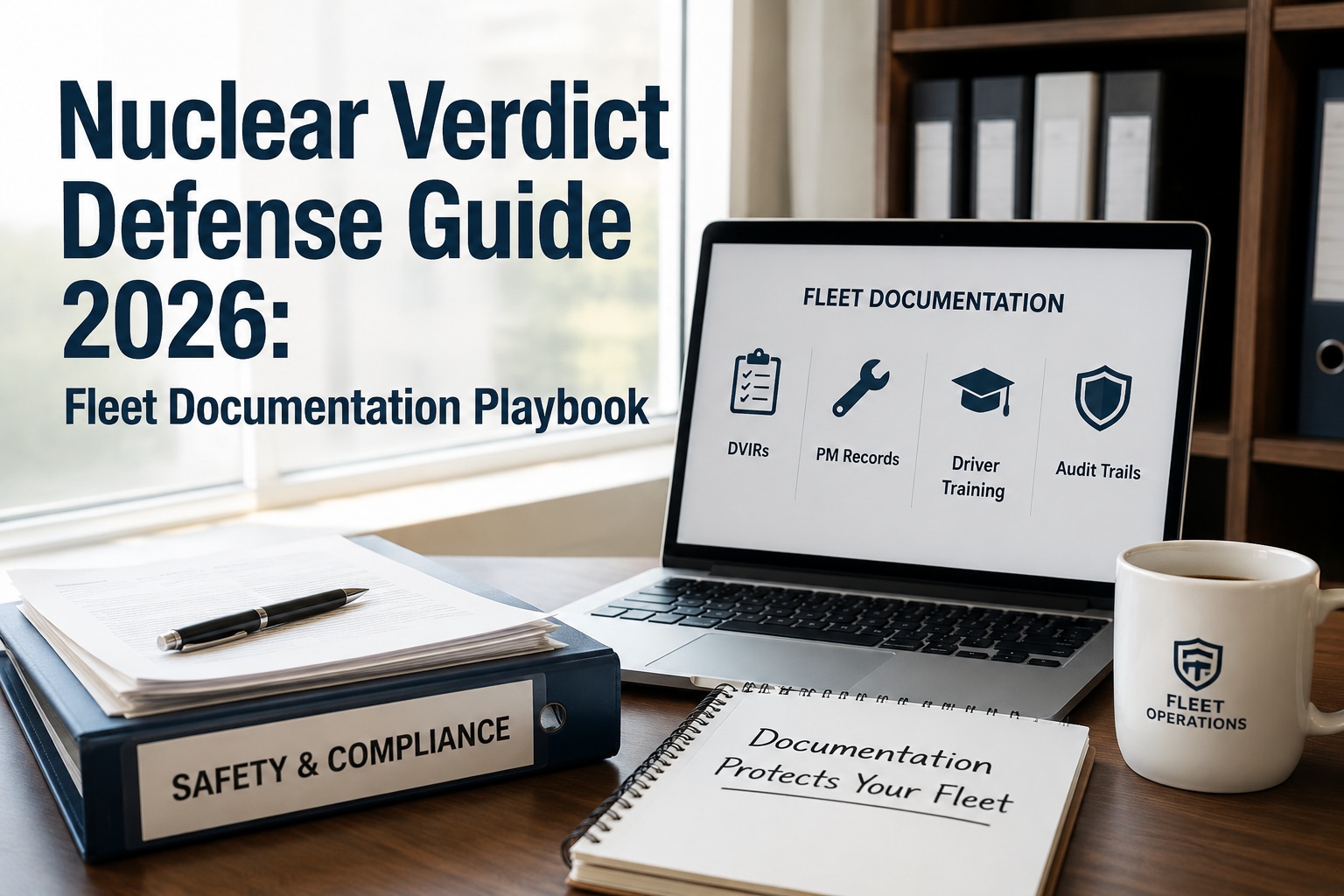
The most dangerous exhibit in a nuclear verdict trucking case isn't the accident report — it's the empty folder. When plaintiff attorneys request three years of DVIRs, PMs, and driver files and the defendant can't produce a clean export, the case shifts from "one driver's mistake" to "systemic corporate negligence." Nuclear verdicts against trucking companies have climbed roughly 300% in a decade, with median awards now $36–$51 million. This guide walks through how attorneys build the case and the digital records that flip the plaintiff's argument. Book a demo
The nuclear verdict severity scale — where the awards actually land in 2026
"Nuclear" used to mean $10M+. The new bar is a whole tier higher.
What actually changed isn't how often trucks crash — crash frequency has held roughly steady. What changed is how plaintiff attorneys build the case. The modern playbook doesn't argue that one driver made one mistake. It argues that a corporation created the conditions for that mistake through weak hiring, ignored maintenance alerts, undocumented training, and rubber-stamped inspections. That argument requires evidence, and fragmented fleet data is where the evidence writes itself for the plaintiff.
How plaintiff attorneys actually build a nuclear verdict case
Understanding the attack pattern is the first step in mounting a defense. The modern nuclear verdict case doesn't rest on the driver's actions at the moment of the crash. It rests on a carefully constructed narrative of corporate indifference, built from documentation gaps you didn't know were gaps until discovery.
-
Stage 1Reframe the crash as a corporate decision
Discovery requests target three years of DVIRs, PM records, driver files, coaching logs, and safety meetings. The theory: any decision made about this driver, this truck, or this fleet is a corporate decision the company must defend. The driver becomes secondary; the corporation becomes the defendant.
-
Stage 2Establish a pattern of ignored warnings
Plaintiff subpoenas telematics data looking for hard-braking events, speeding alerts, and lane-departure warnings on the specific driver, the specific truck, or the fleet at large. Any warning without a documented coaching or maintenance response becomes an exhibit of "ignored warnings." Systemic failure is easier to prove than momentary mistake.
-
Stage 3Weaponize documentation gaps as evidence of indifference
Missing DVIRs. Repair records without certification signatures. Training logs on paper that "can't be located." PM schedules that fell three intervals overdue. Each gap gets displayed to the jury as evidence the company didn't care enough to document. The jury doesn't need to see the crash; they need to see the pattern.
-
Stage 4Anchor damages to corporate net worth
Punitive damages, which drive the bulk of thermonuclear awards, are calibrated to the defendant's ability to pay. Once the jury believes the company created systemic risk, punitives become a moral judgment on the entire enterprise — not compensation for the plaintiff. This is where the $100M+ awards get built.
The pattern is worth pausing on. In four stages the plaintiff moves from "an accident happened" to "a corporation should be punished." At every stage, the company's only defense is documentation. Not policies, not training PowerPoints, not the safety manual on the wall — actual timestamped records showing the discipline was executed, not just intended. Book a demo to see how litigation-ready records get assembled automatically from daily operations
The 6 documentation categories that decide the case
Every nuclear verdict case comes down to the same six documentation categories. Fleets that can produce clean, timestamped, unified records across all six typically settle for a fraction of what's demanded. Fleets that produce fragmented paper across three or more categories often end up in the median award range.
Electronic DVIRs with GPS & photo evidence
Signed digital DVIRs with GPS verification proving the driver was at the vehicle, photos of key components, and quality scoring that flags rubber-stamped inspections. The February 19, 2026 FMCSA final rule (Docket FMCSA-2025-0115) explicitly authorizes electronic DVIRs.
PM records with certification signatures
Preventive maintenance schedules per unit tied to actual completion records, parts used, mechanic sign-off, and post-repair certification. Missing certification signatures on defect resolution is one of the most common findings in litigation discovery.
Driver qualification files & hiring documentation
Complete CDL verification, medical certificates, MVR pulls at regulation intervals, Clearinghouse queries, drug & alcohol testing records, background checks, and hire-date-to-first-incident timelines. Weak hiring documentation drives the negligent-hiring theory that anchors many cases.
Coaching & training records with acknowledgments
Every telematics alert (hard braking, speeding, lane departure) tied to a documented coaching response with driver acknowledgment. Every safety training session with attendance records and comprehension verification. This is where the "ignored warnings" argument gets defeated.
Incident & near-miss reporting infrastructure
Documented near-miss reporting, corrective action tracking, and safety-committee review of every incident. Fleets with active reporting programs demonstrate ongoing risk management. Fleets without them appear to only respond after catastrophic events.
Unified audit trail across all data sources
Every record above needs to be exportable as one unified timeline, tied to the specific unit, driver, and date range. Fragmented data (telematics in one tool, DVIRs in another, driver files on paper) becomes the plaintiff's most damaging exhibit — even when the underlying compliance was clean.
The pattern across all six categories is the same: the record either exists in exportable, timestamped, verifiable form — or it functionally doesn't exist for legal purposes. Paper records that can't be located inside a two-week discovery window are treated as non-existent. Digital records fragmented across platforms are treated as evidence of disorganization. Unified digital records are treated as evidence of institutional discipline. Book a demo to see all six documentation categories tied into one export
Missing DVIR to $50M verdict — how the cascade actually unfolds
The gap between a missed daily inspection and a nine-figure verdict feels absurd until you trace the cascade. Here's how a single documentation failure becomes the exhibit that anchors a plaintiff's case.
-
Day 0Pre-trip inspection skipped or rubber-stamped
Driver checks "OK" on every item without actually performing the inspection. A brake defect that would have been caught goes unlogged. No paper trail, no digital record, nothing to prove the inspection either happened or didn't.
-
Day 47Brake defect contributes to crash
The defect that a proper inspection would have caught contributes to a serious accident. Post-crash inspection identifies the mechanical failure. The driver's actions are secondary to the equipment failure at that point.
-
Month 3Plaintiff discovery request lands
Three years of DVIRs, PM records, and inspection history are subpoenaed. The specific pre-trip on Day 0 is requested. There isn't one. The fleet also can't produce a clean history showing systematic pre-trip completion across the 90 days preceding the crash.
-
Month 8Deposition establishes systemic pattern
Under deposition, the fleet's safety manager acknowledges DVIRs are frequently missing, incomplete, or rubber-stamped. Corporate representatives struggle to explain the compliance culture. What was a single failure becomes evidence of systemic negligence.
-
TrialJury awards $50M — punitives drive the bulk
The jury sees a corporation that couldn't produce evidence of its own safety practices. Compensatory damages cover medical bills. Punitive damages punish the pattern. What started as a mechanical failure becomes a verdict against corporate indifference.
The cascade isn't hypothetical — it maps to case patterns industry analysts describe as typical of the modern nuclear verdict trend. And nothing in it required the driver to be reckless or the fleet to be egregiously bad. It required only that the documentation not exist when discovery asked for it. Prevention lives at Day 0, not at Month 3. Start free and get Day-0 documentation infrastructure on day one
The digital-defense readiness checklist — where does your fleet actually sit?
Every fleet should be able to answer yes to every one of these questions today — not "we're working on it," not "our safety manager could probably pull it together in a week." The discovery window is measured in days, not weeks.
Any "no" is a documentation gap that becomes a plaintiff exhibit in discovery. The good news: every one of these questions has a modern digital answer. The bad news: the fleets that need to hear it most are the ones running on paper DVIRs and quarterly PM spreadsheets, convinced their compliance is fine because "we haven't been audited yet." Audits and discovery arrive on someone else's schedule. Book a demo to see the checklist audited live against your current fleet documentation
From a Risk Manager whose settlement dropped from $22M demand to $3.8M after producing 3 years of clean digital records
The demand letter opened at $22 million. Rear-end collision, one fatality, plaintiff's counsel was one of the top nuclear verdict firms in the region. They subpoenaed three years of DVIRs, PM records, training logs, and telematics data for the specific driver and the specific truck. Under the old paper-and-spreadsheet system, we would have spent two months assembling that package and it would have had gaps.
Instead we exported everything from HVI in about six hours. Every DVIR signed, GPS-verified, photo-documented. Every PM completed on schedule with certification. Every coaching session tied to a specific telematics alert. Plaintiff's counsel saw the package and reset expectations. We settled at $3.8 million — still significant, but not corporate-ending. Our carrier told us the documentation package was the single largest factor in the reduction.
Frequently asked questions
What is a nuclear verdict in trucking and why are they increasing?
A nuclear verdict is a jury award of $10 million or more against a defendant — a threshold originally set by legal researchers to identify catastrophic outcomes. In trucking, nuclear verdicts have climbed roughly 300% over the past decade, with median awards now landing in the $36–$51 million range. "Thermonuclear" verdicts of $100 million or more are becoming more common; some 2024–2026 cases have crossed $1 billion. In 2024 alone, more than 130 companies faced nuclear verdicts — a 52% year-over-year increase — with total awards exceeding $31 billion. According to a 2024 U.S. Chamber of Commerce Institute for Legal Reform study, approximately one in four nuclear verdicts involves a trucking company. What drives the trend isn't higher crash frequency — crash rates have held roughly steady. It's a fundamental change in how plaintiff attorneys build cases. Instead of arguing a single driver made a single mistake, they argue that a corporation created the conditions for that mistake through weak hiring, ignored maintenance alerts, undocumented training, and rubber-stamped inspections. Punitive damages, which drive the bulk of thermonuclear awards, are calibrated to the defendant's ability to pay and to jury outrage at perceived corporate indifference. That combination — systemic-failure theory plus deep-pocket punitive anchoring — is what turns ordinary accidents into corporate-ending verdicts.
How do plaintiff attorneys use documentation gaps against trucking companies?
The modern plaintiff playbook depends on documentation gaps in specific ways. First, discovery requests target 3+ years of DVIRs, PM records, driver qualification files, coaching logs, and safety meeting records. Any missing or incomplete document becomes an exhibit of corporate indifference — not because it proves the crash was caused by that specific gap, but because it establishes a pattern. Second, plaintiff attorneys subpoena telematics data for hard-braking events, speeding alerts, and lane-departure warnings on the specific driver and truck. Any warning without a documented coaching or maintenance response becomes evidence of "ignored warnings," feeding a systemic-failure narrative. Third, fragmented data across multiple systems (telematics in one tool, DVIRs in another, driver files on paper) is treated as institutional disorganization — even when underlying compliance was clean. Juries interpret disorganization as indifference. Fourth, when plaintiff counsel gets the case reframed from "driver's mistake" to "corporate policy failure," punitive damages become available. Punitives are anchored to corporate net worth rather than actual harm, which is where thermonuclear awards get built. The defense counter is always the same: unified, timestamped, verifiable documentation across every category. Paper records that can't be located inside a two-week discovery window are treated as non-existent. Digital records fragmented across platforms are treated as evidence of disorganization. Unified digital records are treated as evidence of institutional discipline — the exact opposite of the plaintiff's theory.
What documentation actually helps defend against a nuclear verdict?
Six documentation categories consistently determine defense outcomes. Electronic DVIRs with GPS verification (proving the driver was at the vehicle), photo evidence of key components, and quality scoring that flags rubber-stamped inspections — the February 19, 2026 FMCSA final rule (Docket FMCSA-2025-0115) explicitly authorizes electronic DVIRs. Preventive maintenance records with mechanic sign-off AND certification of return-to-service, tied to specific units by mileage/engine-hours/calendar triggers. Driver qualification files including CDL verification, medical certificates, MVR pulls at regulation intervals, Clearinghouse queries, drug and alcohol testing records, and background checks. Coaching and training records with documented driver acknowledgments — every telematics alert tied to a specific coaching response, every safety training session with attendance and comprehension verification. Incident and near-miss reporting infrastructure showing active corrective-action tracking. And critically, a unified audit trail across all data sources so the entire package can be exported as one timeline for a specific unit, driver, or date range. The retention floor for DVIRs under 49 CFR 396.11 is 90 days; the retention floor for ELD data under 49 CFR 395.8 is 6 months. But lawsuits run years, and every case is stronger with 3–5 year retention. Digital storage makes extended retention essentially cost-free, and defensive value compounds with time depth.
Are electronic DVIRs legally accepted for nuclear verdict defense?
Yes, and the legal foundation strengthened dramatically in early 2026. On February 19, 2026, FMCSA published a final rule (Docket FMCSA-2025-0115) explicitly authorizing electronic DVIRs, formalizing what had previously been enforced through interpretation. Electronic DVIRs meeting the FMCSA specification satisfy 49 CFR 396.11 requirements identically to paper DVIRs, and are increasingly preferred by insurance underwriters, courts, and FMCSA auditors because they produce demonstrably better audit trails. Beyond FMCSA compliance, electronic DVIRs offer specific litigation-defense advantages that paper cannot match: GPS verification proving the driver was physically at the vehicle when the inspection was signed; photo capture of key components creating time-stamped visual evidence; quality scoring that flags suspiciously fast or uniform inspections (a common plaintiff exhibit); automatic three-signature enforcement (driver, mechanic, second-driver review) preventing the certification-signature gaps that appear repeatedly in litigation discovery; and unlimited retention at essentially zero marginal cost. Juries in nuclear verdict cases specifically look for patterns of rubber-stamped inspections as evidence of carrier negligence. Electronic DVIRs with GPS and photo verification defeat that argument directly. Fleets running paper DVIRs remain legal but face a growing disadvantage in both audit outcomes and litigation defense. Given FMCSA offsite audits have increased approximately 400% in recent years with as little as 48 hours' notice to produce records digitally, paper-based inspection programs are increasingly a liability regardless of litigation exposure.
How does HVI help fleets build nuclear verdict defense infrastructure?
HVI addresses all six documentation categories that determine nuclear verdict defense outcomes, on one integrated platform with the audit trail and export capability that discovery actually requires. On DVIRs: HVI runs electronic DVIRs with GPS verification, photo capture of key components, quality scoring against rubber-stamped patterns, and automatic three-signature enforcement (driver report, mechanic repair certification, next-driver review) — complying with the February 19, 2026 FMCSA final rule and blocking the "rubber-stamped inspection" plaintiff argument at the source. On preventive maintenance: HVI schedules PMs by mileage, engine hours, or calendar with automatic due-date alerts, parts inventory integration, mechanic sign-off, and certification of return-to-service documented per unit per repair. On driver qualification: HVI holds complete driver files (CDL, medical, MVR, Clearinghouse status, training records, hire-date-to-first-incident timelines) with expiration alerts and audit-ready exports. On coaching and training: HVI ties every telematics alert to a specific coaching response and driver acknowledgment, creating the "documented response to warnings" record that defeats the ignored-warnings argument. On incident reporting: HVI supports structured near-miss and incident reporting with corrective-action tracking. And critically, HVI unifies all of the above into single-export audit packages ready for FMCSA, insurance underwriters, and litigation counsel — turning the "fragmented data equals institutional disorganization" plaintiff exhibit into an "integrated safety culture" defense exhibit. Published customer data shows fleets on HVI report approximately 25% lower annual maintenance cost and typical payback around 3 months, and the litigation-defense value shows up most clearly when documentation gets tested by discovery.
Your nuclear verdict defense was either built years ago or it wasn't. Start today either way.
HVI holds every DVIR, PM record, driver file, coaching log, and incident response on one platform — with 5-year retention and single-export audit packages built for FMCSA, insurance, and litigation counsel. When discovery lands, your defense package is one export away instead of a three-week scramble across paper files and disconnected systems.
No credit card · Digital DVIR & PM audit trail live on day one