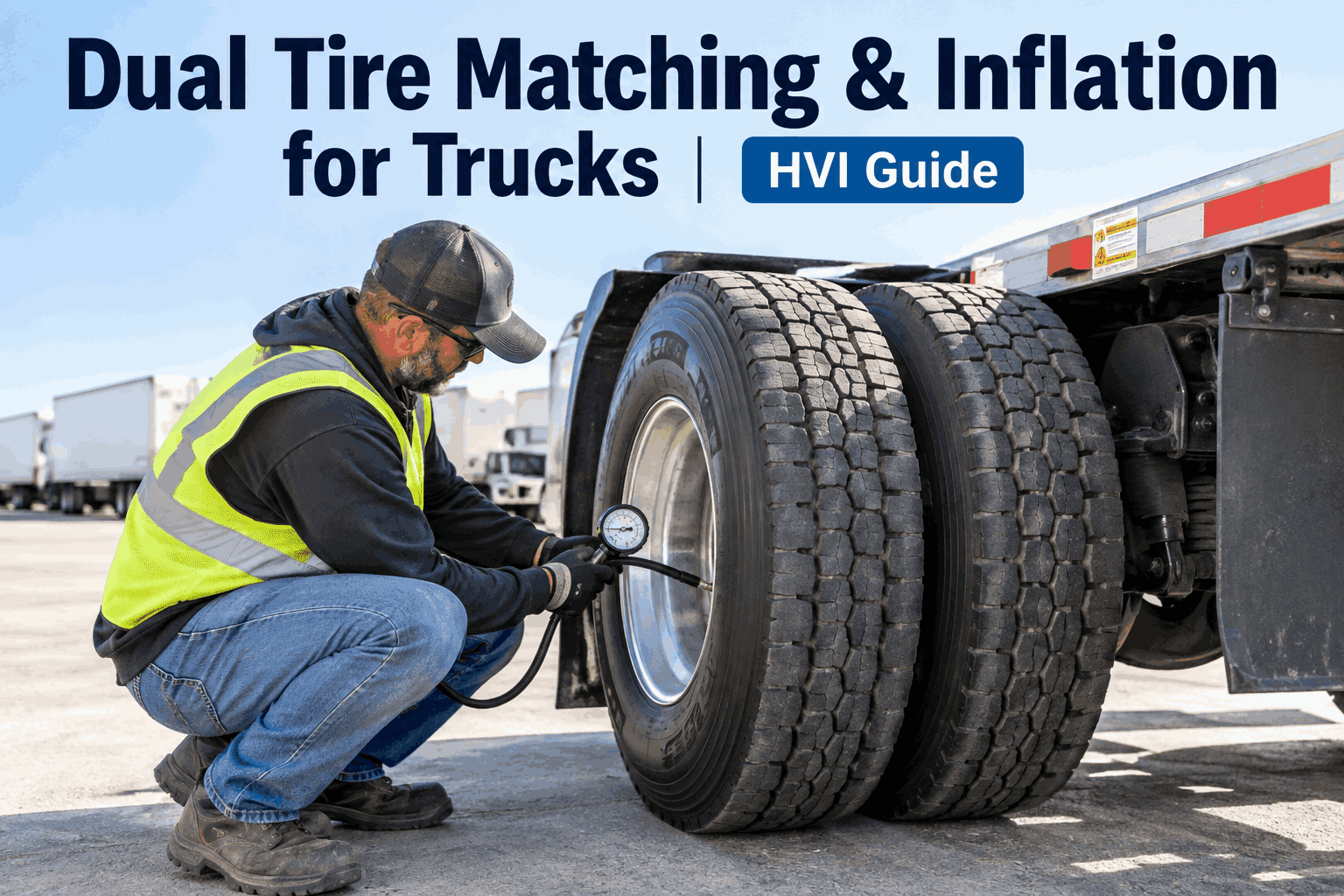
Two tires bolted together on a dual assembly have to roll the exact same distance every rotation — and when they can't, one of them pays for it. Dual tire matching keeps paired duals close enough in diameter, circumference, and inflation to share the load evenly. A gap most drivers can't feel — 5 psi, a quarter inch of diameter — quietly scrubs one tire to death while overloading its mate. This guide covers how close duals must match and how to catch a mismatch early. Book a demo to see dual matching tracked by wheel position.
Mismatched Duals Kill Two Tires at Once
Pair two tires that don't match and the smaller one scuffs itself to death keeping up, while the larger one carries the overload. A 5 psi gap or a quarter inch of diameter is enough — and the driver will never feel it. Matching is measured, not eyeballed.
Duals exist to spread heavy loads over more tires and give a truck a built-in margin if one tire fails. But that only works if the pair shares the load, and sharing depends on both tires being the same effective size. The moment one is smaller — from wear, a different tire, or lower pressure — the physics of two tires forced to spin at the same speed turns the pairing against itself.
Why Duals Have to Match
Two tires on a dual assembly are locked together on the same hub, so they rotate at the same speed no matter what. If they're different effective sizes, one of them can't roll cleanly — and that's where the damage starts.
Scrubbed to death
The smaller-circumference tire covers less ground per rotation but is forced to turn at the same speed as its bigger mate — so it scuffs and drags across the road every single rotation to keep up, wearing itself out fast and unevenly.
Carrying the overload
The larger or higher-pressure tire sits taller, so it takes more than its share of the load — overloading its sidewall, wearing faster, and flexing severely enough that, in the worst case, it can blow out from doing more than its share.
So a mismatch doesn't cost you one tire — it costs you both, plus the risk. As one industry expert puts it, any form of mismatched dual is one set too many. And on a tandem drive axle, a bad enough mismatch can even damage the differentials. The pairing that was supposed to add reliability becomes the thing tearing itself apart. Book a demo to see dual pairs flagged when they drift apart.
The Numbers: How Small a Difference Does Real Damage
The reason dual matching gets ignored is that the differences look trivial. The numbers say otherwise — a gap you'd never notice by eye shifts hundreds of pounds of load, and the load shift isn't even linear.
A 5 psi pressure difference makes the low tire's circumference 5/16" smaller — so it scuffs that much every rotation, roughly 500 times a mile. The industry limit is 5 psi between duals for a reason.
A 15 psi difference can push about 500 lb of extra load onto the higher-inflated tire — the same effect as running that tire overloaded, every mile.
Double the pressure gap and the load shift more than triples — about 1,500 lb — because the load transfer isn't linear. Small gaps are bad; big gaps are catastrophic.
A quarter-inch difference in diameter can make the larger tire carry about 600 lb more than its mate — a height gap you'd struggle to spot without measuring.
Put in tread-life terms, an uncorrected mismatch can cost 5 to 20 percent of a tire's tread life — and it's killing two tires, not one. On a set of expensive commercial tires, that's real money walking out the gate on every mismatched assembly, quietly, mile after mile. The figures vary by tire and load, but the direction never does. Start free and put a pressure and diameter check on every dual.
What Has to Match on a Dual Pair
Matching duals is more than getting the pressure right. USTMA guidance is that paired duals should share the same fundamentals and be as close as possible in outside diameter. Here's what to line up.
Both tires the same size — e.g. both 11R22.5. Different sizes have different dimensions and load ratings and can't share load evenly.
Radial and bias-ply tires deflect differently under load. Mix them on one axle and the bias tire carries the greater share and runs overloaded. Keep construction identical.
Matching tread design keeps the effective diameter and wear behavior consistent, so the pair wears together instead of one running ahead of the other.
Even with everything else matched, wear creates diameter differences over time. Keep the pair as close in diameter and tread depth as you can — many fleets spec within 4/32".
The construction point catches people out most: two tires can be the same size and look identical but be radial and bias, and pairing them guarantees the bias tire runs overloaded. The safe habit is to match all four — size, construction, tread design, and diameter — and treat any gap in the first three as an automatic no. Book a demo to see match criteria checked at fitment.
Measure the Match — Don't Eyeball It
Here's the uncomfortable truth about dual mismatch: neither the driver nor a quick glance can catch it reliably. Drivers generally can't feel a mismatch through the wheel, and by the time it's visible in the wear, damage is done.
Use a tape or dual gauge
Measure diameter or circumference with a proper tape or dual-tire gauge, and check tread depth, rather than judging by eye. A measured number is the only reliable way to compare a pair.
Check both pressures cold
Measure both tires' inflation with a calibrated gauge when cold, and keep the pair within the industry-standard 5 psi — pressure differences create diameter differences.
Record it by position
Log the measurements against the wheel position, so a pair that's drifting apart is caught on a trend — not left until a technician grabs whatever tire is handy for a roadside swap.
That last scenario is the real-world failure: a roadside blowout gets replaced with whatever tire's on the truck, the new tire doesn't match its mate, and nobody knows until the assembly comes back to the shop weeks later with a scrubbed tire. Measuring and recording at inspection is what closes that gap between the shop's spec and what's actually on the axle. Start free and record dual measurements by wheel position.
Dual Spacing and Trapped Debris
Matching isn't only about the tires' dimensions — it's also about the gap between them. Dual spacing has to meet the tire and vehicle manufacturer's minimum, and getting it wrong causes its own damage.
Meet the minimum spacing
Tire and vehicle manufacturers specify a minimum dual spacing so the two tires don't contact each other as they flex under load. Too little spacing lets the sidewalls rub, generating heat and damage.
Watch for trapped debris
The gap between duals catches rocks, wood, and road debris that lodge between the tires. Trapped debris grinds into the sidewalls as the tires flex, cutting and damaging the casing from the inside of the pair.
This is why a dual inspection includes clearing the gap between the tires and confirming the spacing, not just checking the two treads. Debris wedged between duals is easy to miss and can destroy a sidewall — on a casing you might otherwise have retreaded. A few seconds checking the gap protects the whole assembly. Book a demo to add a dual-spacing and debris check.
Spotting a Mismatch: The Wear Signs
When you can't measure every dual every day, the tires themselves leave clues — and they show up first on the smaller or under-inflated tire, the one taking the beating. Learn to read these and you catch a mismatch from the wear pattern.
Lugs wearing in an alternating high-low pattern — a classic scrubbing signature on the mismatched tire.
Wear running diagonally across the tread, from the tire being dragged rather than rolling cleanly.
Repeated flat-spotting around the tire from the scuffing and dragging of a size mismatch.
Erratic or depressed wear on the inner ribs — another sign the tire is fighting its mate.
The tell is that irregular wear on one tire of a pair points at the pairing, not just that tire. When a dual shows scrubbing wear its mate doesn't, the assembly is mismatched — and replacing only the worn one without matching the pair just restarts the cycle. Reading the wear is how you catch the ones the measurements missed. Start free and log irregular wear photos per tire.
How HVI Tracks Dual Matching by Position
Dual matching fails on documentation more than knowledge — the shop knows the spec, but what's actually on the axle drifts out of sight. Three capabilities keep the pairing visible and the cost measurable.
Pressure & match by wheel position
Capture inflation pressure and matching measurements for each dual against its exact wheel position and asset — so a pair drifting outside the 5 psi or diameter spec is caught, not carried.
Photo evidence & defect routing
Photograph irregular wear and trapped debris, and route a mismatched or damaged dual to action — so the finding is documented and fixed, not noticed and forgotten.
Tire cost analysis by position
Trend tire spend and wear by wheel position and unit — so a position or truck repeatedly eating tires from mismatch, alignment, or load shows up as data pointing at the real cause.
The result is that dual matching stops depending on one technician remembering the spec at 2 a.m. on a roadside swap. The pairing is measured, recorded by position, and analyzed — so mismatches are caught early, the scrubbed-tire surprises stop, and the positions quietly costing you tires finally show up in the numbers. Book a demo to see it on your tire program. Start free and track your duals by position.
From a tire manager whose spec kept walking out the gate
I spec duals within 4/32" and 5 psi, and I could hold that all day in my shop — then a roadside blowout gets replaced with whatever tire's on the truck and my spec's gone. We had a trailer come in with one dual a half inch off the ground; both tires were toast in weeks. Once every dual's pressure and measurement got logged by position, those mismatches got caught at inspection instead of at the scrap pile.
Frequently asked questions
What is dual tire matching?
Dual tire matching is pairing the two tires on a dual assembly so they're close enough in size, construction, tread design, diameter, and inflation to share the load evenly. Because both tires are locked on the same hub and spin at the same speed, they must roll the same distance per rotation. USTMA guidance is that paired duals should be the same size designation, construction, and tread design, and as close as possible in outside diameter, with proper minimum spacing. Matching prevents one tire scrubbing while the other overloads.
How much difference between dual tires is acceptable?
Industry practice is to keep dual inflation pressures within about 5 psi of each other, and many fleets spec dual tires within roughly 4/32" of tread depth or a quarter inch of diameter. The reason the tolerances are tight: a 5 psi difference makes the lower tire's circumference about 5/16" smaller, so it scuffs that much every rotation. A 15 psi difference can shift about 500 lb of load, and a quarter-inch diameter difference can shift about 600 lb. Exact tolerances vary by tire and vehicle manufacturer, so check their specs.
What happens if you run mismatched dual tires?
Mismatched duals damage both tires. The smaller or lower-pressure tire is forced to scuff and drag every rotation to keep up with its taller mate, wearing out fast and unevenly. The larger or higher-pressure tire carries more than its share of the load, overloading and stressing its sidewall, and in bad cases can flex enough to blow out. An uncorrected mismatch can cost 5 to 20 percent of tread life on both tires, and a severe mismatch across a tandem drive axle can even damage the differentials.
Can you tell if duals are mismatched by looking?
Not reliably. Drivers generally can't feel a mismatch through the vehicle, and a small but damaging difference in diameter or pressure isn't obvious to the eye. The reliable way is to measure — check both pressures with a calibrated gauge cold, and measure diameter, circumference, or tread depth with a tape or dual gauge. You can spot an existing mismatch from irregular wear on the smaller tire (alternate lug wear, diagonal wear, flat-spotting, inner-rib depression), but by then damage is already happening, which is why measuring beats inspecting by eye.
Can you mix radial and bias-ply tires on a dual assembly?
No. Radial and bias-ply tires deflect differently under the same load — radials flex more — so mixing them on the same axle makes the bias-ply tire carry the greater share of the load and run in an overloaded condition, leading to reduced mileage and early failure. Duals on the same axle must be the same construction. This is one of the fundamentals of dual matching, alongside matching size designation, tread design, and keeping outside diameter and inflation as close as possible.
Keep Every Dual Pair Matched, Measured, and on the Record
Capture inflation pressure and matching measurements by wheel position and asset, photo irregular wear and trapped debris, route mismatches to action, and trend tire cost by position — so a 5 psi drift is caught at inspection, not at the scrap pile, and the tire-eating positions finally show themselves. Live in under two weeks, trusted by 25,000+ users worldwide.
No credit card · No hardware · Tire inspection templates ready on day one