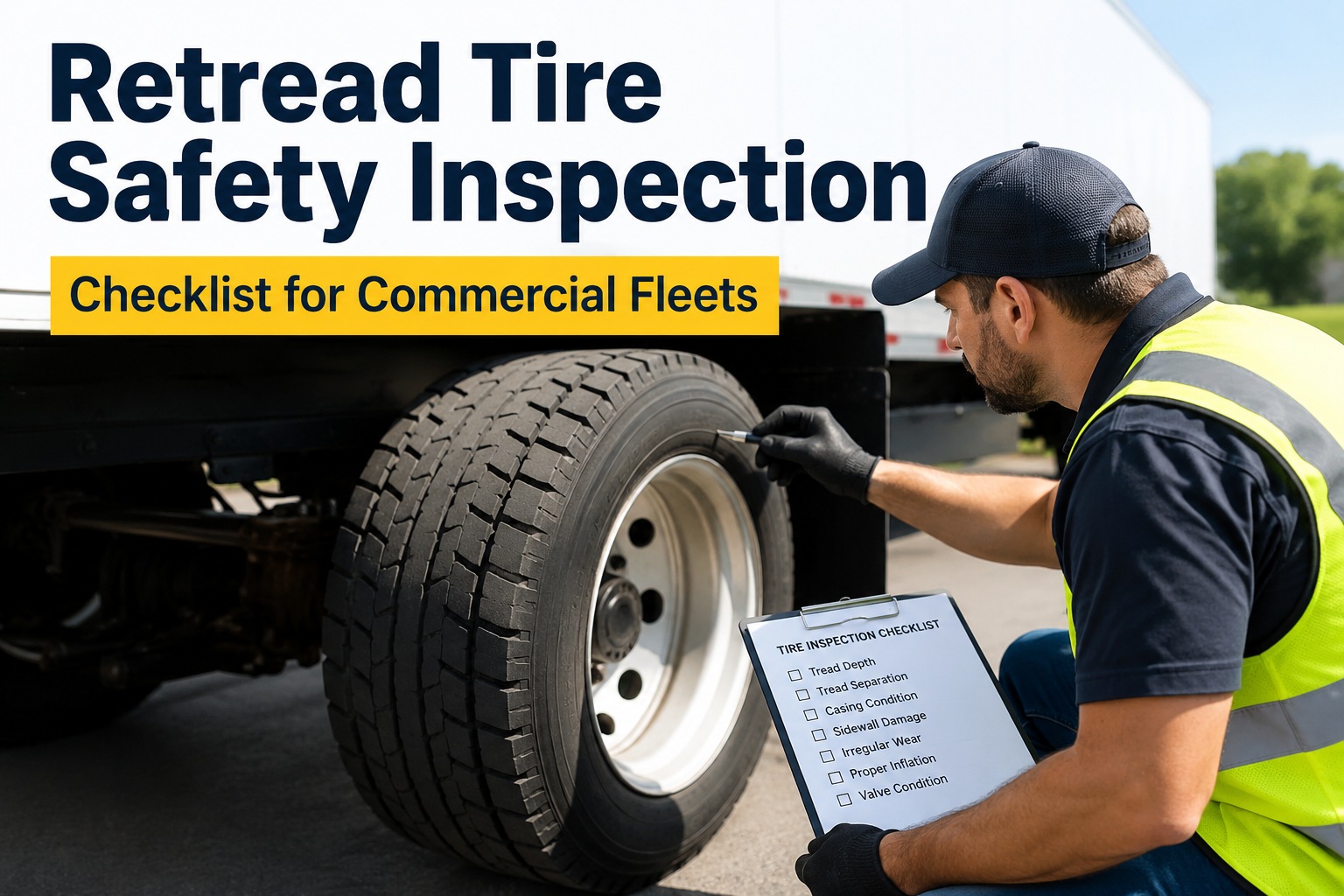
Retread tire safety inspection is one of the most cost-effective preventive maintenance workflows a commercial fleet has — and one of the most consequential when it's skipped. Roughly 50% of all replacement commercial tires used on US trucks in 2026 are retreads, saving fleets 30–50% versus the cost of comparable new tires. But retreads carry a distinct risk profile: tread separation, casing damage, and improper bonding are failure modes new tires rarely exhibit, and every one is detectable in a proper inspection before it becomes a roadside blowout. This retread tire safety inspection checklist walks the five critical defects every driver and technician should recognize, the pre-trip retread inspection routine, the comprehensive quarterly inspection procedure, the FMCSA position rules for retreads, and the five common mistakes fleets make with retread inspection programs. Book a demo after you see how digital retread inspection integrates with fleet maintenance workflow.
5 Critical Retread Tire Defects
Retread failures don't announce themselves — they show up as small visual signals long before the tire fails on the road. Below are the five every inspection should look for, ranked by severity.
Tread separation
New tread rubber lifting away from the casing. Visible as gaps, bulges, or "peeling" between tread and casing. Catastrophic failure risk — take out of service immediately. Most common retread-specific failure.
Sidewall bulge or blister
Visible bulge on sidewall indicates internal casing damage — often from impact or overloading. Weakened casing at high risk of blowout. OOS under 49 CFR 393.75.
Exposed cord or belt
Any body ply or belt material visible through the tread or sidewall. OOS under 49 CFR 393.75 regardless of tire type — replace immediately.
Uneven wear pattern
Cupping, feathering, or edge wear on retread indicates alignment, pressure, or balance problem. Not immediately unsafe but accelerates retread failure — correct root cause within days.
Bond line irregularities
Visible seam or line where new tread meets old casing shows minor waviness or thin spots. Not automatic OOS but log and schedule closer monitoring — can progress to separation over weeks.
Recognizing the defects above is step one. Below are the two inspection routines every retread program needs — the daily pre-trip walkaround and the comprehensive quarterly inspection — plus the FMCSA position rules and the five recurring mistakes fleets make.
Pre-trip retread tire inspection checklist — 7 items
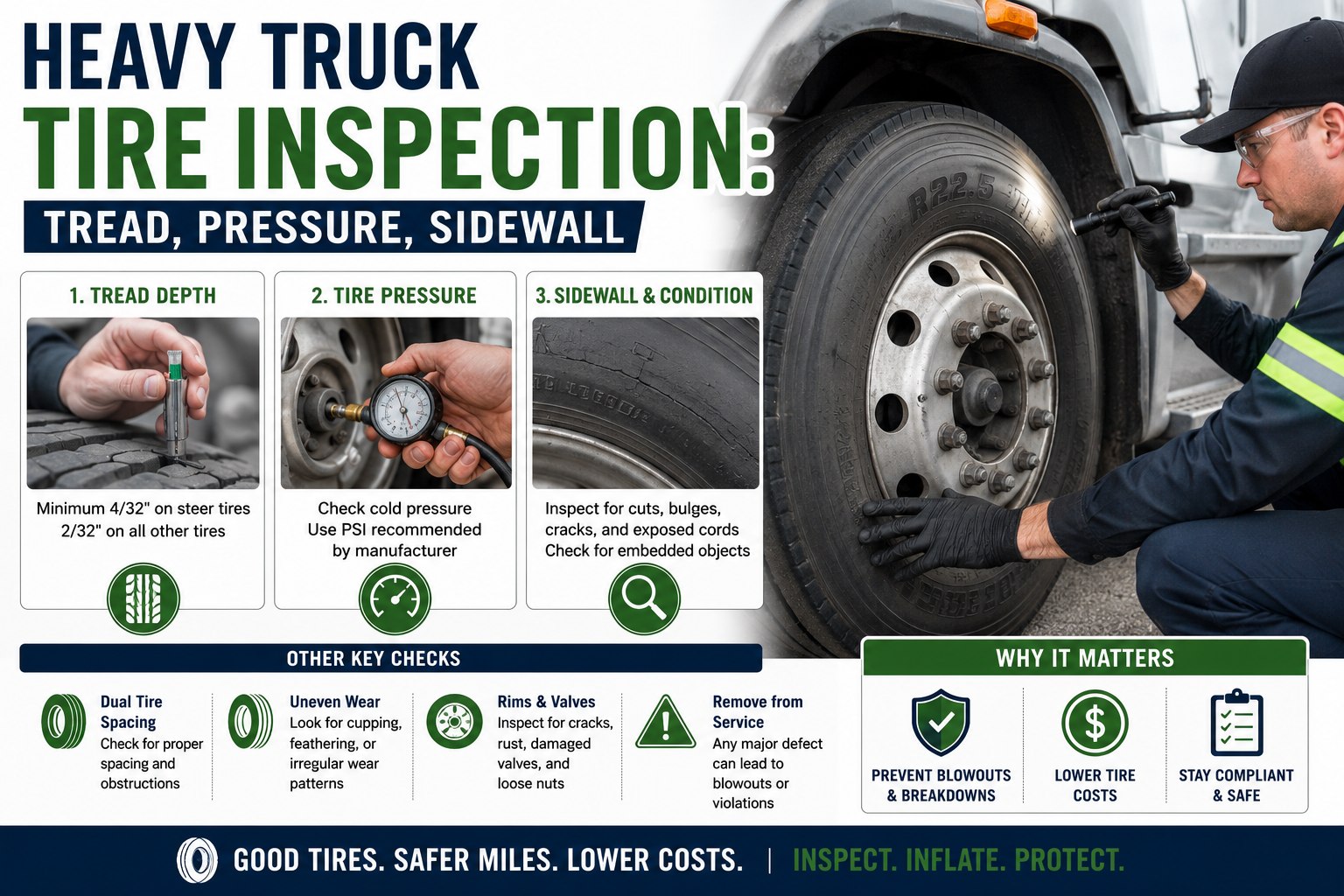
Every driver should run these seven checks on every retread tire during pre-trip inspection. Total time: 3–5 minutes for a full 18-tire tractor-trailer combination. Documented pre-trip inspection is required under FMCSA regulations and protects the fleet against CSA "Driver Observed" violations under the 2026 CSA scoring split.
Pre-trip retread inspection
7 items · 3–5 min per rigDocumented pre-trip inspection is not optional under FMCSA rules and matters even more under the 2026 CSA "Driver Observed" split, where tire defects a driver should have caught now create a distinct visible mark on carrier profiles. Book a demo to see digital pre-trip DVIRs with photo capture
Comprehensive quarterly retread inspection checklist — 7 items
Beyond driver pre-trip inspection, every retread tire deserves a comprehensive technician-led inspection quarterly (or every 25,000 miles, whichever comes first). This is where defects too subtle for pre-trip observation get caught.
Comprehensive quarterly inspection
7 items · 15–20 min per tireThe quarterly comprehensive inspection is where retread program ROI is preserved. A retread that fails on the road costs $500–$1,500 in roadside service plus potential cargo delay; the same defect caught in the yard costs a tire replacement labor charge. Start free and put quarterly retread inspections on autopilot
FMCSA rules on retread tires by axle position
Federal retread rules are simpler than most fleets realize — but industry best practice adds discipline beyond what regulation requires. Below is where retreads are legal, where they're prohibited, and where they're technically legal but not recommended.
Bus front (steer) wheels
The only federal ban on retreads in commercial motor vehicles under 49 CFR 393.75. No exceptions.
Truck steer axle
Federally permitted with load capacity ≥ 4,920 lbs. Industry best practice: use new tires on steer position for safety and steering control. Insurance underwriters increasingly discount fleets that avoid steer retreads.
Drive and trailer axles
Retreads are the standard on drive and trailer positions. Approximately 50% of all US commercial replacement tires on these positions are retreads. Same tread depth rules apply (2/32" minimum in major groove).
Every retread position decision should reference (1) the FMCSA minimum, (2) the fleet insurance underwriter's stance, and (3) the retread supplier's application guidelines. All three should align before spec'ing retreads for a position. Book a demo to see compliance-tracked tire position policy
5 mistakes fleets make with retread tire inspection
Every retread program that underperforms traces the gap to one of five recurring mistakes.
Treating retread inspection identical to new tire inspection
Driver runs the same 30-second visual on retreads that they run on new tires. Misses subtle bond line irregularities that only reveal themselves under focused inspection. First failure typically shows up as tread separation at highway speed.
Sourcing retreads from uncertified suppliers to save cost
Fleet buys retreads $30–50 cheaper from an uncertified retreader. Failure rate on those retreads runs 3–5x higher than certified-facility retreads. Real cost including roadside failures and litigation exposure runs orders of magnitude higher.
Under-inflating retreads to reduce sidewall stress
Well-intentioned driver runs retreads 5–10 PSI below spec because "the sidewall looked stressed." Under-inflation is actually the #1 accelerator of retread failure — increases heat, weakens the bond, shortens life dramatically.
Not tracking retread history per position
Retreads rotate around the fleet without lifecycle tracking. Nobody knows how many retread cycles a casing has been through, or when it was last inspected. Failure comes without warning because no baseline history exists.
Undocumented inspections that don't defend in litigation
Driver "inspects" retreads verbally at pre-trip but nothing gets written down. Tire fails on the road, causes injury accident, plaintiff attorney requests inspection records. Fleet has nothing to produce. Verdict: negligence, uncapped damages.
Every mistake above compounds silently until the first roadside failure or the first depositions in litigation reveal the documentation gap. Get the inspection discipline right the first time. Book a demo to see digital retread inspection workflow — or start free and deploy this week .
From a fleet maintenance director on the retread inspection turnaround
Our tire-related roadside events were running about 22 per year across 68 tractors, and about 70% of them were retreads — either tread separation or casing failure. We audited our program: driver pre-trip was cursory, we had no quarterly comprehensive inspection, retread supplier certification wasn't tracked, and inspection documentation was nearly nonexistent.
We rolled out this exact checklist workflow in Q2. Digital pre-trip with photo capture, quarterly technician inspection, TRIB-certified suppliers only, per-tire lifecycle records. Retread failures dropped 68% in year one. Roadside events dropped from 22 to 8. Roadside service and cargo delay costs alone recovered the whole tire program budget.
Frequently asked questions
Are retread tires safe for commercial trucks?
Yes, quality retread tires from certified retreaders are safe and legal for use on drive and trailer axles of commercial trucks — and approximately 50% of all replacement commercial tires used on US trucks in 2026 are retreads. The safety profile depends on three factors: the quality of the retreader (TRIB certification is the industry standard), the integrity of the original casing (which must be inspected before retreading), and ongoing inspection discipline throughout the retread's service life. When done properly, retreads deliver comparable safety performance to new tires at 30–50% lower cost. The most common failure modes — tread separation, sidewall bulges, exposed cord, and uneven wear — are all detectable in a proper inspection before the tire fails on the road. Airlines use retreads on aircraft tires, the US military runs retreads on its vehicle fleet, and every major US trucking fleet runs retreads on drive and trailer positions. What matters is inspection discipline and supplier quality — not whether the tire is retreaded.
Can retread tires be used on steer axles?
Federally, retread tires are permitted on the steer axle of commercial trucks under FMCSA 49 CFR 393.75, with the requirement that load capacity be at least 4,920 lbs. The only federal prohibition on retread steer tires applies to buses, where retreads on front (steer) wheels are strictly banned. However, industry best practice strongly recommends new tires for the steer position on all commercial trucks regardless of federal permission — steer tire failure has more severe control consequences than drive or trailer failure, and insurance underwriters increasingly favor fleets that avoid retreads on steer positions. The tread depth minimum for steer tires (retreaded or new) is 4/32" in any major groove, compared to 2/32" for other positions. Most professional fleets in 2026 run new tires on steer axles and retreads on drive + trailer positions — capturing the cost savings where it's operationally sensible without accepting the higher-consequence steer position risk.
How often should retread tires be inspected?
Retread tires need inspection at three cadences. First, driver pre-trip inspection on every workday — a 3–5 minute walkaround covering the 7-item checklist in this guide, focused on visible separation, sidewall condition, exposed cord, tread depth, pressure, uneven wear patterns, and dual matching. Documented pre-trip is required under FMCSA rules and matters especially under the 2026 CSA "Driver Observed" scoring changes. Second, comprehensive technician-led inspection quarterly or every 25,000 miles (whichever comes first) — a 15–20 minute per-tire deep inspection covering bond lines, casing condition, precise tread measurement, rotation history, retread age, supplier certification, and full documentation. Third, tire lifecycle review annually with the retread supplier — assessing which positions are performing well, which have higher failure rates, and whether the casing is a candidate for another retread cycle at end of service life.
What causes retread tire failure?
Retread failures trace back to a few recurring root causes. Poor original casing quality — if the casing had hidden damage that the retreader didn't detect, the retread inherits the weakness regardless of tread quality. Inadequate retread process quality — improper adhesive, incomplete curing, or bond line defects introduced during retreading. Under-inflation during service — the #1 field accelerator of retread failure, as insufficient pressure increases sidewall flex, generates heat, and weakens the bond. Overloading beyond rated capacity produces the same heat-generation problem. Excessive age — retreads over 4–5 years old start losing structural integrity even if tread depth remains legal. Impact damage from potholes, curbs, or debris that wasn't caught in pre-trip. TRIB-certified retreaders use shearography or x-ray on every casing before retreading to detect internal damage — which is why supplier certification matters as much as any single field practice.
How much money do retread tires save fleets?
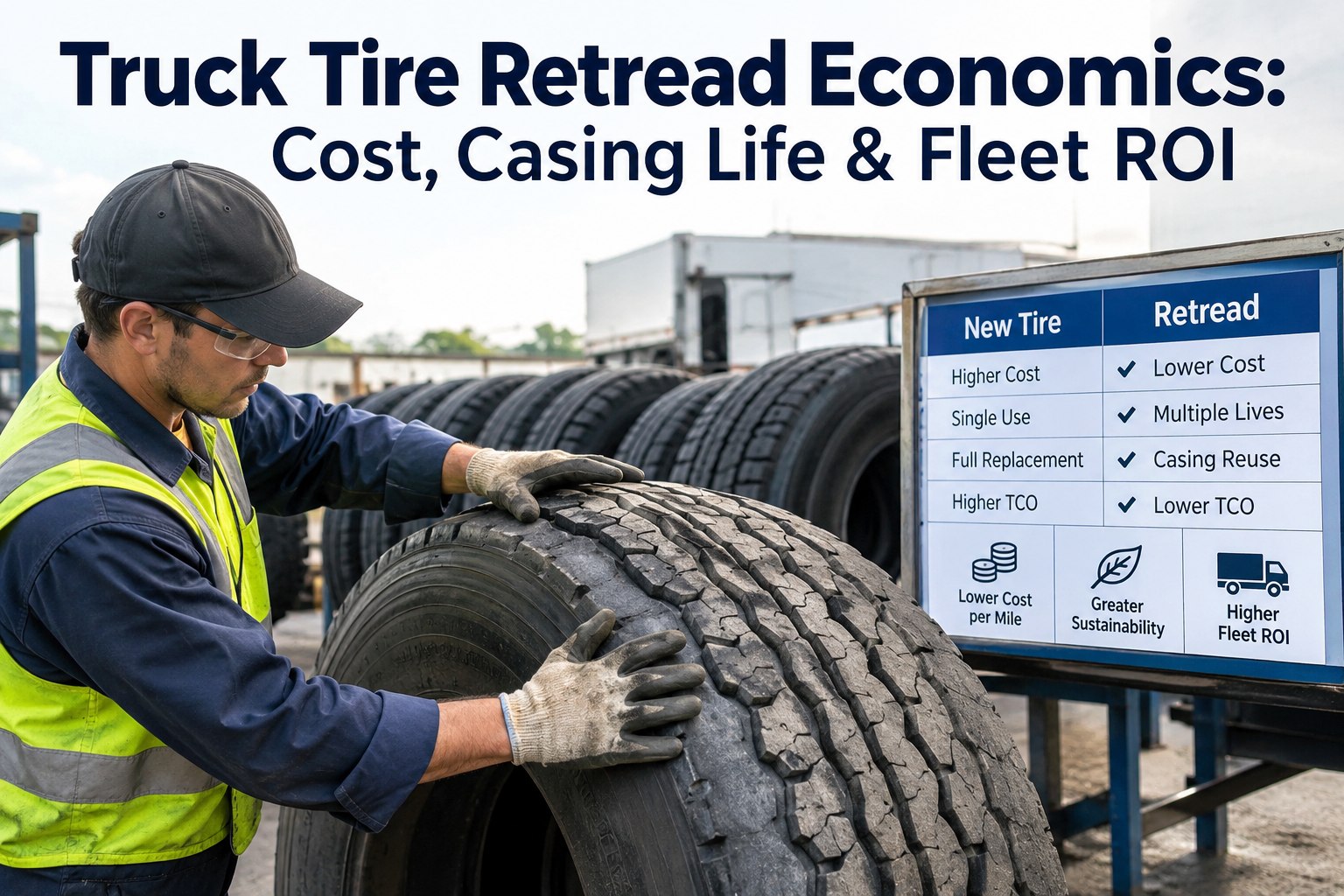
A quality retread costs $150–$300 versus $300–$600 for an equivalent new commercial truck tire — a 30–50% savings per tire. For a typical Class 8 tractor-trailer running 18 tires with retreads on the 14 non-steer positions, the savings per replacement cycle land at $2,000–$4,000. Over the truck's lifetime running multiple retread cycles per casing, total savings reach tens of thousands of dollars per vehicle. On a 50-truck fleet the annual retread savings often exceed $150,000 versus running new tires everywhere. However, those savings only materialize if inspection discipline is maintained — a single retread failure that causes a roadside blowout costs $500–$1,500 in service alone plus potential cargo delay costs, and a retread failure that causes an accident with injuries can generate liability in the six or seven figures. The economics favor retreads decisively when the inspection program keeps failure rates low.
Turn both retread inspection checklists into automated fleet workflow
HVI captures every pre-trip and quarterly retread inspection with photos, GPS, timestamp, and technician signature. Tire lifecycle records per position track rotation, retread history, defect findings, and replacement across the fleet. Live in under two weeks — tire-related roadside failures typically drop 40–60% in the first quarter.
No credit card · No hardware · Tire inspection workflow ready day one