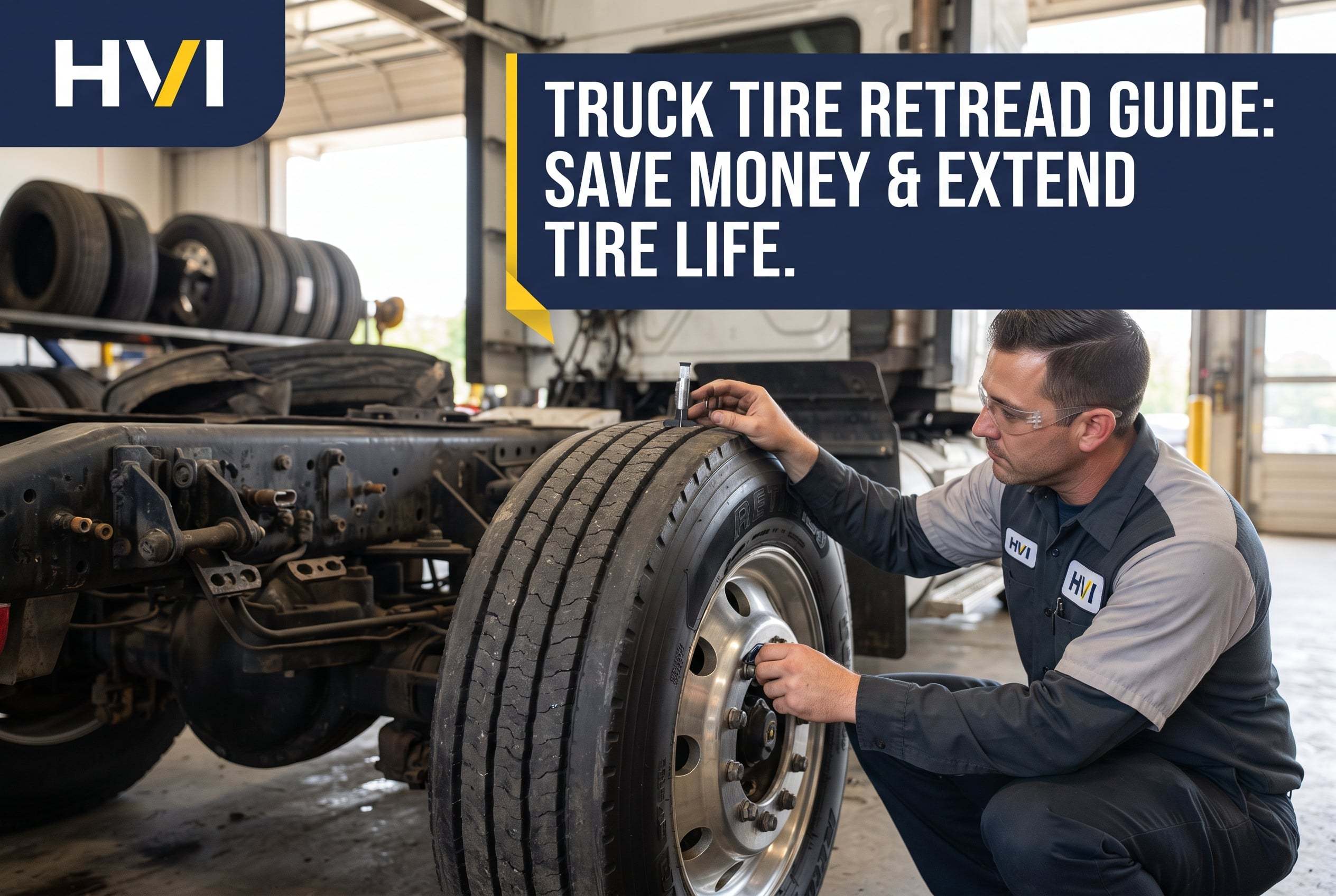
Here's the mistake that quietly costs fleets money: comparing a retread's sticker price to a new tire's sticker price and stopping there. Truck tire retread economics don't live on the purchase order — they live in cost per mile, casing life, and the one roadside blowout that can erase a season of savings. A retread is cheaper up front, almost always. Whether it's cheaper per mile depends on your casings and your discipline. This playbook shows how to evaluate retreading on lifecycle cost. Book a demo to see per-casing economics in HVI.
Truck Tire Retread Economics
The value isn't the tread — it's the casing. Here's how to know whether retreading actually lowers your cost per mile.
Tires are one of the largest operating costs a fleet carries — routinely a top-three line item behind fuel and driver wages. That's exactly why the retread question matters, and why answering it with purchase price alone leaves money on the table in both directions: some fleets overpay for new tires they didn't need, others chase cheap retreads on casings that were never going to deliver. The honest answer starts with understanding what you're actually buying when you retread.
The casing is the asset
Most of a truck tire's manufacturing cost is in the casing — the structural body of steel and rubber beneath the tread. Retreading reuses that expensive foundation and replaces only the worn tread. That single fact is the entire economic case.
Full casing cost + tread. The most expensive mile the tire will ever run.
Casing already paid for — you're buying tread and processing only.
Same casing, another life — if it was protected along the way.
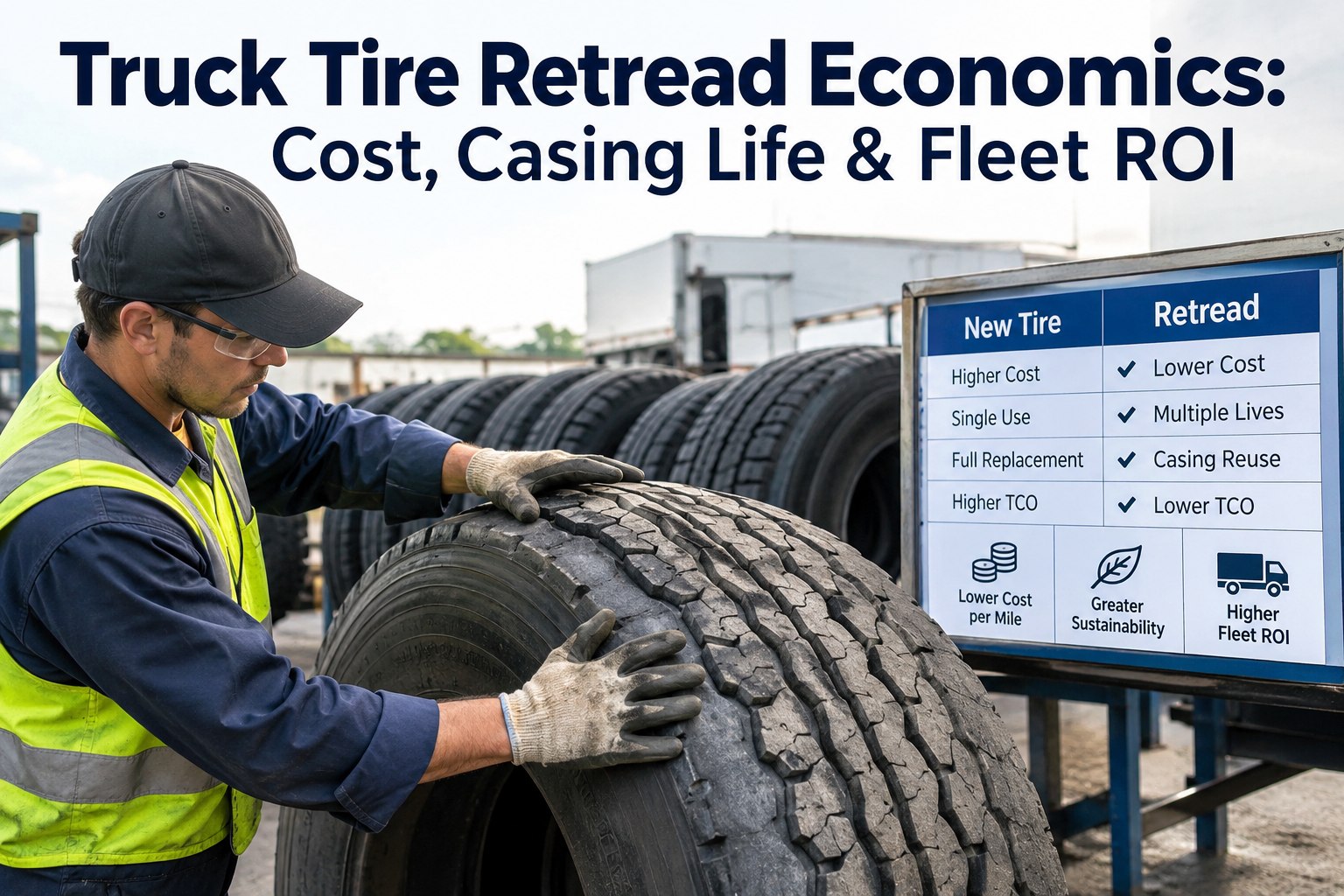
A quality retread typically costs meaningfully less than a comparable new tire — industry and retreader sources commonly cite figures in the range of 30–50% less, though the actual gap varies widely by tire size, brand, application, and casing condition. The point isn't a fixed percentage; it's that you're reusing the priciest component. Get two or three lives out of one casing and the math on cost per mile shifts hard in retreading's favor. Book a demo to track how many lives each casing actually delivers
Cost per mile is the only honest metric
Purchase price tells you what a tire costs. Cost per mile tells you what it's worth. The formula is simple, and it reframes the entire retread-vs-new debate — because a cheaper tire that delivers fewer miles can lose to a pricier one that runs longer.
"Total lifecycle cost" is where fleets get it right or wrong. It's not the retread price — it's the new-tire purchase, spread across every life the casing delivers, plus retread cost each cycle, plus inspection and processing, plus casing rejections that never made it to a second life, plus downtime exposure. Divide that whole picture by the miles actually achieved and you get a number you can compare honestly across positions, brands, and suppliers. Commercial tire operations increasingly manage the business in cents per mile, not dollars per tire, for exactly this reason. Start free on HVI to calculate real cost per mile from your own tire history.
What the ROI actually depends on
Retreading isn't automatically cheaper — it's cheaper when specific conditions hold. These are the levers that decide whether a program creates value or quietly destroys it, and every one of them is measurable.
How many of your removed casings actually pass inspection for a second life versus getting scrapped.
Your retreader's yield — the percentage of casings sent that come back as usable retreads.
Whether each life delivers the miles you expected — the denominator in every CPM calculation.
Trailer positions favor retreads heavily; steer axles almost always run new for control and safety.
One roadside failure can erase the savings from many tires — the hidden line in the equation.
Whether casings are pulled for retread at the right time, before damage makes them unretreadable.
Notice these aren't opinions — they're rates and counts. A fleet that knows its casing survival rate, its retreader's yield, and its mileage-per-life can calculate retread ROI precisely. A fleet guessing at all three is running a program on faith — which is why turning these rates into tracked, per-casing and per-retreader numbers is the first step to a program you can actually defend.
Casing preservation is the whole game
Every retread life you lose to a scrapped casing is money gone — the original tire's cost now spread across fewer miles. And casings rarely die from tread wear; they die from abuse that was preventable. These are the factors that decide whether a casing survives to be retreaded.
- Underinflation — flexes and overheats the casing, causing internal damage long before it's visible
- Overloading — stresses the structure beyond design, accelerating fatigue
- Run-flat / low-pressure running — a single event can ruin an otherwise good casing
- Road hazards & impacts — cuts, punctures, and sidewall damage past repairable limits
- Irregular wear from misalignment — uneven stress that shortens both tread and casing life
- Inflation discipline — the single biggest lever; correct pressure protects structure and fuel economy
- Load management — staying within rated capacity preserves the casing for multiple lives
- Alignment & rotation — even wear keeps the casing retreadable
- Timely removal — pulling tires before the casing is compromised, not after
- Consistent inspection — catching damage early enough to repair or reroute the casing
The connection to economics is direct: underinflation alone quietly damages the casing while also costing fuel — industry research (NACFE) associates roughly a 0.5–1.0% fuel-consumption increase for every 10 psi a tire runs low. So a neglected tire loses money twice: worse fuel now, and a dead casing later that can't take a retread. Preservation isn't a maintenance nicety; it's the input that makes the whole retread model work. Book a demo to flag underinflation before it kills a casing
The one number that erases the savings
Here's the scenario that ambushes retread math — and it has nothing to do with retread quality. A single roadside tire failure carries a cost stack that can wipe out the savings from many tires at once.
After-hours mobile service, often billed hourly with a minimum call-out.
Often bought at whatever's available, not your negotiated price.
Lost driver hours and delayed freight while the truck sits.
Late loads, missed appointments, knock-on dispatch disruption.
Depending on location, timing, and freight, a single incident can run into the high hundreds or beyond once every line is added — enough to erase the per-tire savings from a whole set of retreads. And critically, an NHTSA-sponsored study found new and retread tires are equally vulnerable to failure; road hazards and underinflation are the real causes, not the retread itself. That flips the usual worry: the threat to retread ROI isn't retread quality, it's the unmanaged conditions that strand any tire. Managing those conditions — the wear, pressure, and alignment issues that strand any tire — is what protects the savings a retread program is supposed to deliver.
A position-based strategy usually wins
The best-run fleets rarely choose "all new" or "all retread." They match the tire to the position, because the economics and safety priorities differ across the truck. This hybrid approach is the practical playbook most structured programs land on.
Control, handling, and safety take priority. Fleet policy almost universally runs new tires on steers, not retreads.
A balance based on casing quality and application — strong retread candidates once casings are proven.
Lower-stress position where retreads deliver most of their cost advantage across the fleet.
This is why "should I retread?" is the wrong question. The right one is "which positions, on which casings, at what cost per mile?" — and that's answerable only with position-level and casing-level history. A blanket policy in either direction leaves value on the table. Start free and evaluate retread performance position by position across your fleet.
From a tire manager who ran the real numbers
For years we judged retreads by the invoice — cheaper than new, so we ran them everywhere and felt smart. Then we started tracking cost per mile by position and casing, and the picture completely changed. Our trailer retreads were a bargain. But on one drive-tire brand, the casings kept failing inspection at the second life, so our "cheap" retreads were actually expensive per mile once you counted the scrapped casings.
We'd been flying blind on the number that mattered. Once we could see casing survival and miles per life, we changed which casings we saved and which brands we bought new. Same trucks, better spend — just from finally measuring the right thing.
Why this is a fleet-data problem
Every number in this playbook — cost per mile, casing survival, retread yield, miles per life — requires following individual tires and casings through their whole lifecycle. That's impossible on paper across a fleet, and it's exactly where a system changes the game.
Every mount, position change, and rotation logged per tire and casing.
Miles accumulated and tread measured over time — the basis for cost per mile.
Repairs, casing inspections, retread cycles, and rejections captured per unit.
Where spend is rising, which brands retread best, and each casing's final outcome.
With that history in place, the retread decision stops being a philosophy and becomes a calculation. You can see which casing brands survive to a second and third life, which positions justify retreads, where tire spend is climbing, and whether last year's program change actually paid off. That's the shift from buying tires on price to managing tires on cost per mile. Book a demo to turn your tire history into retread-program ROI you can measure
Retreads aren't cheaper — good casings are
The honest answer to "are truck tire retreads worth it?" is: it depends, and the things it depends on are all measurable. Truck tire retread economics come down to reusing the casing — the most expensive part of the tire — across multiple lives, which lowers cost per mile if the casing survives, the retread delivers its expected mileage, and a roadside failure doesn't erase the savings. Compare acquisition prices and retreading looks like an easy win; compare lifecycle cost per mile and the real winners and losers emerge, often varying by position, casing brand, and how well the fleet preserves its casings.
That's why the strongest tire programs aren't built on a retread policy — they're built on tire data. When you track each casing's lifecycle, survival rate, mileage, and true cost per mile, you can prove where retreading creates value and where it doesn't, position by position. HVI is built to be that layer: per-tire and per-casing history, maintenance and cost tracking, and the analytics to see where tire spend is rising and whether your retread program is actually earning its keep. Always validate assumptions against current market pricing and your own casing data, since tire economics vary widely. Book a demo to see how HVI tracks fleet tire costs and maintenance.
Frequently asked questions
Are truck tire retreads actually cheaper than new tires?
Up front, almost always — a quality retread commonly costs meaningfully less than a comparable new tire, with industry and retreader sources frequently citing figures in the range of 30 to 50 percent less, though the actual gap varies significantly by tire size, brand, application, and casing condition. But acquisition price isn't the real measure. What determines whether a retread is genuinely cheaper is cost per mile: the total lifecycle cost of the tire divided by the miles it actually delivers. A retread wins on cost per mile when the casing is sound and it achieves its expected mileage, because you're reusing the casing — the most expensive part of the tire — instead of buying it again. It can lose when casings fail inspection early, when mileage falls short, or when a roadside failure adds emergency service and downtime costs. So retreads are usually cheaper to buy, but whether they're cheaper to run depends on your casings, your maintenance discipline, and the position they're used in.
How many times can a truck tire casing be retreaded?
A well-maintained commercial truck tire casing can typically be retreaded multiple times. Industry references, including data cited from USTMA and OOIDA, put the average at roughly two to three retread lives per casing, and some manufacturers estimate premium casings average around two retreads. High-tier commercial tires are engineered from the start to be retreaded, which is why the casing is treated as a reusable asset rather than a disposable part. The key qualifier is "well-maintained": the number of lives a casing actually delivers depends heavily on how it was treated during service. Underinflation, overloading, run-flat events, impact damage, and irregular wear from misalignment can all end a casing's retread potential early — sometimes after zero additional lives. Casings that are kept properly inflated, loaded within spec, aligned, and inspected regularly are far more likely to reach their full retread potential. Because each additional life spreads the original casing cost across more miles, protecting casings to reach two or three lives is central to retread economics.
How do I calculate cost per mile for tires?
Cost per mile is the total lifecycle cost of a tire divided by the total miles it delivers. The critical part is defining "total lifecycle cost" correctly. It isn't just the retread price or the new-tire price in isolation — it's the new-tire purchase spread across every life the casing provides, plus the cost of each retread cycle, plus inspection and processing costs, plus the value of casings that were scrapped before reaching a second life, and ideally an allowance for downtime exposure. You then divide that complete cost by the miles actually achieved across all lives. Doing this properly lets you compare retread and new tires honestly, and compare brands, retreaders, and wheel positions on the same basis. A cheaper tire that delivers fewer miles can have a higher cost per mile than a more expensive tire that runs longer, which is exactly why purchase price alone is misleading. The challenge is that accurate cost per mile requires tracking each tire and casing's cost and mileage through its whole lifecycle, which is why fleets increasingly rely on tire-tracking systems rather than spreadsheets or memory.
Should retreads go on the steer axle?
In practice, no. While federal regulation prohibits retreads on the steer axle of buses specifically, and technically permits them on truck steer positions only under a limited load-capacity condition, virtually all fleet policies prohibit retreads on steer tires as a matter of safety and control. The steer axle governs handling, stability, and directional control, and fleets almost universally run new premium tires there. The economics of retreading are realized on the other positions: drive axles typically run a mix of new and retread depending on casing quality and application, and trailer positions are where fleets maximize retread usage because the lower-stress environment lets retreads deliver most of their cost advantage. This position-based approach — new on steers, mixed on drives, retreads maximized on trailers — is the strategy most structured tire programs converge on, because it matches each position's safety priorities and economics rather than applying one blanket rule to the whole truck. Always follow current regulations and your own fleet safety policy.
How can fleet software improve tire retread ROI?
Every metric that determines retread ROI — cost per mile, casing survival rate, retread yield, and miles achieved per life — depends on following individual tires and casings through their entire lifecycle, which is impractical to do on paper across a fleet. A platform like HVI improves retread economics by making that tracking systematic: recording each tire's installation, position changes, mileage, tread measurements, repairs, casing inspections, retread cycles, rejections, and final disposition, along with the associated costs. With that history, maintenance teams can calculate true cost per mile by position and by casing brand, see which casings survive to a second or third life versus which get scrapped early, identify where tire spend is rising, and measure whether a change to the retread program actually improved the numbers. It also surfaces the upstream issues — like underinflation and irregular wear — that quietly destroy casings and cause roadside failures, so they can be fixed before they erase retread savings. The result is that the retread decision becomes a measurable calculation per position and per casing rather than a blanket policy based on purchase price, letting fleets put retreads exactly where they create value and buy new where they don't.
See whether your retread program actually pays
HVI tracks each tire and casing through its full lifecycle — install, position, mileage, tread, repairs, retread status, cost, and final scrap — so you can calculate real cost per mile, spot casings that die early, and prove where retreading creates value. Turn tire spend from a guess into a measured number. Mobile-first for the yard and the shop, live in under two weeks.
No credit card · Per-casing tire & cost tracking · Retread-program analytics on day one