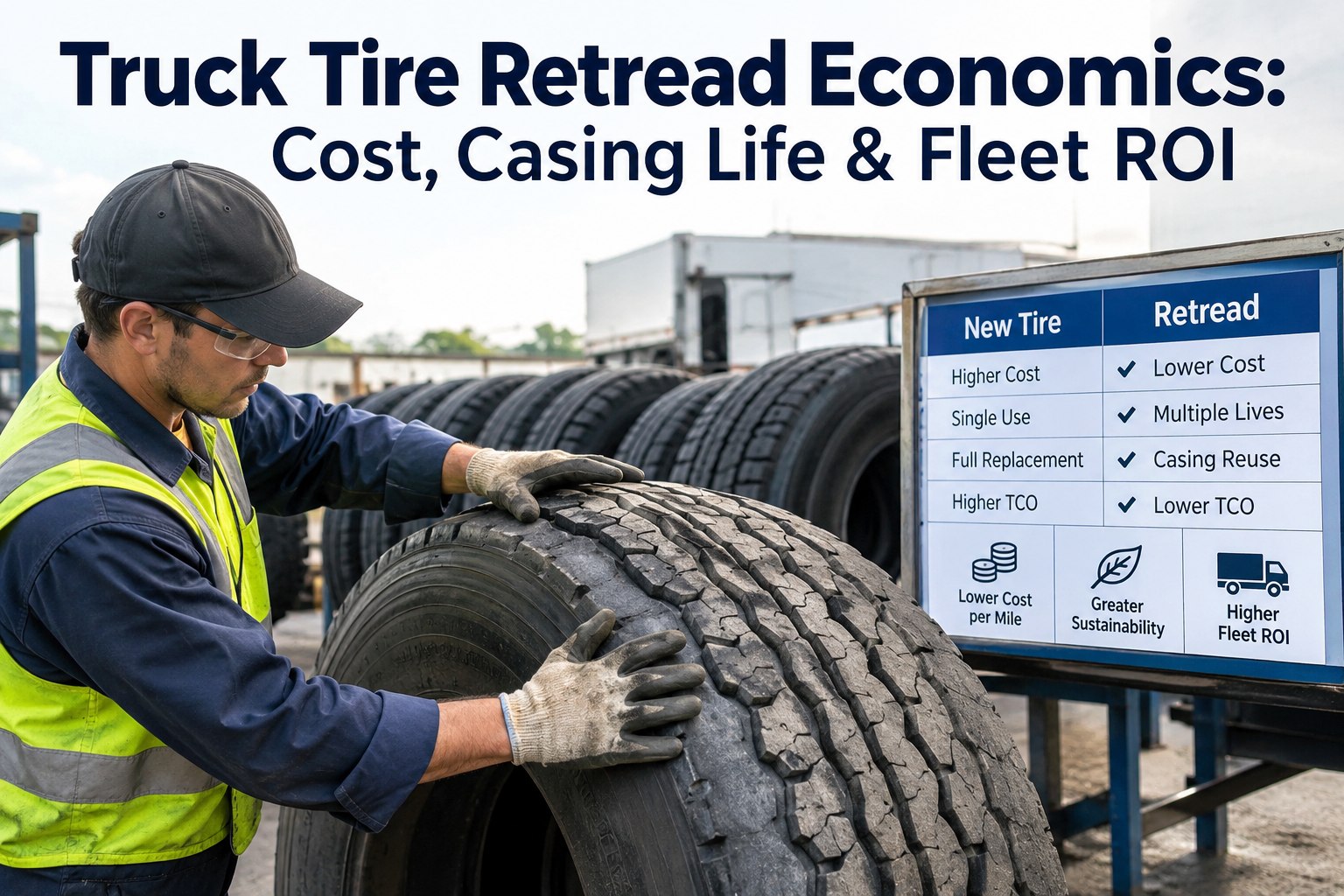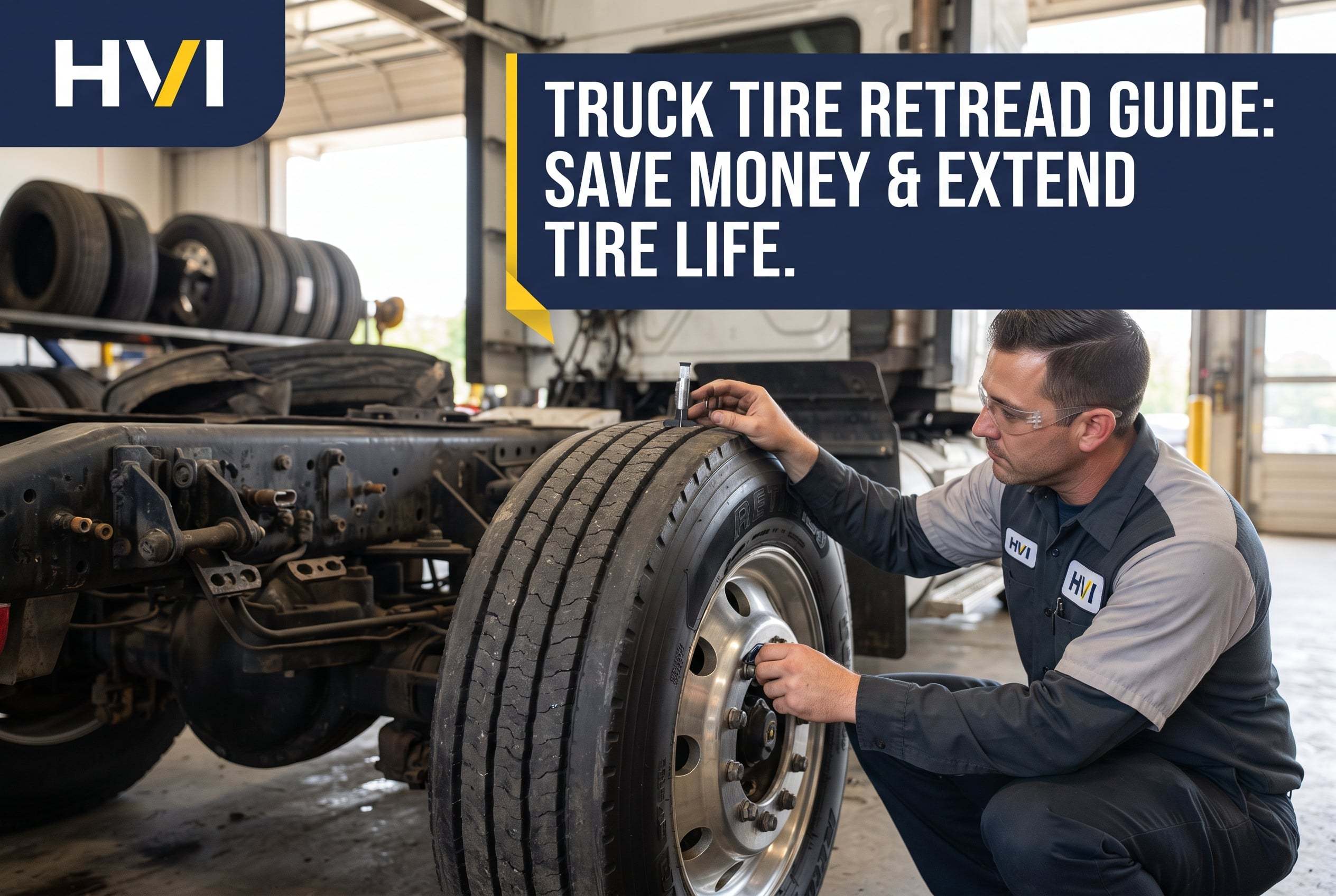
A truck tire casing is worth roughly $600 new, $95 as a scrap credit, and up to $1,800 if you retread it twice before it dies. That $1,700 spread per casing is the entire retread economics conversation. This truck tire retread guide isn't another comparison of retread vs new tires — that debate has been settled: 44% of commercial replacement tires in North America are retreads, 90% of large fleets use them, and the industry saves $3 billion a year doing it. What actually decides whether your specific fleet captures that value is casing management: whether your daily inspection habits, inflation discipline, and pull-point timing keep casings retreadable through 2–3 generations — or send them to scrap after one run. This is the operational playbook that decides which side of the math you land on. Book a demo to see casing lifecycle tracking built into a mobile DVIR.
The Truck Tire Retread Guide
One premium casing. Three tire lives. Or one casing that goes to scrap after 100,000 miles because nobody watched the pressure. This is the operator playbook that decides which one you get.
- New tire $600 Premium casing
- Retread 1 $250 150K+ miles
- Retread 2 $200 Trailer position
The reason retreads work is that most of a tire's manufacturing cost is in the casing — the body, belts, and steel cords that carry the load. The tread that touches the road is the cheap part. A retread reuses the expensive part at a fraction of a new tire's price. Which means the real skill in fleet tire management isn't choosing between retread and new — it's keeping casings healthy enough to earn a second and third life. Here's the numbers, then the playbook.
The retread math — four numbers that shape everything
These are the industry benchmarks fleet managers should know before running a single tire program calculation. Every one of them affects how you spec, inspect, and pull tires.
- 44% of commercial replacement tires in North America are retreads — not a niche choice
- $3B Annual industry savings from retreading — Bridgestone/Bandag data
- 30-50% Cost savings per retread vs. new tire — $150-$250 vs $400-$600+
- 2-3× Retread cycles a quality casing supports when maintained properly
FedEx, UPS, and Schneider National run retreads as standard practice on drive and trailer positions. That's not cost-cutting — it's operational discipline. What separates their outcomes from a fleet that sends casings to scrap after one run is casing management, not tire selection. See casing lifecycle tracking in a demo
The 5 casing killers — what sends a $600 casing to scrap
A retread plant will only process casings that pass inspection. Reject rates at quality shops sit at 15-25% — too low means they aren't inspecting rigorously. Every rejected casing is real money burned. Here are the five conditions that produce nearly all the rejections.
Chronic underinflation
The single largest casing killer. Running 10-20% below spec generates internal heat that separates belts, cracks liners, and destroys the casing structurally from the inside. It looks fine externally — the retread plant's shearography sees the delamination and rejects. Prevention: daily gauge check, TPMS on long-haul, pressure logged on every DVIR.
Severe sidewall damage
Curbing, deep cuts, and impact fractures kill the casing. Any exposed cord or belt material is automatic rejection. Sidewall bulges indicate internal structural failure — casing goes to scrap regardless of age. Prevention: operator training on curb approach, sidewall visual on every walk-around, photo capture of any damage.
Run-flat operation
Even briefly driving on a flat destroys the casing internally. The sidewall folds under load and the reinforcement crushes. Casing looks recoverable after re-inflation; the retread plant catches the internal damage. Prevention: driver-training that says "pull over" not "just get to the exit," TPMS with low-pressure alerts.
Chronic overload
Load ratings exist for a reason. Sustained overloading (even 10-15% over rating) accelerates casing fatigue, breaks belt bonds, and shortens retread eligibility. Common on last-mile and construction operations. Prevention: weight compliance discipline, correct load-range spec on the tire in the first place.
Casing age
Most quality retread plants cap casings at 5-7 years from DOT date code, regardless of tread condition. Rubber compounds degrade with UV, ozone, and thermal cycling even when parked. Prevention: track DOT date codes at intake, retread quickly rather than sitting on casings, don't buy stale used casings without provenance.
Every one of the five is preventable with routine discipline. And every one of them is visible on a photo-verified digital DVIR before it kills the casing. Start free and get casing-inspection prompts built in
The retreadability decision matrix
Not every worn tire deserves a retread attempt. This is the four-state framework a shop technician (or a well-trained driver at pull) uses to decide whether the casing goes to the retreader, gets a repair first, gets scrapped for the credit, or gets pulled early to preserve future value.
-
Sound
Send to retreader Even wear, no sidewall damage, no exposed cord, in DOT date-code window. Expect $50-$100+ casing credit if selling; $250 retread if reusing.
-
Repairable
Repair, then retread Small tread punctures within repair limits (nail hole under 3/8″, in the tread crown only). Section repair, then to retread plant. Sidewall repairs are not permitted on any tire.
-
Marginal
Scrap for credit Age past 5-7 years, minor structural concerns, or irregular wear that indicates alignment issues. Premium brand-name casing = up to $95 scrap credit. Take the credit, don't gamble on rejection.
-
Failed
Scrap, root-cause investigation Run-flat damage, sidewall cut through cord, chronic underinflation signs, or belt separation. Scrap the tire, and investigate what killed it — because the pattern will repeat across the fleet if not fixed.
The trap most fleets fall into is running "marginal" casings all the way to failure trying to squeeze one more mile. That trades $95 of guaranteed credit for a coin flip on a $250 retread — and a roadside call if it fails first. Pull early, take the money. Book a demo — see the pull-point decisions logged automatically
The 4 daily habits that add a retread
The distance between a casing that earns 2 retreads and one that gets scrapped is not luck — it's four routine habits. None of them are difficult. All of them require consistency, which is the actual differentiator.
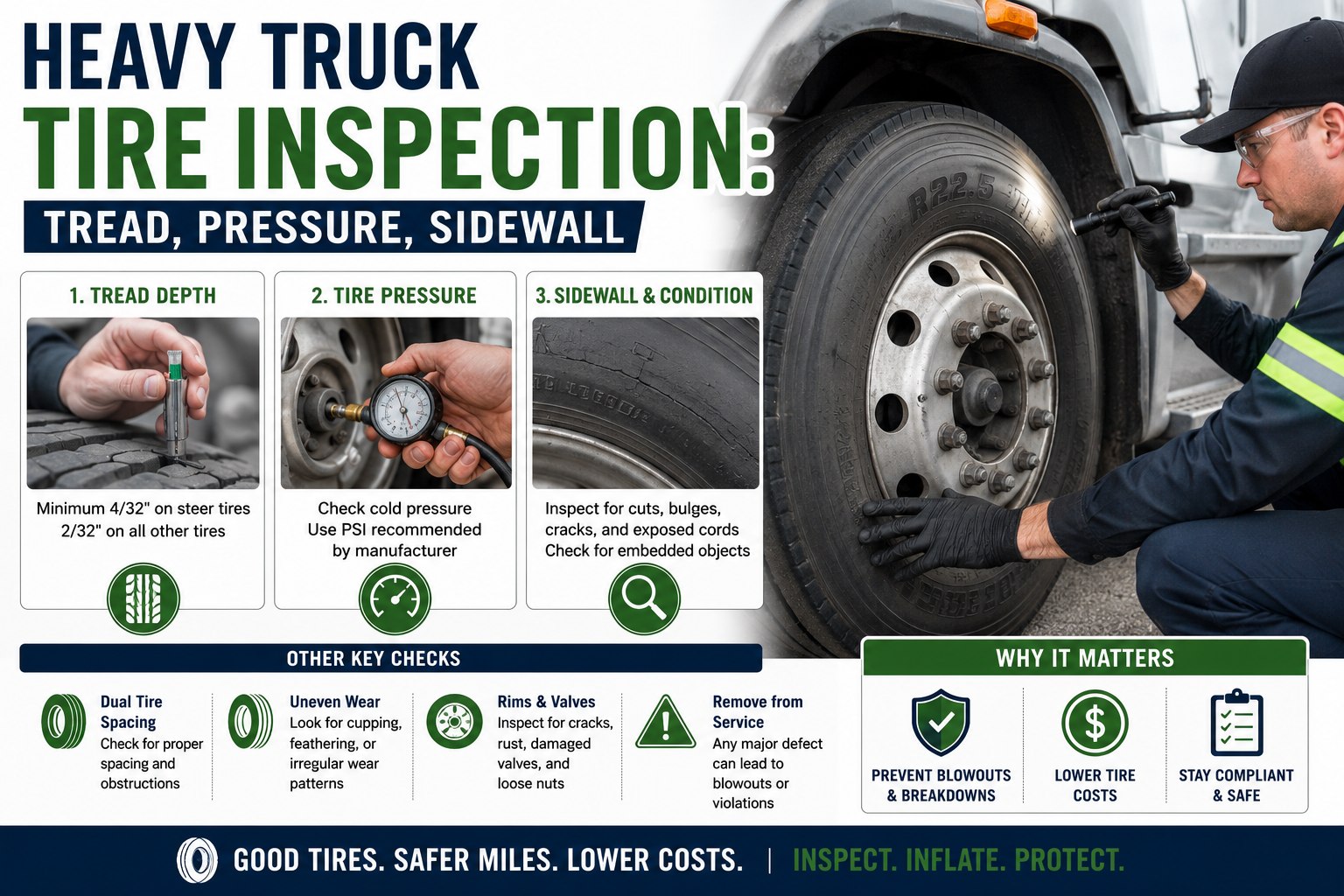
Pressure check with a gauge, daily
Not by eye, not by kick. A calibrated gauge on every tire, every shift, logged on the DVIR. A tire underinflated by just 20% loses roughly 25% of its tread life and destroys retread eligibility. This is the single highest-leverage tire habit.
Rotate on schedule, not by feel
Position-based wear is inevitable; ignoring it turns even wear into cupping and feathering, which retreaders reject. Rotate drive and trailer positions on the OEM interval (typically every 25,000-50,000 miles) or on wear-rate divergence, whichever comes first.
Pull at the retread point, not the failure point
Standard industry pull point is 4/32″ on steers, 2-4/32″ on drive and trailer. Running tires to legal DOT minimum (2/32″ steer, 1/32″ other) leaves nothing for retread — the buffer is gone, the casing may be compromised. Pull with tread to spare and preserve the casing.
Track every casing by DOT date code
Barcode or RFID at purchase. Log every position change, tread measurement, retread generation, and removal reason. The dataset tells you which brands retread best in your operation, which routes chew casings fastest, and when to pull. Guesswork is what leaves the retread savings on the table.
Four habits, done consistently across a 50-truck fleet, produce the 3-5% total operating cost reduction the top-tier fleets consistently show. Digital tire tracking typically delivers 300-500% ROI in year one. Start free and start tracking casings today
Position strategy — where retreads earn their keep
Not every axle is equal for retread economics. The industry consensus, adopted by every major fleet running retreads at scale, is a position-based strategy. Here is how it lands.
-
Steer axle New tires
Safety-critical position. Federal regulation (49 CFR 393.75) permits retreads under 4,920 lb load capacity, but industry practice is universal: new premium tires only. The retread savings don't outweigh the steering-control risk.
-
Drive axles New or retread by duty cycle
Depends on operation. Long-haul, predictable lanes = retreads perform well. Stop-and-go or high-torque applications = new tires often make sense. Casing quality on the first cycle sets up the second retread economics.
-
Trailer axles Retreads default
Where the money is. Trailer tires only carry load — no steering, no torque. Retreads perform indistinguishably from new tires here, at 40-60% less cost. Most large fleets run retreads exclusively in trailer position.
-
Bus steer axles Prohibited
49 CFR 393.75 explicitly prohibits retreads on the steer axle of any bus, regardless of load capacity. Not a policy choice — federal law. All other bus positions may use retreads.
A blended strategy — new on steer, mixed on drive by application, retreads on trailer — is what every major fleet running retreads at scale uses. That's not tradition; it's optimization. Book a demo to see position strategy applied to your fleet
From a fleet manager who redesigned the tire program
We were burning through casings. Buying new tires every cycle. I thought we had a retread problem — turned out we had a pressure problem. Nobody was gauging tires daily. Everyone kicked and drove.
We put HVI on every driver's phone, made pressure a required field on the pre-trip, and required a photo of the gauge reading if it was under spec. Six months in, our first-retread success rate went from about 40% to 78%. We're now averaging 2.1 retreads per drive casing. On 44 tractors, that's roughly $58,000 a year we're not spending on new rubber. Same tires. Same routes. Different habit.
Frequently asked questions
Are retread tires safe for commercial trucks?
Yes. The NHTSA-sponsored University of Michigan study, which collected 86,000+ pounds of tire debris across five states, concluded that new tires and retread tires are equally vulnerable to failure. The leading causes of tire failure across both categories are road hazards (32%), maintenance and operational factors (30%), and underinflation (14%) — not the retread process itself. Quality retreads produced by certified plants using shearography inspection, computerized buffing, and factory-grade vulcanization meet or exceed DOT safety standards. This is why 44% of commercial replacement tires in North America are retreads, and why 90% of large fleets — including FedEx, UPS, and Schneider National — run retreads as standard practice on drive and trailer positions. The safety concern with retreads is not the process; it is casing quality going in and inspection rigor at the retread plant. A certified retreader with a 15-25% casing rejection rate is applying real inspection standards. A shop that accepts everything is not.
How much can a fleet save by retreading tires?
Retreads cost 30-50% less than new tires — typically $150-$250 per retread versus $400-$600+ per new tire. For a tractor-trailer with 14 retreadable drive and trailer positions, that's approximately $3,500 in savings per recapping cycle. Over 2-3 retread generations per casing, total lifetime savings reach $7,000-$10,500 per truck. Across a 50-truck fleet, structured tire management with proper retread utilization typically reduces total operating costs by 3-5% — which translates to $75,000-$150,000 annually. The industry-wide savings from retreading are approximately $3 billion per year, according to Bridgestone/Bandag data. The exact savings depend on operation type, route profile, casing quality, and, most importantly, how well the fleet manages casing preservation through daily inflation discipline, proper rotation, and correct pull-point timing. Fleets that skip those habits leave most of the savings on the table because their casings never earn a second retread.
How many times can a truck tire casing be retreaded?
Most quality commercial tire casings support 2-3 retreads when properly maintained; premium casings from top-tier brands can occasionally support 4 or more. The number depends on casing brand and model, operating conditions, maintenance discipline, and retread process quality. Each retread saves 30-50% versus buying a new tire, so the difference between one retread and three retreads on a casing is worth several hundred dollars in savings per position. Casing preservation is what determines how many retread generations you get. The five conditions that end casing life early are chronic underinflation (running 10-20% below spec generates internal heat that separates belts), severe sidewall damage from curbing or impacts, run-flat operation (even briefly driving on a flat destroys internal structure), sustained overloading, and casing age beyond 5-7 years from the DOT date code. Fleets that catch and prevent these consistently earn multiple retreads per casing; fleets that don't watch pressure or ignore sidewall damage typically get one retread if they're lucky.
Are retreads legal on steer axles?
On trucks and tractors, retread tires are technically legal on steer axles under 49 CFR 393.75 if the tire's load capacity does not exceed 4,920 pounds. On buses, retreads are explicitly prohibited on the steer axle regardless of load capacity — that's federal law, not a policy choice. In practice, virtually all commercial fleet policies prohibit retreads on truck steer axles as well, because the safety-critical role of the steer position doesn't justify the retread savings. Industry-standard practice is new premium tires on steer axles across the entire fleet, with retreads focused on drive and trailer positions where the economics work without adding steering-control risk. Where the savings really live is trailer position, where retreads perform indistinguishably from new tires because the tire only carries load — no steering input, no drive torque. Most large fleets run retreads exclusively in trailer positions and blend new-with-retread on drive positions by duty cycle.
What makes a casing pass or fail retread inspection?
A certified retread plant inspects each casing with visual examination and shearography (an ultrasound-like technique that detects internal separations invisible to the eye) before it's processed. Common rejection reasons include: chronic underinflation or run-flat damage that has separated the belt structure from the casing, severe curbing or sidewall cuts, exposed cord or belt material through tread or sidewall, chronic overload evidence (belt distortion, sidewall flexing patterns), tread punctures outside the repairable zone or above the size limit (typically 3/8 inch in the crown), sidewall repairs of any kind (never permitted), and casing age beyond the plant's DOT date-code limit (typically 5-7 years). A quality retreader rejects 15-25% of casings — a rejection rate significantly lower than that is a red flag that the plant is not inspecting rigorously. Every rejected casing represents real money lost, which is why the daily habits that prevent underinflation, curbing, and run-flat operation are the highest-value tire management activities a fleet can perform.
Track every casing from purchase through third retread
HVI turns tire inspection into a data-generating asset workflow: pressure captured, tread depth logged, sidewall photos automatic, DOT date codes tracked, retread generations counted, and cost-per-mile by position ready for renewal negotiations. Live on your fleet in under two weeks — and the retread ROI starts paying back on the next tire cycle.
No credit card · No hardware · Casing tracking on every DVIR