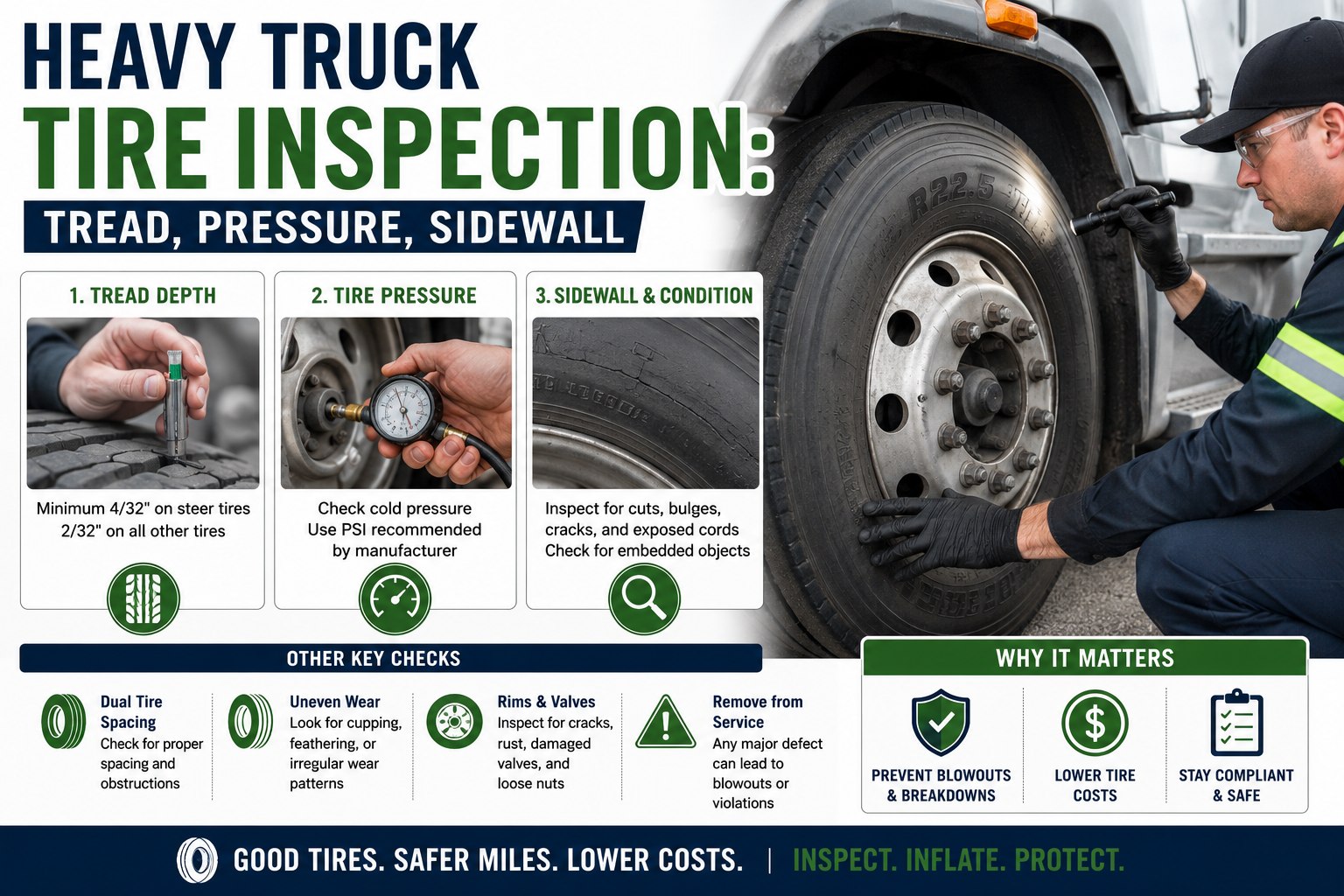
You are twenty miles from the delivery stop when the steer axle starts wandering. A hiss turns into a thump, and suddenly you are calling for a roadside service truck instead of backing into a dock. Tire failures rarely happen without warning, but the warnings are easy to miss when your inspection relies on a quick glance instead of a gauge. A proper heavy truck tire inspection catches the 3/32-inch lining, the slow leaker, and the sidewall bubble before they become a roadside out-of-service order or a catastrophic blowout. Tires represent 10 to 15 percent of a fleet's total operating cost, and skipping the physical measurements is the fastest way to inflate that number. Move your tire checks online with HVI to stop guessing and start measuring.
Heavy Truck Tire Inspection: Tread, Pressure, and Sidewall Guide
The exact gauge-based inspection routine, legal minimums, and out-of-service triggers every Fleet Manager and technician needs to catch tire defects before the DOT does.
- AxleSteer (L/R)
- Tread Depth6/32 in (Pass)
- Cold PSI110 psi
- SidewallNo defects
- Inner DualChecked
- ResultIn Service
- ~21%
of vehicle out-of-service violations during Roadcheck are tire-related
CVSA International Roadcheck data - Over 50%
of roadside breakdowns are attributed directly to tire failure
Industry fleet maintenance reports - 4/32 in
minimum tread depth required on steer axles (2/32 in elsewhere)
49 CFR 393.75 - 10-15%
of total fleet operating costs are consumed by tires and fuel impact
ATRI operational cost data
The core tire inspection checklist
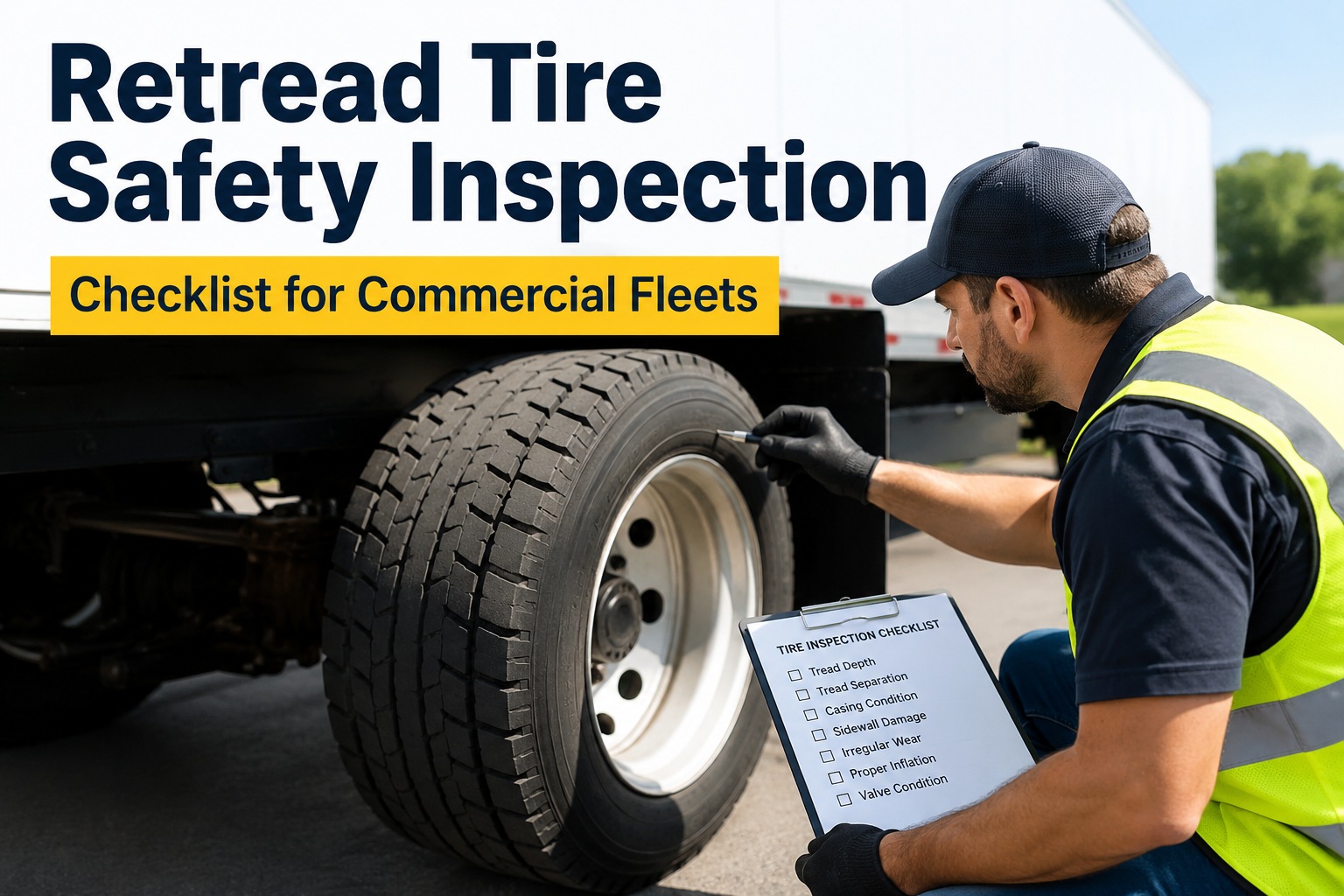
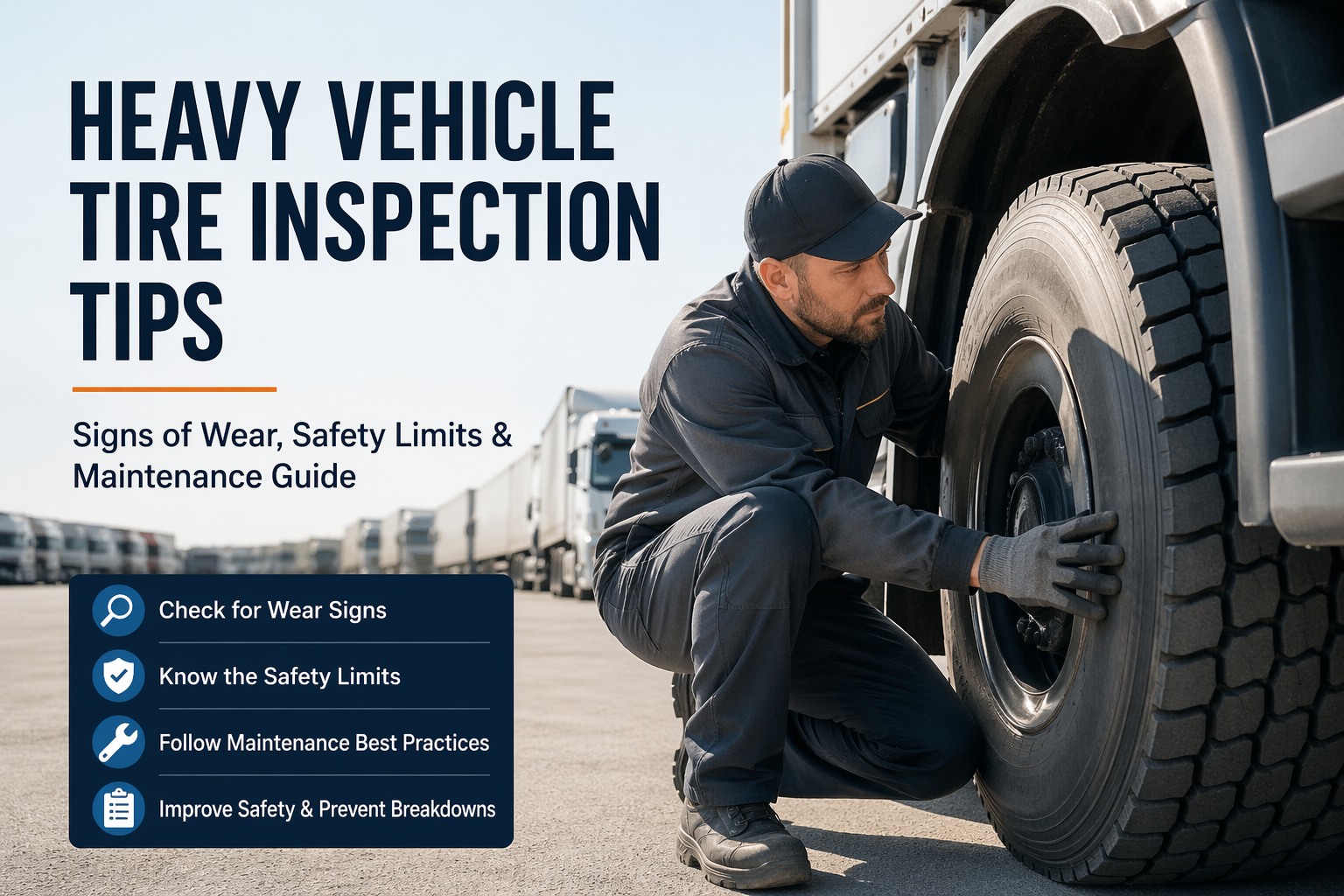
A visual once-over is not a tire inspection. To actually catch defects before they become violations or blowouts, your technicians need a structured, gauge-based workflow. Visual tread estimation is the top reason violations get missed, because a tire sitting at 3/32 inch on a steer axle looks perfectly fine to the naked eye but is already illegal. Every heavy truck tire inspection must lock in four specific data points before a unit leaves the yard.
Tread Depth Measurement
Measure at the lowest point in a major groove, not the highest rib. A proper tread depth gauge gives you an exact reading. Anything at 4/32 inch on a steer or 2/32 inch on a drive/trailer is an immediate fail.
Cold Inflation Pressure
Check pressure before the truck has moved. Compare the reading to the placard spec, not the sidewall max. A tire 20% under-inflated burns more fuel and fails structurally long before it looks flat.
Sidewall Condition
Inspect both the outer and inner faces of every tire. Look for cuts, cracks, bulges, or exposed cords. A sidewall bubble means the body ply has failed and the tire must come off immediately.
Inner Dual & Matching
Pull the tap or use a camera to check the inner dual. Ensure tires on the same dual assembly are within 5 PSI of each other and that diameters are matched to prevent rapid wear on the smaller tire.
Expert view from the shop floor
"The inner dual is where we kept getting burned. A driver does their walkaround, sees the outer tire looks fine, and heads out. But the inner tire had a slow leak and dropped to 40 PSI. By the time they hit the scale, the casing was shredded. We don't do paper DVIRs anymore. Every tire gets a gauge number logged into the app now, or the truck doesn't move.
-- Marcus S., Fleet Maintenance Manager, regional reefer carrier
Tread depth and pressure: the legal and financial line
The difference between a passing tire and a violation often comes down to a fraction of an inch. Federal law under 49 CFR 393.75 is strict: any tire on a steering axle must have at least 4/32 inch of tread depth in a major groove. Drive and trailer tires can run down to 2/32 inch, but pushing them that far is a false economy. Tread depth directly impacts traction, heat dissipation, and your ability to stop in the rain.
Pressure is just as critical. A tire that is 20% under-inflated will lose roughly 10% of its tread life and increase rolling resistance enough to impact your fuel economy. Since tires and fuel are your two highest variable costs, ignoring a 10 PSI drop is literally burning money. You can see how HVI tracks pressure trends over time by booking a demo, but the baseline rule is simple: if the gauge reading does not match the placard, the tire gets flagged before the truck leaves the gate.
| Tire Position | Min Tread Depth | Target Cold PSI | Out-of-Service Trigger |
|---|---|---|---|
| Steer Axle | 4/32 inch | Per placard (typically 100-110) | Below 4/32 or exposed cord |
| Drive Axle | 2/32 inch | Per placard (typically 85-100) | Below 2/32 or flat spot |
| Trailer Axle | 2/32 inch | Per placard (typically 90-105) | Below 2/32 or separation |
| All Positions | N/A | Match to placard | Inflation below 50% of max |
Sidewall inspection and immediate out-of-service triggers
Sidewalls take the brunt of curb strikes, potholes, and road debris. A tire can look perfect on the tread face but be ready to fail because the internal structure is compromised. During your sidewall inspection, you are looking for any break in the continuity of the rubber. Cuts that expose body ply cords, impact bulges (often called "zipper breaks" on steer tires), and localized swelling are all signs that the tire's structural integrity is gone.
There is no "monitor and see" for sidewall damage. If you see exposed cords or a bulge, the tire is dead. The same goes for tread separation, where the top layer of rubber begins peeling away from the casing. These are immediate out-of-service triggers. A tire inflated below 50% of its maximum sidewall pressure is also an automatic OOS condition. To prevent these from slipping through, you should standardize your tire inspection workflow with HVI so technicians are forced to look for and document these specific failure modes.
Pre-Trip Visual & Tactile
Driver walks the truck, thumping tires and visually checking for obvious sagging, debris, or damage. Logged as a pass/fail in the mobile app.
Yard Gauge Check
Maintenance tech applies a tread depth gauge and pressure gauge to every position, logging exact numbers into the system against placard specs.
Inner Dual & Sidewall
Tech uses a dual tap or inspection mirror to view inner duals and runs a hand along the inner sidewall to feel for hidden cuts or bulges.
Auto-Flag & Work Order
If tread is under 4/32 (steer) / 2/32 (drive), or PSI is off-spec, HVI automatically generates a work order to pull the tire before dispatch.
Tire wear patterns and what they tell you
Reading a tire is like reading an X-ray of your truck's mechanical health. Uneven wear is never the tire's fault, it is a symptom of something else failing. Catching these patterns early during a heavy truck tire inspection allows you to fix alignment or suspension issues before they eat a $600 tire.
Feathering / Cupping
If the tread blocks are wearing unevenly front-to-back, you likely have a toe alignment issue or worn steer axle components like tie rod ends or kingpins.
Shoulder Erosion
When the outer edges of drive tires wear faster than the center, the tire is consistently under-inflated. The center wears faster when over-inflated.
Diagonal Scrub
Patchy, diagonal wear on trailer tires usually points to a misaligned trailer axle or excessive scrubbing during tight turns at the dock.
Mismatched Diameters
If one tire in a dual pair is wearing out incredibly fast, the tires are mismatched in diameter. The smaller tire is being dragged by the larger one.
Tracking these wear patterns requires keeping a history of tire positions and inspection notes. If you want to see how HVI manages tire rotation and wear tracking, the system maintains a full lifecycle record for every casing, from new purchase to retread.
Frequently asked questions
What is the minimum tread depth for heavy truck tires?
Federal regulations require a minimum of 4/32 inch of tread depth in a major groove for any tire on a steering axle. For drive and trailer axles, the minimum is 2/32 inch. However, many fleets pull tires at 6/32 inch on drives to allow for a safe retread.
How often should truck tire pressure be checked?
Tire pressure should be checked with a gauge during every pre-trip inspection by the driver, and physically verified by a technician during scheduled preventive maintenance intervals or any time the truck is in the yard for more than a day. Pressure must be checked cold, before driving.
What makes a tire out-of-service during a DOT inspection?
A tire is placed out-of-service if it has tread depth below the legal minimum, exposed body ply or belting material, a sidewall bulge or separation, or is inflated to less than 50% of the maximum pressure printed on the sidewall.
Can you inspect the inner dual tire without removing it?
Yes, technicians use a dual tire inspection tap or a telescoping inspection mirror to view the inner faces of dual tires. This is critical because inner duals frequently harbor slow leaks, rubbing, or debris damage that cannot be seen from the outside.
How does tire pressure affect fuel economy?
Under-inflated tires increase rolling resistance, which directly reduces fuel economy. A tire that is 10% below its placard pressure can decrease fuel efficiency, and the effect compounds across an 18-wheel tractor-trailer. Maintaining proper pressure is one of the fastest ways to lower operating costs.
Conclusion: make the gauge the rule
Tire failures are rarely sudden mechanical mysteries. They are the result of skipped measurements, ignored wear patterns, and paper inspections that document compliance instead of safety. A rigorous heavy truck tire inspection uses a tread depth gauge at the lowest groove, a pressure gauge against the placard spec, and a physical check of every sidewall and inner dual. By treating tires as the 10 to 15 percent operating cost center they are, and logging every measurement digitally, you eliminate the guesswork that leads to roadside breakdowns and DOT violations. Start digitizing your tire inspections with HVI and give your maintenance team the data they need to keep the fleet rolling.
Put gauge-based tire inspections on every driver's phone
HVI guides drivers and techs through tread, pressure, and sidewall checks with mandatory measurement inputs. Catch the slow leakers and bald steers before they cost you a roadside service call or a DOT fine.
No credit card · No hardware · Live on your fleet in under two weeks