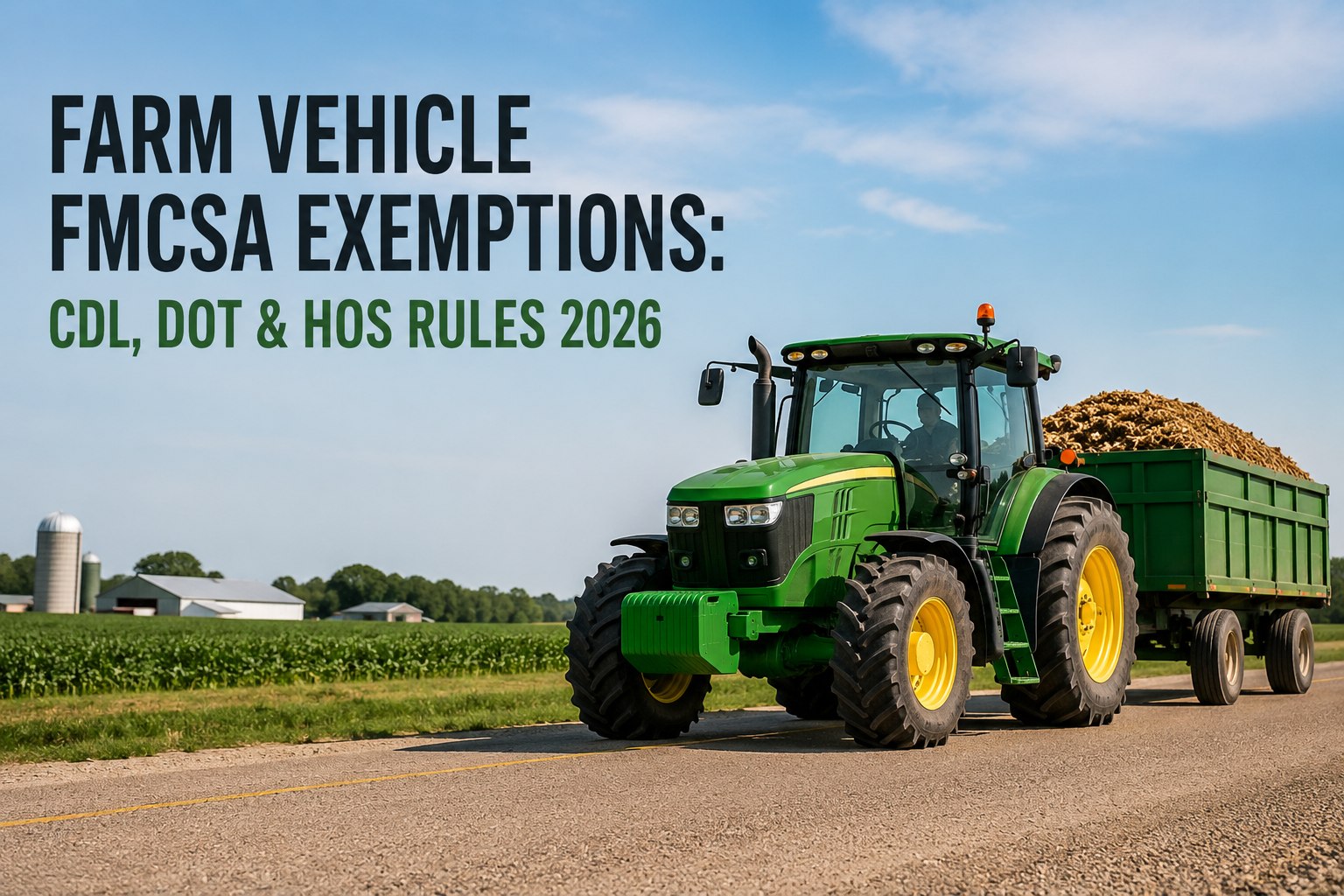
A grain farmer hauling corn to the local elevator in a 30,000-lb straight truck can legally skip the CDL, the ELD, the medical card, and most of the DOT rulebook. The same farmer hauling that same corn to an ethanol plant 200 air-miles away cannot. The farm vehicle FMCSA exemption is real and generous — and it fails the second you step outside the conditions. This guide walks the Covered Farm Vehicle rules under MAP-21, the 150 air-mile ag HOS exemption, and the mistakes that turn a lawful farm haul into a fine. Book a demo
Four conditions decide whether the FMCSA rulebook applies to your farm truck
Miss one and the exemption disappears. Meet all four and most of the federal safety regulations don't apply to that vehicle.
Roughly 100,000 vehicles and 75,000 drivers operate under MAP-21 CFV exemptions nationally, per FMCSA's post-implementation safety study. About 78% of those carriers operate across state lines. That scale matters because it means the exemption isn't obscure — but the eligibility conditions are still commonly misread. Getting the vehicle registration right, the driver relationship right, the trip purpose right, and the "not for hire" part right is what separates a lawful exemption from a very expensive assumption.
The weight-tier rule — where 26,001 lbs draws the line
MAP-21 splits Covered Farm Vehicles into two weight tiers with very different scope. This split is the single most important number in the whole farm exemption framework, and it's where most eligibility disputes actually happen.
CFV exemptions apply anywhere the vehicle operates — interstate and intrastate, no mileage cap. This is the tier where most pickup trucks, service trucks, and lighter grain trucks operate. As long as the four CFV conditions are met, the exemptions travel with the vehicle.
CFV exemptions apply only within a 150 air-mile radius of the farm or ranch. Outside that radius, standard FMCSA rules resume — the driver needs CDL, HOS applies, ELD required, DVIR applies, medical card required. This tier includes most tractor-trailer grain trucks and heavier hauling equipment.
The heavy-tier 150 air-mile radius is measured in air miles, not road miles. An elevator 130 air-miles away might sit 175 road miles by highway routing — still inside the exemption zone. A destination 160 air-miles away that only takes 150 road miles because of a direct highway is still outside. Distance is measured as-the-crow-flies from the farm to the destination. Track the air-mile distance to every regular hauling destination before assuming the exemption applies. Book a demo to see per-route air-mile distance tracked automatically
What CFV status actually exempts you from — the eight-item list
When all four conditions are met and the operation fits the weight tier scope, Covered Farm Vehicles are exempt from a large portion of the federal safety regulations. Here's the practical breakdown of what falls away.
CDL requirement
Farmer, family member, or farm employee driving a CFV does not need a Commercial Driver's License. State intrastate CDL rules may still apply in some scenarios.
Medical qualification
DOT medical card and physical qualifications requirements are exempted for CFV drivers under MAP-21.
Hours of Service
Federal HOS regulations under 49 CFR §395 do not apply to CFV operations within scope. Drivers can operate on the schedule that agricultural work demands.
Electronic Logging Device
ELD mandate does not apply to CFV operations since HOS itself doesn't apply. No electronic logging required.
DVIR
Driver Vehicle Inspection Reports required under 49 CFR §396.11 for standard CMVs are not required for CFV operations. Good practice still applies.
USDOT number (federal)
Federal USDOT number requirement is exempted for CFVs meeting all conditions. State-level requirements for intrastate operations may still apply.
Drug & alcohol testing
Federal DOT drug and alcohol testing requirements under 49 CFR §382 do not apply to CFV drivers. Farm owners can still elect to test.
Periodic inspection
Annual federal periodic inspection requirements are exempted for CFV operations. State inspection rules may still apply and often do.
Notice what's not on the list. Anti-tampering rules on emissions equipment still apply. State-level requirements often don't move with the federal exemption — a CFV exempt from federal USDOT may still need state registration and safety compliance depending on the state. And the exemption is federal safety regulations only; nothing about the CFV rule changes commercial insurance requirements or state highway law. Start free and document exemption conditions per unit on day one
The 150 air-mile agricultural HOS exemption — a separate rule with its own scope
This is where fleets get confused. The 150 air-mile agricultural HOS exemption at 49 CFR 395.1(k) is a completely different rule from the CFV exemption. It applies to any motor carrier — including for-hire carriers — but only exempts HOS, not the full CFV package. And it only runs during state-designated planting and harvest seasons.
Any motor carrier
Applies to for-hire carriers, private carriers, farm-owned trucks — anyone transporting qualifying ag commodities or farm supplies. Not restricted to CFVs.
Ag commodities or farm supplies
Transporting agricultural commodities from source, OR farm supplies from wholesale/retail distribution point TO the farm. Trip must be 100% agriculture-related.
Planting & harvest seasons
Only during state-designated planting and harvest seasons for the specific commodity. Season dates set by each state and can vary by commodity type.
Within 150 air-miles of source
Radius measured in air miles from the source of the commodity — the farm, ranch, OR an intermediate storage or loading facility. Not road miles.
Three details worth memorizing on this rule. First: unladen return trips are exempt too — going to pick up an ag commodity or returning from a delivery point both count. Second: trips beyond 150 air-miles are exempt until the driver crosses the 150 air-mile line; HOS resumes from that point forward. Third: farm supplies exemption only runs in the wholesale/retail-to-farm direction; farm-to-repair-shop is NOT exempt. Missing that last detail is a common source of violations during off-season equipment moves. Book a demo to see 150 air-mile boundaries tracked per active haul
Common farm exemption mistakes — what gets fleets fined despite legitimate ag operations
Farm exemption violations rarely come from bad-faith actors trying to game the rule. They come from good-faith farmers and small ag carriers who misread a specific condition. Six patterns account for the majority of citations issued to otherwise-legitimate agricultural operations.
Mixed-purpose trips
Trip must be 100% agriculture-related to qualify. A truck hauling corn to the elevator that also picks up a residential appliance for a family member loses the exemption on that leg.
Farm to repair shop
Moving farm equipment from the farm to a repair shop is NOT covered by the 150 air-mile ag exemption. The farm-supplies leg only covers wholesale/retail-to-farm direction.
Manufactured products
Raw ag commodities (corn, soy, cattle, wheat) are exempt. Manufactured products derived from them (ethanol, canned food, processed meat) are not. Corn to ethanol plant = exempt; ethanol from plant to distributor = not exempt.
Air miles vs road miles confusion
150 miles by highway routing is NOT the same as 150 air-miles. Air-mile distance is measured straight-line. A destination that's 145 air-miles away might be 190 road miles — still exempt.
Off-season operation
The 150 air-mile HOS exemption only runs during state-designated planting and harvest seasons for the specific commodity. Operating outside the season means standard HOS applies even for otherwise-eligible ag hauls.
For-hire assumption on CFV
CFV exemption applies to private carriage only. A farmer hauling their own corn = CFV eligible. Same farmer hauling their neighbor's corn for pay = for-hire, CFV disqualified. Small distinction, large consequence.
Documentation is what protects fleets when these edge cases come up at the roadside. A trip log showing origin, destination, commodity, air-mile distance, and season designation is what turns a "we're exempt" argument into a defensible record. Paper logbooks rarely have this level of detail; digital inspection records with GPS trip tracking do. Book a demo to see per-trip exemption documentation built automatically
From an Ag Fleet Manager running 18 grain trucks across three states
We got hit with a citation in Iowa during harvest three years ago that woke us up. One of our drivers was hauling corn to an ethanol facility that was 158 air-miles from the farm. He'd made that same trip six times that harvest thinking it was under the 150 mark because Google Maps showed 148 road miles. The inspector pulled up the actual air-mile calculation and issued the violation. Roughly $1,600 in fines plus the CSA hit.
What changed for us was moving to digital trip documentation with real air-mile distance tracked per route. Every regular hauling destination now has its air-mile distance recorded once, and drivers can see the exemption status before they leave the yard. We haven't had another farm-exemption citation since. The rule isn't the problem — the geography confusion was. Getting the actual numbers out of the guesswork zone fixed it.
Frequently asked questions
What is a Covered Farm Vehicle under FMCSA rules?
A Covered Farm Vehicle (CFV) is a category of farm vehicle defined under the MAP-21 (Moving Ahead for Progress in the 21st Century Act) that qualifies for broad exemptions from federal motor carrier safety regulations. Four conditions must all be met for CFV status: (1) the vehicle is registered by the state as a farm vehicle and typically carries state-issued farm license plates; (2) the vehicle is operated by the farm/ranch owner, a family member, or an employee of the farm/ranch; (3) the vehicle is transporting agricultural commodities, livestock, machinery, or farm supplies to or from the farm/ranch; and (4) the operation is not for hire — private carriage only, no compensation for hauling someone else's freight. FMCSA's post-implementation safety study estimated that approximately 100,000 vehicles and 75,000 drivers operate under CFV exemptions nationally, with about 78% of covered farm vehicle carriers operating across state lines. Two weight tiers determine the scope of the exemption: light CFVs (GVWR of 26,001 lbs or less) enjoy unlimited-distance exemption both interstate and intrastate; heavy CFVs (GVWR over 26,001 lbs) get the exemption only within 150 air-miles of the farm or ranch. Outside the 150 air-mile radius on a heavy CFV, standard FMCSA rules resume — the driver needs a CDL, HOS applies, ELD is required, DVIR applies, and the medical certificate becomes mandatory again.
What FMCSA rules do Covered Farm Vehicles avoid?
Covered Farm Vehicles meeting all four MAP-21 conditions are exempt from a substantial portion of federal motor carrier safety regulations. The eight main exemptions are: (1) CDL requirements — farmers, family members, and farm employees do not need a Commercial Driver's License to operate the CFV within the vehicle's applicable scope; (2) DOT medical qualification — the DOT medical certificate and physical qualifications requirements do not apply; (3) federal Hours of Service under 49 CFR §395 — drivers can operate on the schedule agricultural work demands; (4) Electronic Logging Device (ELD) mandate — since HOS doesn't apply, ELD doesn't apply either; (5) Driver Vehicle Inspection Report (DVIR) under 49 CFR §396.11 — not required, though good-practice inspection still applies; (6) federal USDOT number requirement is exempted, though some state-level requirements may still apply for intrastate operations; (7) drug and alcohol testing under 49 CFR §382 — federal testing requirements do not apply, though farm owners can still elect to test; and (8) annual federal periodic vehicle inspection — not required at the federal level, though state inspection programs often still apply. What CFV status does NOT exempt: emissions and anti-tampering rules on the vehicle; state highway laws; commercial insurance considerations that flow from the vehicle's use; and state-specific requirements that may parallel or exceed federal rules. A CFV exempt from federal USDOT may still need state registration in states like California and Texas.
What is the 150 air-mile agricultural HOS exemption?
The 150 air-mile agricultural HOS exemption at 49 CFR 395.1(k) is a separate rule from the CFV exemption — it applies to ANY motor carrier (including for-hire carriers), not just farms, but it only exempts HOS, not the full CFV package. Coverage: drivers transporting qualifying agricultural commodities from the source, or farm supplies from a wholesale/retail distribution point to the farm, within 150 air-miles of the source, during state-designated planting and harvest seasons. Key mechanics per 2018 FMCSA final guidance: (1) source location can be the farm/ranch OR an intermediate storage/loading facility; (2) unladen return trips are exempt — drivers going to pick up an ag commodity or returning from a delivery point both count; (3) trips beyond 150 air-miles are HOS-exempt until the driver crosses the 150 air-mile line, at which point HOS resumes from that point forward; (4) 150 miles is measured in air miles (straight-line distance), NOT road miles — a destination 130 air-miles away might be 175 road miles by highway routing but still qualifies. Critical distinction: farm supplies exemption runs only from wholesale/retail-to-farm direction. Moving farm equipment from the farm to a repair shop is NOT covered, even though it's ag-related. And the trip must be 100% agriculture-related to qualify — mixing an ag haul with any non-ag pickup or delivery invalidates the exemption on that leg. During off-season periods (outside state-designated planting/harvest windows), standard HOS applies even for otherwise-eligible ag operations.
Do farm vehicles need a USDOT number?
It depends on the vehicle, the operation, and the state. At the federal level, Covered Farm Vehicles meeting all four MAP-21 conditions are exempt from the federal USDOT number requirement. However, several important nuances apply. First: state-level intrastate USDOT number requirements are not automatically exempted by the federal CFV rule. Many states have their own registration requirements for farm vehicles above certain weight thresholds, and CFVs may still need state farm-vehicle registration or state-issued identifiers even when the federal number is exempt. Second: if the vehicle is used for any non-CFV operation — for-hire work, non-agricultural transport, or a trip that falls outside the 150 air-mile radius for a heavy CFV — the federal USDOT requirement applies for those operations. Third: hazmat transport in placardable quantities triggers USDOT requirements regardless of farm exemption status. Fourth: interstate operation outside the CFV scope generally requires a USDOT number even if intrastate operations are exempt. Fifth: the safety study underlying MAP-21 found approximately 100,000 vehicles operating as CFVs nationally, meaning a substantial share of farm-related transportation does operate under the exemption — but a substantial share does not, either because the four conditions aren't met or because the operation exceeds the CFV scope. Practical rule: verify eligibility conditions per vehicle, per operation type, per state before assuming the USDOT requirement is exempt.
How does HVI support agricultural fleet compliance?
HVI ships pre-built inspection and compliance templates for agricultural fleets covering Covered Farm Vehicle documentation, the 150 air-mile HOS exemption tracking, custom harvester operations, and mixed-mode fleets that run both CFV-exempt and standard commercial operations. CFV eligibility documentation per unit records state farm plate status, driver-farm relationship, and load classification; trip-by-trip logs preserve GPS route data, timestamps, and air-mile distance to the destination, so when a state inspector or FMCSA auditor asks whether a specific trip qualified for exemption, HVI produces the evidence trail. Route-based air-mile distance is calculated once per regular destination and displayed to drivers before they leave the yard, eliminating the road-miles-vs-air-miles confusion that Terry B.'s Iowa grain fleet used to hit citations on. Planting and harvest season windows are configured per commodity per state, so the 150 air-mile HOS exemption only triggers during actual eligible periods. Beyond exemption tracking, HVI covers the operational side that ag fleets still need regardless of federal exemption status: state inspection compliance, mechanic sign-off, work orders, parts inventory for grain trucks and equipment, and preventive maintenance intervals per unit. For custom harvesters running seasonal cross-state operations, HVI's mixed-jurisdiction templates handle the shift from exempt to non-exempt status as the operation moves through different state windows. Published customer data shows fleets on HVI report approximately 25% lower annual maintenance cost with typical payback around 3 months.
The farm exemption is real. The documentation to prove it is what fleets miss.
HVI documents CFV eligibility conditions per unit and per trip, tracks air-mile distance to every regular destination, and preserves the audit trail that turns "we were exempt" into a defensible record. Live in under two weeks. Custom templates for grain hauls, custom harvesters, and mixed-mode agricultural fleets.
No credit card · Ag fleet templates ready on day one