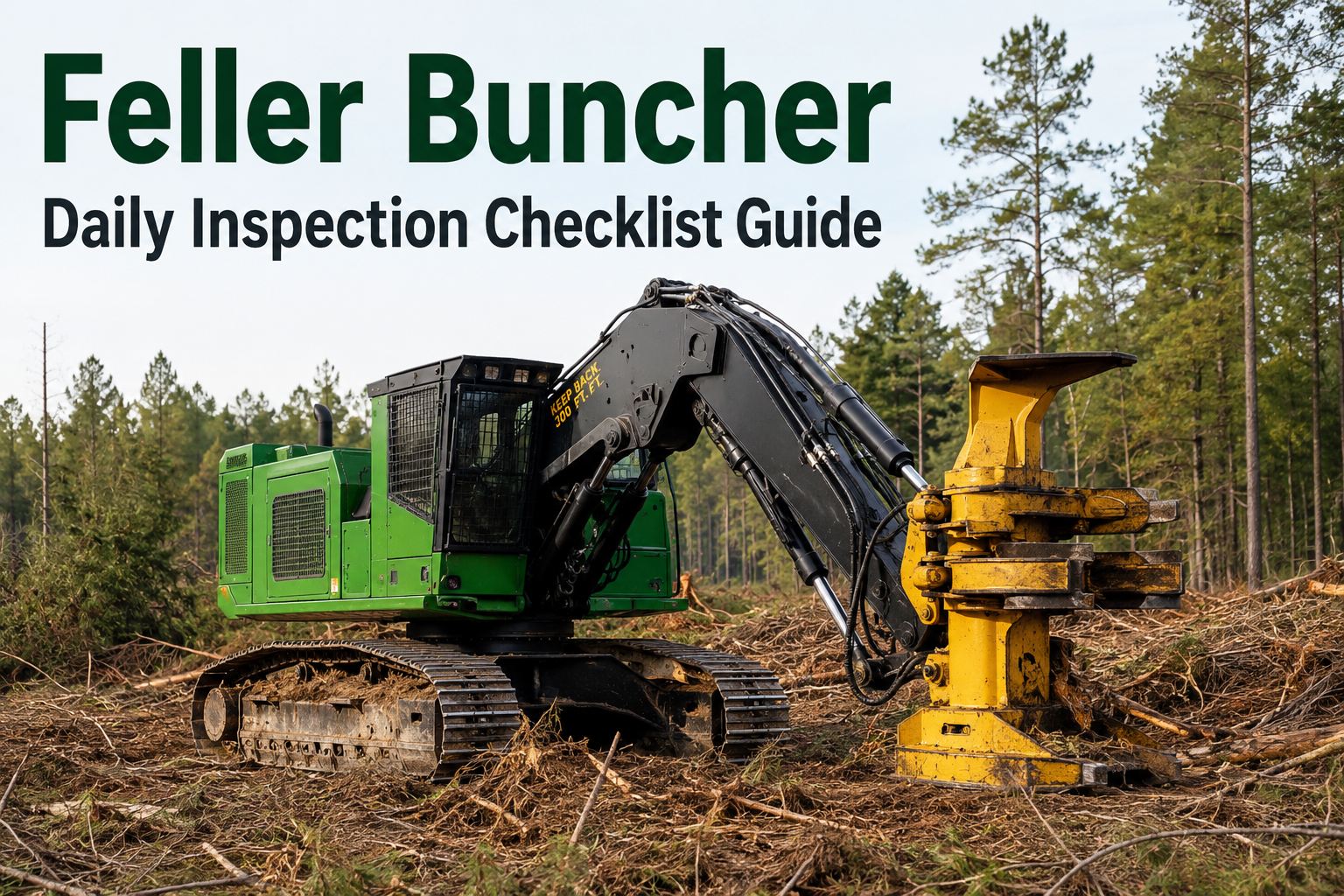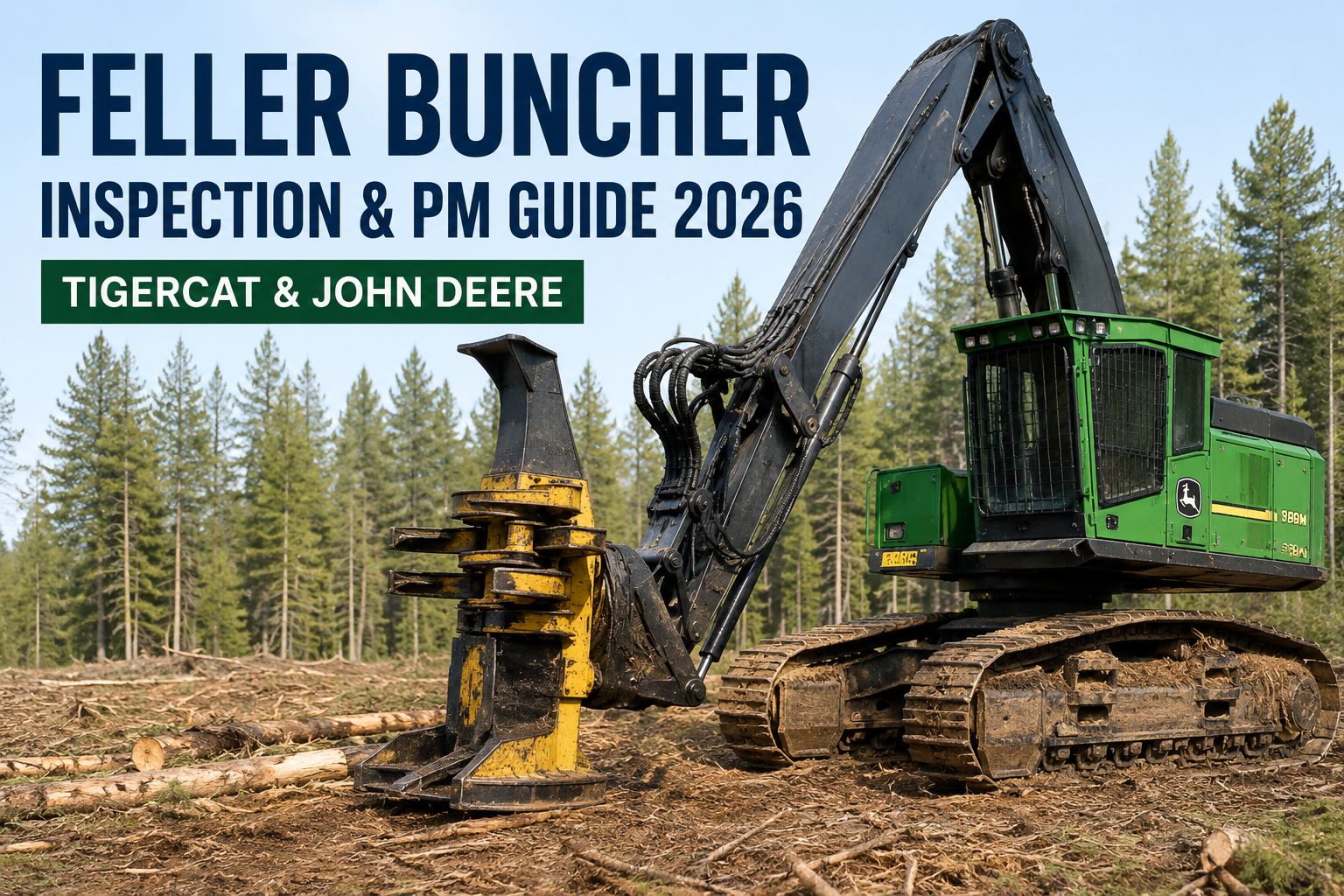
A single tooth on a feller buncher disc costs $15–$40. Sixteen or twenty teeth per disc. Two or three tooth kits per season on a hard-running machine. Multiply across a 4-buncher fleet and the disc-tooth line alone runs $6,000–$15,000 a year — before a single bearing, hose, or track pad enters the conversation. Feller buncher maintenance is dominated by the disc saw and boom-wrist-track cascade, and the fleets that control cost are the ones that track components at the individual-part level. This feller buncher inspection guide walks the disc saw anatomy, tooth selection, OEM-specific approaches for Tigercat and John Deere, and the 5-tier PM cadence. Book a demo
Six components. The saw disc drives the maintenance budget.
Disc, teeth, mandrel, housing, accumulator arms, skirt plate. Each has its own wear rate and its own inspection cadence.
Rotating steel disc that carries the teeth. One-piece or segmented. Bears the primary cutting load. Failure mode: bearing failure, warp from severe rock strike, cracking.
Carbide-tipped or heat-treated steel. Rotatable in reversible holders. Chief consumable. Failure: tooth loss, rock chipping, bolt shear.
Disc mounting spindle with high-load bearings. Runs at continuous 1,150+ rpm under shock loading. Failure: bearing wear, seal loss, mandrel damage from severe strike.
Encloses the disc; protects hydraulics and structural mounting. Skirt plate is sacrificial. Failure: skirt wear-through, protection compromised.
Cylinders grip and hold cut trees for multi-tree bunching. Cushioned. Failure: cylinder seal loss, hose chafe, pin/bushing wear.
Head positioning for cut angle control. Handles high torque loading. Failure: wrist bearing wear, tilt cylinder failure, hydraulic pressure loss.
The feller buncher is a specialist machine. Unlike a general-purpose excavator, its economics are dominated by one component — the disc saw head — and the disc saw's economics are dominated by one line item: the teeth. Fleets that manage tooth consumption, tooth-selection to conditions, and disc-mandrel bearing service capture most of the maintenance savings available. Everything else (boom, wrist, tracks, hydraulics) matters, but doesn't move the annual budget the way saw-head discipline does.
Tooth selection — four types for four operating conditions
Tooth selection is the single most consequential maintenance decision on a feller buncher. Wrong tooth type for the operating conditions produces excess tooth loss, disc damage, and lost production. Four primary types cover the range of forestry conditions, each with distinct advantages.
Choosing wrong on tooth type produces measurable production loss. Running Super Carbide on a rocky site produces chipping and tooth loss faster than the productivity gains justify. Running Concave Steel on rocky ground produces catastrophic tooth failure and potential disc damage. Reversible tooth holders that let teeth be flipped, and the ability to re-sharpen Beaver teeth on the blade, both extend service life significantly — and both need to be tracked at the individual tooth-position level to work as maintenance economics. Book a demo to see per-tooth wear tracking configured for disc saw heads
Tigercat vs John Deere — different design philosophies, different PM structures
The two dominant feller buncher OEMs approach maintenance access, component design, and telematics differently. Fleets running mixed OEM inventories need model-specific PM templates for each, not a universal checklist. The differences below apply broadly across their lineups.
M-Series: 853M, 859M, 903M, 953M, 959M
800-series: 845E, 855E, 860E, 870E · smaller: 720G, 724G
Beyond the OEM design differences, the practical maintenance approach diverges. John Deere M-series emphasizes daily-check accessibility. Tigercat emphasizes service depth on scheduled intervals. Neither approach is wrong — but the PM template that works for a fleet of Tigercat 855Es will produce compliance gaps on a fleet of John Deere 953Ms and vice versa. Model-specific templates matter. Book a demo to see Tigercat and John Deere PM templates configured per model
The 5-tier PM cadence — from daily walkaround to major service
Feller buncher maintenance runs on five service intervals, each with a specific scope and skill level. Skipping any tier forces the others to compensate, and the eventual failures land at the worst moments — typically peak-season production when downtime is most expensive.
Pre-start walkaround
- Fluid levels — engine oil, hydraulic, coolant
- Visual on saw disc, teeth intact, no obvious damage
- Hose & hydraulic visual for leaks
- Track tension & visible track condition
- Cab controls, gauges, monitor functional
Shift/refuel check
- Grease disc-saw wear points per OEM schedule
- Tooth condition & retention bolts
- Boom pivots & wrist wear check
- Accumulator arm hydraulic response
- Track pad condition & debris clearance
Component inspection
- Full tooth-set inspection, rotation or replacement
- Disc mandrel bearing free-play test
- Hydraulic filter change per OEM interval
- Hose & coupling detailed inspection
- Track roller & idler bearing check
System service
- Hydraulic oil sampling & analysis
- Engine oil & filter change (OEM schedule)
- Full boom & wrist pin/bushing inspection
- Cooling system service
- Undercarriage measurements per OEM spec
Major service
- Disc mandrel bearing pack service or replacement
- Full hydraulic system pressure test
- Boom & wrist major component service
- Undercarriage major service (rollers, chains, sprockets)
- Full electrical & telematics diagnostic
The tier structure isn't universal — specific intervals vary by OEM model and operating conditions. What holds across models is the layered discipline: daily catches obvious problems, 10-hour catches early wear, 250-hour catches developing issues, 500-hour verifies system health, and 1000-hour restores baseline. Fleets running paper checklists at any tier lose the historical trending that makes preventive maintenance actually preventive. Start free and get 5-tier PM templates configured per feller buncher model
The high-wear taxonomy — where the maintenance budget actually goes
Fleet managers who track feller buncher maintenance at the line-item level find consistently that five wear categories account for most of the annual maintenance spend. Ranking them lets budget priorities align with actual cost distribution.
Saw teeth & disc components
Consumable teeth are the single largest per-machine line item. Rock strikes, hardwood stumps, and abrasive site conditions all accelerate wear. Tooth-type selection to conditions is where the biggest savings live.
Hydraulic hoses & couplings
The high-pressure hydraulic system driving disc, boom, wrist, and accumulator produces continuous stress on hoses and couplings. Chafing, heat cycles, and pressure spikes all shorten service life. Failure means immediate downtime.
Undercarriage & tracks
Steep terrain, rocky sites, and heavy machine weight combine to accelerate track pad, roller, idler, sprocket, and chain wear. Undercarriage represents a substantial fraction of long-term ownership cost.
Disc mandrel & bearings
The bearing pack supporting the rotating disc runs at continuous 1,150+ rpm under shock loading. Major service at 1,000 hours, but bearing wear can advance faster in severe conditions and needs monitoring.
Boom, wrist, & accumulator pins
High-torque loading and abrasive environment produce pin and bushing wear at every pivot point. Progressive wear rather than sudden failure, but ignored wear cascades into structural damage.
The pattern across the five categories is the same: track at the component level with history preserved per part per machine. Aggregate machine-hour maintenance costs mask which category is driving the spend on a specific unit, and the specific unit is where the budget improves or degrades. When a fleet finds that Machine A is consuming teeth 40% faster than Machines B and C, the diagnostic question is site condition, operator behavior, or tooth selection — and the answer lives in the individual-tooth history. Book a demo to see high-wear tracking dashboards per machine
From a Forestry Fleet Manager who runs 5 feller bunchers on Appalachian hardwood
We run three John Deere 953Ms and two Tigercat 855Es on mixed hardwood in West Virginia. Rocky ground, dense timber. Tooth consumption was killing us — roughly $14,000 a year across the five machines. Everybody knew we were burning teeth, nobody could tell you which machine or which operator was doing it fastest.
What changed the number was tracking teeth at the individual position when they came off the disc. Six months in, we could see that our two youngest operators were consistently going through teeth 35-40% faster than the veterans — and it wasn't skill, it was tooth selection. They were both running Super Carbide on rocky sites because it "cuts better." Once we standardized to Beaver Steel on those specific sites, our annual tooth cost dropped to about $8,500. That's $5,500 recovered from one tooth-selection change, on 5 machines. And now we've got the wear-history data to make the next tooth decision better than the last one.
Frequently asked questions
What are the main maintenance items on a feller buncher?
Feller buncher maintenance is dominated by the disc saw head and its supporting systems, but a complete PM program covers six component groups. (1) Saw disc — the 57-inch typical diameter steel disc rotating at approximately 1,150 rpm. Inspection covers cracking, warp from severe rock strike, and disc integrity. (2) Saw teeth — 16 to 20 carbide-tipped or heat-treated steel teeth per disc, the primary consumable. Rotatable in reversible holders to double service life. (3) Mandrel and tapered roller bearing pack — the disc mounting spindle running continuously under 1,150+ rpm and shock loading. Bearing free-play checked at 250-hour intervals, major service at 1,000 hours. (4) Housing and skirt plate — wear-resistant steel enclosure protecting the disc, hydraulics, and mounting. Skirt plate is sacrificial and requires periodic replacement. (5) Accumulator arms — typically 4-inch diameter hydraulic cylinders that grip and hold cut trees for multi-tree bunching. Inspection covers cylinder seals, hose chafe, pin and bushing wear. (6) Wrist or tilt system — 40-degree or 360-degree lateral tilt for head positioning. Wrist bearing wear, tilt cylinder condition, and hydraulic pressure are the key checks. Beyond the head, the feller buncher requires undercarriage service (tracks, rollers, idlers, sprockets), boom pivot and bushing service, engine and cooling system PM, and telematics/electrical system maintenance. But the head drives the annual maintenance budget on nearly every feller buncher operation — and within the head, saw teeth are consistently the largest line item. Fleets that track components individually rather than at the aggregate machine-hour level capture most of the available cost savings.
How often should feller buncher saw teeth be replaced?
Saw tooth service life varies dramatically with tooth type, operating conditions, and site characteristics. There is no universal replacement interval that applies across conditions. Regular Carbide teeth on softwood plantations with clean sites can run several hundred hours between replacements. The same teeth on rocky Appalachian hardwood may require replacement or rotation every 30-50 hours. Super Carbide teeth (with 60% thicker carbide tip) extend service life significantly on suitable conditions but chip catastrophically on rocky sites. Beaver Steel teeth can be re-sharpened on the blade with a disk grinder, which extends service life substantially on severe conditions where carbide chipping is the primary failure mode. Reversible tooth holders let each tooth be flipped to expose fresh cutting edge, effectively doubling service life on suitable holders. The practical management approach is not to specify replacement intervals but to track individual tooth condition on a defined inspection cadence: daily visual check, 10-hour operator inspection with rotation of any tooth showing partial wear, and 250-hour full tooth-set inspection with replacement of any tooth beyond re-usable condition. Wear history per tooth position across similar operating conditions, tracked over time, produces the actual tooth-life data that drives budget planning. When individual tooth history is captured, patterns emerge: which operator produces highest tooth consumption, which site conditions accelerate wear, which tooth type performs best per condition. Aggregate tooth budgets mask all of that. Individual-tooth tracking exposes it.
What is the difference between John Deere and Tigercat feller buncher maintenance?
John Deere and Tigercat approach feller buncher design and maintenance differently, and fleets running mixed OEM inventories need model-specific PM templates for each. John Deere M-series (853M, 859M, 903M, 953M, 959M) emphasizes daily-check accessibility. Service points are positioned so operators can complete pre-start walkaround without opening major covers. The 953M runs a 246 kW (330 hp) engine at 1,900 rpm with 8.88m boom reach. The FR27 disc saw felling head is standard on 953M/959M and available as an upgrade on 853M/859M/903M. RCS (Rapid Cycle System) tunes machine response per operator skill level. JDLink telematics provides remote monitoring, diagnostics, and PM tracking. Optional undercarriage-mounted toolbox provides convenient storage for spare teeth. Tigercat 800-series (845E, 855E, 860E, 870E, plus smaller 720G/724G/726G) emphasizes service depth on scheduled intervals with wide access panels. The ER Leveling system provides automatic self-leveling on slopes up to 45 degrees, a distinctive advantage on steep terrain. Hydraulic management is tuned for fuel economy. RemoteLog platform provides machine monitoring. The Tigercat model lineup is extensive, from small tracked 718E through large tracked 870E, offering size flexibility. For maintenance workflow, the practical implication is that the same PM checklist won't work optimally across both OEM families. Each requires its own template with model-specific inspection points, service intervals, and access procedures per the OEM service documentation. Digital PM systems with model-specific templates handle this cleanly; paper checklists tend to devolve to a generic feller-buncher form that misses critical model-specific requirements.
How do you choose the right feller buncher saw teeth?
Tooth selection is the single most consequential feller buncher maintenance decision because it drives the largest recurring cost line and the biggest production impact. Four tooth types cover most conditions. Super Carbide (60% thicker tip than standard, aggressive cutting angle) delivers highest production and lowest fuel consumption on softwood plantations, clean sites, and consistent conditions where impacts are managed. Best-in-class production but expensive if run on wrong conditions. Regular Carbide (straight tip carbide) is the workhorse default for mixed hardwood/softwood conditions with moderate rock exposure. Balances cutting performance with impact durability. Beaver Steel (heat-treated with straight edges) is highly durable against rock strikes and can be re-sharpened on the blade with a disk grinder. Preferred choice for rocky sites, severe hardwood, salvage operations, and extreme conditions where carbide chipping is the primary failure mode. Concave Steel (heat-treated with concave profile) is a lower-cost tip for easy operating conditions with minimal impacts. Trades cost for durability where conditions permit. The wrong tooth type on the wrong conditions produces measurable production loss and elevated tooth consumption. Super Carbide on rocky sites chips faster than production gains justify. Concave Steel on rocky ground produces catastrophic tooth failure and potential disc damage. Reversible tooth holders let teeth be flipped to expose fresh cutting edge, effectively doubling service life — this option should be evaluated during head selection or replacement. The optimal fleet approach is to standardize tooth selection per site condition based on operational history, tracked per machine per site per tooth type over time. Individual-tooth wear data across similar conditions is the input that makes the next tooth decision better than the last.
How does HVI support feller buncher maintenance tracking?
HVI runs feller buncher preventive maintenance with per-component tracking rather than aggregate machine-hour metrics — individual saw teeth by disc position, disc mandrel bearing service history, hydraulic hose replacement per route, and boom-wrist-track pin measurements tracked separately per machine. Model-specific PM templates configured for John Deere M-series (853M, 859M, 903M, 953M, 959M) and Tigercat 800-series (845E, 855E, 860E, 870E) plus smaller variants, with OEM-specific service intervals, access procedures, and inspection points embedded in the workflow. The 5-tier PM cadence (daily, 10-hour, 250-hour, 500-hour, 1,000-hour) is structured per model, so operators and technicians follow the correct interval-specific procedure. Tooth-type selection is recorded against operating condition, so wear patterns get compared across similar sites and the tooth-selection decision improves over time based on data rather than habit. When a machine's tooth consumption diverges from the fleet average, HVI surfaces the pattern automatically for investigation — often revealing operator tooth-selection differences (as Tom R.'s Appalachian operation discovered when younger operators were running Super Carbide on rocky sites 40% faster than veterans running Beaver Steel). Photo evidence at critical inspection points provides audit trail for warranty claims and OEM support conversations. Published customer data shows fleets on HVI report approximately 25% lower annual maintenance cost with typical payback around 3 months; for feller buncher operations where tooth consumption alone can run $10,000-$20,000+ per machine annually, the tooth-selection optimization enabled by individual-tooth wear tracking typically pays back the software within the first quarter of use.
Tooth cost isn't a mystery. Individual-position tracking turns it into a managed budget line.
HVI runs feller buncher maintenance with per-component tracking, model-specific PM templates, and tooth-history analytics that surface optimization opportunities. Live in under two weeks. Typical fleet sees measurable tooth-cost reduction within one quarter of tracking.
No credit card · Feller buncher templates ready on day one