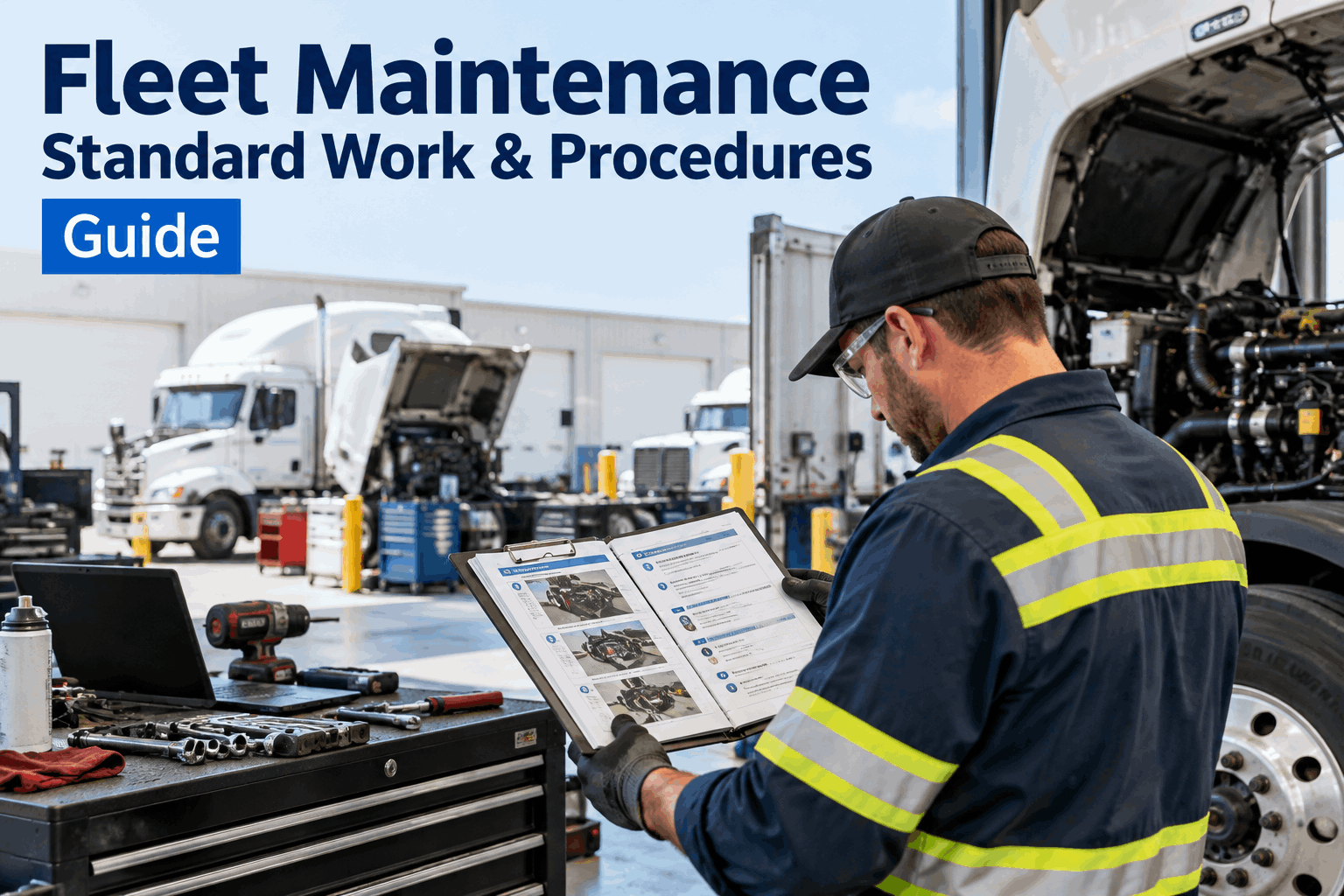
Hand the same repair to three technicians and you'll often get three different jobs — different sequence, different torque, different idea of "done." Maintenance standard work removes that variation: it's the current best-known way to do a task, followed the same way every time and measured, so a repair never depends on who picked up the ticket or on knowledge that walks out when your best fitter retires. Book a demo to see it made measurable at the asset level.
Three Technicians, One Repair Standard
Consistent fleet repairs don't come from hoping everyone does it the same way. They come from documented standard work — one best method, followed and measured on every asset.
Here's the programme — how standard work differs from an SOP, what inconsistency actually costs, the four parts of a standard job, why it's how you keep knowledge in the building, version control and asset-level access, and how you prove it's working.
Standard work isn't just an SOPthe distinction that changes how you use it
People use the terms interchangeably, but they do different jobs. An SOP is a policy document — it says what should happen. Standard work is the shop-floor version — the current best method for one task, at the point of work, that a technician actually follows and you can measure against.
- A policy or governance document
- Lives in a binder or a shared drive
- Describes the process in general terms
- Reviewed occasionally, often out of date
- The current best method for one task
- At the asset, in the technician's hand
- Exact sequence, specs and steps
- Followed every time and measurable
If you already have SOPs, standard work is what turns them from a document into practice. HVI's guidance on writing effective maintenance SOPs covers the writing; this is about making the procedure the way the job is actually done. Book a demo to turn procedures into standard work
What inconsistency actually costs
Repair variation doesn't announce itself — it shows up as scattered costs, comebacks and a shop that can't improve because it has no baseline. These are the four ways an unstandardised shop quietly bleeds money and knowledge.
That last point is the quiet killer: you can't improve a task that's done differently every time — there's nothing stable to measure or beat. Standardise first, and every other maintenance gain becomes measurable.
The four parts of a standard jobwhat a maintenance standard work instruction actually contains
A standard work instruction isn't a wall of text — it's a tight, repeatable definition of one task. Get these four parts right and any qualified technician can do the job the same way, to the same result, without guessing.
The expected time is what most shops omit, and it's what turns standard work into a planning tool — accurate scheduling, honest capacity, and an early signal when a job overruns because something's off. Together, these four are the difference between a procedure and a wish.
It's how you keep knowledge in the buildingthe retiring-technician problem, solved
The most valuable maintenance knowledge in most fleets isn't written down anywhere — it lives in the heads of a few veteran technicians. Standard work is how you get it out of their heads and into a form the whole shop can use, before it leaves with them.
- The method is tribal, not documented
- New techs learn by trial and error
- It retires when the veteran does
- Quality depends on who's on shift
- The best method is captured as a procedure
- New techs ramp up on the proven way
- It stays when people move on
- Quality is built in, not personality-driven
This is the conversion case that lands hardest with fleet leaders: a documented procedure library turns your best technician's judgment into an asset the company owns, so training is faster and a retirement isn't a crisis. Start free and capture your best methods before they walk.
Version control & asset-level accessthe right procedure, at the right asset, every time
A standard is only as good as the copy the technician is actually holding. Two failures undo most procedure programmes: the tech works from an old version, or the procedure is too buried to reach at the point of work. Standard work has to solve both.
Asset-level access is what makes standard work real rather than aspirational — it sits inside work order and maintenance management, so the procedure travels with the job. Following the standard becomes the path of least resistance, not an extra step people skip under pressure.
How you know it's actually workingwhere standard work meets analytics
Standard work without measurement is just more paperwork. The point of standardising is that consistency becomes visible in the numbers — and that's where the programme proves its worth to the people signing off on it.
PM compliance
See whether scheduled work is actually being done to standard and on time, across the whole fleet — not assumed.
Cost per asset
Track what each asset costs to maintain, so a unit drifting above the standard shows up as a number, not a hunch.
Trend & improve
With a stable standard as the baseline, analytics show which procedures actually reduce rework and cost over time — so you improve the standard itself, not just guess at it.
This is the loop that makes standard work pay off: standardise the work, then use analytics and reporting to prove compliance and cost per asset, and feed what you learn back into the procedure. Standard work makes the data trustworthy; the data makes the standard better. Book a demo to close the loop
Before and after you standardisethe shift fleet leaders actually feel
The gains from standard work show up as a change in pattern, not a single dramatic number. This is the shift most fleets recognise once every technician is working from the same procedure.
The change leaders feel most is control: quality stops depending on who's on shift, and the numbers on the dashboard finally reflect a process that's actually consistent.
From a maintenance director
We had two brilliant senior techs and a stack of newer ones, and honestly the quality of a repair depended on who picked up the ticket. When one of the seniors gave notice, I realised thirty years of "just knowing" was about to walk out the gate with him. We spent his last months turning his methods into standard procedures tied to each asset class — sequence, torque, the lot. Now a newer tech opens a work order and the right procedure's already there, and our PM compliance and cost-per-asset numbers finally mean something because everyone's working the same way. It stopped being personality-driven.
How HVI runs maintenance standard workprocedure library, asset-level access and analytics
Standard work holds up when the procedure library is versioned, served at the asset, and measured through analytics instead of filed and forgotten. HVI's procedure management, PM compliance and cost-per-asset analytics keep the standard live and provable.
Build the procedure library
Capture each task as standard work — sequence, specs, time — version controlled.
Serve it at the asset
The current procedure attached to the asset and work order, in the tech's hand.
Measure compliance & cost
Analytics show PM compliance and cost per asset so the standard is provable.
See how the procedure library, asset-level access and analytics live inside HVI's inspection and maintenance platform. Walk through it in a quick demo
Maintenance standard work: quick answers
What is maintenance standard work?
Maintenance standard work is the current best-known method for a maintenance task, documented so it's performed the same way every time and can be measured. It captures the task scope, the exact sequence of steps, the specs and parts (torques, tolerances, fluid grades, part numbers), and the expected time. The goal is consistent, repeatable repairs that don't depend on which technician does the job — and a stable baseline you can then improve. It comes from lean manufacturing, where "standard work" specifically means the current best-known method for a task, not a fixed rule set in stone: when someone finds a better way, the standard is updated and everyone moves to it.
What's the difference between standard work and an SOP?
An SOP is a policy or governance document that describes what should happen in general terms and usually lives in a binder or shared drive. Standard work is the shop-floor version: the current best method for one specific task, delivered at the point of work, that a technician actually follows and you can measure against. SOPs say what should happen; standard work makes it happen the same way every time. In practice, standard work is what turns an SOP from a document into daily practice.
How does standard work preserve maintenance knowledge?
In most fleets the best repair knowledge lives in the heads of a few veteran technicians and isn't written down anywhere. Standard work captures that method as a documented procedure — sequence, specs and judgment — so it becomes an asset the company owns rather than tribal knowledge. New technicians ramp up on the proven method instead of learning by trial and error, quality stops depending on who's on shift, and a retirement or resignation doesn't take years of expertise out the door with it.
Why does maintenance standard work need version control?
Because a standard is only useful if the technician is working from the current version. Without version control, methods improve but old printouts linger in toolboxes and people keep doing the job the outdated way. Version control means a procedure is updated once, the previous version retires, and the correct current instruction is the only one available — attached to the asset and the work order so it's in the technician's hand at the point of work, not buried in a folder.
How does HVI support maintenance standard work?
HVI lets you build a versioned procedure library, attach the correct standard work to each asset and work order so technicians access it at the point of work, and then measure whether it's being followed through PM compliance and cost-per-asset analytics. That closes the loop: the standard makes repairs consistent, the analytics prove compliance and surface assets drifting above standard, and what you learn feeds back into improving the procedure — with documented evidence for the people who signed off on the programme.
Make every repair the same repair
HVI runs maintenance standard work end to end — a versioned procedure library, the right instruction served at each asset and work order, and analytics on PM compliance and cost per asset so you can prove the standard is followed and improving, not just written.
No credit card · Build your first standard procedures on day one
- Task, sequence, specs & time
- Veteran methods captured
- One version, controlled
- Attached to each asset
- PM compliance & cost tracked