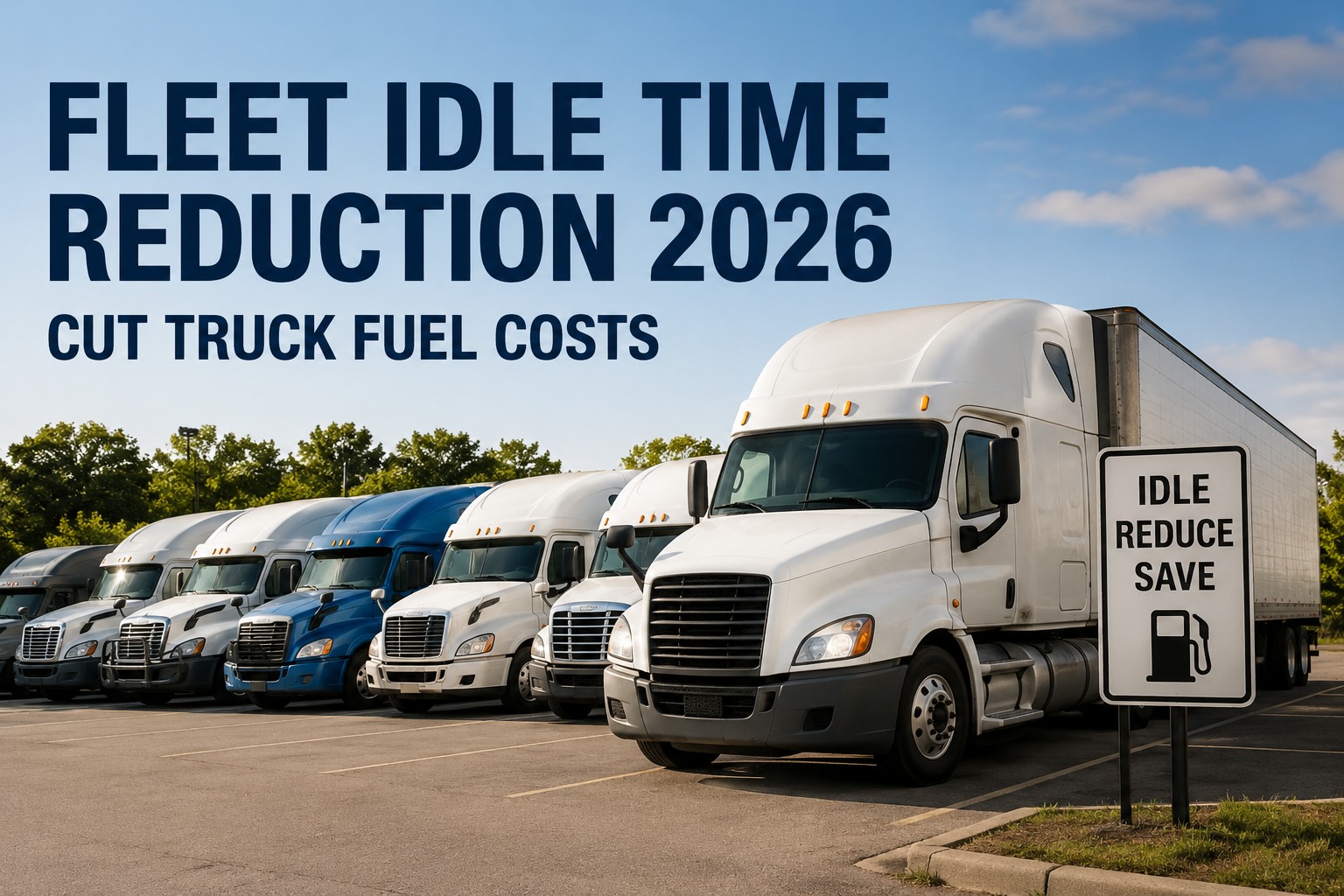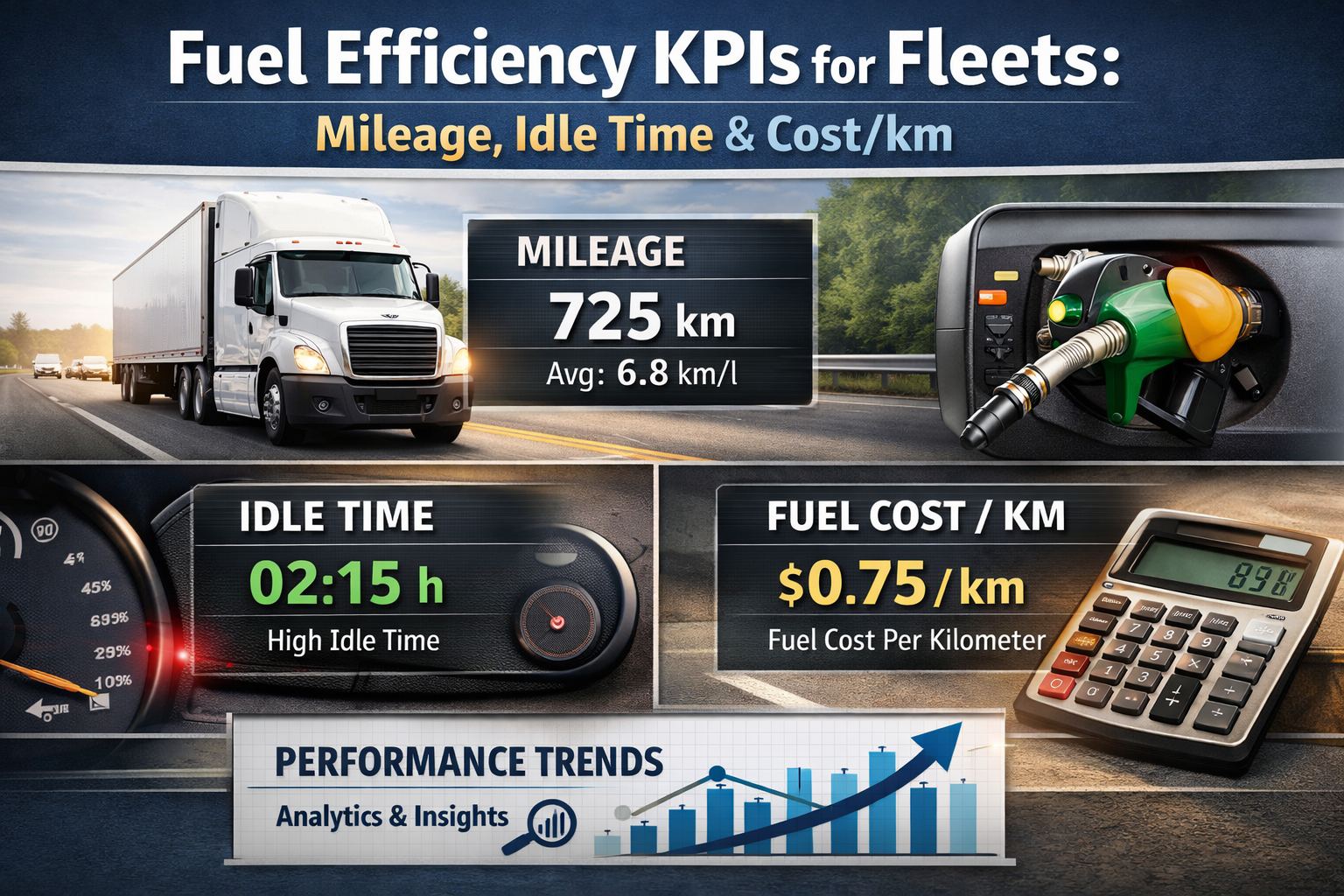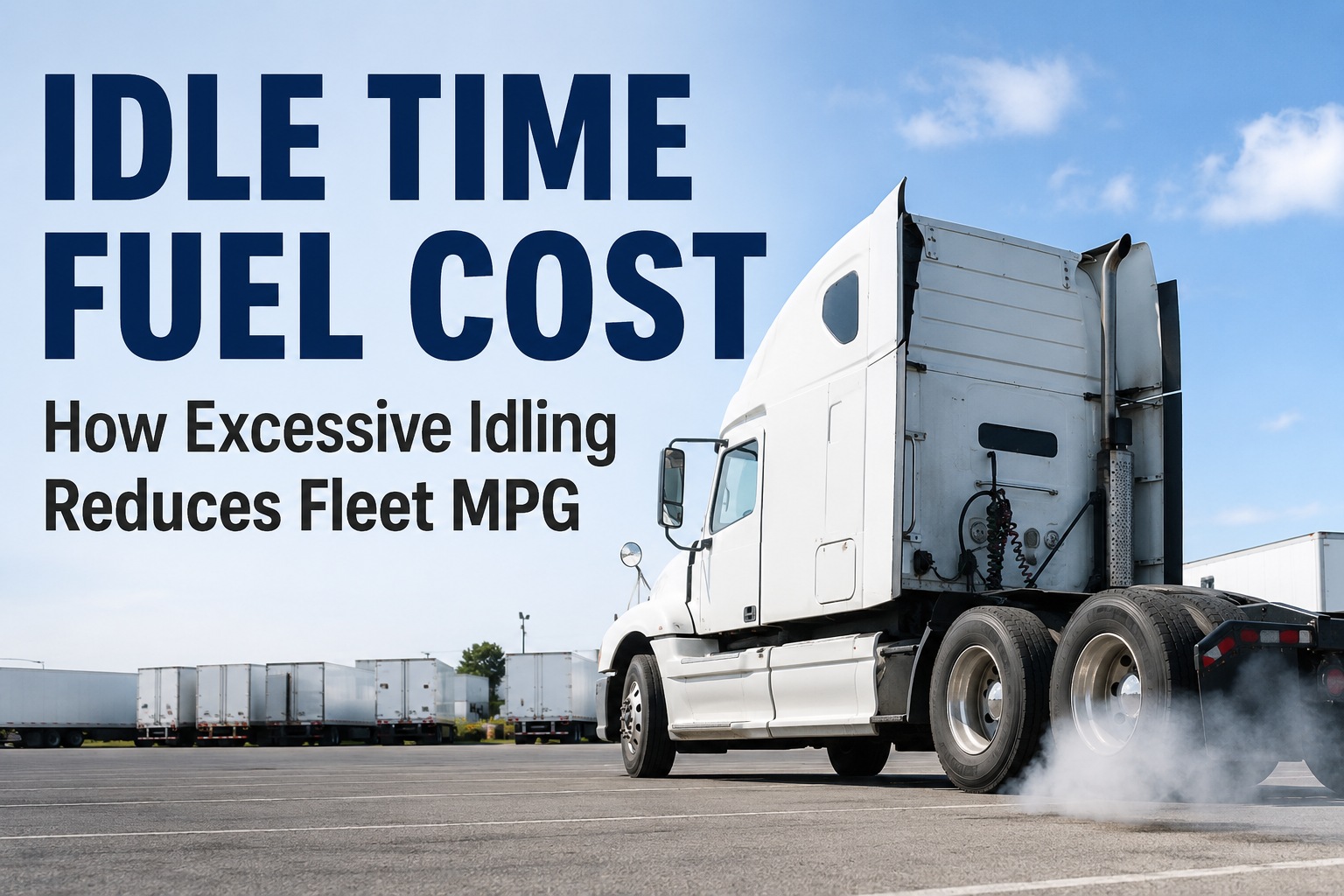
Idle time fuel cost is the largest invisible line item on your fleet P&L. A truck parked with the engine running burns roughly $3 an hour, produces zero revenue miles, silently degrades effective fleet MPG, and adds engine wear equivalent to 25 miles of driving per idle hour. That's not a rounding error — on a mid-sized fleet it's a six-figure annual bleed most CFOs never see because the fuel invoice doesn't distinguish idle from motion. This page shows you exactly what your idle costs today, why your advertised MPG isn't the number you're actually getting, and the four-step path from where you are to where you should be. Book a demo after you see your number.
What Is Your Fleet's Idle Time Actually Costing You?
Pick your fleet size and current idle level. See the number your CFO is missing.
Whatever number you just saw is what's hiding inside your fuel bill right now. Below is where every dollar of it comes from, why it doesn't stay a fuel bill for long, and the exact four moves that recover most of it inside a quarter.
$3.08the cost of every idle hour
A heavy-duty diesel at idle burns 0.8 to 1.5 gallons per hour depending on engine size, accessory load, and outside temperature. At $3.85/gal, that's $3.08 to $5.78 every hour the engine runs producing zero miles.
What makes this number worse than it looks: the fuel is only the beginning. Every idle hour also adds roughly 25 miles of engine wear (per ATA data), prevents diesel particulate filter regeneration cycles from completing, and burns Diesel Exhaust Fluid at inflated consumption rates. One hour of idle costs closer to $6 in total system impact once you account for the maintenance tail.
Multiplied across a fleet-wide workday of 2 to 4 idle hours per unit, this per-hour number becomes the invisible six-figure line item on your P&L — and it's the one line an audit almost never catches. Book a demo to see per-truck idle cost captured automatically
$6,000what idle steals from every truck's MPG
Fleet MPG is the metric CFOs actually track — and it lies. The advertised 6.5 MPG on a truck's spec sheet assumes the engine is making miles. Idle produces zero miles per gallon. Every idle hour degrades the effective MPG for the whole reporting window, and the fuel-per-mile line you see is the effective number, not the sticker number.
The gap between "best in class" and "undermanaged" on the same physical truck is 1.6 MPG. On a 100-truck fleet running 100,000 miles/truck/year, moving from 30% idle to under 10% idle recovers roughly $1M annually. The idle percentage isn't a KPI; it's a bank account. Book a demo to see MPG trended against idle per truck
Where does it go?the 5 sources of fleet-wide idle
Idle isn't one behavior. It's a stack of five distinct patterns with five different fixes. Ranked here by realistic share of fleet-wide idle time across mixed operations.
- 40% Waiting to load / unload
- 25% Cab climate control (HVAC)
- 15% Excessive cold-weather warm-up
- 12% "Just for a minute" stops
- 8% Traffic and drive-thru
Top 3 sources = 80% of total idle. Different fixes for each. That's why a single policy doesn't move the number — a stacked approach does. Start free and get idle source-breakdown built in
$0the path from where you are to where you should be
Best-in-class fleets run under 10% idle. Getting there from a 30%+ baseline is not one intervention — it's a stacked sequence of four, in a specific order. Each step compounds on the ones before it. Here's the descent, with realistic recovery at each stage.
-
NowBaseline30% idle$224,000 / yearWhere most untracked fleets sit. No idle policy, no telematics visibility, no driver scorecards. Fuel bill is a mystery.
-
1Add: 5-minute idle policy20% idle$150,000 / year save $74,000Written policy: engine off after 5 minutes stationary, exceptions defined for HVAC, PTO, DPF. Zero-cost intervention. 30-day rollout.
-
2Add: Telematics visibility12% idle$90,000 / year save $134,000Automatic ECM capture, per-truck daily scorecards, weekly trending. $25-45/vehicle/month. Payback typically 30-60 days.
-
3Add: Driver coaching & scorecards9% idle$68,000 / year save $156,000Weekly rankings, bottom 20% coached. Positive reinforcement outperforms punitive. Culture shift happens by week 8.
-
4Add: Anti-idle hardware (APUs)7% idle$50,000 / year total save $174,000APUs, battery HVAC, or shore power for long-haul cab-comfort idle. Highest capex, longest payback (12-24 months), largest final reduction.
Layered consistently, the four steps move a 100-truck fleet from $224,000 to $50,000 of annual idle cost — a 78% reduction. Not aspirational; measurable. The math doesn't require new trucks, new lanes, or a technology overhaul. It requires the discipline stack, applied in order. Start free and layer in step 1 and step 2 this week
From a director of maintenance who ran the numbers
We thought our idle number was maybe 12%. When we finally pulled clean telematics data, it was 31%. On 62 trucks that's roughly $180,000 a year of pure waste we'd been writing checks for.
Policy plus scorecards moved it to 14% in two months. What surprised me most wasn't the fuel savings — it was the DEF and DPF numbers. Regeneration cycles started completing on their own; our aftertreatment maintenance line dropped 40%. The idle number was hiding two costs, not one.
Frequently asked questions
How much fuel does a truck actually burn while idling?
A heavy-duty diesel truck at idle burns roughly 0.8 to 1.5 gallons per hour depending on engine size, load on accessories (heat, A/C, PTO), and outside temperature. Class 8 sleeper cabs sit near the top of that range because of larger displacement and heavier accessory load; smaller trucks and Class 6-7 units sit near the bottom. Heavy equipment (excavators, dozers, wheel loaders) idles at 0.5 to 1.5 gallons per hour with similar variability by size. At current diesel prices around $3.75 to $3.90 per gallon, that's roughly $3 to $6 per hour of pure idle cost — before you account for the maintenance tail (roughly 25 miles of engine wear per idle hour per ATA data), aftertreatment stress, and DPF regeneration issues that idle patterns cause. Multiplied across a workday of 2-4 idle hours and a fleet of dozens or hundreds of units, the annual cost typically lands in the mid-six-figure range for mid-sized fleets and seven figures for large fleets. It's the largest controllable fuel line item on almost every commercial fleet.
How does idle time reduce fleet MPG?
Fleet MPG is calculated as total miles driven divided by total gallons burned. Every gallon burned at idle produces zero miles, which pulls the ratio down for the whole reporting period. A truck rated at 6.5 MPG that idles 15% of engine-on time delivers an effective MPG of roughly 5.5 — a 15% degradation invisible on any single fill-up but crystal clear on the monthly fuel-per-mile line. At 30% idle, the same truck delivers roughly 4.6 effective MPG (29% degradation). At 45% idle, roughly 3.8 effective MPG (41% degradation). These numbers assume typical duty cycle and 0.8 gallons per hour idle rate; harsher patterns produce steeper degradation. On a 100-truck fleet running 100,000 miles per truck per year, moving from 30% idle to under 10% idle recovers roughly 1.5 MPG effective — worth approximately $1 million annually in fuel cost at current diesel prices. Every fleet-MPG number should be read as an idle-management scorecard.
What is a "good" idle time percentage for a fleet?
Best-in-class fleets consistently run under 10% idle time across the fleet, measured as idle hours divided by engine-on hours. Industry average for well-managed operations sits at 10-15%. Anything above 20% signals undermanaged idle policy or missing telematics visibility. Above 30% is common on fleets that have never systematically tracked idle, and represents the largest short-term cost-recovery opportunity available. Heavy equipment operations tend to run higher (25-40% is common) because the machine sits stationary during loading cycles, but even there the target should be under 20% with proper operator training and 5-minute shutoff policy. Some duty cycles legitimately require higher idle: reefer operations, PTO work, extreme-weather cabin comfort, and emergency response. But those exceptions should be defined explicitly in the idle policy, tracked separately, and never used as a blanket excuse for undisciplined idle across the general fleet.
Does excessive idling damage the engine?
Yes, and in more ways than most operators realize. The American Trucking Associations estimates that every hour of idle equates to roughly 25 miles of engine wear on a typical Class 8 truck — meaning a truck idling 3 hours per day accumulates the wear equivalent of an extra 75 miles of driving daily, without generating any revenue miles. Beyond straight mechanical wear, sustained idle prevents diesel particulate filters from reaching regeneration temperature, which produces soot buildup that eventually requires a $4,000-$8,000 aftertreatment service. Diesel Exhaust Fluid consumption increases disproportionately during long idle periods. Turbocharger seals, injector tips, and cylinder head components experience thermal-cycling stress that accelerates their failure rate. Several manufacturers now specifically reference idle-hour thresholds in warranty terms, and excessive idle patterns can void certain coverage. Idle isn't neutral for the engine — it's actively harmful, and the maintenance line reflects it about 12 to 18 months after the pattern establishes.
Are there legal limits on truck idling?
Yes, and the map is fragmented. California enforces a 5-minute idle limit under CARB regulations, with fines up to $300 per violation for commercial vehicles, along with additional restrictions in urban air-quality management districts. Similar or stricter limits apply in New York, Massachusetts, Connecticut, New Jersey, Illinois, Colorado, and many major municipalities including New York City (3-minute limit), Salt Lake City, Denver, and others. Exemptions typically exist for extreme weather, sleeper berth operation on federally certified equipment, active PTO work, and emergency response. Beyond state law, some customers and shipping partners now include anti-idling clauses in their contracts, particularly on distribution center yards and food-grade cold-chain operations. The regulatory floor is rising: the EPA's SmartWay program certifies fleets on idle metrics, and increasingly, insurance underwriters and sustainability-focused shippers are asking for idle percentage data in RFPs. Idle-time discipline has moved from a cost-control question to a compliance-and-commercial-eligibility question in the last few years.
Turn the number you just calculated into a live tracked KPI
HVI captures per-truck idle hours automatically from telematics, breaks the number down by source and location, trends it against MPG week over week, and surfaces the specific drivers and units producing the waste. What used to be a mystery line on the fuel invoice becomes a manageable metric. Live in under two weeks.
No credit card · No hardware · Idle dashboard ready on day one