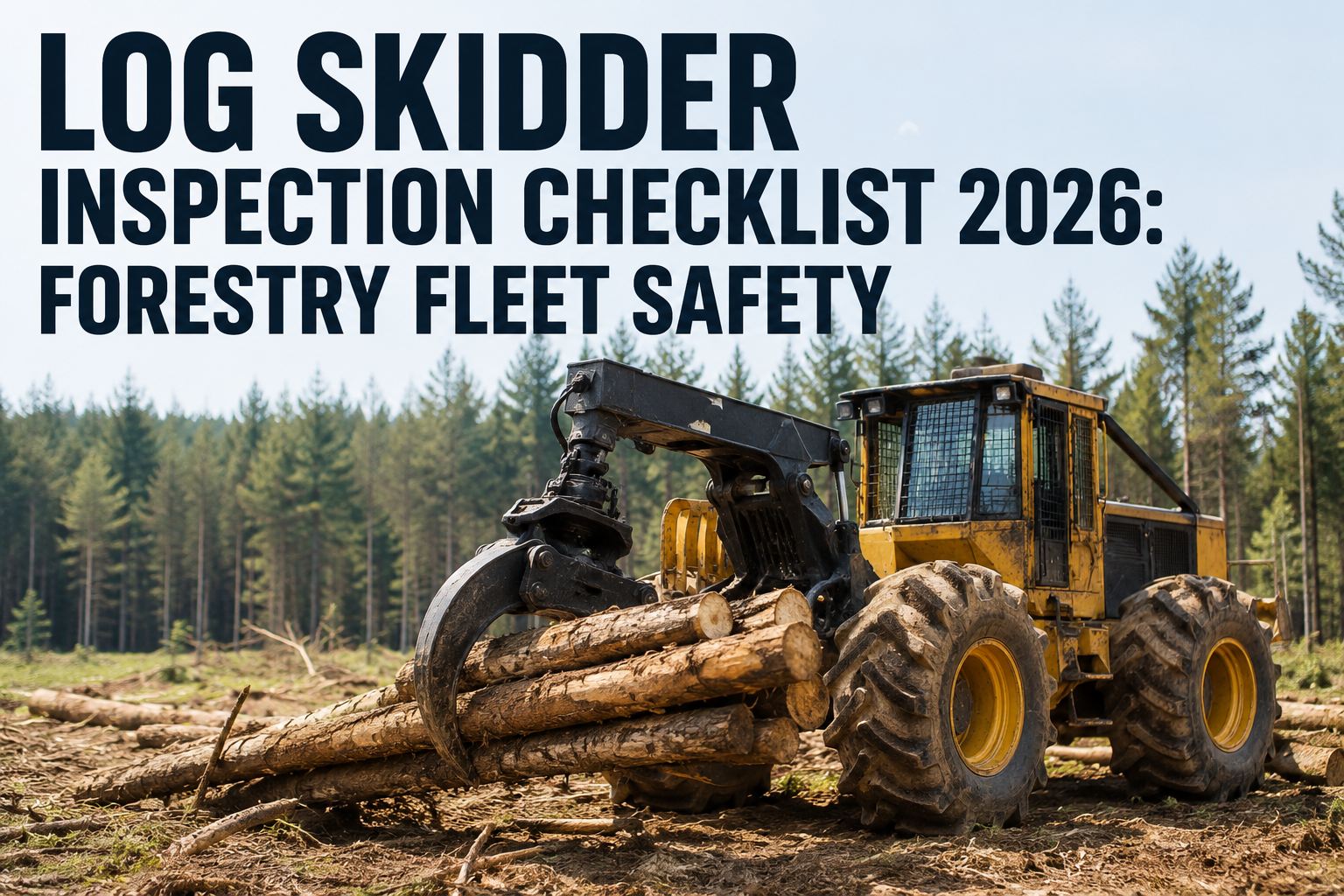
A skidder failure on the landing looks like a broken machine. A skidder failure between the stump and the landing looks like a life-safety event — a snapped choker cable at load, a hydraulic burst on articulation on a slope, a ROPS mount that never got its wear inspection. OSHA's 29 CFR 1910.266 makes protective structures on skidders mandatory since February 1995, but the standard doesn't specify a daily inspection cadence. That's on the logging operation. This log skidder inspection guide walks grapple-vs-cable differences, the 8-station daily walkaround, OSHA compliance, and the 5 highest-risk failure points. Book a demo
Grapple or cable — different mechanisms, different inspection focus
A universal skidder checklist misses the components specific to each type. This is what each configuration requires.
Hydraulic grapple system
Winch + steel cable + chokers
Skidders operate at the intersection of highest terrain difficulty and highest cable/hydraulic loading — steep slopes, rocky ground, wet trails, heavy log payload, articulated steering under torque. Every component sees loading conditions that a shop or on-road vehicle never encounters. The inspection discipline that keeps the machine running productively is also the discipline that keeps the operator alive. OSHA's 1910.266 defines the compliance floor; competent logging operations run above it.
OSHA 29 CFR 1910.266 — the compliance floor every skidder operation must meet
OSHA's Logging Operations Standard applies to all logging activity regardless of end use or commercial status. Five specific requirements apply to every skidder on every job. Failure at inspection means the machine cannot legally operate; failure in the field means the operator may not survive the incident.
ROPS / FOPS required
Every skidder placed into initial service after February 9, 1995 must have Rollover Protective Structure (ROPS) and/or Falling Object Protective Structure (FOPS). Machines manufactured after August 1, 1996 must meet SAE J1040 (ROPS) and SAE J397 (deflection).
Seat belts required
Each ROPS-equipped skidder must have seat belts meeting SAE J386 (June 1985). Operators must wear them at all times when operating. Seat belts cannot be removed; the employer must replace any that are.
Fire extinguisher on machine
Portable fire extinguisher required on every skidder per subpart L of Part 1910. Inspection cadence follows the extinguisher standard — monthly visual, annual maintenance service, hydrostatic test at 5, 6, or 12 years by type.
Securing procedure before leaving machine
Before leaving a skidder unattended, operator must: set parking brake or brake lock, place transmission in park, ground all moving elements (blade, grapple, arch), and discharge stored energy in hydraulic elements.
Operator training documented
Every log skidder operator must be trained on the specific machine and documented. Training covers safe operation, inspection, hazards, and emergency procedures. Records maintained in the driver qualification file.
Any OSHA inspection of a logging operation will verify these five items at minimum. Documented daily inspections, current operator training records, and inspection history per machine are what turn a compliance visit from an ordeal into a routine event. Book a demo to see OSHA 1910.266 requirements built into skidder inspection templates
The 8-station daily walkaround — grapple & cable common ground
Regardless of skidder type, eight stations cover the daily pre-operational inspection. Runs about 10-15 minutes when done thoroughly — and 10-15 minutes is what stands between a routine shift and a breakdown on the trail.
Stations 3 and 8 are the OSHA-compliance-critical stations — ROPS/FOPS integrity, seat belt condition, and fire extinguisher status. Skipping either invalidates the pre-operational inspection and produces a documented gap if OSHA reviews records. Stations 4, 5, and 7 are the productivity-critical stations — articulation, winch/grapple, and hydraulics failures produce most in-service breakdowns. Start free and get the 8-station skidder walkaround configured for offline field use
The 5 highest-risk failure points — where safety and production converge
Not every component failure is equal. Five specific failure modes on skidders are both high-probability (they happen regularly across the industry) and high-consequence (they produce serious injury or major downtime). Every daily inspection should give these five extra attention beyond the general walkaround.
Cable / wire rope failure
Failure mode: Steel cable snaps under load, potentially recoiling with catastrophic force. Root causes: broken strands accumulating over time, kinks from misrouting, corrosion in wet conditions, worn end fittings.
Grapple hydraulic failure with load
Failure mode: Grapple releases under load due to seal failure, hose burst, or hydraulic pressure loss. Falling logs create severe strike hazard.
ROPS/FOPS mounting compromised
Failure mode: Rollover protection fails during actual rollover due to worn mounting bolts, cracked structure, or repairs that removed integrity. Operator injury far more severe than intact structure would produce.
Articulation hydraulic loss on slope
Failure mode: Steering hydraulic pressure loss on grade leads to loss of directional control, potential rollover. High-consequence at typical logging site slopes.
Choker failure at load (cable skidders)
Failure mode: Choker cable fails at end fittings, sliding hook, or worn wire, releasing load. Ground worker in choker-setting role is at highest exposure.
These five failure modes are what turn "the inspection saved us" from a hypothetical into a specific outcome. Every skidder inspection template should treat the five as required checks with photo evidence, not general walkaround items. And every logging operation should track failure patterns across the fleet — if the same component fails on multiple machines, the answer is systemic (site conditions, PM interval, replacement source), not machine-specific. Book a demo to see risk-focused inspection with photo evidence per critical component
OEM approaches — John Deere, Tigercat, and Cat skidders
The three dominant skidder manufacturers approach design and maintenance access differently, and mixed-fleet operations need model-specific inspection templates for each. The differences below apply broadly across their current lineups.
L-II series: 648L-II, 748L-II, plus 540/640 legacy
H-series: 612 (compact), 620H, 630H, 632H, plus 610C legacy
555 series, 545, 525, plus 517/518 legacy
Beyond the OEM design differences, inspection templates need to reflect the specific model. A generic "skidder inspection" checklist misses features specific to newer L-II grapples, Tigercat Turnaround cabs, or Cat's ROPS mounting configurations. Model-specific templates capture what actually needs to be checked on the machine at hand. Book a demo to see model-specific templates for John Deere, Tigercat, and Cat skidders
From a site supervisor running a 4-skidder crew on Pacific Northwest steep ground
We run two John Deere 648L-IIs and two Tigercat 620Hs on 45-degree Oregon slopes. Cable coverage is nonexistent past the landing. For years we ran paper inspections that got filled in at the truck when everyone came off shift — whatever they could remember. Nobody was falsifying anything, but the workflow made real-time inspection impossible.
Moving to offline mobile inspection changed the whole discipline. The check happens where the machine is, before start, with photo evidence per station. Two months in, one of my operators caught a cracked ROPS mount tab on his 620H during the daily walkaround — the crack was small enough that he might have missed it with paper. That machine would have been operational for weeks with a compromised rollover protection structure on 45-degree ground. The offline capability is what made rigorous field inspection actually possible for the first time in my career.
Frequently asked questions
What should a log skidder inspection cover?
A complete log skidder inspection covers 8 stations of daily pre-operational walkaround plus OSHA-mandated safety equipment checks. Station 1: fluid levels — engine oil, hydraulic reservoir, coolant and cap condition, transmission and axle fluid. Station 2: tires or tracks — pressure and condition, chain condition if fitted, sidewall damage, rim and lug condition. Station 3 (safety-critical): ROPS and FOPS structure intact with no cracks, FOPS canopy secure, mounting bolts torqued, seat belt meeting SAE J386 serviceable. Station 4: articulation joint — pivot pin and bushing wear, articulation lock functional, hydraulic hose routing, grease points serviced. Station 5: winch or grapple system — on grapple skidders, cylinder seals and pins, rotator seals; on cable skidders, drum and cable condition, full choker inspection. Station 6: blade and arch — blade edge and wear plates, blade cylinder condition, arch structural welds, log-contact wear points. Station 7: hydraulics and hoses — all hoses and couplings for leaks, chafing points near articulation, cylinder seal condition, manifold connections. Station 8 (safety-critical): cab and safety equipment — fire extinguisher charged and dated, controls and gauges functional, lights and horn and backup alarm operational, mirrors and visibility clear. Beyond the 8 stations, cable skidder-specific checks include full cable length wire rope inspection with gloved hand feel for broken strands, choker inspection per Virginia Tech SHARP Logger guidance, and fairlead sheave condition. The workflow runs 10-15 minutes when done thoroughly and stands between routine production and in-service breakdown.
What are the OSHA requirements for log skidders?
OSHA's Logging Operations Standard at 29 CFR 1910.266 defines five specific requirements every skidder must satisfy. ROPS/FOPS protective structures: every skidder placed into initial service after February 9, 1995 must have Rollover Protective Structure and/or Falling Object Protective Structure per 1910.266(f)(3). Machines manufactured after August 1, 1996 must have ROPS tested, installed, and maintained per SAE J1040 (April 1988). FOPS deflection limits per SAE J397 (April 1988). Seat belts: each ROPS-equipped skidder must have seat belts meeting SAE J386 (June 1985), operators must wear them at all times when operating, and seat belts cannot be removed. Fire extinguisher: portable fire extinguisher required on each skidder per subpart L of Part 1910, with monthly visual inspection, annual maintenance service, and hydrostatic testing at 5, 6, or 12 year intervals depending on extinguisher type. Securing procedure before leaving machine per 1910.266(f)(2)(vii): parking brake set, transmission in park, all moving elements grounded (blade, grapple, arch), and stored hydraulic energy discharged. Operator training documented per 1910.266(i)(3)(ii): every log skidder operator must be trained on the specific machine with records maintained in the driver qualification file. PPE requirements from broader OSHA standards apply: ANSI Z89.1 hard hats at all times, safety glasses, hearing protection where noise exceeds 85 dBA 8-hour TWA, and high-visibility clothing per ANSI/ISEA 107. The 1910.266 standard applies to all logging activity regardless of end use or commercial status. Documented daily inspections, current operator training records, and inspection history per machine are what an OSHA compliance review will verify.
What's the difference between grapple and cable skidder inspection?
Grapple and cable skidders use different mechanisms for log transport and consequently have different inspection focus areas. Grapple skidders use a hydraulic grapple with either box-style or tong configuration to grab and hold logs directly. Inspection focus: grapple cylinder seals and pin wear, rotator seals and hydraulic swivel integrity, mounting bolts, grapple hydraulics (cylinder seals, hose routing, coupling condition, pressure spec), boom system (single-function with 2 cylinders or dual-function with 4 cylinders including all cylinder condition and pin/bushing wear at every pivot), and arch structural welds with wear points where logs contact. Cable skidders use a winch and steel cable with chokers wrapped around logs by a ground worker (choker setter). Inspection focus: winch drum condition and wire rope wear per foot, drum brake function, hydraulic motor condition, steel cable (broken strands, kinks, corrosion, diameter reduction from wear, end fitting integrity) with full-length visual and gloved-hand feel per Virginia Tech SHARP Logger guidance, chokers (sliding hook wear, end loops, wire condition per choker), fairleads (sheave wear, mounting integrity, cable routing free of chafing), and blade and arch condition. The common ground — fluid levels, tires or tracks, ROPS/FOPS, articulation joint, blade, hydraulics, cab and safety equipment — applies to both types. Bogie skidders and dual-function skidders (grapple plus winch) combine elements from both configurations and need inspection templates covering the specific mix on the machine. Cable operations add an additional safety dimension because the choker setter works in the load path — choker inspection and safe procedures (chokers set on log butt end unless top-first is safer, never in middle of log, winch or release only when workers clear) are life-safety-critical.
How often should a log skidder be inspected?
Log skidder inspection runs on a layered cadence covering daily, weekly, monthly, and OEM-specified hour-interval PM. Daily pre-operational inspection: 8-station walkaround before first start each day, covering fluid levels, tires/tracks, ROPS/FOPS integrity and seat belt condition, articulation joint, winch or grapple system, blade and arch, hydraulics and hoses, and cab and safety equipment. Runs 10-15 minutes. This is what OSHA and internal safety programs expect at minimum. Weekly detailed inspection: extends daily coverage with ROPS/FOPS mounting bolt torque verification, full cable inspection (cable skidders), grapple cylinder seal inspection (grapple skidders), fire extinguisher visual per subpart L requirements, and grease service points per OEM schedule. Monthly compliance review: fire extinguisher tag inspection, seat belt condition documentation, operator training currency check, inspection record audit. Hour-interval PM per OEM specification: John Deere L-II series, Tigercat H-series, and Cat 555-series each have their own scheduled maintenance intervals for engine service, hydraulic system service, drivetrain service, and major component service. Typical intervals cluster around 250-hour, 500-hour, 1,000-hour, and 2,000-hour milestones with progressively deeper service scope at each level. The daily inspection is what catches most issues before they cascade into breakdown or safety event. The weekly interval catches developing wear before it reaches failure threshold. The monthly interval satisfies compliance documentation. Skipping any tier forces the others to compensate, and eventually the compensation fails — usually at the worst possible moment during peak-season production.
How does HVI support log skidder inspection and OSHA compliance?
HVI runs skidder inspection with offline field capability configured for the reality of forestry operations — cable coverage is often nonexistent past the landing, and inspection needs to happen where the machine is, not where the signal is. The 8-station daily walkaround runs from the operator's phone with photo evidence per station, GPS location captured, timestamp preserved, and automatic sync when the device returns to coverage. OSHA 1910.266 requirements are built into templates: ROPS/FOPS integrity check with photo evidence, seat belt SAE J386 serviceability, fire extinguisher dated status per subpart L, securing procedure documentation, and operator training currency. Model-specific templates configured for John Deere L-II series (648L-II, 748L-II) and legacy 540/640, Tigercat H-series (612, 620H, 630H, 632H) and legacy 610C, and Cat 555-series plus legacy 517/518. Grapple vs cable configuration templates capture the components specific to each configuration — grapple cylinder and rotator inspection versus wire rope and choker inspection. When OSHA reviews inspection records or an incident review requests maintenance history, export produces the complete audit trail per machine, per operator, per date with photo evidence. For site supervisors like Dan W. on Pacific Northwest steep ground, the offline capability is what makes rigorous field inspection actually possible in the first place — and the ROPS crack caught on his 620H is the specific outcome that pays back the software many times over. Published customer data shows fleets on HVI report approximately 25% lower annual maintenance cost with typical payback around 3 months; for forestry operations where a single OSHA finding or ROPS-related incident can produce six-figure exposure, the compliance improvement alone justifies the software within the first quarter.
Skidders operate where signal doesn't. Offline inspection with photo evidence is what makes rigorous field discipline actually work.
HVI runs skidder inspection offline from the operator's phone, syncs when back in coverage, and produces OSHA-ready audit trail. Live in under two weeks. One ROPS crack caught pre-incident pays for years of software cost.
No credit card · Skidder inspection templates ready on day one