Min max inventory levels help fleet maintenance teams keep essential parts available without tying up cash in unnecessary stock. A practical policy combines historical usage, supplier lead times, safety stock and upcoming preventive maintenance rather than relying on guesswork. This guide shows how to calculate stocking limits, adapt them for critical spares, and review them as fleet demand changes.
Min-Max Inventory Levels: Keep Critical Parts Ready Without Overstocking
Turn parts usage, delivery lead time, and maintenance schedules into stocking decisions your team can explain and repeat.
What do minimum and maximum inventory levels mean?
A min-max policy defines when the parts room should initiate replenishment and how much inventory it should aim to hold after an order arrives. It works best when teams distinguish the reorder trigger from the target maximum and account for stock already on order.
Minimum / reorder point
The inventory position at which the parts team should consider placing an order. It covers expected demand during supplier lead time plus an appropriate buffer.
Maximum / order-up-to level
The desired inventory position after replenishment planning. It typically covers lead-time demand, the ordering review period, and safety stock.
Inventory position
On-hand usable units plus confirmed units on order, minus allocated or backordered units. Use a consistent definition to avoid duplicate orders.
A “minimum” is sometimes defined differently in company policies. State whether it means the reorder point or the lowest physical quantity permitted; use the same definition in every report and procedure.
See how a min-max stocking cycle works
Inventory declines as technicians use parts. When the inventory position reaches the reorder point, the buyer replenishes toward the maximum. Safety stock helps absorb reasonable variation in demand and lead time.
The chart is conceptual: actual stock can vary, deliveries may arrive in batches, and a reorder point should normally be evaluated against inventory position rather than on-hand stock alone.
Min-max inventory formulas fleet managers can use
Start with the average demand per day and a realistic supplier lead time. Then choose safety stock based on service risk, variability, and how expensive a stockout would be.
D = average daily demand; L = lead time in days; SS = safety stock.
R = days between order reviews. This is a practical periodic-review target, not a universal formula.
IP = inventory position. Adjust for supplier pack sizes, minimum order quantities, and pending demand.
From usage data to a stocking rule
A fleet uses approximately 2 filters per day. Its supplier normally takes 5 days to deliver. The parts manager selects 8 filters of safety stock and reviews ordering every 12 days.
ROP = (2 × 5) + 8 = 18 filters. MAX = 2 × (5 + 12) + 8 = 42 filters. If inventory position is 24, the preliminary replenishment quantity is 18 filters.
Before ordering, check whether planned PM services, pack quantities, or an incoming delivery change that number.
Illustrative values only — calibrate to your fleet and supplier history.
Make inventory decisions with better maintenance context
Use HVI to organize fleet parts information, maintenance work orders, and preventive maintenance records that support your team's manual stocking reviews.
Different fleet parts need different stocking rules
One universal min-max percentage is rarely suitable. Fast-moving consumables, intermittent repair parts, and mission-critical components create very different operational risks.
| Part category | Demand pattern | Stocking approach | What to verify |
|---|---|---|---|
| Oil and fuel filters | Regular, PM-driven | Use recent usage and scheduled services to set replenishment levels | Correct model, engine variant, service interval |
| Belts and hoses | Intermittent | Hold critical variants where downtime risk justifies carrying cost | Age, material condition, fit and cross-reference |
| Brake components | Variable, safety-critical | Prioritize validated compatibility and repair lead time | Axle/application specification and supplier quality |
| Specialty sensors | Low-volume, potentially urgent | Evaluate stockout consequence before applying demand-only rules | Failure history, shelf life, return terms |
| Fluids and consumables | Frequent, often predictable | Consider storage limits, package sizes and seasonal use | Specification, contamination controls and expiry |
These are stocking strategies, not recommended numerical quantities. A useful min-max inventory policy must be based on each fleet's asset mix, work orders, supplier performance, and risk tolerance.
Why low usage does not always mean low stock
A part used once a year may still deserve a shelf position if its absence sidelines a specialized vehicle for weeks. Treat critical spares separately from routine demand-driven inventory.
What happens if this part is unavailable?
Assess downtime, safety implications, substitute availability and lead time.
Use demand-based min-max
For easily sourced, noncritical parts, rely on consumption history, short replenishment lead times and economical order sizes.
Review for excess stockSet a critical-spares exception
Consider a protected minimum, approved substitute, emergency supplier agreement or a spare held for specific high-risk assets.
Document the business caseInclude asset retirement plans and manufacturer part supersessions in the review. An expensive component that is critical today can become obsolete when the last compatible vehicle leaves the fleet. If your team is cleaning up excess stock, see the dead stock and obsolete parts reduction guide.
Build a repeatable replenishment process
Good formulas will not rescue inaccurate counts. Establish a clear ownership path between maintenance planners, parts-room staff, buyers and technicians.
Clean part records
Standardize descriptions, part numbers, units of measure, equipment fitment and storage locations. Remove duplicate identifiers.
Measure real consumption
Review issues to maintenance work orders and separate normal PM demand from one-time campaigns or exceptional repairs.
Confirm lead times
Use actual supplier delivery history, not just quoted lead times. Account for order cutoffs, weekends and backorders.
Set and approve thresholds
Calculate a starting reorder point and maximum; flag expensive or safety-critical parts for manager approval.
Replenish and reconcile
Review inventory position, pending PM jobs, order multiples, open purchase orders and actual physical counts.
Revisit exceptions
Update settings after fleet changes, supplier disruptions, seasonal shifts or repeated stockouts.
Which measures show whether min-max levels are working?
Track a few practical signals together. Low inventory value alone is not success if technicians are waiting for essential components.
Stockout incidents
Count parts requests that cannot be filled when needed. Review by asset criticality and root cause.
Emergency purchases
Track expedited orders, extra freight and technician delays caused by unexpected shortages.
Inventory accuracy
Compare cycle counts with recorded usable quantities, especially for high-use parts.
Slow-moving stock
Review items with little demand, high carrying cost or no compatibility with active equipment.
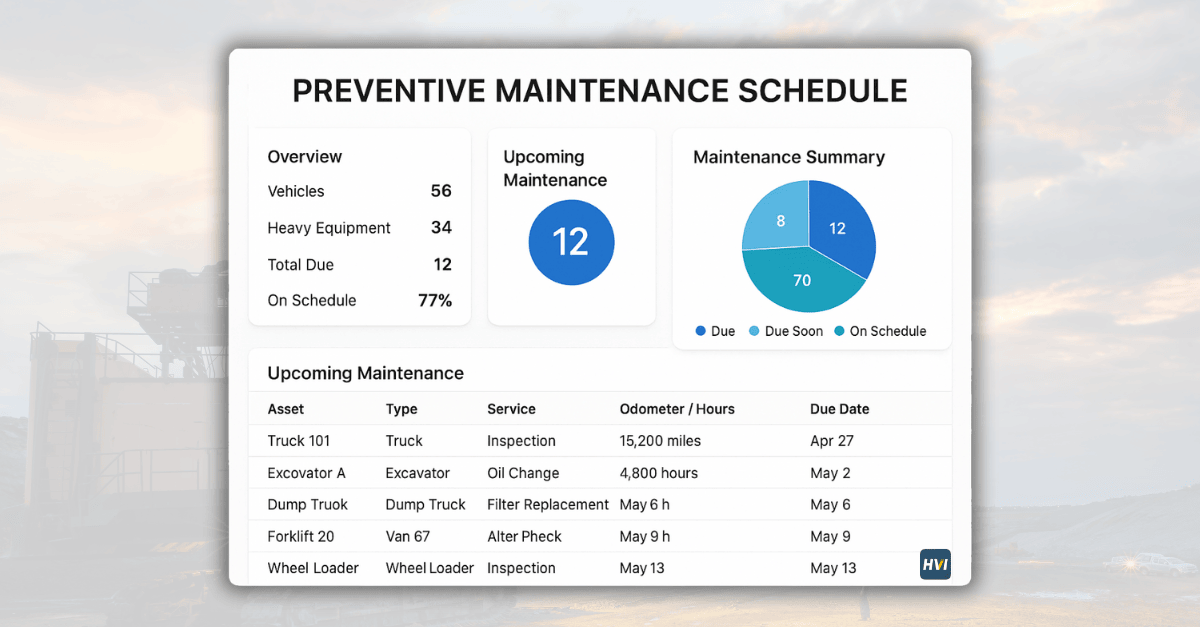
For a related process, use PM parts kitting and staging to prepare scheduled maintenance jobs before the vehicle enters the shop. Reorder levels should account for those upcoming service requirements rather than waiting for shelves to empty.
Connect parts decisions to actual fleet maintenance activity
HVI can support the records that make stocking reviews more informed. Your team remains responsible for defining thresholds, interpreting demand and placing supplier orders using its approved purchasing process.
Parts & inventory
Organize parts information and review available inventory records.
PM planning
Consider upcoming preventive maintenance when estimating demand.
Work orders
Connect maintenance tasks with parts usage and repair documentation.
Manual stock review
Use the records to assess min-max levels and purchasing priorities.
HVI is not represented here as automatically calculating optimal thresholds, forecasting demand or generating supplier purchase orders. Book a demo to review HVI's current parts and maintenance capabilities for your fleet.
Keep fleet maintenance moving with organized parts information
Explore how HVI helps your team bring parts records, service schedules and maintenance work orders into a more consistent workflow.
Start with one parts family, then scale
Trying to recalculate every SKU at once creates unnecessary rework. Pilot the approach with a group of frequently used, clearly identified service parts.
Validate records
Count selected SKUs, correct units of measure and check vehicle compatibility. Separate usable stock from damaged or reserved parts.
Estimate demand
Review 6–12 months of consumption where available, confirm lead times and identify scheduled maintenance demand.
Approve the policy
Set preliminary minimums, maximums, safety stock and critical-spares exceptions. Assign review ownership.
Test and adjust
Check actual orders, shortages and overstock. Update values before expanding to more categories.
Parts-room min-max checklist
Min-max inventory levels: common fleet questions
Quick answers for parts managers setting up or improving their stockroom replenishment policy.
What is the difference between minimum stock and a reorder point?
Minimum stock can mean a target floor, while the reorder point is the inventory position that triggers replenishment. Some organizations use the terms interchangeably. Define the policy explicitly so buyers do not wait until the safety buffer is exhausted before ordering.
What is the basic min-max inventory formula?
A common reorder-point formula is average daily demand multiplied by supplier lead time, plus safety stock. For periodic ordering, a practical maximum is average daily demand multiplied by lead time plus review period, then add safety stock. Adjust both for the fleet's actual risk and purchasing constraints.
How much safety stock should a fleet parts room hold?
There is no universal quantity. Base the buffer on demand variability, supplier reliability, lead-time variation, repair urgency, alternative sourcing and carrying cost. Critical components may require a separately approved minimum even if historical demand is low.
How often should min-max levels be reviewed?
Review high-use or frequently stocked-out parts more often, and reassess immediately after major fleet changes, supplier delays or new PM schedules. A monthly exception review and a broader quarterly policy review can be a useful starting cadence, but teams should adapt it to their operations.
Does HVI automatically calculate min-max levels or place purchase orders?
This guide does not claim those automated capabilities. HVI supports parts and inventory records, preventive maintenance and work-order information that can inform a manually managed min-max policy. Confirm specific capabilities during a live HVI demo.
Build a more dependable fleet parts process
Start with accurate parts records and maintenance context, then make stocking decisions that fit your fleet.