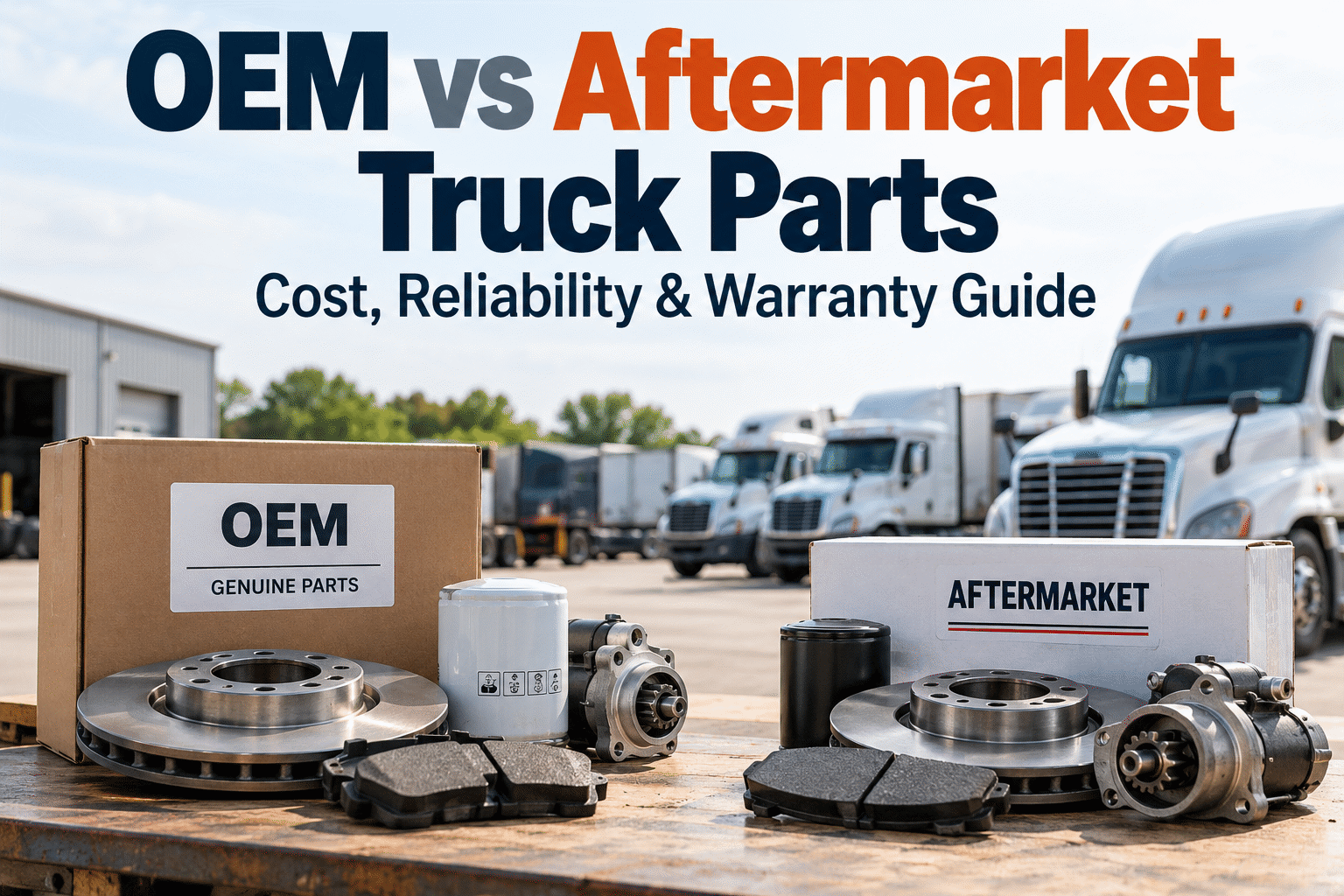
OEM vs aftermarket truck parts decisions should consider much more than the quoted part price. Compatibility, warranty coverage, repair labor, vehicle downtime and replacement frequency all influence the true cost. This practical fleet guide compares both sourcing options, shows how to evaluate real repair scenarios and explains how maintenance records support better purchasing decisions.
OEM or aftermarket?Choose the part that makes business sense.
Go beyond the sticker price. Compare fit, quality evidence, installed cost, warranty and operational risk before approving your next truck repair.
Two sourcing paths. One maintenance objective.
Both types of replacement parts can be appropriate. The right answer depends on the particular component, supplier, vehicle and operating conditions.
OEM truck parts
Parts supplied by the original equipment manufacturer or its authorized distribution channel. They can simplify exact specification matching and may come with manufacturer-specific service support.
- A manufacturer procedure specifies a particular part
- Warranty, emissions or safety documentation needs careful review
- Exact configuration matching is difficult
- Authorized technical support is valuable
Aftermarket truck parts
Replacement components supplied outside the original branded channel. Options range from established application-specific manufacturers to products with limited technical documentation.
- Fit and performance specifications are verified
- Supplier support and warranty terms are clear
- Availability helps avoid costly downtime
- Maintenance history supports the alternative
Important: An OEM label does not guarantee the longest service life, and an aftermarket label does not mean poor quality. Evaluate the specific part and supplier, not just the category. Book a demo to explore HVI parts and work-order records →
What changes when you choose a supplier?
Use these checkpoints during purchasing approval. They are evaluation questions, not universal claims about either option.
| Decision factor | OEM | AFTERMARKET | What to verify |
|---|---|---|---|
| Purchase price | Quoted factory-channel price | Alternative supplier quote | Unit price, freight, core charges and discounts |
| Compatibility | Confirm VIN and configuration | Validate cross-reference and fitment | Exact engine, axle, build year and application |
| Availability | Dealer or distribution stock | Independent distributor stock | Actual delivery date and vehicle downtime |
| Warranty | Manufacturer or seller terms | Supplier or component-maker terms | Coverage period, exclusions, labor and claims process |
| Quality evidence | Manufacturer specifications | Testing, certification and supplier evidence | Documented performance for intended duty |
| Service history | Review failures and repairs | Review failures and repairs | Repeat repair rates by part number and vehicle |
The lowest-priced part may not deliver the lowest repair cost.
Compare the entire repair event and the risk of repeating it—not just the invoice for the component.
Example only: invented numbers to demonstrate the method, not market pricing or typical performance.
Calculate total installed cost
Include a repeat-repair allowance only when your own evidence supports an estimate. A component that costs less but takes longer to source or install can still be the more expensive choice.
Know what a replacement part really costs your fleet.
Explore HVI parts inventory, maintenance work orders and equipment history to support more informed purchasing reviews.
Different truck components deserve different levels of scrutiny.
Match the review process to the consequence of a poor fit or premature failure. The examples below are procurement considerations, not endorsements.
Brakes & steering
Confirm application, specifications, applicable certifications and installation instructions. Treat uncertain compatibility as a stop point.
Filters & consumables
Compare filtration specifications, service interval, documented performance and availability. Check that substitutions meet equipment requirements.
Sensors & electronics
Validate connectors, calibration requirements, software compatibility and diagnostic procedures before fitting an alternative.
Driveline & major assemblies
Include installation time, core returns, remanufactured options, warranty support and the cost of a second repair.
Protect warranty coverage with a documented decision.
Aftermarket installation does not automatically void every warranty. Actual coverage depends on the applicable contract, law, component, cause of failure and evidence.
Identify the warranty. Check the vehicle, component and seller documents that apply to this repair.
Confirm part eligibility. Review any specified components, service procedures and emissions or safety conditions.
Record installation evidence. Retain invoice, part number, technician notes, date, mileage and relevant diagnostic results.
Clarify claims responsibility. Ask whether parts, labor, towing or consequential costs are covered and what exclusions apply.
A repeatable six-step decision process
Turn ad hoc purchasing into a consistent, reviewable choice without slowing routine service unnecessarily.
Identify vehicle, failed component, service duty and urgency.
Check specifications, part references and technical requirements.
Review evidence, stock availability, returns and support.
Include labor, freight, downtime and repeat-repair risk.
Record sourcing rationale and warranty information.
Use repair history to improve future selections.
Pre-purchase approval checklist
Use these questions before authorizing a substitute component.
- Is fitment confirmed for this exact truck?
- Are safety and emissions requirements satisfied?
- Are written warranty and return terms available?
- Has total installed cost been considered?
- Will the part and supplier be recorded on the work order?
- Is there a plan to review repeat failures?
Turn purchasing choices into usable fleet maintenance history.
HVI supports the recordkeeping side of parts decisions. It does not independently certify supplier quality, determine warranty eligibility or guarantee component reliability.
Maintain consistent parts records. Keep the component and supplier information available for future maintenance review.
Connect parts usage to repairs. Record which replacement was used during a work order and on which asset.
Review equipment history. Investigate repeat failures or unusual replacement intervals using service records.
Support cost discussions. Use documented parts and maintenance costs alongside separate supplier quotes and downtime estimates.
Want to see the available workflow? Book an HVI parts and maintenance demo →
OEM vs aftermarket truck parts: FAQs
Practical answers to common fleet sourcing and warranty questions.
Are OEM truck parts always better than aftermarket parts?
Do aftermarket truck parts automatically void the vehicle warranty?
How should fleets compare OEM vs aftermarket parts cost?
Which truck parts need the most careful compatibility checks?
How can HVI help with replacement parts decisions?
Make your next parts decision easier to defend.
Bring parts records, repair history and maintenance costs together in a more organized fleet workflow.